New Places, New Faces

Over the past year I’ve had the opportunity to become a part of a number of very different communities. These include the scientific community at the Leibniz Institut in Bremen, Germany; the international student community at the University of Essex, England; and a more adventurous community in Bodø, Norway (above the Arctic Circle). As a 2015 Oregon Sea Grant Scholar, I now have the opportunity to join the marine science community at the Hatfield Marine Science Center in Newport, Oregon.

11655209_10207370764694377_439883129_n

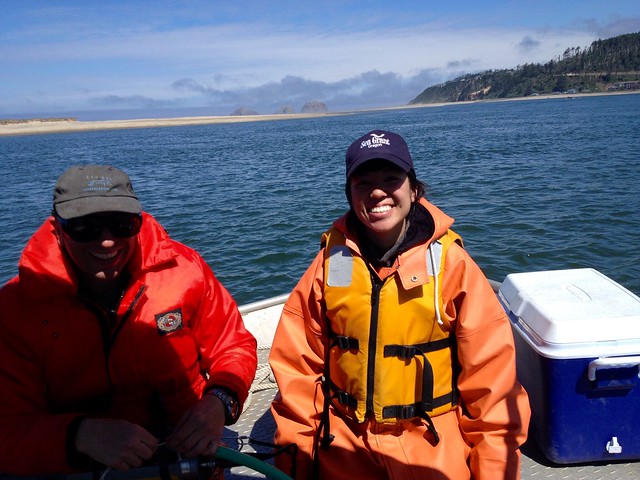
First day working for the Feds–US Environmental Protection Agency

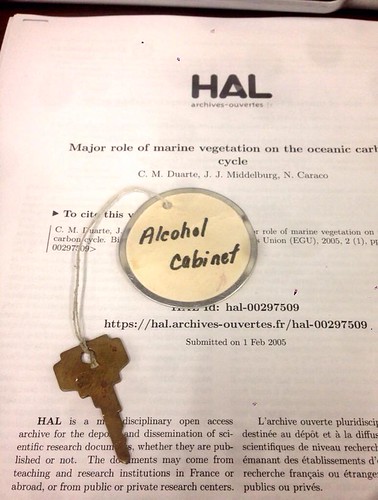
This summer I’ll be working with Dr. Ted DeWitt and Melissa Errend at the EPA Pacific Coastal Ecology Branch Field Station. Coming into my project I thought I’d put together a pretty solid idea of what my project entailed–Ecosystem Service Transferability. Within the first two days, however, I became increasingly uncertain as to what I’m actually really doing here. By Friday morning, I had again returned to a sort of semi-clarity on my direction and summer goals. Nonetheless, I think that it will take a bit more time to really feel comfortable and engaged in the topic I’ll be addressing. For the time being, I’m reading a mountain of papers on carbon sequestration, the oceanic carbon cycle (look beneath the alcohol cabinet key), and the ability of marine environments to store anthropogenic CO2–Known as “Blue Carbon.”

My work doesn’t involve any field or lab work, but hopefully I’ll have the chance to get in the mud, the boat, or the lab with some other projects. I may not have hunted from crabs this week, but this (below) EPA-desk-find has given me a personal goal this summer–Find the Alcohol Cabinet!

11277887_10207370764254366_743896161_n

What/where is the Alcohol Cabinet, and why do I have a key to it?

On a more serious note, I have two primary professional goals this summer. The first is to produce a case study on ecosystem service transferability robust enough to be incorporated in the EPA’s final report on ecosystem transferability. My second professional goal is to develop my skills in scientific communication both through social media and more standard mediums like posters and powerpoint.

So far I’ve found Oregon pretty fascinating from the ubiquity of Birkenstocks (should I buy a pair to fit in?), to the colloquial “for sure,”  to drive up espresso windows. Newport is a small but busy city with lots to see and do. I’ve already sampled some of the local seafood, Oregon pink shrimp, at the famous Mo’s. Everywhere is surprisingly green, but with temperatures around 14 degrees Celsius the first day I arrived, I was pretty surprised to find the Oregon coast just as cold as Bodø, Norway. Since then, the weather has been extremely pleasant, and to my sincere surprise, there hasn’t been any rain yet. One of my first week highlights is getting to know my fellow Oregon Sea Grant Scholars and the REU students. Together we’ve already had a cookout, beach bonfire, seen Jurassic World, and spent some time identifying the local fauna. Part of our local fauna observation included an Osprey hunting in the estuary (some fish were harmed during this experience). Its pretty awesome getting to hang out with people who think talking about fish, global warming, or new scientific discoveries is cool. I know, “#nerdstatus”, but we embrace it unabashedly.

All-in-all, I’m pretty stoked for this summer and the professional and personal opportunities and challenges it will present.

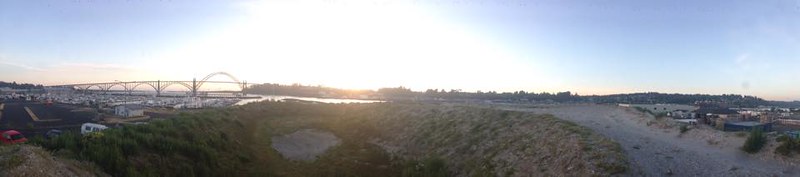
As a parting gift, here is the Newport sunset

11638048_10207370765374394_283687771_n

You can also keep up with me on Twitter: @ronaldtardiff and with my fellow OSG scholars by searching for #OSGscholars on Twitter.

The Beginning of an Oregrown Summer

Dear Reader,

The name’s Rosalyn, and in this bona fide Oregrown summer, I am a Oregon Sea Grant Summer Scholar, privileged enough to be working with Cheryl Brown at the U.S. EPA at Hatfield Marine Science Center as a Water Quality Evaluation intern. I will be conducting research on ensuring the sustainability of water resources in the face of climate change and other human stressors. I will also be aiding in identifying the factors which result in the expression of nutrient impairments, and the results of these studies will be used to develop nutrient criteria to protect Oregon estuaries from anthropogenic nutrient inputs or to predict how water quality in estuaries may change in the future.

Within this first week, I have been out in the field (!!!!), read background context papers regarding estuarine health in surrounding areas, done extensive safety training, made a lot of new friends, made some gooooooood food, sailed in the bay, gone to the farmer’s market, gone wildlife exploring and more.
IMG_20150620_171100

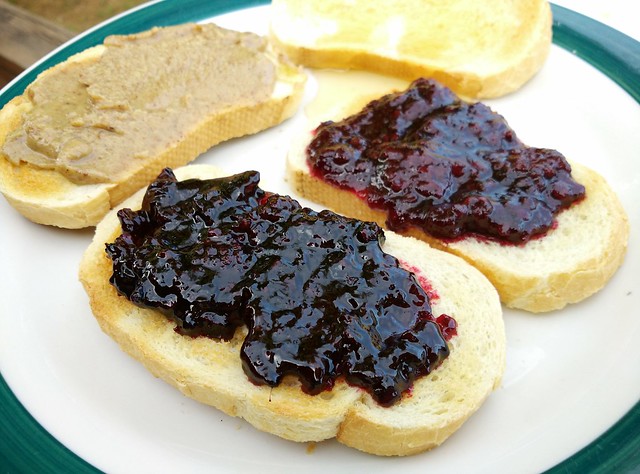
Comparing Oregon blackberry jam with California blackberry jam (Oregon’s a lot sweeter/darker). Pictured in back is walnut butter from back home, and local Oregon honey on the other.

When I’m not in Oregon, I study Wildlife, Fish and Conservation Biology, with a specialization in Aquatic Toxicology at the University of California, Davis (Go Ags!).

Research wise/Professionally, my research background and interest include marine debris, specifically plastics and synthetic materials, and its impacts on wildlife health. Generally, toxicology, aquatic health, chemical and environmental fate, and both freshwater and marine systems.

Personally, you can call me a hippie, but I love: cast iron skillets, cooking, dinghy sailing, compost, dumpster diving, spoken word poetry, discussions on gender issues, racial issues, the food system, and social justice.

…Fast forward to Oregon…

In order to effectively get things done, I have conducted SMART goals!

Professionally (2):

1) Be less awkward in a roomful of professionals in my field

2) Navigate and learn how to use twitter (?!?!)

Personal (1):

1) See, identify, and learn 25 native animals down to species level

(I’ve already gotten 6 down from our couple days of amateur birding)!

– Common Murre (saw this one while sailing) Uria aalge

– Caspian Tern, Hydroprogne caspia

– Osprey, Pandion haliaetus

– Barn Swallow, Hirundo rustica (here’s the call: http://macaulaylibrary.org/audio/105740/play)

– Ring-billed gull, Larus delawarensis

– Semipalmated plover, Charadrius semipalmatus

I definitely want to see some herps before this summer ends though, and our outing of seeing Jurassic World does not count.

Also, there’s currently only me and another OSG scholar in our dorm, and it’s great having all this space. But, we’re looking forward to our two new bunk mates arriving later today. Our dorm front is decked out (hahaha) with a long wooden deck connecting all the other dorms, a gazebo with grills for public use, a volleyball and basketball court. In the distance you can see all of our respective organizations/entities and the bay behind those. Living so close to the water is amaaaazing.


With little to no organization, here are some general thoughts about this past week:

With our first day in the EPA office, while taking a tour of the conference room, we were directed to where to find coffee and promptly asked if we drank coffee. A fellow intern mentioned she didn’t, and a passerby commented “hahaha, you will soon” and she could not have been more right.

I typically save my caffeine addiction for finals week or during our multiple midterm weeks during school. However, I’ve found it difficult to function in the workplace without multiple cups of coffee in one day. This is my first time with a full-time job, working 8-5 Mondays through Fridays, and it’s really been a reality check. I immediately began to criticize America’s thirst for “efficiency” at the expense of working people to the point of needing a substance to maintain stamina. I’m trying to go to bed earlier to combat the necessity for a cup of joe, but it’s difficult to balance working full-time with the desire to have a life, socialize, do household chores, etc. I compare it to your freshman year of college, where in the first few weeks you seriously question how people balance school work with socializing and getting involved. I suppose I’m going through a similar transition– figuring out how to navigate having a life with having a full-time job. (Which in itself is a privilege I am learning to acknowledge– that I’ve never had to balance a full-time job with other obligations. I exponentially respect students back home more, working their own way through school.)


What I’ve noticed with individuals and groups within my field, I’ve always thought was very ironic—the lack of sustainability and sustainable oriented choices. Single-use disposable utensils, plates, cups in events, lack of waste reduction/management in the office, leaving lights on when there is sufficient natural light and more.  I’ve noticed this issue back home, in other areas, and now here in Oregon. I think there’s a huge disconnect between what we’re studying and the everyday. It can be acknowledged that the everyday action you may take might not “save the world” or make an enormous impact, but if every person had this mentality, isn’t this the driving force behind Tragedy of the Commons, and other concepts we study?

For example, we had a welcome barbeque with polystyrene cups, plastic water bottles and disposable plates/utensils. I found this heart-wrenching because all of us had our dorms with reusable plates and cups merely 100 feet away. In addition, doing research on polystyrene impacts on aquatic systems, my heart breaks every time Solo cups are used.

However, this just means there’s so much room for implementation. I’m hoping before I leave I can try to implement some sort of change within the office or with events associated with the programs going on.


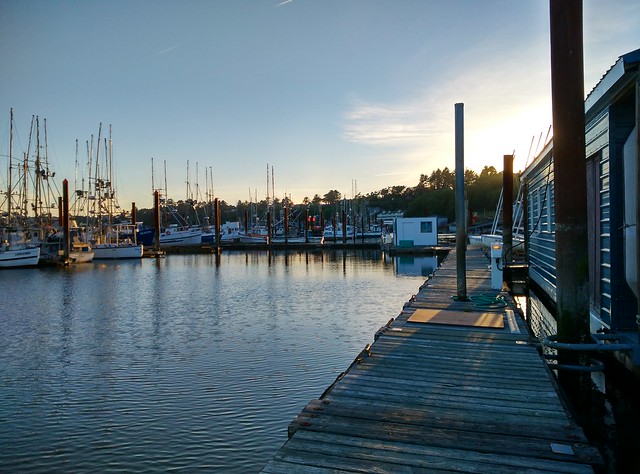
Upon my first day of meeting my mentor, the first thing Cheryl had said to me was, “you’re on the sailing team!” and I was surprised that she knew this about me. Then, I remembered that I had put it on my resume to signify that I knew how to work with boats. We began talking about sailing and she asked if I had wanted to go out on the water in a 420 for a fun-run regatta put on by the local yacht club. I enthusiastically agreed and two days later I was out on the bay! Crewing for 420s is similar to the FJ’s I’m used to back at school, but the winds here are ridiculously better than back home. Wind was around 20 knots, with gusts up to 30 knots… so much fun. I was able to crew for Laurie, who works at NOAA as a salmon biologist. She’s one of the best skipper’s I’ve had and we had a lot of fun talking about the recent toxic algal bloom, pseudo-nitzschia, which produces domoic acid which bioaccumulates up the food chain. Afterwards, we went to the boathouse and had a BBQ with all the other sailors and I met some awesome people. Most of them work at Hatfield too, so it was awesome finding a smaller niche within a bigger community.
IMG_20150619_201735_HDR
IMG_20150617_201749

IMG_20150617_201805

the boathouse


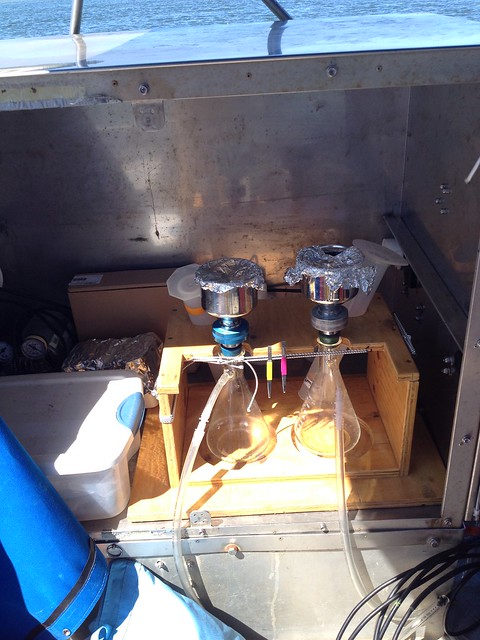
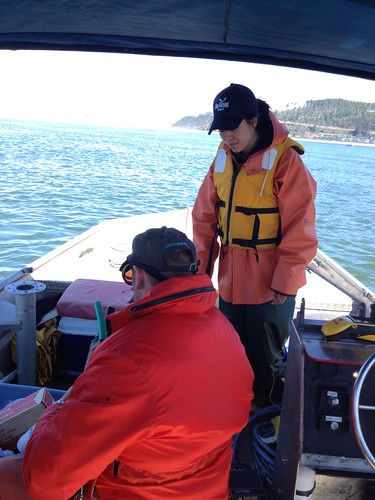
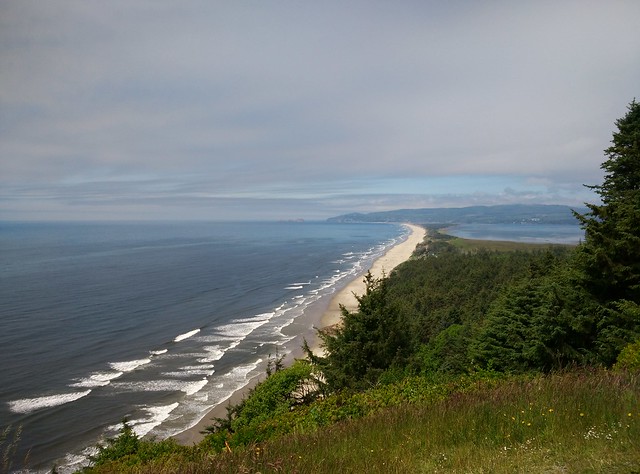
Field work was absolutely amazing. We sampled at Netarts, about two hours north of Newport, for chlrophyll a and nutrients in 7 different spots within the system. We filtered for chlorophyll a right on the boat! I’ve always only done sample collection in the field and all the processing back at the lab, so it was really really cool seeing it done a different way.
IMG_20150618_150019

Overlooking Netarts

IMG_20150618_083540
IMG_20150618_081006
IMG_20150618_080858
IMG_20150618_080421

IMG_4334

Chlorophyll a Filtration

IMG_4333

FullSizeRender

It was great being out on the water for a work day. I’ve decided my future job needs to at least have a field work component.


Also, something I’ve realized I need to start coming to terms with is gender issues within the sciences. It’s great being a part of Women in Science groups and whatnot, and it’s amazing to see that women are so heavily represented in both the REU group that is here, and the Sea Grant Scholars. Something I discussed with a grad student I work with, is that even though there’s a huge influx of women in the sciences coming in, there’s still an older cohort of males in higher positions in the sciences. It’s just something that takes time to even itself out. But it’s awesome to see women representation in the sciences truly progressing. I also noticed back home though, in the freshwater fish community, it is still predominantly men. In contrast, the marine community at UCD is actually predominantly equal or more females. I wonder why this is?

Within my first week here, I’ve already experienced a gendered microaggression towards me in the workplace, to which I didn’t know how to respond. I think it’s important that coming into a field dominated by men, women need to be equipped with a mentality that the hard work that was done to get to where they are should never be invalidated by anyone, and to be prepared to stand her (or whichever pgp) ground.


Oregon’s beautiful and I absolutely love the coast. Being by the water is always such a treat. Newport’s really adorable and the working dock with seafood coming in daily is really cool. There’s a huge fishery for Oregon pink shrimp in Newport, and apparently, (I learned from Laurie) the biggest fishery for imitation crab is here in Newport. Apparently, they fish for hake, and then add a gel and coloring to make imitation crab. Interesting stuff!

Follow my twitter for day-to-day updates @SeeRosalynSea

The blog post does not reflect the views of Oregon Sea Grant, Hatfield Marine Science Center, Oregon State University, or the United States Environmental Protection Agency.

From Cornfields to Coastal Mudflats

It has been roughly 12 days since I departed on my 4 day cross-country road trip from Indiana to the coast of Oregon. Many sites were seen like Medicine Bow, Winnemucca Mountain, and Crater Lake. Taking the time to see such colossal structures really made me realize how small we are in the vastness of our own country, let alone the planet.
It took 35+ hours to get to Oregon, and I’ve only been here for roughly a week, but I already feel a sense of home here. For the next 9 weeks, to my understanding, I will be working with integrating different pit trap methods for the capture of juvenile Dungeness crabs (Cancer magister) as well as the utility of using underwater video to get quality quantitative data on fish and invertebrate use of US West Coast intertidal estuarine habitats. Working this week with the USDA under my mentors, I have been very fortunate to already be getting out into the field.


Dungeness Crab (Cancer magister) caught from pit trap

This week we drove 60 miles north to Netarts, OR and checked shell bags for colonization by shellfish. We also took water quality in areas that were bare (lacked vegetation) and areas with seagrass present. Closer by (Yaquina Bay), pit traps were set up for the capture of Dungeness crabs to quantify their morphometrics to create more accurate size selection in the future. To our delight, we managed to catch several crabs, along with a few mud shrimp.

Mud shrimp that was dug up with the traps


There is no doubt that the next 9 weeks will pass by quickly, a lot will be learned and a lot of great memories are to be made. With that I hope you continue to enjoy my blogging as the weeks go by. I’m lucky to call this beautiful city and state my home for the summer. Follow me on here or via twitter @Prechtelguy93

Week One: Done

Tomorrow marks my first completed week as an Oregon Sea Grant Scholar. While this week has been primarily adjusting to the 9-5 work day, cooking all my own food, and the windy Newport weather, I also find it quite easy to feel as though I have been here for weeks already.

I am interning at the U.S. EPA Pacific Coastal Ecology Branch and have been data mining and compiling information related to assessing the climate vulnerability for marine organisms along the coast in an online tool called CBRAT (Coastal Biodiversity Risk Analysis Tool). I have been searching for literature that predicts estimated sea level changes. This has been more difficult than I had originally anticipated as most papers reference the IPCC’s predicted global sea level rise while I am looking for predictions specific to Pacific ecoregions. I am looking at twelve ecoregions from the Beaufort Sea in the Arctic to the Cortezian Shelf which contains the Gulf of California. So far, I have found at least one estimate for ten of the twelve ecoregions. Sea level rise is then applied to the vulnerability for marine organisms by using their life history traits and also knowledge regarding the urbanization of that region. For example, a crab that lives in the intertidal zone will be forced to move further inland due to sea-level rise but might be blocked by a wall in Southern California but will have plenty of room to move inland in the Arctic regions. The crab in Southern California will receive a relatively high algorathmic vulnerability rating for the program and thus be more susceptible to sea-level rise and climate change than the crab in the Arctic. Organisms that do not live in the intertidal zone won’t be as affected, so they will receive a low algorathmic rating for the program.

My mentor has also promised future work on ocean acidification, which I eagerly await.

This experience has not been solely working. During the evenings, I am able to relax with the other OSG scholars and with the REU students staying at Hatfield. Today students for Hatfield’s summer session are expected to arrive, so they’re will be even more people to meet! One of the highlights from this past week was going to the jetty in South Beach and building a pretty sturdy campfire. An REU student built the fire, but I was able to contribute to the fire display with lighter fluid. Other adventures include going to the Farmer’s Markets, walking the Estuary trail, and chasing Newport sunsets.

Untitled

Untitled

While this week has been very eventful, I expect more exciting work and free-time adventures to come over the next nine weeks. Also, my twitter handle is @EdelsonMicaela and I will be posting almost daily about my adventures here in Newport!

Exploring the Oregon Coast

This week has been a whirlwind of information at my new job with the Oregon Department of Fish and Wildlife looking at the human dimensions aspect of the marine reserves. I am currently writing this post from my hotel in Garibaldi, a town located a couple hours north of Newport. The graduate student I am working with named Theo and I will be heading up to Garibaldi frequently to do observational and survey research of people using the beach and boats in the reserves at Cape Falcon. My mentor says we’re basically getting paid to hang out on the beach and talk to surfers all day, so not too shabby of a gig I’ve got here right? On the drive up today we stopped at the Tillamook Cheese Factory and sampled some of the delicious cheese they produce.

photo 1-1

We also scoped out the sites that we will be doing these studies at and they were some of the most beautiful places I’ve seen on the Oregon coast. If you ever want to try your hand at surfing then head to Oswald West State Park! There were dozens of surfers in the cove there when we arrived. Overall I am excited to head back to Garibaldi next Monday and begin doing the studies!

Prozac project changes

When I last checked in, I had just begun a pilot study that would assess how shell thickness in mussels may be affected by exposure to Prozac. Unfortunately, the experiment was a bust, mostly owing to the impractical housing conditions which stressed the animals and led to high mortality. I quickly scrapped this project, with the intention of returning to it as a side project sometime later next year. My new focus will still assess the affects of prozac on marine life, but from a completely different angle: animal behavior.

I’d like to introduce this new project by telling you how I came up with the idea. While visiting Netarts, Nehalem, and Yaquina Bay, I noticed the abundance of shore crabs living in the estuary and that they reside primarily in soft sediments, mud, and beneath rocks, never too far from the water margin. This struck me as another creature that may be at risk from contaminants as they are transported from waters upstream and adsorb onto the sediments. I wondered if these crabs were in contaminated estuaries, how would their behavior change and how would this influence food web dynamics. To my knowledge, this is a somewhat unexplored connection linking contaminants as an agent to potentially influence shifts in food webs. We often hear about bioaccumulation of contaminants up the food web, but what if contaminants also affect the behavior of animals and cause them to be more or less susceptible to predation because of abnormal behavior?

The shore crab Hemigrapsus oregonensis, has been extensively studied and their behaviors have been well documented. My aim was to assess whether crabs exposed to Prozac at  3 and 30ng/L (i.e. documented concentrations in estuaries) would be more at risk of predation when compared to unexposed crabs. Because Prozac is a psychoactive drug, it is likely that their behavior will be altered at even low levels with persistent exposure. I am conducting this experiment by creating simulated estuary habitats in 30 tanks (10 replicates for each treatment) with rocky substrate and hideouts to allow for normal predator escape/evasion behavior. We will be dosing the shore crabs every 10 days with Prozac to simulate pulse events (e.g. increased rainfall) into the estuary. The meat of the study will be the addition of the predator, the Red rock crab, to the shore crab tanks and assessing the response to the predator during the behavioral trials, which will last ~1hr. We will run these behavioral trials during the day and at night to see observe their reactions. This project will run from June 1-August 15.

We have already had the animals living in our estuary mesocosms since June 1 and we will be conducting the first set of  behavioral trials next week. More developments to follow. I’m very excited about this study and I believe it is important to explore how contaminants might affect wildlife in Oregon’s estuaries should we

Welcome, 2015 Summer Scholars!

Our 2015 Summer Scholars are here! They are attending orientation today at the Sea Grant office in Corvallis, then at the Hatfield Marine Science Center in Newport. These seven undergraduates from around the country have been placed with federal and state agencies for the next ten weeks. In addition to supporting agency programs and initiatives, the goal is to offer students professional skills, agency workplace experience and real-life practice in marine resource science, policy, management and outreach. Check the blog next week for their introductions, and weekly from then on for updates on their progress. You can also follow them at #OSGscholars on Twitter.

Untitled

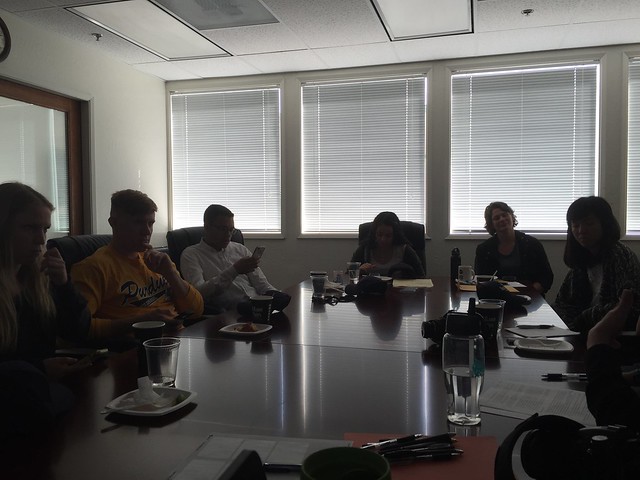
The new Summer Scholars during the social media training, smartphones in hand. Yes they were asked to pull out their phones! Apologies for the dark picture

As this is my first blog post from my current position, I’ll introduce myself. I am the Summer Scholars Program Coordinator this year, drawing from my experience as a Summer Scholar in 2013. Since January, I have been helping to set up the program, including advertising, reviewing applications, interviewing, and event planning, among other things. In the fall, I am off to pursue a Master of Science in Marine and Environmental Science at the University of the Virgin Islands. Until then, I will be supporting the students and their mentors throughout the summer, helping them to achieve their goals.

Watch for updates on the scholars and their use of social media, on Twitter at @SarahLHeidmann and/or here on the blog!

Here, There, and Everywhere

I’m writing today not from the northern Oregon coast—where I spent the last year as a Natural Resources Policy Fellow at the Tillamook Estuaries Partnership—but from Raleigh, North Carolina. It’s different here, of course. From what I’ve seen so far, it’s significantly cheaper and significantly warmer. You can get a plate of hush puppies for fifty cents, beautiful bright red cardinals hop from branch to branch, and strangers about your mom’s age casually call you “honey.” But like Oregon, it’s a lush, green place invested in and dependent on its natural resources, coastal resources included. Sea Grant, the National Estuary Program, and the National Estuarine Research Reserve all have active, large branches in North Carolina. In addition, both Duke University and the University of North Carolina Chapel Hill operate marine labs out on the coast.

But I am not here to work for any of these fine institutions. Thanks to a fellowship with the American Association for the Advancement of Science (AAAS), I will be spending the summer at the Raleigh News and Observer as a science reporter. Every summer for over forty years, AAAS has placed current or recent science graduate students at newspapers, magazines, radio stations, and other media outlets. I am lucky enough to be one of 20 students or near-students (I actually graduated with my Master’s in March of 2014) selected this year.

Although I expect to cover a wide variety of science stories, after a year working for TEP and Sea Grant, I’m curious about the environmental issues faced by this coastal state. Like TEP, the Abermarle-Pamlico National Estuary Partnership seeks to monitor and restore its watershed and to encourage public participation in that process. In fact, the APNEP Comprehensive Conservation and Management Plan reads very familiar. Like TEP, this estuary partnership seeks to rehabilitate an estuary from the effects of “forestry, farming, industry, mining, and development” and is working to improve anadromous fish passage, wetland function, riparian plant communities, public access to waterways, and landowner education about nutrient management. In other words, concerned citizens 3,000 miles away from each other are working on solutions to many of the same problems. Whether or not I am able to write about this topic for the News and Observer, this is the kind of connection I want to highlight in my future career as a writer.

Thanks to Oregon Sea Grant for putting me in action this past year at an agency working to effect change; now I will be reporting on such agencies. I believe my experience as a Natural Resource Policy Fellow will help me become a critical, accurate, curious, and well-informed science writer—this summer and wherever I find myself afterwards.


Oregon Shellfish Initiative Update

Working as the Sea Grant Legislative Fellow staffing Oregon’s Coastal Caucus, I was given the opportunity help craft House Bill 2209, the Oregon Shellfish Initiative. The intent of the Shellfish Initiative is to support Oregon’s oyster industry and preserve wild stocks of oysters for recreational harvest. The oyster industry in Oregon has already felt the impacts of ocean acidification and hypoxia, and a major component of the Initiative includes funding for continued research and monitoring capabilities.

I had the opportunity to visit Hatfield Marine Science Center in Newport and see Dr. Chris Langdon’s lab which is home to the Molluscan Broodstock Program. Dr. Langdon and his grad students have been breeding and selecting oyster lines for productivity in changing ocean chemistries. The Shellfish Initiative contains an appropriation for the MBP, as the legislature sees that this research is vital to understanding how different molluscan shellfish will respond to fluctuations in the carbon cycle, and helping the shellfish industry mitigate those impacts through broodstock that is best adapted to the conditions.

I was also able to tour the Whiskey Creek Shellfish Hatchery in Netarts Bay, which works closely with Dr. Langdon’s lab. Whiskey Creek had experienced substantial larval die-offs, and it was only due to monitoring equipment that detected more than just simple pH measurements that they were able to determine the cause of the die-offs. Whiskey Creek is now able to monitor and adjust the chemistry of the seawater tanks in which they raise broodstock, which they supply to approximately 75% of oyster growers on the West Coast. The Shellfish Initiative also appropriates funds to Oregon State University for ongoing support of the research partnership with Whiskey Creek Hatchery.

These partnerships were in place before the creation of the Oregon Shellfish Initiative, but it’s been extremely gratifying to me to be working on legislation to fund this important research. The Initiative also increases funding to the Oregon Department of Agriculture for more frequent water quality monitoring in Tillamook Bay, with the aim of being able to reopen the bay for oyster harvest more quickly after a closure. If the Tillamook Bay pilot project is successful, the increased monitoring could be expanded to other estuaries in the future.

The Shellfish Initiative also convenes a Shellfish Task Force which will report back to the legislature by the 2016 short session with recommendations on how to continue to enhance and expand the commercial oyster industry while addressing the impacts of ocean acidification and hypoxia on both cultivated and wild shellfish. Ideally, Sea Grant will continue to play a role as a bridge between research, industry, agencies, and coastal communities as the Shellfish Initiative recommendations are implemented.

The bill had a successful public hearing and work session in the House Committee on Ag & Natural Resources, and will soon be heard in the Ways & Means Natural Resource Subcommittee. There is a national shellfish initiative, Washington has a shellfish initiative, and California has one in the works, so the timing seems perfect for the Oregon Shellfish Initiative, and all the parties are committed to moving it forward.

Watch this space for more updates!

Where’s Waldo

Sorting plankton is a bit like a game of Where’s Waldo, except that Waldo is moving and translucent, and the entire background scenery is moving along with him.

In my case, the Waldos I am looking for are appendicularians. I separate them from the commotion of the background plankton by their distinctive shape and motion. They are easily confused with the transparent rod-shaped body of chaetognaths (“arrow worms”)—but have a more pronounced, football-shaped head—and the sinusoidal wriggling of a nematode—yet less fitful. Their motion can be hard to detect amidst the darts and jolts of the ever-abundant calanoid copepods.

Some days my sample (collected from the net in the figure below) is filled with so many Waldos I cannot possibly pipette them all. Some days I can sort for hours and never find a single one. Usually it is one extreme or the other: no goldilocks plankton here.

IMG_0867

Conducting plankton tows in the Charleston Marina with my salty dog, Zephyr.


My task for this term is establishing cultures of appendicularians at our lab on the main campus of the University of Oregon in Eugene—60 miles from the ocean and 120 miles from the collection site. It is rather daunting, particularly since my appendicularians are smaller than copepods—barely visible even when backlit and examined by the squinting, trained eye. Their life cycle is about six days, depending on temperature. Scientifically speaking, they progresses from external fertilization of the egg to embryogenesis to organogenesis to metamorphosis to somatic growth to maturation and reproduction. Less scientifically, they grow from an egg to a little tadpole to a bigger tadpole to a tadpole with a disproportionally large head (yellow for females, blue for males) and then, once her and his heads fills with eggs and sperm, their gamete-brains explode and a new generation begins.

I have yet to raise appendicularians through their full life cycle. For the time being, my efforts are focused on keeping adults alive inland for a few days at a time, which necessitates to a lot of driving back and forth between Eugene and the coast. On the days when hours of scanning yields only Waldo-less samples, I wonder: is it too late to study copepods?