Oregon Aquaculture Highlights

Hello! I am a new fellow so I’ll start by introducing myself and my background. My name is Amy Ehrhart and I am the Aquaculture Fellow for Oregon Sea Grant. I started this position in November 2020 part-time while I finished my PhD in Environmental Science and Management at Portland State University. I was about two weeks away from my defense when the position began which made for a whirlwind of a month. But somehow I was able to defend, edit and submit everything on time. It feels surreal to be done with graduate school and starting a fellowship, especially during a pandemic. 

So how did I get into aquaculture? My dissertation research focused on pharmaceutical contaminants in coastal ecosystems. Two of my research chapters addressed effects and accumulation of these compounds in Pacific oysters, which are commercially grown in Oregon and Washington. To conduct field experiments, I used off-bottom rack-and-bag culture methods (see picture below) to grow oysters in areas near and far from contaminant sources. While aquaculture was not the main focus of my research, I gained a good understanding of oyster biology/ecology, different growing methods, areas where culture is taking place, and some industry priorities. Since starting the fellowship I have learned A LOT more about aquaculture in Oregon and the West coast and I am enjoying the deep dive into this topic.  
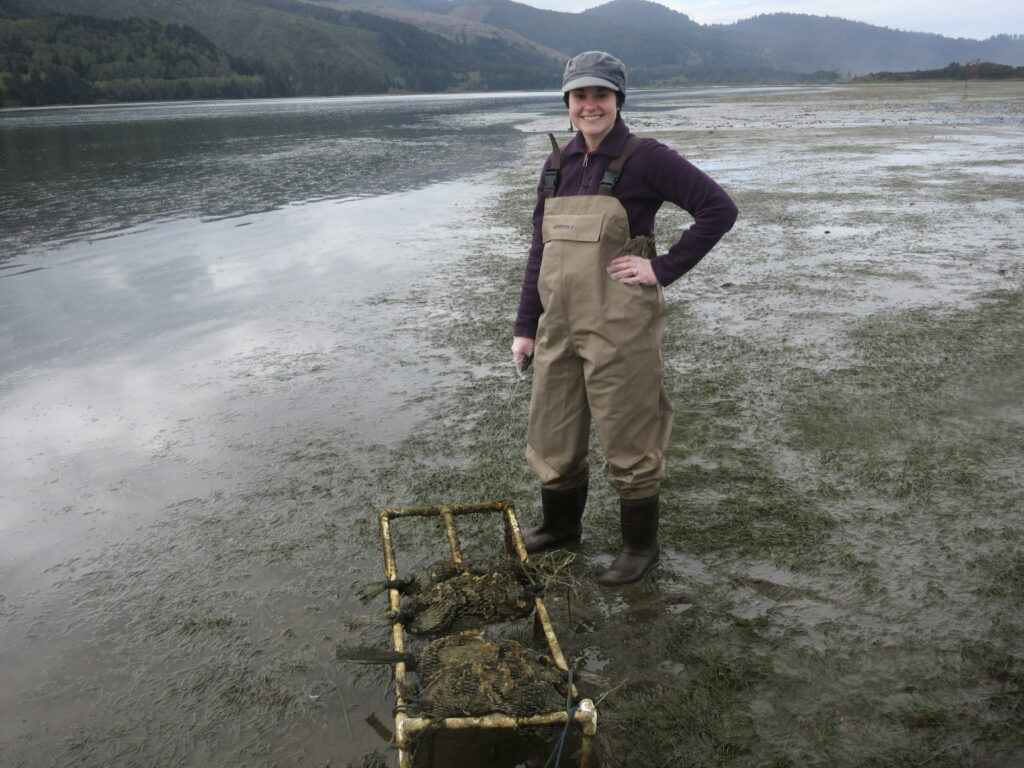
Pacific oysters being grown in mesh bags attached to a PVC rack in Netarts Bay, Oregon (April 2017).

So far in my fellowship I have focused on three main projects: conducting a landscape analysis, planning a needs assessment, and participating in a regional seaweed aquaculture collaborative. I also provided updated content for the Oregon Sea Grant aquaculture website to highlight these current endeavors. There hasn’t been a large focus on aquaculture at Oregon Sea Grant for a few years so there was a need to identify who the major players are in the industry. I was tasked with completing a “landscape analysis” or more simply put, a spreadsheet of people, groups, and agencies involved with marine aquaculture in Oregon. I spent a good portion of my time compiling this information, and I continue adding to it as my work continues. 

My second project involved planning a needs assessment for growers, prospective growers, agencies, and researchers working on aquaculture topics. Globally, about 50% of seafood comes from aquaculture (NOAA Fisheries), and a lot of this is imported to the U.S. from other countries. There is federal support for coastal states to increase domestic aquaculture production, but they face several challenges and barriers. Oregon aquaculture production is fairly low compared to other states, and there is a potential opportunity for expansion, which could provide significant economic benefits for the state. But we don’t know if there is interest in expansion in marine aquaculture or what the current challenges are for growers. The goal of the needs assessment is to identify needs and barriers surrounding aquaculture expansion and use this information to inform outreach and engagement strategies. I am currently finalizing an online survey that will be distributed as soon as it gets human subjects research approval. 

My third project has been participating in a collaborative group that represents California, Washington, Oregon, and Alaska with a focus on seaweed aquaculture. Seaweed is a relatively new product, and one that I knew very little about coming into this group. I have been working hard to catch up so I can contribute meaningful recommendations. Our goal is to plan a regional symposium on seaweed farming that will be beneficial to growers and other industry members in all west coast states. This is incredibly challenging as all of the states have highly variable regulatory requirements, environmental constraints, and current seaweed operations. In Oregon, seaweed aquaculture is in the very early stages and constitutes 2-3 growers that cultivate Pacific dulse seaweed in land-based tanks. This is very different from a state like Alaska, that produces large amounts of kelp in the offshore environment. Identifying topics and strategies that apply to all states at a regional level has been an interesting challenge, and I look forward to strategizing and learning more. 

These first three months of my fellowship have flown by and I am really enjoying the work! It was difficult to start a job with a heavy focus on stakeholder engagement during a pandemic that restricts in-person interactions, but I am feeling much more optimistic about the future as vaccines are being administered and COVID-19 cases are starting to drop.

Thanks for reading and stay safe out there!

Beginning your research project during a global pandemic

In the Haze

Graduate school can be hard and a dredge. You get lost in the details, in YOUR project, in the details of your project and you lose perspective. When I decided to come back to school for my graduate degree, I decided that I would lay down some boundaries that might help me keep better perspective. Work whilst at work, play and rest at home. Obviously there would be some exceptions (research is not a 40 hour a week job, between teaching classes, taking classes, applying for funding and grants, conducting your research, and professional service inevitably there is always some working during your planned free time), but I found that sticking to this plan to be very helpful. Working from my office gave me a chance to engage in work actively and intentionally, reinforcing a need to use my time wisely and efficiently. This also meant that I was able to disengage and recharge when I went home.

Then, COVID-19 made its internationally debut. EVERYONE has been impacted by COVID, I am no exception. Overall, I feel very lucky and privileged to have faired as well as I have. Yes, my field work has been continually delayed, but I have a paying job, food in my belly, and a roof over my head, and a loved one (and furry one) to keep me company at home. It is hard not to be grateful when I know that I am much better off than many. That is the large-scale perspective.

When I analyze how my professional life has been affected by COVID-19 things start to get fuzzy. For the safety of myself and my family, I work from home. I have a quiet place to work and have no real obligations or worries that hinder my ability to work from home (like children or loved ones that need my care). Yet, I know that my ability to stay focused and motivated has decreased. My ability to draw the lines between work hours and personal hours has blurred, my efficiency has gone down, and as a result my morale has greatly suffered. Being a graduate student can be hard… I have so many privileges including setting my own schedule and having ultimate flexibility and culpability with nearly every choice that effects my professional life. But it can be difficult to keep perspective when you have ONE over-arching goal over the course of several years to accomplish – your research project, your thesis, your publication(s). It is hard to see the progress you have made, to see the steps forward, and the steps you have already taken behind you.

In my experience, field work keeps you connected to your study subject. Working in the field rejuvenates your excitement, inspires new ideas, and thus keeps you motivated throughout the rest of the year. Like many, my field work has been delayed due to COVID-19 (hopefully, I will be collecting data this fall). However, the combination of working from home on a research project with no definite end date, and without any field work or significant excuse to leave the safety of my home, has left me feeling a bit lost and dejected.

Do the next right thing…

Alas, time continues to pass and the reality of an impending defense date looms somewhere in the future. Currently, it seems difficult to see the light at the end of the tunnel. It almost feels as though I have stalled out before my project even started, yet I remind myself of the long-term goal. The goal is to conduct a research project from start to finish, complete a thesis, publish, and obtain my master’s degree in fisheries science and hopefully along the way I will take a step towards doing some good in the world of marine science.

For now, I will keep in mind advice that I once received from a wise source, Disney’s animated film Frozen 2, “All one can do is the next right thing”. At this point in time that means continuing to engage in my quantitative ecology class where I am learning about how to better conduct data analysis; continue to make appointments with mentors and collaborators who can help inspire ideas and motivate me during this strange time; and lastly, to refine my methodology as much as possible before data collection begins this fall. One day at a time, one step at a time, just doing the next right thing.

State Agency Role in Natural Resource Management

One of things that has surprised me the most, is the difficulty State agencies have in weighing all of the interests involved in authorizing activities off the coast. For my project particularly, there are several State agencies who have authority and expertise over key State resources that may be affected by an authorization of an activity. From working in the non-profit world, I was unaware of how many stakeholders are considered throughout the administrative process.

Marine Spatial Planning, is an interesting field, with several intersections of studies involved. From economics to marine sediment management, natural resource agencies are tasked with weighing each and every use and resource to determine whether certain projects can move forward. While this sounds pretty straight-forward, I have learned that this can become pretty tricky, very quickly.

Like many other coastal states, the Oregon Coastal Management Program (OCMP) follows the networked approach, which allows several agencies to have jurisdiction over marine resources located in State waters. This model allows for each agency to “flex” their expertise while also contributing to strategizing the State plan for coastal management. The Dept. of Land Conservation and Development (DLCD) is tasked with ensuring that these needs are met throughout the State, which includes ensuring coastal management is integrated into several other agency work plans. For example, the Oregon Dept. of Fish and Wildlife (ODFW) is tasked with managing the biological resources of the State, including resources found within Oregon’s territorial sea. The OCMP relies heavily on ODFW’s expertise in planning for activities in the territorial sea, and leverages their ability to analyze the effects of certain activities to those resources. In addition to speaking with experts in the agency, OCMP often communicates with the local communities to ensure that their concerns are heard, and responded to (in real time).

Some of the time, these concerns can be at odds with each other, and DLCD is tasked with making the ultimate decision, as to whether certain projects can move forward with the State’s approval.* This dichotomy has been pretty interesting to watch. Over time, I have realized that each of the agency employees have different ways of engaging with these audiences to ensure their voices are heard. For example, one of my mentors has a regular marine policy phone call with ODFW to hear any of these concerns informally. This ensures that the networked partner agency is apprised of potential agency actions, and has the time and space to respond in an unfiltered manner. Hearing these concerns, and coordinating with ODFW has developed into years of a healthy working relationship.

I think learning how to strike this balance has been a great lesson for me, and I hope to implement it as I continue to work in the marine natural resource management world!

*Under the Coastal Zone Management Act, States have the ability to review certain federal permits known to have reasonable foreseeable effects to State resources for compliance with State enforceable policies. While federal government, ultimately has discretion, the State plays a large role in ensuring these concerns are appropriately mitigated by the person pursuing the activity.

How do we know if marine reserves influence recreational fishing communities?

We’ve almost made it! The year 2020 is just about to end and 2021 is right around the corner. Though many issues that were highlighted in 2020 won’t be going away in 2021 and need to continue to be addressed, there are some things to look forward to. Just this month, healthcare workers started receiving the first round of the COVID-19 vaccine. As more and more people get vaccinated, we will hopefully see the end of strict quarantine measures in the near future. Maybe we will even be able to spend the 2021 holidays with family without a mask in sight! 2021 will also bring a new administration with climate change as a top priority, which will likely influence ocean policies and management. So, while 2020 was an important year and we should not forget what we learned in it, here’s to hoping that 2021 doesn’t throw us any detrimental curveballs.

Now that you’re up to date on some of what’s happening in the USA, let me update you on what I’ve been working on. In my last blog post I outlined how I’m using the Oregon Department of Fish and Wildlife’s (ODFW) daily angling license sale data to determine if marine reserves have influenced recreational fishing. Since people are no longer able to fish in the marine reserve sites, we might expect this to result in fewer licenses purchased in towns near the reserves post implementation. This might also be observed by an increase in licenses purchased in towns further from the reserves.

However, whether or not people decide to go fishing is just one aspect of measuring a potential reserve effect on recreational fishing communities. For those that do decide to go fishing, how much they catch and over what time period is another crucial component. This metric is referred to as Catch Per Unit Effort (CPUE). For our analysis, we calculate CPUE by dividing the total number of fish caught by the number of anglers aboard the vessel and by the number of hours fished. This creates a standardized metric whereby we can compare fishing trips with varying numbers of anglers and hours fished. Specifically, we can compare CPUE reported at docks near marine reserves pre- and post-marine reserve implementation. We might expect that marine reserve site closures could increase effort, thereby decreasing CPUE, by forcing anglers to spend more time traveling further to avoid the reserves. On the other hand, we might expect site closures to increase catch, thereby increasing CPUE, due to spillover effects whereby a greater abundance of fish inside the reserves leads to a greater abundance of fish outside the reserves.

Lucky for me, ODFW has been collecting the information I need to calculate CPUE through the Ocean Recreational Boat Survey (ORBS).  This is an annual survey of Oregon’s marine recreational fishery that estimates both catch and effort at the top 10-11 ocean access points. This survey was first developed in 1979, but the original focus was on generating accurate salmon estimates in a timely manner. The ORBS survey has since expanded and provides valuable data on stock abundance and health for many species, which is used for management purposes.

By looking at both daily angling license sales as well as CPUE on charter boats, we should be able to uncover any potential marine reserve effects on the recreational fishing community. Of course, there are many covariates to take into account that could influence CPUE, such as catch regulations and environmental variables. I won’t dive into this right now, but maybe another blog post detailing the difficulties of finding downloadable historical buoy data without huge gaps is in order. Signing off for now, happy New Year!

Climate change scenario planning for Oregon’s Dungeness crab fishery

In my last post I introduced two scenario planning processes facilitated by The Nature Conservancy (TNC). The bulk of my fellowship position has been in support of these processes. In that post, I offered an overview of scenario planning, and outlined developments in the federal fishery scenario planning process with the Pacific Fishery Management Council (PFMC). In this post, I share progress of the Oregon Dungeness crab fishery climate change scenario planning process.

Scenario Planning for Oregon’s Dungeness crab fishery

TNC launched the Dungeness crab scenario planning process early in 2020, with the expectation of completing the exercise by Summer 2021. This process was modeled off a successful framework used with PFMC, and tailored to fit Oregon’s crab fishery and its socio-economic connections. Throughout the majority of my fellowship, I assisted my supervisor, Gway Kirchner and Scenario Insights (a contracted scenario planning facilitator) to integrate a broad set of representative voices from across the Oregon coast in the process.    

It is important to plan for the future of this fishery because Dungeness crab is (generally) Oregon’s most lucrative single species fishery. It is also one of the only Oregon fisheries that operates in winter months, so it offers employment opportunities and economic relief to natural resource-dependent coastal communities during a slow time of year. The Dungeness fishery has been faced with some big challenges over the past five years, namely an increase in whale entanglements and high bio toxin levels (bio toxin levels are monitored throughout the season, and area closures are implemented as needed to ensure consumer safety). These challenges are symptomatic of early climate change effects, and could intensify as time goes on. A scenario planning process offers managers, fishermen, industry, researchers, markets and communities the opportunity to look into the future at different potential situations. These processes offer a framework to collaboratively brainstorm ideas and decisions that could improve the ability of all relevant parties to adapt to a changing world.  

Planning during a Pandemic

The state scenario planning process is designed for robust input from all stakeholders and to work collaboratively to research, create and deepen the scenarios. Unfortunately, the COVID-19 pandemic, which began during the early stages of this process, made it impossible to host in-person programs. Thus, the process was redesigned into a pandemic-friendly, online collaborative format.

By summer, the Dungeness crab scenario planning process had been moved to virtual format and the kickoff meeting, scenario creation workshop and smaller focus groups were successfully held. The virtual format required a lot of flexibility and hard work to connect with relevant parties, plan and conduct meetings, and ensure all voices were heard especially if some participants were unfamiliar with how to operate an online platform. While online collaboration was challenging at times, the process yielded robust results.

Fig. 1: Dungeness crab scenario diagram. Scenario Insights (2020)

I will briefly zoom in on the August 12th scenario creation workshop, because it was a great example of collaboration through an online format. TNC and Scenario Insights were able to offer a truncated, online version of the January 2020 federal scenario creation workshop, complete with speakers and a guided framework design process. Participants, facilitators and the core team worked together to produce the diagram below, which shows four plausible scenarios along two axis: viability of crab fishing in 2040 and variability of stock and ocean conditions in 2040 (fig.1). Similar to the Federal scenario creation workshop, this integrated the experience, knowledge and concerns of managers, researchers, fishermen and other stakeholders. After the scenario creation workshop, two subsequent virtual meetings were held with a scenario drafting team to fill in social, economic, regulatory and ecosystem aspects of each scenario.

Next Steps

After the wintertime rush of the 2020/2021 commercial crab season, TNC will facilitate discussions with a broader diversity of stakeholders to ground-truth the scenarios, examine how individuals see these scenarios fitting into their individual realities, and document potential ideas or applicable action items that emerge from those dialogues. TNC hopes to finish this process by summer 2021.

Fellowship Wrap Up

I am so appreciative of my Natural Resource Policy Fellowship with The Nature Conservancy. Over the past 15 months, TNC site has folded me into a number of dynamic marine and coast conservation projects, including two innovative climate change scenario planning process. This fellowship has been a tremendous opportunity for me to connect my academic background with current climate change resilience work. Not to mention, excellent collaboration and networking opportunities. My position closes at the end of December, so this will be my final blog post. I look forward to bringing my skills in social science, climate change research and outreach to my next career steps.

The photo below shows me holding a Pacific red rock crab during a TNC employee trip to the Oregon coast in October, 2019. Both Red rock crabs and Dungeness crab are often caught in recreational traps (or “pots”) across the Oregon coast. This trip was the first of many highlights from my time at TNC, and an opportunity to share my inordinate love for the Oregon coast with new colleagues. Thank you to Oregon Sea Grant and The Nature Conservancy for offering so many opportunities to grow as an early career social scientist.

Photo Credit: Alli Gardner/TNC
Photo credit: Allie Gardner/TNC

A Progress Report on Federal Fishery Scenario Planning

In my Spring 2020 blog, I wrote about the Pacific Fishery Management Council (PFMC) scenario planning process. As an Oregon Sea Grant fellow based at The Nature Conservancy (TNC), I have held a support role in parts of this process, and have observed the exercise since October 2019. In that post I also mentioned the beginnings of an Oregon-specific Dungeness crab fishery scenario planning process facilitated by TNC.

In this entry I will focus on developments in the scenario planning process for the Pacific Fishery Management Council. My next blog (coming very soon) will examine how the Oregon Dungeness crab fishery scenario planning process builds on and deviates from the PFMC process. If you would like to go back and learn more about PFMC scenario planning, please read (or re-read) my previous posting HERE.  

Scenario Planning Overview

Before I share more on the PFMC scenario planning process, I will quickly go over some general history of scenario planning.

Scenario planning is a tool that was first used by the oil industry in the 1960’s, the process was so successful that it has since been adapted by companies, NGOs, financial institutions and government entities around the world. Managers and decision makers use this strategy to avoid tunnel vision when visualizing, and preparing for the future. You can think of scenario planning as a tool used to plan for future uncertainty, and a practice that helps decision makers develop appropriate strategies to meet that uncertainty (Wilkenson & Kupers 2013).

Click HERE for a great read from the Harvard Business Review on the history of scenario planning.

Scenario developers draw upon literature, knowledge of experts and data sets that reflect current conditions, trends and future predictions. They use this information to create a set of plausible and relevant pictures that show what the future could look like. Scenarios must be plausible, but not necessarily probable; a distinction that is important because it is easy default to planning based off subjective predictions or extrapolations of the current state. Using these default methods can be extremely limiting because they doesn’t leave space for divergence from an expected trajectory (Wilkinson & Kupers 2013).

Once formed, “scenarios” are placed on axis. Each axis reflects a scale of no change (or low change) to extreme change of a future system. The number of scenarios developed differs by process, but the PFMC process uses four scenarios. After scenarios are created, plausibility is cross checked with stakeholders, scenarios are researched, then turned into stories that illustrate these possible futures. Managers and decision makers integrate stories and their broader implications into strategy development, strategic planning processes and risk assessments.

Scenario Planning for West Coast Fisheries

The Pacific Fishery Management Council is one of the eight Regional Fishery Management Councils in the United States. PFMC recommends management measures for all federal fisheries conducted off of West Coast states, including California, Oregon and Washington (PFMC). PFMC and TNC are working together to conduct a scenario planning process under the current Fishery Ecosystem Plan: The Climate and Communities Initiative. The goal of this scenario planning process is to identify socio economic, environmental, cultural and biological challenges that fishery stakeholders may face over the next two decades (PFMC 2020 (B)).

January Workshop

In my aforementioned, post I described the January scenario planning workshop held by PFMC and TNC, facilitated by the consulting firm Scenario Insights. This workshop included 80+ fishermen, managers, tribal members and scientists in a brainstorming session that examined the question: How will climate change impact West Coast species and communities over the next 20 years? (PFMC 2020 (B)). The workshop produced a set of four scenarios, organized across two axis: Climate and ocean conditions and species abundance/availability (Fig 1.). Post meeting, scenario components, axis and scenario descriptions were sent to researchers, the council community and other relevant parties. these groups conducted further research, validated plausibility, and added details, data and further scenario illustration.

This presentation, created by Jonathan Star of Scenario Insights, illustrates the scope of the January workshop:

Fig. 1: https://www.pcouncil.org/documents/2020/03/g-3-a-supplemental-cci-workshop-presentation-1-follow-up-from-a-workshop-co-sponsored-by-the-nature-conservancy-and-pacific-fishery-management-councilin-support-of-the-fishery-ecosystem.pdf/

Scenario Development

On August 2, 2020, the PFMC Climate and Communities Core Team released the set of fully developed scenarios for West Coast fisheries in 2040. This document includes:

  • Information on projected future environmental conditions, demographics, ocean uses, technology, economics and societal values, policy environment
  • Four refined scenarios (see Fig. 2)
  • Descriptions of each scenario
  • How each West Coast federal fishery may look under a given scenario.
Fig. 2: https://www.pcouncil.org/documents/2020/11/scenarios-for-west-coast-fisheries-climate-and-communities-initiative.pdf/

Next Steps

The PFMC Climate and Communities Core Team will begin meetings with stakeholders in early 2021 to review these scenarios ground-truth their contents. The core team will examine perceived challenges and opportunities related to the future of fisheries, and actions needed for commercial fisheries to remain profitable in the future. The core team is also interested in stakeholder thoughts on how existing successful conservation benefits can be maintained in the future, and what needs to be done to avoid future overfishing or habitat degradation. The Pacific Fishery Management Council will likely take final action during their March or September Meetings. Ideally actionable items will be identified during this process, and a work plan will be developed to ensure sustained momentum towards a future of climate-smart fisheries on the West Coast.

Sources

Wilkenson, A., Kupers, R. (2013) Harvard Business Review. https://hbr.org/2013/05/living-in-the-futures

Pacific Fishery Management Council. Who We Are And What We Do. (Website) https://www.pcouncil.org/about-the-council-2/

Pacific Fishery Management Council (2020) (A). Supplemental CCI workshop presentation 1: Developing future scenarios for climate change in the California Current Ecosystem (presentation). https://www.pcouncil.org/documents/2020/03/g-3-a-supplemental-cci-workshop-presentation-1-follow-up-from-a-workshop-co-sponsored-by-the-nature-conservancy-and-pacific-fishery-management-councilin-support-of-the-fishery-ecosystem.pdf/

Pacific Fishery Management Council (2020) (B). Follow up from a workshop co-sponsored by The Nature Conservancy and the Pacific Fishery Management Council in support of the Fishery Ecosystem Plan Climate and Communities initiative. https://www.pcouncil.org/documents/2020/03/g-3-a-supplemental-cci-workshop-presentation-1-follow-up-from-a-workshop-co-sponsored-by-the-nature-conservancy-and-pacific-fishery-management-councilin-support-of-the-fishery-ecosystem.pdf/

Pacific Fishery Management Council’s Climate and Communities Core Team (2020). 2040: Scenarios for West Coast Fisheries. https://www.pcouncil.org/documents/2020/11/scenarios-for-west-coast-fisheries-climate-and-communities-initiative.pdf/

Fellowship reflections

As Oregonians once again prepare for the start of the ocean commercial Dungeness crab season, I am wrapping up my second year as an Oregon Sea Grant fellow. And what a year it has been!

I left the office back on March 6th for a long-awaited trip to Morocco. My husband and I were planning to travel around the country for two weeks including a solo road trip that would take us from Marrakesh to the Sahara Desert and countless incredible spots along the way. A few days in to our trip and just before that road trip was set to begin, we found ourselves frantically searching for options to get home due to the new COVID-19-related travel bans being issued which were quickly closing off many of our options for traveling back. As we stood in the Marrakesh Airport amidst thousands of other travelers in the same situation, I sent an email to my supervisor letting her know what was going on, and that I’d likely need to quarantine for two weeks and figure out a way to work remotely when I get back. After taxiing two hours to Casablanca, we managed to get seats on one of the last available flights before all international travel in and out of the country was restricted. When we finally arrived back in Newport, I settled in for what we all thought would be a few weeks of working from home. I never would have believed that I’d be sitting in my kitchen-office writing this nine months later, having just spent several days preparing a full Thanksgiving meal for only two people.

Like so many others, the ongoing pandemic and other unprecedented events taking place in our country have shaped so much of the last year for me. On the one hand, my ill-fated Morocco trip is just one of many missed opportunities from the last nine months. And yet, as so many others have noted throughout this blog, this time has shown me how incredibly resilient the people around me are. Meetings, conferences, and workshops have transitioned to virtual platforms, seemingly without skipping a beat. In my own work, all three West Coast states are making substantial progress towards drafting Conservation Plans (CPs) to reduce the risk of whale entanglements in Dungeness crab gear. While I hope that it is safe to resume in-person work in the somewhat near future, I’ve been inspired by the immense capacity for adaptation and the ways that people have found to “come together” while staying apart.

As my fellowship comes to a close, I’ll be transitioning to a limited duration position with Oregon Department of Fish and Wildlife working through June 2021 on finalization of both Oregon’s CP and Dungeness Crab Fishery Management Plan (FMP). For the CP, this will involve drafting the remaining sections to ensure a statutorily complete draft which will be submitted to the National Marine Fisheries Service (NMFS) as part of the state’s Incidental Take Permit application under Section 10 of the Endangered Species Act. Following submission, NMFS will initiate their formal review process including National Environmental Policy Act evaluation, a Biological Opinion, public comment, and the resulting permit issuance determination. For the FMP, a complete draft has been developed and is being reviewed internally. There will be an opportunity for public input when the draft is released later this winter, prior to being presented to the Oregon Fish and Wildlife Commission for potential adoption. I’m looking forward to being able to see each of these plans through to completion and continuing to be a part of ODFW’s Dungeness crab team.

I’m also incredibly grateful for my two years as an Oregon Sea Grant fellow. Not only has it exposed me to all of the interesting and important work taking place within the Oregon Dungeness crab fishery, it’s also provided invaluable connections within the Oregon Sea Grant community and professional development opportunities which will serve me well as I continue working on issues which affect Oregon coastal communities and ecosystems. Finally, of all the things that I’ve gotten out of my time as a fellow, this might be the most exciting… In my very first blog post, I wrote that I had yet to take the obligatory headshot of myself holding a crab to use in work-related presentations. Well, I can officially report, that is no longer the case!

Thank you!

Navigating Imposter Syndrome & Research Anxiety

As I wrapped up my year as a Malouf scholar, I reflected on whether or not I was able to meet the goals of the award. A mixture of everything going on in the world, created the perfect storm for uncertainty and doubt to creep into my mind, and I struggled with a bout of imposter syndrome. I revisited my Malouf application and was reminded that this was not the first-time uncertainty appeared. In my personal statement I asked myself “why would I be a good fit for this scholarship, and why is my research valuable to the Oregon Sea Grant community?” My response was “why not? The Malouf Scholarship aims to support graduate students who combine societally relevant research with education and public engagement, and that is exactly what my research aims to do. To educate people on underrepresentation in marine and fisheries science, and to engage the public and science community in a conversation about diversity and inclusion.” Reading through my statement I was quickly reminded, that although I had not accomplished all of my goals, I was able to make progress on many of them.

Navigating Research Anxiety

In addition to dealing with imposter syndrome, I also dealt with research anxiety related to my work and the increased attention on diversity, equity and inclusion in STEM fields this summer. For a while, it seemed like every other day I was receiving an email about the topic, which was encouraging, but I also felt a sense of pressure to get my research out. I wondered if I was missing an opportunity to capitalize on the amount of attention the topic was getting. However, while it seemed like a reasonable idea from publication perspective, it did not sit well with me on a personal level. I had to remind myself why I decided to pursue my research in the first place; because I believed in the importance of shedding light on underrepresentation in marine and fisheries science. At the very least, I felt that I owed it to my research participants to put the time and dedication into my data analysis and results. The fact that I was dealing with research anxiety made me realize that it might be best to take a break from my research.

Redirecting my Attention to a Virtual Internship

The perfect opportunity to pause my dissertation research presented itself this summer. Prior to Covid-19, I was scheduled to go to Seattle for an internship with NOAA’s Northwest Fisheries Science Center. Unfortunately, instead of an in-person internship we decided that a virtual one would be best, which I began in September. The timing of the internship worked out perfectly and provided a valid justification for taking a break from my dissertation research and focusing my attention elsewhere. The research project I’m working on with NOAA looks at the ecological and social drivers of salmon restoration projects in Oregon and Washington and has an environmental justice component, which I am excited to explore. While the internship required me to shift my focus to a new project and new methodology, I think my qualitative data analysis will benefit from the pause. Hopefully, I will be able to look at my data with fresh eyes and less research anxiety.

Self-Care

As I reflect back on the year, one thing that stands out is the importance of self-care and finding what works best for you. It was definitely hard to stay motivated this year. The task of continuing “business as usual” seemed wrong. For my first few years of graduate school, I was able to find a happy balance by taking regular trips home for an academic and mental break. Not being able to travel as much as I would like has required me to seek new ways to find a balance and practice self-care. I admit, I’m still not the best at it. One of the highlights of the past few months has been having video calls with my 9-year old cousin, talking about Roblox and TikToK (both of which I still don’t understand) and finding similarities in our struggles to navigate virtual learning. She’s much better at it than I am. Our calls are reminders that it’s okay to forget that I’m a graduate student and disconnect from the academic world every now and then.

Advice for Future Scholars

One of the biggest lessons I learned over the past few months and the best advice I could give to future scholars is to remember, it is okay to not be okay all the time. Life is hard. Work is hard. School is hard. However, we all have something to bring to the Oregon Sea Grant community and we all deserve to be here, even if we don’t always feel that way. So, continue to be great! Best wishes!

Navigating my first virtual conference presentation

In my last post, Navigating human subjects research in a time of social distancing, I highlighted how I utilized online data collection methods to continue my dissertation research. Soon after, I quickly realized that the pandemic was not only impacting my plans for interacting with my research participants, it was also impacting how and when I would be able to communicate my science. Prior to the pandemic, I had multiple in-person talks and presentation scheduled which were eventually postponed, with the hopes that an in-person meeting would be possible at a later date. However, after everyone adjusted to restrictions, I was faced with a new challenge, navigating virtual conferences.

I had the opportunity to present my research at two virtual conferences this year. For the first presentation, I was asked to complete a pre-recorded 5-minute lightning talk, which was something I had never done before. As a interdisciplinary social scientist, in a field primarily dominated by natural scientist, it sometimes takes a while for my audience to process why my research is important for natural resource management. Finding the best approaches to communicate my research in ways that are understandable to a broad group of people, is something that I enjoy, but can be time consuming. It usually involves me spending a decent amount of time explaining terms and theories before actually jumping into my research questions. So, as one can imagine, a 5-minute talk seemed like a daunting task. However, I quickly realize that it was a great opportunity to walk the audience through my research questions and demonstrate how I was able to adapt my data collection methods during the pandemic.

So, for this post, I decided to share part of my presentation. Unfortunately the initial file was too large to upload, therefore I had to reduce the video quality (which cause the images to be blurry) and divide the talk into the videos below. Hopefully you’re still able to follow along!

As I re-listen to the recorded presentation, it is hard not to nitpick at what I could have done better. Overall, it was an interesting process. Making sure the presentation was the correct length and that my voice recording lined up with the slides and transitions, took much longer than I expected. And while I don’t know if pre-recorded lightning talks are for me; I am glad I was able to experience it.

Kearney, A., & Kaplan, S. (1997). Toward a Methodology for the Measurement of Knowledge Structures of Ordinary People: The Conceptual Content Cognitive Map (3CM). Environment and Behavior, 29(5), 579-617

Transitioning from the field to the lab: establishing workflows to peer into the daily lives of young marine fishes

Amid COVID and wildfire related closures, finding a sense of order and normalcy in my research process has been challenging. Therefore, I consider myself lucky that I am able to continue the lab-based aspects of my PhD research. Lab work is time consuming and can be tedious, required days to months of repetitive tasks, but I am grateful for the order and organization that my lab workflow brings me. In this blog post, I’d like to share what this workflow looks like, the kind of information I gain from lab analyses, and some of my expected results from my last six months of lab work.

The workflow

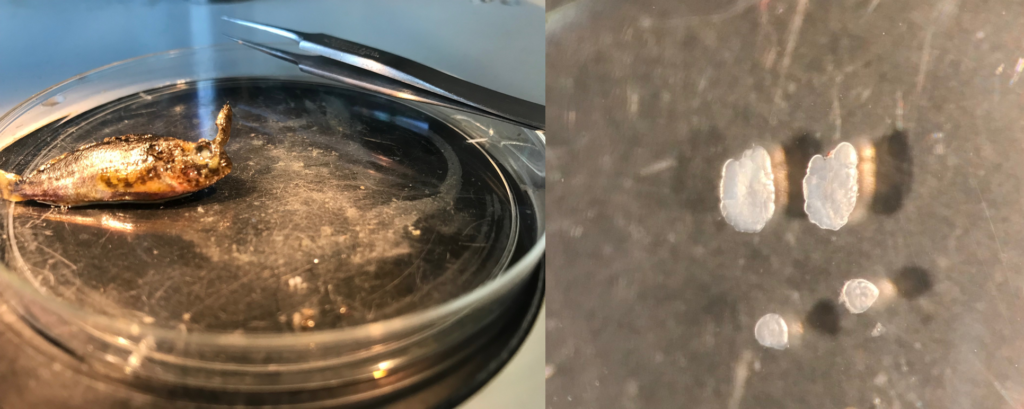
After collecting, identifying, and measuring the length of hundreds of juvenile fishes using SMURFs (see my May blog post), it is time to take these fishes back to the lab. My lab work flow looks something like this: I use forceps and a scalpel to peel back the dorsal (top) of the fish’s cranium from the nose to the beginning of the vertebra tools to very thin forceps – the tips are as wide as 0.7mm mechanical pencil lead – and begin to move the brain away from the lateral sides of the cranium. I work under a dissecting microscope. My eyes look through the eye piece while my hands manipulate the specimen. I prod, search, and finally find what I’m so carefully looking for. I remove small white object from either side of the brain. They are slightly smaller than a grain of short grain rice. I try not to let my hands shake as I deposit the object safely in a microcentrifuge tube for storage, and take a breath of relief. 400 dissections later, I relocate to a new microscope station – a compound and dissecting scope with cameras that allow me to see and capture the microscope images on my computer. I mount each of these samples to a microscope slide, use 2000 grit sandpaper to sand both sides of the sample, and place it under 400X magnification. I smile – now the fun begins.

On the left, a juvenile cabezon with the cranial cavity opened in preparation for otolith removal. On the right, two pairs of otoliths extracted from the fish. Each fish has three pairs of otoliths, similar to human ear bones, but I am only interested in the two largest pairs of otoliths.

So why all this fuss? What are these mysterious small, nearly microscopic white objects?

Most fishes (except sharks, rays, and lamprey) have ear stones called otoliths, which are the small, white structures found in the cranium. Otoliths are made of calcium carbonate, the same compound found in the shells of many invertebrates. These structures that aid orientation, balance, and hearing, similar to human ear bones. Otoliths are an important tool in fish biology and fisheries science because they serve as an annual record book, kept over a fish’s entire life. Otoliths have alternating translucent and opaque zones that correspond to alternating periods of fast and slow growth, respectively. Otoliths have a familiar terrestrial analog: tree rings. I remember my fourth-grade teacher leading our class through a guided exploration of a tree “cookie”. We counted the rings to age the tree, observed alternating light and dark bands of different sizes, and connected these observations with seasonality (light availability, precipitation) and growth rates in nature (see my January blog post on seasonality in the ocean). Otoliths are a similarly powerful tool for fish biology and management, as they allow us to understand how fish populations grow and age over time and in relation to a changing climate, pollution, and even management regulations. They are also a powerful ecological tool – allowing scientists to peer into the lives of the fishes and understand what kinds of environmental conditions result in faster or slower growth.

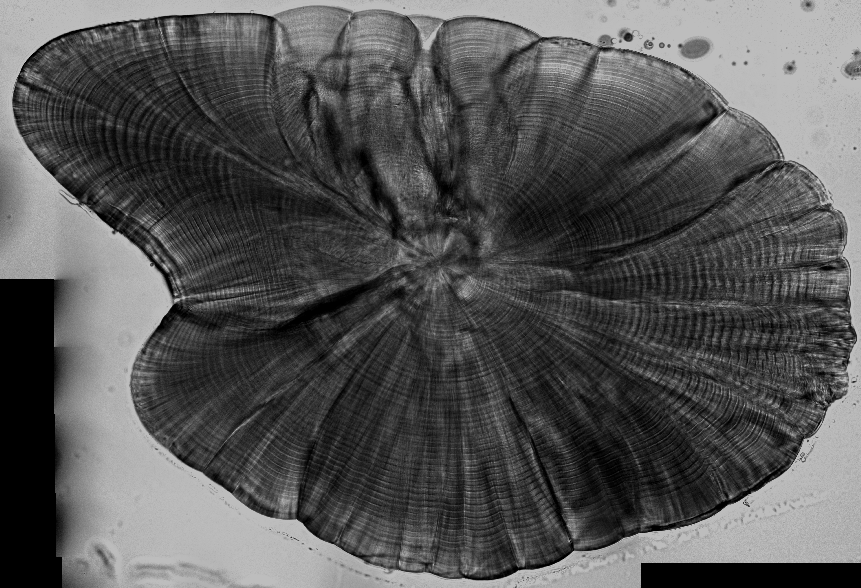
For many years, fish biologists have used otoliths from adult fishes to measure population vital rates and translate this information into management decisions. In 1971, a groundbreaking discovery credited to Yale geologist Giorgio Panella forever changed the fields of fish biology, fish ecology, and fisheries science: it was possible to read the information stored in larval and juvenile fish otoliths as well – only in these young fishes, the alternating light and dark rings represented a daily log book. Imagine the excitement of scientists when they discovered that they could now peer into the daily lives of young fishes! In marine fishes, upwards of 99% of fish eggs produced do not survive to adulthood. There is a mortality gauntlet through which all young fish must pass, and few survive, due to the challenges of finding food in a vast open ocean, of avoiding myriad predators, and of avoiding currents that would sweep them away from suitable habitat. Prior to the discovery of otolith daily increments, this mortality gauntlet was poorly understood, making it difficult to predict when and why adult fish populations undergo periods of boom and bust.

A juvenile cabezon otolith that has been polished and imaged at 400x total magnification. Each ring represents a daily increment; this individual is 65 days old.

My research and expected results

Understanding this mortality gauntlet has been a central goal of my PhD research. Specifically, I study a socio-economically important nearshore groundfish found from Baja California, Mexico to Alaska, the cabezon (Scorpaenichthys marmoratus). Since COVID-19 made my 2020 field season impossible, I have instead been dissecting, polishing, and analyzing otolith data from juvenile cabezon with the goal of understanding what early life characteristics are important for growth and survival through the mortality gauntlet. Because the time series of samples for my project extend from 2013-2019, I am also able to investigate how these critical early life history characteristics change from year to year, and even from month to month.

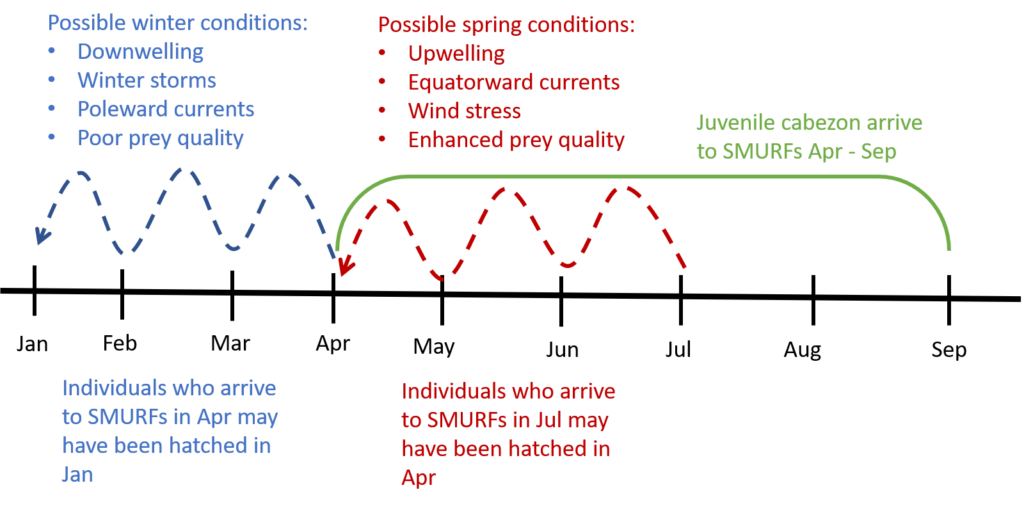
Cabezon exhibit a somewhat unique recruitment strategy – that is, the timing and magnitude with which juveniles arrive to the nearshore to settle and grow into adulthood. Unlike many other nearshore groundfishes, cabezon recruit in multiple events, spanning the April – September months. This is a departure from the “single-pulse” strategy, where the juveniles (e.g. rockfishes) arrive over a short time window (e.g. two weeks in July). By the time the cabezon are collected in the SMURFs, they could be anywhere between 2 and 4 months old. That they arrive over a 6-month window means that they have experienced a vast range of ocean conditions (e.g. winter storms, changing currents, upwelling, downwelling, water temperature). I expect to find a “portfolio” of early life characteristics that enable the young fish to survive in different ocean conditions. For example, individuals that arrive to the SMURFs in May were likely hatched in January, experienced “winter” conditions, and could have a “winter” growing strategy (e.g. slow growth due to poor feeding conditions). In contrast, individuals that arrive to the SMURFs in July were likely hatched in April, experienced “spring” conditions, and could have a “spring” growing strategy (e.g. fast growth due to enhanced feeding conditions). Altogether, I am interested in understanding how this portfolio effect of early life strategies may enhance the resilience of the cabezon population to disturbances such as the 2014-2016 marine heat wave and other climate and fishing related changes.

Schematic linking recruitment (arrival to SMURFs) with potential hatch dates and associated growing conditions.