Mid-Summer Progress Report

How have I found myself in the middle of week SIX, already? I’m into the double digits with my interviews and have a very full calendar for the next few weeks. My original aim was to have interviews wrapped up by the end of week seven, but I’ve got some scheduling spilling over that deadline. This is making it ever more important that I keep up with interview transcriptions and analysis along the way, since I’ll be presenting a poster at our final symposium in week nine! With a decent number of interviews behind me, now, I’ve begun to see recurring commentary on certain successful elements of engaged research, and have heard some suggestions for improvement echoed by a few people. It’s all starting to come together, although I need to spend this next week better organizing all of this data in a format that will feed into my final report.

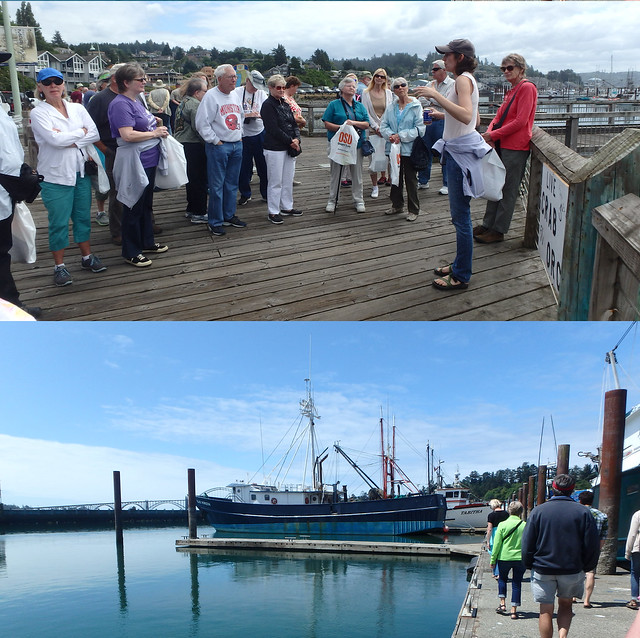
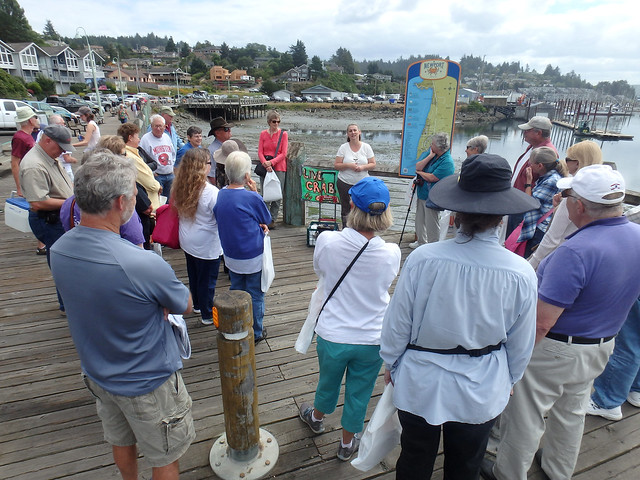
I have to give a quick shout-out to Ruby Moon after tagging along to her Shop the Dock program in the past week. It was great to see a program in action, and watch the engagement between community members and local industry through this direct marketing exchange. What a great activity – there was a huge crowd that came out to learn about navigating the docks!
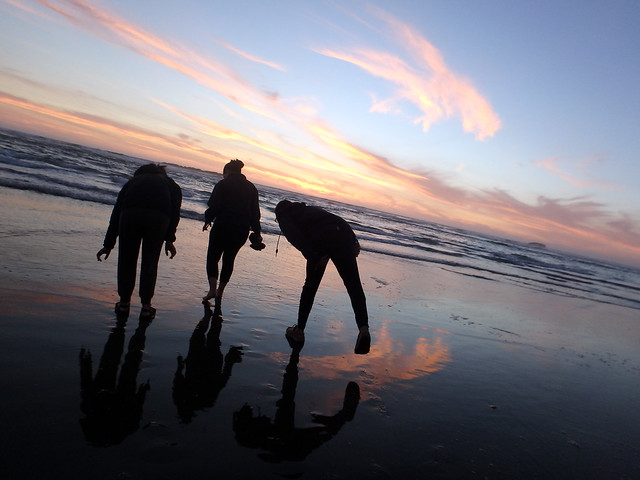
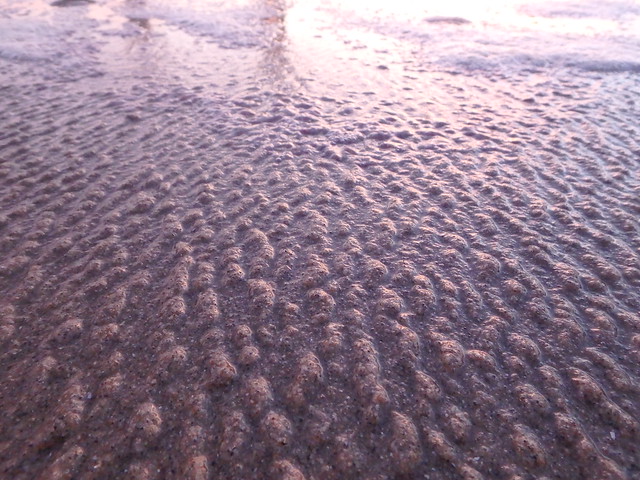
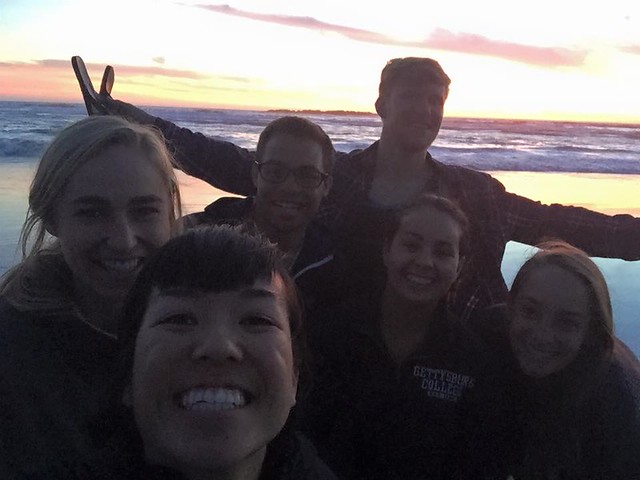
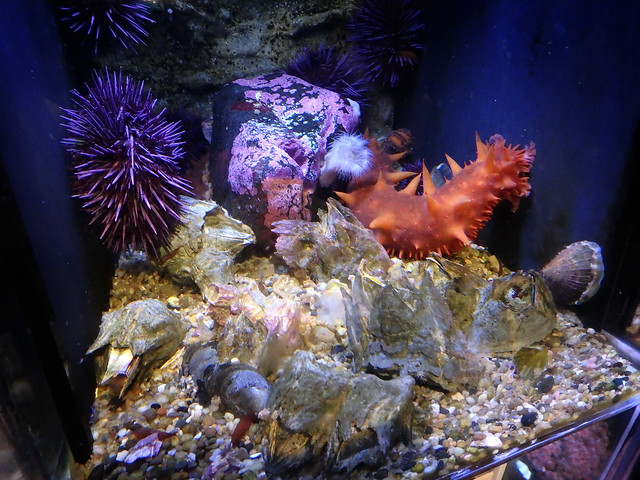
Dock ShopDock Shop I also spent a lot of time thinking about science communication and engagement over the weekend during our mid-summer check-in. Miriah Kelly led an excellent workshop, and I enjoyed round-table discussions that were had throughout the morning. We talked about a lot that day, but here are a few things I jotted down that are good to remember and incorporate into my thinking: (1) Your identity as a scientist is built up through everything you’ve ever communicated and the positions you’ve taken on other research and issues. (2) In communicating your message, recognize and account for the fact that the general public often has stereotyped ideas of who scientists are and what they do. (3) You will often take a role as an information gatherer, generator, provider, or translator in your scientific work, but equally important are your abilities to be a good manager, listener, director, networker, facilitator, behavior changer, and passion generator (love that last one). After the morning workshop, we also had a chance to visit the Newport Aquarium as a group. I realized that this was everything I’d been previously missing out on in my museum and aquarium explorations: when you go with a bunch of other marine scientists, you learn SO MUCH MORE. The information panels are never quite enough to satisfy my curiosities, but I was really happy to hear my co-scholars and mentors share their specific knowledge about the species we were seeing throughout the exhibits that day. We also ended the mid-summer check in well with a barbecue, camping, and incredible sunset at Beverly Beach, just up the coast. And, as you’ll notice in the picture below, only a bunch of marine scientists can be found staring at the ground in front of a such a beautiful sunset :) Speaking of such, does anyone have thoughts on what those pink, gooey clumps are that we found strewn across the sand (see photo below)? We were stumped. Anyhow, it was wonderful to spend time with the other summer scholars and hear about their interests and experiences in marine systems. Newport Aquarium Beverly Beach SunsetWhat are these?
Onward and upward! It should be a crazy but incredibly interesting week as interviews continue.

Oregon Coast Economic Summit

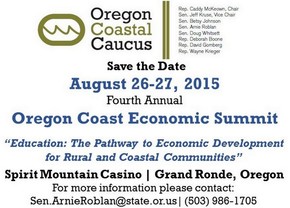
Next month, there will be a number of interesting panels at the 4th Annual Oregon Coast Economic Summit (OCES), which is sponsored by the Oregon Coastal Caucus. See the invitation below:


Coastal Caucus Logo


Greetings,

It is with great pleasure and much excitement that the Oregon Legislative Coastal Caucus invites you attend the 4th Annual Oregon Coast Economic Summit (OCES), which will take place on Wednesday, August 26th and Thursday, August 27th at Spirit Mountain Casino in Grande Ronde.  This year’s theme will highlight the collaboration necessary to help young people prepare for our region’s and our state’s rapidly changing economy.

The Summit will feature highly informative panel discussions on a wide range of topics with a focus on the Oregon coast’s unique economic diversity.

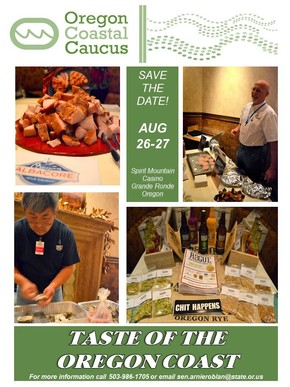
We are also pleased to announce the return of the very popular “Taste of Oregon,” a reception that allows attendees to sample locally made food and beverages from the Oregon coast, including products of the Dungeness Crab Commission, Pelican Brewery, Kruse Farms, 7 Devils Brewing Co., Tillamook Cheese, and many more.

The attendance of more than 400 policy decision makers from federal, state, local and tribal governments, as well as the numerous educators and representatives from the private sector promise to make this Summit a vital think tank for the exploration of new ideas and new approaches to problems and challenges that face our communities.

Registration for Oregon Coast Economic Summit

Hotel Accommodations:

Please note that a block of rooms has been reserved for guests at Spirit Mountain Casino for Wednesday and Thursday nights at a special group rate. In order to secure a room at the discounted rate, please call the Lodge at Spirit Mountain Casino at 503-879-2350 for August Summit.  Registration Code 603248.

*******

FlyerTOCCTillamook

Moray-ming for Engagement

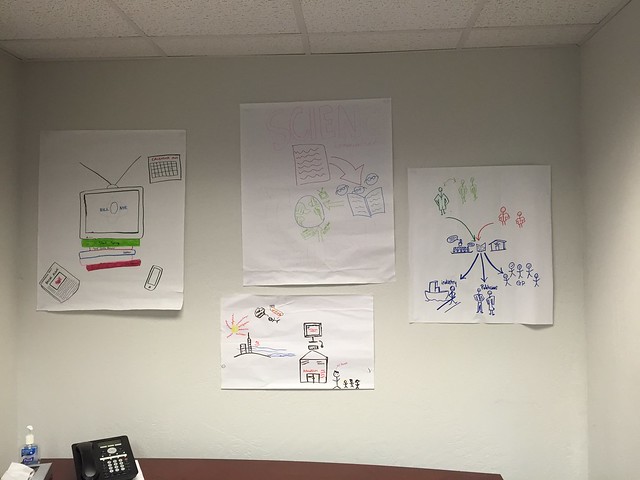
Last Friday marked the halfway point for our Summer Scholars. In honor of the occasion, we hosted a check-in event in Newport. With five short weeks remaining, we wanted to see their personal and professional progress so far, and (as you may not be able to tell from my poorly-punned title) aim for more engagement between them. The morning consisted of a science communication workshop, spectacularly led by Sea Grant’s Miriah Kelly. The morning included a quick opportunity for students to present their work so far. They also drew their interesting and diverse mental models of scientific communication (#scicomm), which are now on display in the Sea Grant office in Corvallis.

Untitled

Some of the mental models on display in the Sea Grant office

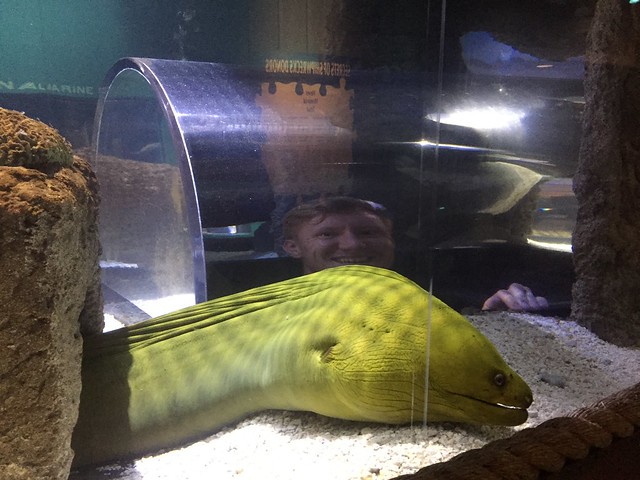
After the presentations and a quick feedback session over lunch, the scholars headed to the aquarium to see some science communication in action (and have a little fun on the side). Austin got a kick out of the giant green moray eel in the new shipwrecks exhibit.

Untitled

Austin with Banner, the giant green moray eel.

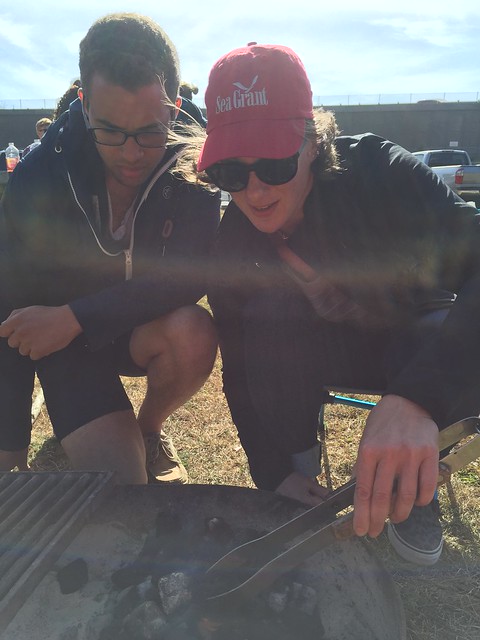
We rounded out the day with a delicious BBQ at Beverly Beach, and left the scholars to camp overnight in the park.

Untitled

The fire- and grill-masters

The day seemed to be a hit with the scholars. It was a long one, but it was a nice balance of productivity and learning with fun and relaxation. The students got quite a bit out of the communication workshop- we had some great discussions about advocacy on social media and the purpose of communication, among other things. Some highlights of what I learned:

  • Figure out who your receiver is. Knowing their values will help you frame your message.
  • Get feedback from your receiver. This is just as important as the message.
  • Provide multiple layers of information so that people can get to their own desired depth of knowledge.
  • The end goal of science communication is a behavior change. Focusing your message will help achieve this.

You can follow the scholars here on the blog and/or on Twitter at #OSGscholars. You can follow me @SarahLHeidmann.

Whale, Whale, Whale…What do we have here?

When looking back on my childhood, I could easily tell you that my love for whales began right here in Newport at the Oregon Coast Aquarium. Like any native Oregonian kid in the 90’s, I fan girled hardcore for Keiko the whale (Aka: Freewilly) and would harass my parents constantly to go visit him in the aquarium. I knew then that I wanted my future career to be focused around marine animals, especially whales…

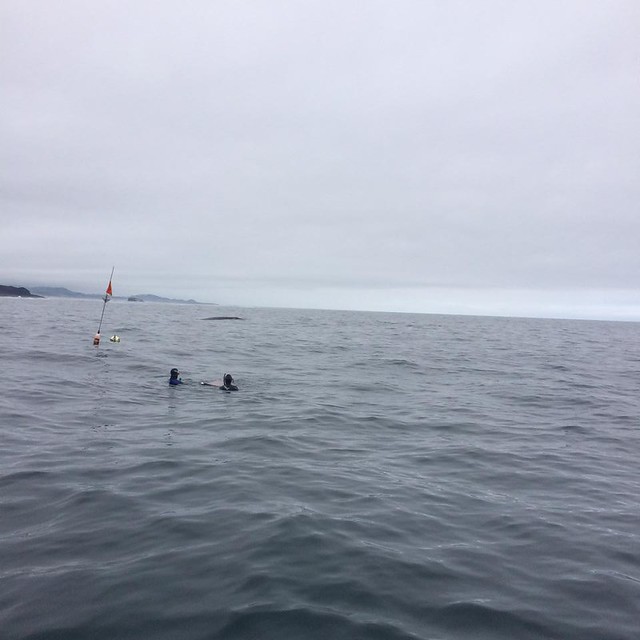
Monday began with another SMURFing trip that occurs every two weeks. As I talked about before, it was an amazing experience and I was excited to do it again. This time, I did not suit up and get in the water, but instead helped to collect data and extract the juvenile fish from the SMURF. Although, this time we didn’t only see juvenile fish, we saw a whale! It was a crazy sight and came so close to Sara and Dani who were retrieving the SMURF. I wasn’t even in the water and I thought that it was so incredible! This experience just solidified why I love marine science (and whales) so much.


11741726_1116895791657646_1588845370_n


The rest of the week consisted of more sea star monitoring. This time, Sara and I worked with a team from UC Santa Cruz on Wednesday and Thursday. Again this was awesome, and the getting my hands dirty was great, yet unfortunately the 4 am wake up each day was a struggle. Waking up and being at work when it is still dark out is the weirdest experience although I still really enjoyed it. The fact that three of my work days this week consisted of field work was a win and also on Friday we were able to go to the aquarium for our mid Summer check in with Sea Grant! I was able to  put my rockfish speices I.D to the test while wandering the aquarium and check out some sea lions and otters. They also had great fudge in the gift shop. They get an A plus in my book. Friday was also very humbling in the fact that it helped me to realize that I need to brush up on my public speaking. A workshop was held on scientific communication and speaking in front of everyone was actually quite terrifying to me. It is definitely something I must overcome and I’m glad we had the workshop.

Finally, I would like to say that I am in awe that we are in week six now. I have had a great experience so far and I am looking forward to the last half of the summer and continue hanging out with my fellow interns!


1455931_944820685578495_2141687852120381047_n

Week Four: Celebrations and Sea Surface Temperature!

I am no longer writing for this blog as a teenager! My twentieth birthday was Saturday and my family and best-friend came down to Newport for the weekend! We walked around Hatfield, we walked along the Bay front, visited the beach, did a little hiking, and celebrated my birthday at the Noodle café. The weekend was like home at the beach!

IMG_20150711_150741

IMG_20150711_154106

IMAG0724

This week at work I was researching predicted sea-surface temperatures in 2100 for each ecoregion. I also had to find values for each of International Panel on Climate Change’s Representative Concentration Pathways (RCPs). These are emission scenarios that could occur over the course of the century depending on emission restrictions and other climate change initiatives that we pursue. The four scenarios are 2.6, 4.5, 6.0, and 8.5—named after the range of possible radiative forcings in 2100. As I am finding four projections for each of the twelve ecoregions, I have to find 48 values. However, the literature does not have all of those numbers and I am waiting until this week to talk to one of mentors, Henry, to get his opinion on what the course of action should be as he was out of town most of this past week.

Nonetheless, what I have found has been worrisome. All of the values I have found project at least a 1˚C increase by the end of the century with some scenarios predicting up to a 5˚C increase. In order to determine organisms’ relative vulnerability to an increase in sea surface temperature, Henry is developing a table of thermal cutpoints for each ecoregion based on current mean sea surface temperature data and the projected sea surface temperature values. None, low, moderate, and high risk of temperature increase for the species will be determined through the species’ thermal tolerance which is indicative of their current biogeographical distribution. Henry developed a complicated series of rules that I don’t completely understand and don’t think I can properly explain quite yet.

In addition to researching sea surface temperature, the other intern working in my office, Christina (my other mentor), and I were all supposed to get field work training on a boat last Friday; however, the intern was sick and we postponed the trip until next week. Since I was waiting for Henry to return, I didn’t have much research to do. Instead, I helped Christina write an abstract for a climate conference that she will attend in November. She will be presenting a poster on CBRAT and how it is incorporating climate change impacts and specific values to assess species’ vulnerability. She has presented at this conference before, but this will be the first time she is able to report on the climate side of CBRAT which will surely please the climatologists at the conference—many of whom have published studies that I have obtained values from.

Wading into the data…

The end of week three signaled the shift into high gear or perhaps “low gear” because time doesn’t pass so quickly. The databases have been selected, the data has been pulled from papers, additional numbers have been received from researchers in several countries, and now I’m  faced with making sense of it all. I know, it sounds pretty boring, and at times it can be. Looking at 4000 rows of data, debating how to weigh a lack or surplus of information from one site in order to compare it to another, figuring out how to make it all useful…it’s particularly challenging. But before we can begin teasing out exciting new information, the data mining stage is crucial. Outside the mind-numbing, we had a number of other activities going on this week: we had a productive and clarifying conference call with the lead developer of one of the models we will be working with, the Natural Capital Project’s inVEST Blue Carbon model. In addition, the grad/postdoc students at the EPA hosted an extremely helpful resume/CV workshop…it’s been 4 years since I changed the format of my CV and it definitely needed a refresh.

This past weekend was also the Fourth of July and I can’t think of any better way to celebrate America than going out bright and early to explore Caper Perpetua, part of a federally protected National Forest. It’s a beautiful manifestation of one of the world’s greatest land conservation schemes–the US National Forest System, which is truly something all Americans should be proud of. While there, I finally satisfied one of my goals coming out to Oregon: tide-pooling on the Pacific coast.


The SRGP Receives $205 Million for 2015-17!

The Oregon Legislature recently approved $205 million to be used for the Seismic Rehabilitation Grant Program (SRGP). For 2015-16, $50 million will be spent on public schools. For 2015-2016, $125 million will be spent on public schools and another $30 million will be spent on emergency service buildings. The Legislature passed a separate bill to spend $125 million on a program to help build public schools in areas that are less seismically vulnerable. That means that Oregon will be spending at least $300 million in its effort to improve the seismic safety of public schools.

Check out this article: http://ijpr.org/post/2015-marks-banner-year-earthquake-preparedness-oregon

Do you have a moment?

Would you help us improve our customer service by completing a short survey?

How many times have you been asked this question? How many times have you been the one asking it? The number of times I have asked someone to complete a survey has increased considerably in the last three months.

In May I asked all participants in the science-stakeholder engagement portion of the Willamette Water 2100 (WW2100) research at OSU to complete an online questionnaire about their participation in, expectations of, experiences with, and outcomes from WW2100. After inviting all 238 members of the WW2100 listserv to participate in my survey, reminding them, and then reminding them again, 137 WW2100 participants took the time (approximately 30 minutes) to thoughtfully respond to my questions. 137 respondents out of 238 invited is a respectable response rate of 48%. The questionnaire was about 30 questions long and looked something like this:

Qualtrics

In my last post I shared about conducting interviews of select participants in WW2100. Using more than one method to gather data is called a ‘mixed methods approach’ and can deliver more robust results because they were found by more than one way. That is what I intend to do with my qualitative interview data and now my quantitative survey data.

Qualitative data analysis can be done in several ways but I have chosen to use a ‘fancy highlighting program’ called MaxQDA (description credit to Sarah Calhoun, MRM, OSU). This program allows a researcher to identify relevant text and organize it according to codes, or repeating ideas, which can then be displayed together on request. I have just completed my second pass of coding (identifying repeating ideas and organizing them into themes) so that now when I open MaxQDA on my computer, it looks something like this:

Concepts that emerged in the qualitative data can be assessed quantitatively using the survey data. I would like to share some (very) preliminary results from my analyses with you. One challenge that consistently emerged in the interviews was that participants held different expectations for the roles that stakeholders and research team members would play throughout the process. However, although the survey results indicate that stakeholders and research team members were expected to fulfill different roles, stakeholders and research team members did not differ in their expectations for each other. That is, albeit preliminarily, there was not a quantitative difference in expectations for the role of stakeholders and research team members. I’ll have to explore this challenge more.

Another aspect of stakeholder engagement that my survey can really illuminate involves the outcomes of having participated in such a process. My survey measured participant concepts of model utility (the scientific results), process utility (was it worth the time?), feeling heard, and understanding. I then correlated these concepts with a participant’s participation in the project. All four concepts were significantly positively correlated with participation. This means that individuals who reported greater participation also reported greater perception of model utility, process utility, feeling heard, and understanding. How neat is that?!

There is still a lot of work to be done but the data are in and now all that is left is to make sense of them. I split my time between the words of my interviewees and the numbers from my survey. Together they will tell a complete story of the WW2100 science-stakeholder engagement process which can then be read as an example for future engagement projects. Stay tuned for the final results and presentation!

Pit Traps for the Mudflats

This week was great for field experience. I spent a majority of the time working in the mudflats deploying pit traps (24 in total). Multiple field days, waking up at the early hours, and trekking through the mud has been both tiring and rewarding. I have learned about capture methods for crabs and also have been looking into new methods for panoramic/stereoscopic filming (will have more information next blog). Also it has been long awaited, but in the middle of this coming week I will have some video footage of the crabs from the experimental pit traps from last week. Found some very interesting footage of a crab which, from what we believe, is trying to crack open his shell to molt. Spending the 4th of July in Oregon was wonderful as well. The fireworks show may not have been an Indiana show, but it was definitely enjoyable.

Example of pit trap for size selection of Dungeness crabs

Endless Oppor”TUNA’ties

Week three is officially over and I can very confidently say that this has been my favorite week of working for the Marine Reserves Program, hands down. The week consisted of three days of field work and stability and deadlines for some of the goals that I want to achieve while here in Newport.

As I talked about the previous week in my blog post, I was able to go out SMURFing on Monday morning. This turned out to be a lot of fun even though we had an early wake up. During this excursion, my job was to replace each of these larval recruitment nets (SMURFS as they call them), and bring the ones that were already deployed back in to sample. When the nets come up on the boat, they water is dumped on them and they are shaken to attempt to retrieve juvenile fish from them. From there the fish are measured and counted. It is a way of monitoring the recruitment of fish in the marine reserves and the comparison areas. There were a total of eight SMURFS to retrieve and replace, four in the comparison area (Cape Foulweather) and one in the Otter Rock Marine Reserve. We were done by ten in the morning and the process is very straight forward so it didn’t take long.

The week continued to get better and on Tuesday, Sarah (the other Marine Reserves intern , Christian (our supervisor) and I were able to go to the aquarium and snorkel in the tanks. I cannot get over how amazing this was and the fact that as a kid this was my lifelong dream whenever I went to the aquarium….besides meeting Keiko.  For the most part, our reasoning for going was to help us identify the rockfish species that live off the coast so when we score videos, we will be more confident in the fish we are identifying. I also think they just wanted us to have some fun. :)

11665835_1111062602240965_734369212_o

But wait, there’s more. Thursday we went sea star sampling at Otter Rock Marine Reserve! During this time, we looked for sea stars in the intertidal area of the reserve and categorized them as either healthy or diseased with sea star wasting disease. The amount of sea stars in the area has decreased dramatically due to this, yet during the time monitoring, we found one that could be categorized with the disease. In the long run, I realize that office work will be a big part of the job as well, but for now, I am really enjoying being able to go out in the field so much!

11665975_1111062682240957_593509890_o

One of the best things that I enjoy about this job is the fact that on Wednesdays they have soccer! For an hour during lunch for the past two weeks, I’ve gotten to play pick up outside on the lawn by the dorms. It’s been fun and definitely a good way to get out of the office for a bit, plus I LOVE playing soccer. The only downer is a lot of the World Cup woman’s soccer matches have been at four so I haven’t been able to watch them as much as I’d like. Although right now I am currently watching the final and the US is doing work. Hopefully when I write next week I will be able to say that I watched a US win!

11717141_1111062712240954_838999504_n