Week One: Done

Tomorrow marks my first completed week as an Oregon Sea Grant Scholar. While this week has been primarily adjusting to the 9-5 work day, cooking all my own food, and the windy Newport weather, I also find it quite easy to feel as though I have been here for weeks already.

I am interning at the U.S. EPA Pacific Coastal Ecology Branch and have been data mining and compiling information related to assessing the climate vulnerability for marine organisms along the coast in an online tool called CBRAT (Coastal Biodiversity Risk Analysis Tool). I have been searching for literature that predicts estimated sea level changes. This has been more difficult than I had originally anticipated as most papers reference the IPCC’s predicted global sea level rise while I am looking for predictions specific to Pacific ecoregions. I am looking at twelve ecoregions from the Beaufort Sea in the Arctic to the Cortezian Shelf which contains the Gulf of California. So far, I have found at least one estimate for ten of the twelve ecoregions. Sea level rise is then applied to the vulnerability for marine organisms by using their life history traits and also knowledge regarding the urbanization of that region. For example, a crab that lives in the intertidal zone will be forced to move further inland due to sea-level rise but might be blocked by a wall in Southern California but will have plenty of room to move inland in the Arctic regions. The crab in Southern California will receive a relatively high algorathmic vulnerability rating for the program and thus be more susceptible to sea-level rise and climate change than the crab in the Arctic. Organisms that do not live in the intertidal zone won’t be as affected, so they will receive a low algorathmic rating for the program.

My mentor has also promised future work on ocean acidification, which I eagerly await.

This experience has not been solely working. During the evenings, I am able to relax with the other OSG scholars and with the REU students staying at Hatfield. Today students for Hatfield’s summer session are expected to arrive, so they’re will be even more people to meet! One of the highlights from this past week was going to the jetty in South Beach and building a pretty sturdy campfire. An REU student built the fire, but I was able to contribute to the fire display with lighter fluid. Other adventures include going to the Farmer’s Markets, walking the Estuary trail, and chasing Newport sunsets.

Untitled

Untitled

While this week has been very eventful, I expect more exciting work and free-time adventures to come over the next nine weeks. Also, my twitter handle is @EdelsonMicaela and I will be posting almost daily about my adventures here in Newport!

Exploring the Oregon Coast

This week has been a whirlwind of information at my new job with the Oregon Department of Fish and Wildlife looking at the human dimensions aspect of the marine reserves. I am currently writing this post from my hotel in Garibaldi, a town located a couple hours north of Newport. The graduate student I am working with named Theo and I will be heading up to Garibaldi frequently to do observational and survey research of people using the beach and boats in the reserves at Cape Falcon. My mentor says we’re basically getting paid to hang out on the beach and talk to surfers all day, so not too shabby of a gig I’ve got here right? On the drive up today we stopped at the Tillamook Cheese Factory and sampled some of the delicious cheese they produce.

photo 1-1

We also scoped out the sites that we will be doing these studies at and they were some of the most beautiful places I’ve seen on the Oregon coast. If you ever want to try your hand at surfing then head to Oswald West State Park! There were dozens of surfers in the cove there when we arrived. Overall I am excited to head back to Garibaldi next Monday and begin doing the studies!

Prozac project changes

When I last checked in, I had just begun a pilot study that would assess how shell thickness in mussels may be affected by exposure to Prozac. Unfortunately, the experiment was a bust, mostly owing to the impractical housing conditions which stressed the animals and led to high mortality. I quickly scrapped this project, with the intention of returning to it as a side project sometime later next year. My new focus will still assess the affects of prozac on marine life, but from a completely different angle: animal behavior.

I’d like to introduce this new project by telling you how I came up with the idea. While visiting Netarts, Nehalem, and Yaquina Bay, I noticed the abundance of shore crabs living in the estuary and that they reside primarily in soft sediments, mud, and beneath rocks, never too far from the water margin. This struck me as another creature that may be at risk from contaminants as they are transported from waters upstream and adsorb onto the sediments. I wondered if these crabs were in contaminated estuaries, how would their behavior change and how would this influence food web dynamics. To my knowledge, this is a somewhat unexplored connection linking contaminants as an agent to potentially influence shifts in food webs. We often hear about bioaccumulation of contaminants up the food web, but what if contaminants also affect the behavior of animals and cause them to be more or less susceptible to predation because of abnormal behavior?

The shore crab Hemigrapsus oregonensis, has been extensively studied and their behaviors have been well documented. My aim was to assess whether crabs exposed to Prozac at  3 and 30ng/L (i.e. documented concentrations in estuaries) would be more at risk of predation when compared to unexposed crabs. Because Prozac is a psychoactive drug, it is likely that their behavior will be altered at even low levels with persistent exposure. I am conducting this experiment by creating simulated estuary habitats in 30 tanks (10 replicates for each treatment) with rocky substrate and hideouts to allow for normal predator escape/evasion behavior. We will be dosing the shore crabs every 10 days with Prozac to simulate pulse events (e.g. increased rainfall) into the estuary. The meat of the study will be the addition of the predator, the Red rock crab, to the shore crab tanks and assessing the response to the predator during the behavioral trials, which will last ~1hr. We will run these behavioral trials during the day and at night to see observe their reactions. This project will run from June 1-August 15.

We have already had the animals living in our estuary mesocosms since June 1 and we will be conducting the first set of  behavioral trials next week. More developments to follow. I’m very excited about this study and I believe it is important to explore how contaminants might affect wildlife in Oregon’s estuaries should we

Welcome, 2015 Summer Scholars!

Our 2015 Summer Scholars are here! They are attending orientation today at the Sea Grant office in Corvallis, then at the Hatfield Marine Science Center in Newport. These seven undergraduates from around the country have been placed with federal and state agencies for the next ten weeks. In addition to supporting agency programs and initiatives, the goal is to offer students professional skills, agency workplace experience and real-life practice in marine resource science, policy, management and outreach. Check the blog next week for their introductions, and weekly from then on for updates on their progress. You can also follow them at #OSGscholars on Twitter.

Untitled

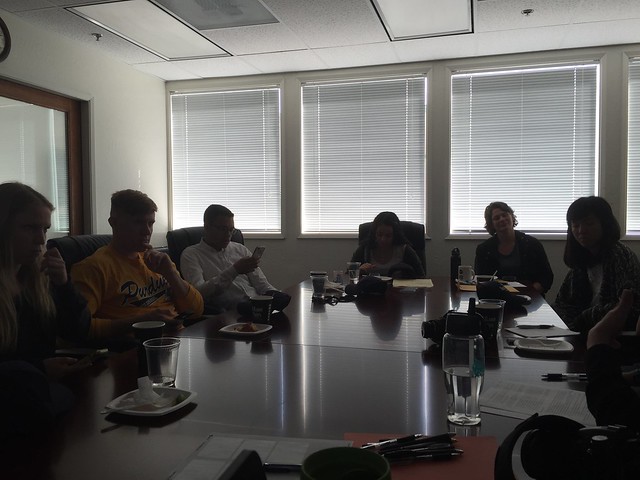
The new Summer Scholars during the social media training, smartphones in hand. Yes they were asked to pull out their phones! Apologies for the dark picture

As this is my first blog post from my current position, I’ll introduce myself. I am the Summer Scholars Program Coordinator this year, drawing from my experience as a Summer Scholar in 2013. Since January, I have been helping to set up the program, including advertising, reviewing applications, interviewing, and event planning, among other things. In the fall, I am off to pursue a Master of Science in Marine and Environmental Science at the University of the Virgin Islands. Until then, I will be supporting the students and their mentors throughout the summer, helping them to achieve their goals.

Watch for updates on the scholars and their use of social media, on Twitter at @SarahLHeidmann and/or here on the blog!

Here, There, and Everywhere

I’m writing today not from the northern Oregon coast—where I spent the last year as a Natural Resources Policy Fellow at the Tillamook Estuaries Partnership—but from Raleigh, North Carolina. It’s different here, of course. From what I’ve seen so far, it’s significantly cheaper and significantly warmer. You can get a plate of hush puppies for fifty cents, beautiful bright red cardinals hop from branch to branch, and strangers about your mom’s age casually call you “honey.” But like Oregon, it’s a lush, green place invested in and dependent on its natural resources, coastal resources included. Sea Grant, the National Estuary Program, and the National Estuarine Research Reserve all have active, large branches in North Carolina. In addition, both Duke University and the University of North Carolina Chapel Hill operate marine labs out on the coast.

But I am not here to work for any of these fine institutions. Thanks to a fellowship with the American Association for the Advancement of Science (AAAS), I will be spending the summer at the Raleigh News and Observer as a science reporter. Every summer for over forty years, AAAS has placed current or recent science graduate students at newspapers, magazines, radio stations, and other media outlets. I am lucky enough to be one of 20 students or near-students (I actually graduated with my Master’s in March of 2014) selected this year.

Although I expect to cover a wide variety of science stories, after a year working for TEP and Sea Grant, I’m curious about the environmental issues faced by this coastal state. Like TEP, the Abermarle-Pamlico National Estuary Partnership seeks to monitor and restore its watershed and to encourage public participation in that process. In fact, the APNEP Comprehensive Conservation and Management Plan reads very familiar. Like TEP, this estuary partnership seeks to rehabilitate an estuary from the effects of “forestry, farming, industry, mining, and development” and is working to improve anadromous fish passage, wetland function, riparian plant communities, public access to waterways, and landowner education about nutrient management. In other words, concerned citizens 3,000 miles away from each other are working on solutions to many of the same problems. Whether or not I am able to write about this topic for the News and Observer, this is the kind of connection I want to highlight in my future career as a writer.

Thanks to Oregon Sea Grant for putting me in action this past year at an agency working to effect change; now I will be reporting on such agencies. I believe my experience as a Natural Resource Policy Fellow will help me become a critical, accurate, curious, and well-informed science writer—this summer and wherever I find myself afterwards.