Amit Bashyal’s paper on anti-neutrino scattering is published
Amit Bashyal’s thesis work on anti-neutrino quasi-elastic scattering has been published as Bashyal et. al., “High-statistics measurement of antineutrino quasielastic-like scattering at Eν ~ 6 GeV on a hydrocarbon target”, Phys. Rev. D 108, 032018 , in the August 1 issue of Physical Review D. This paper uses the full MINERvA medium-energy data sample with 635,592 candidate interactions and […]
September 13, 2023
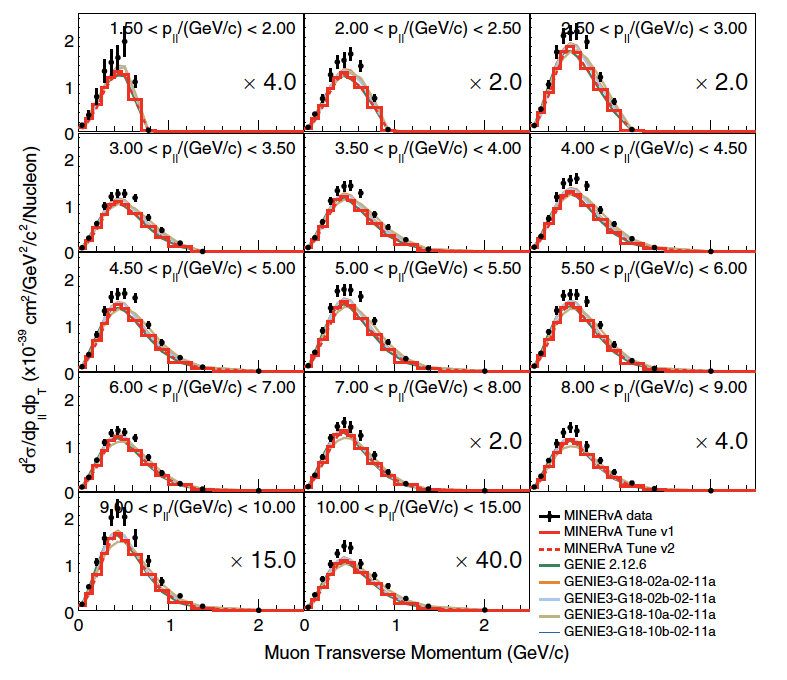
The double-differential quasi-elastic-like (CCQE) anti-neutrino cross section from the MINERvA experiment medium energy sample as a function of transverse (pT) and longitudinal (p||) momentum. The dark points are the data and the curves show various neutrino interactions models.
Amit Bashyal’s thesis work on anti-neutrino quasi-elastic scattering has been published as Bashyal et. al., “High-statistics measurement of antineutrino quasielastic-like scattering at Eν ~ 6 GeV on a hydrocarbon target”, Phys. Rev. D 108, 032018 , in the August 1 issue of Physical Review D. This paper uses the full MINERvA medium-energy data sample with 635,592 candidate interactions and the improved MINERvA neutrino flux and energy scale (see Amit’s previous paper, Bashyal et. al., “Use of neutrino scattering events with low hadronic recoil to inform neutrino flux and detector energy scale”, 2021 JINST16 ).
Left: Measured (data points) and MINERvA Tune v1 prediction (dotted lines) of CCQE-like dσ/dQ2 for neutrinos (red) and antineutrinos (this measurement, black) extracted with at neutrino and antineutrinos energies ∼6 GeV. Right: Summary of fractional uncertainties on the differential antineutrino cross section as a function of Q2.
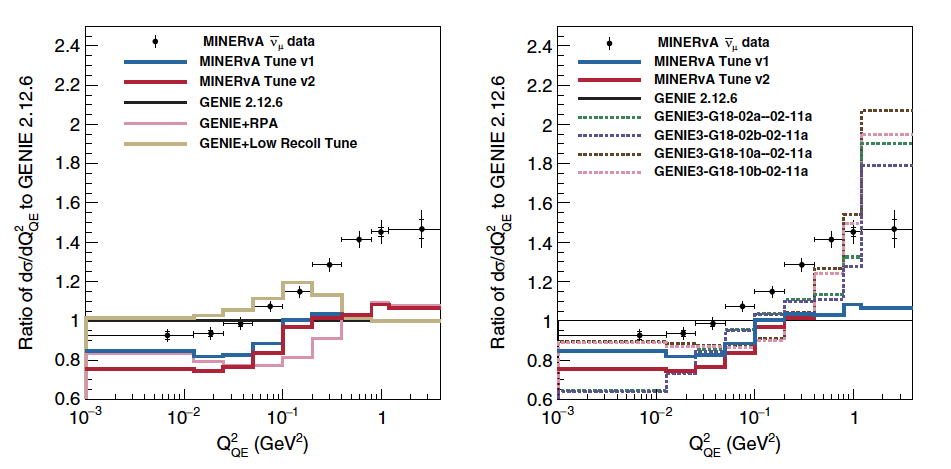
Comparisons of the cross section predicted by various tunes applied on GENIE with respect to the baseline GENIE 2.12.6 (black) as a function of Q2 (left). MINERvA Tune v1 (blue) is the standard simulation tuned to the MINERvA low energy data. MINERvA Tune v2 (red) is MINERvA Tune v1 with non-resonant pions suppressed in the low Q2 region. The remaining curves on the left show the effect of enabling different corrections to the base model. The plots on the right show comparisons of cross-section predictions for GENIE v3.0.6 (dotted lines) with the MINERvA tuned GENIE v2.12.6 predictions. Inner error bars represent statistical uncertainties and outer error bars represent systematic uncertainties.
The new GENIE 3 series models do a much better job of explaining the high Q2 dependence of the observed cross section.
Full details are available in his doctoral thesis. Amit is now a postdoc at Argonne National Laboratory.