New to our reference shelf…

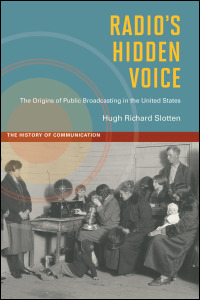
A detailed study of American public radio’s early history: Radio’s Hidden Voice: The Origins of Public Broadcasting in the United States, by Hugh Richard Slotten.

“Employing extensive research from archives across the United States, Hugh Richard Slotten examines the origins of alternative broadcasting models based especially on a commitment to providing noncommercial service for the public. These stations, operated largely by universities and colleges, offered diverse forms of programming meant not merely to entertain but also to educate, inform, enlighten, and uplift local citizens.” Want to know more?

Finding Aids

The following 9 finding aids for OSU Archives collections were completed or updated in July 2009. They have been loaded to the NWDA finding aids database and have a PDF on the OSU Archives’ website. MARC records for all of the collections are available through the OSU Libraries’ Catalog, Summit Navigator, and Worldcat. One of the collections was received in 2009; four are for collections for which there was previously no information available online. The OSU Archives now has 418 finding aids in NWDA.

Most of these are new finding aids; one (for the Technology Educators of Oregon Records) is an update of an existing finding aid.

A Dairy Program for Oregon Scrapbook, 1929

Graham, Robert D., Papers, 1903-1973

Home Economics, College of, Oral Histories, 1968-1985 (OH 11)

Home Economics, College of, Motion Picture Films and Videotapes, 1950-1998 (FV P 044)

Landscape Architecture Department Records, 1932-1982 (RG 089)

Rodman, Wilma M., Photograph Collection, 1950-1974 (P 147)

Science, College of, Videotapes, 1991-1997 (FV P 084)

Technology Educators of Oregon Records, 1954-2001

Walls, Robert B., Collection, 1916-1974

Marcus Borg named canon theologian at Trinity Cathedral in Portland

“Marcus Borg, internationally known biblical scholar, was installed as the first canon theologian at Trinity Episcopal Cathedral in Portland, Oregon. Borg will present public lectures, teach adult courses within the parish, preach occasionally, and serve as a consultant for parish education programs.”

He holds a DPhil degree from Oxford University and is Hundere Distinguished Professor of Religion and Culture, an endowed chair, at Oregon State University.

Want to know more about the post at Trinity Episcopal Cathedral?

Want to see the collection guide for Dr. Borg’s papers at the OSU Archives?

Want to know more about Dr. Borg?

Want to read Dr. Borg’s blog for the Washingon Post?

Watch for it: tomorrow is Wednesday!

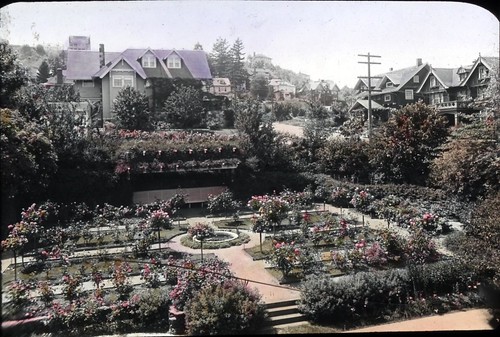
We return home this week in Flickr Commons for a much deserved “trip to Mount Hood.” Thirty-five enchanting images that let you travel from Portland’s rose gardens, through Multnomah Falls, and up to the tippy top up the Upper Glacier on the mountain. Black and white or hand-colored, these glass lantern slides are an incredible look at the past…

And, as we’ve found with other sets from the Visual Instruction Department, there was a delightful description of the images for instructors found with the set! And, as an added bonus, we also found that the description booklet included wonderful details for the individual images, which are included in the “Description/Notes” field for each image in the set. If you can tear yourself away from the images, the extra information, written in 1930s-ese, is well worth reading.

Favorites? It’s hard to choose, but make sure you linger on images of the Rose Garden, the harbor scene, Mitchell Point Tunnel, and the glaciers of Mt. Hood!

Oregon! Oregon! A Sesquicentennial Celebration in Four Acts

Hold on to your myrtle wood as Pink Martini and the Oregon National Guard 234th Army Band and Oregon 150 present “Oregon! Oregon! 2009: A sesquicentennial fable in IV acts,” which will debut August 28, 2009 at the Oregon State Fair and then tour the state – the icing on the cake of the state’s 150th birthday party.

Want to know more? Check out the Oregon! Oregon! 2009 site.

New US Archivist Nominated

President Obama will nominate David S. Ferriero to become the United States Archivist, according to a White House spokesman.

Mr. Ferriero currently serves as the Andrew W. Mellon Director of the New York Public Libraries. Before his position at NYPL, Ferriero worked as the University Librarian and Vice Provost for Library Affairs at Duke University. He succeeds Professor Allen Weinstein, who resigned as Archivist last December.

Why is this position so important? As the country’s top archivist, he would oversee the activities of the National Archives and Records Administration, including the release of government documents, like presidential papers. And, to quote Al Kamen, “The archivist job has become something of a lightning rod for controversy, particularly as various agencies and administrations press for keeping their records secret for decades despite strong pressures from historians and the public to declassify as much information as soon as possible.” To learn more, both the Washington Post and NY Times Caucus blog both have great pieces on the nomination.

“Meet Phineas Gage… Or how Flickr changed our life”

This is a great story that shows the importance of listening to our users AND the power of Flickr…

We’ve heard the story: a railroad worker is impaled with a spike in his head and lives. “Phineas Gage influenced 19th-century thinking about the brain and the localization of its functions, and was perhaps the first case suggesting that damage to specific regions of the brain might affect personality and behavior.

This story begins with photo collectors Jack and Beverly Wilgus and an unusual dageurreotype they acquired over thirty years ago. They posted images from their collections on Flickr, uploading one in December 2007 they called “Daguerreotype – One Eyed Man with Harpoon.” One comment by one user, in December 2008, changed that title and gave us the only picture of Phineas Gage (it is not the one in this post because reproduction rights are restricted). A Flickr user said “maybe you found a photo of Phineas Gage?” and the rest is history — which you can read more about on their web site “Meet Phineas Gage.”