Hints of Gold in the Backlog: Part 4 of 4

This is Part 4 of a research exploration by Cataloger Vance Woods and History of Science/Rare Books Librarian Anne Bahde.  Part 1Part 2; Part 3.

With these details confirmed, Vance could finally prepare the catalog record for the item. The time spent on cataloging proper is by far the least time-intensive of the process; the key is to have all the pertinent information at hand so that when one begins working on the bibliographic record most of the necessary data is readily available. 

As it happens, Vance was in the middle of a rare books cataloging class, and was able to incorporate some of the things he learned in the class into the record as he went. For one thing, having not worked with too many items of such early date, this was Vance’s first foray into the wonderful world of signatures (otherwise known as a collation, an indication of how the printed leaves were meant to be folded and gathered for binding). In this case, the situation was complicated by the fact that the symbol used was the Greek letter eta, which is not available in most cataloging systems, and therefore required bracketing and “transcription”: “Signatures (in Greek characters): ē4.”

Through each step of our research process to answer our initial questions “what is this item?” and “how did it come to OSU?,” we both had to call on our primary source literacy skills. Primary source literacy is defined as the set of skills needed to successfully find, understand, analyze, interpret, and use primary sources such as rare books and archives in research. 

Developed in 2015-2018 by a team of 12 special collections and archives educators (of which Anne was a proud member), the SAA/ACRL-RBMS Guidelines for Primary Source Literacy show why these skills are critical for students of all ages engaging in any research involving original sources. Fluid flexing of these skills allowed us to find information quickly and efficiently through the research process for our Libavius item.

At the beginning of our process, we drew on the item to generate and refine our research questions, moving from “what is this item?” to exploring its role in the alchemical debate and the potential complications of its publication (1C). As sources were discovered and knowledge was extended, our questions took on different angles and elements, and new information was gathered at each step. We integrated that knowledge into our searching, and searched in different ways for the item in different places (1D). To place the item in a disciplinary context, we pursued secondary sources and used our knowledge of the relationships between secondary and primary sources. (1A). We examined the item and factored in material elements to understand the piece through the communication norms of the period (3A, 4E). Because we understood that the title might exist in a variety of iterations, excerpts, transcriptions, or translations through time, we searched for it across multiple platforms and adjusted our search terms as needed. (3C).

As we learned more about the item, we evaluated it critically in light of what we knew about the creator and his personal biases, as well as the original purpose behind its publication (4B). We were able to situate the source in context by applying knowledge about the time and culture in which it was created, while considering its publication history and format (4C). Our consultation of trusted expertise helped us identify and consider the reasons for gaps and contradictions in the potential publication history of the item (4D). 

When examining its provenance and movement through the centuries, we articulated what might serve as primary sources to answer this question: purchase receipts, communication with dealers, descriptions from rare book dealers and auction records (1B). We identified possible locations of these sources in other collections using a variety of strategies and pursued those leads for more information (2A, 2B). We encountered policies that affected our access to primary sources and recognized their potential impact on our research (2E). When considering new sources, such as the auction catalog, we assessed their appropriateness for meeting our goals (4A). We met the actors in our story with historical empathy and understood how their moment in history affected their actions (4E). Finally, through our reports here, we communicated the content of sources with attention to the context of their production (3E). We examined a variety of sources to construct our research claims (5A), and practiced appropriate citation and copyright practices (5B, 5D). 

With the catalog record completed, the Libavius pamphlet can take its place at last among its partners in the History of Science Rare Book Collection and join a strong concentration of rare books on the history of pharmacy and chemistry. Because we now know some of its hidden stories, the item can now function in a variety of ways to teach these primary source literacy skills. It might used to support classes or research involving early modern scientific discourse or communication, or the history of pharmaceutical use of metals, or the effects of war on the human condition, or the movement and dispersal of collections over time. 

For each of these approaches, this same Libavius pamphlet could be used in class activities or research, but for each context it can hold a different teaching power, and be used to teach and learn various primary source literacy skills in partnership with other complementary sources. 

The resources needed to complete quality descriptive cataloging of materials are significant, and the effort must nearly always be collective. We complete our stage of this work with questions still turning in our heads: Was the full text for our preface ever published? Might there be a record of anyone using or referencing it? Were there more prefaces printed? If so, where did they go, and if not, why not? How might this text have affected alchemical arguments of the time? Knowing that research is iterative, and that there will always be more questions than time, we place the item in the collection and wait for others to take up these paths of inquiry. 

Acknowledgements
Professor Bruce Moran, University of Nevado-Reno
Brad Engelbert, Oregon State University Library and Press 
Cali Vance, University of Washington Special Collections
Allee Monheim, University of Washington Special Collections
Thüringer Universitäts- und Landsbibliothek in Jena, Germany staff

Bibliography and Further Reading

Principe, Lawrence M., ed. Chymists and Chymistry: Studies in the History of Alchemy and Early Modern Chemistry. Sagamore Beach, MA: Science History Publications, 2006. 

Moran, Bruce T.. Distilling Knowledge: Alchemy, Chemistry, and the Scientific Revolution. United Kingdom: Harvard University Press, 2009.

Moran, Bruce T.. Paracelsus: An Alchemical Life. United Kingdom: Reaktion Books, 2019.

Moran, Bruce T.. Andreas Libavius and the Transformation of Alchemy: Separating Chemical Cultures with Polemical Fires. United States: Science History Publications/Watson Pub. International, 2007.

Debus, Allen G.. Chemistry and Medical Debate: Van Helmont to Boerhaave. United States: Science History, 2001.

Newman, William R. Atoms and Alchemy : Chymistry and the Experimental Origins of the Scientific Revolution. Chicago: University of Chicago Press, 2006.

For more on u/v historical usage: 

McKerrow, R. B. An Introduction to Bibliography for Literary Students. Oxford: Clarendon Press, 1927.

Leslie, Deborah J. and Benjamin Griffin. Transcription of Early Letter Forms in Rare Materials Cataloging. 2003. https://rbms.info/files/dcrm/dcrmb/wg2LeslieGriffin.pdf

Hints of Gold in the Backlog: Part 3 of 4

This is Part 3 of a research exploration by Cataloger Vance Woods and History of Science and Rare Books Librarian Anne Bahde. Part 1; Part 2.

We were heartened by Professor Bruce Moran’s response to our inquiries, though they had introduced new questions. We sent scans of the rest of the pamphlet to Moran, and told him of our discovery of the title in this index, to see if he could shed any further light. He replied:

“I can affirm that this is a preface to a work that is focused on the Disputatio de auro potabili of Thomas Erastus.  Libavius admits that the man (Erastus) is dead [Erastus died in 1583], but that what he wrote is still alive; and he points out that Erastus, in his book, has brought together nearly all the arguments that “we recollect he wrote and said against our opinions/ views.”  So, this is very much a counter-thrust, but without seeing the text itself there is no way of knowing what kinds of arguments Libavius has in mind.  The main thing is, you have here only the preface to the work itself.  I looked at the library in Jena to see what it has.   That copy also has only the preface.  So, it too is not complete and has no text beyond what you have.  The interesting thing is that the preface refers to the Disputatio as having been edited fourteen years before.  We know that the book appeared in 1578, so that would make the composition of the Libavius text, if not its publication, 1592.  I have no idea where the date 1596 in the index comes from.  The Jena copy has no date.  Perhaps the text went to print later.  But since both you and Jena have copies that have no date and only include the preface (and nothing else), perhaps the text was never published (for one reason or another) and all that remains are a few copies of the preface itself.”

Professor Moran’s interpretation provided some fascinating answers, but yet again we had more questions than we began with. We knew now that the item was likely meant to be used in an educational context, and was intended to be presented in direct juxtaposition to Erastus’ work on Paracelsus and the ingestion of gold. But we also knew that what we held was only a fragment of what was intended to be part of a larger product; because it had been potentially separated from its original context, we could not fully appreciate how it was intended to be used and understood. 

We puzzled further over the item’s provenance and began tracing its potential movements from the date of its publication through various owners, and ultimately to SCARC’s backlog. A review of acquisition records confirmed that we lacked clear documentation about how or when it was acquired by OSU. 

We began this research from the ownership mark we did have, the bookplate from pharmacologist Emil Starkenstein. Starkenstein was one of the most important figures in European pharmacology in the 20th century. He published prolifically on a wide range of topics in the field and held respected teaching positions. He had a passion for book collecting early in his career, and he built an unrivaled pharmacological collection

We quickly found other evidence of other treasures he collected. The Morgan Library holds a 14th century manuscript herbal from his library, and a census of the rare Fabrica of Vesalius indicates a copy with his bookplate.  The bookplate in his rare Libavius piece was one of at least four lovely plates Starkenstein used to mark his books. 

But this brilliant life was among the six million murdered by Nazis in the Holocaust. According to an oral history from rare book dealer Ludwig Gottschalk cited in Starkenstein’s Wikipedia entry, Starkenstein’s family agreed to sell the collection to him before Starkenstein was sent to Mauthausen in 1942. But “when Gottschalk faced deportation to the camps himself, he secreted the library in several locations in the Black Forest and went into hiding. After the war, he reassembled the Starkenstein books and for nearly half a century sold items from the collection under the name Biblion, Inc., in Forest Hills, New York.” 

Our pamphlet likely laid hidden in the forest with the rest of Starkenstein’s collection during the war. This heartbreaking report urged us to consider the awful decisions Starkenstein, his family, and Gottschalk had faced as they were persecuted for their faith. Making the decision to part with a lovingly acquired, splendid collection must have been achingly sad; perhaps that sadness was only outweighed by the immense fear Starkenstein must have felt for himself and his family. 

Gottschalk selected those hiding spots for the precious books hoping to live through the war and come back for them. As keys to his potential economic survival after the war, he must have hoped desperately that they would still be there. What had seemed at first an unassuming pamphlet now stood to us as a potent symbol of the profound losses of the Holocaust.

As far we as could tell from other compiled provenance data for our collections, we held no other books with Starkenstein’s bookplate. As we reviewed internal historical acquisitions files, Anne found a typed dealer description for our item. Though no dealer was listed on the page, the format and style matched many other items in our collection with dealer descriptions from the well-known Los Angeles book dealer Zeitlin & Ver Brugge. 

It is unknown how the pamphlet moved from Gottschalk’s Biblion to Zeitlin & Ver Brugge, but we began to look closer at how it may have moved from Zeitlin & Ver Brugge to OSU.

The unmarked, typed dealer description that matches the style of others from Zeitlin & ver Brugge
A typical typed dealer description from Zeitlin & ver Brugge
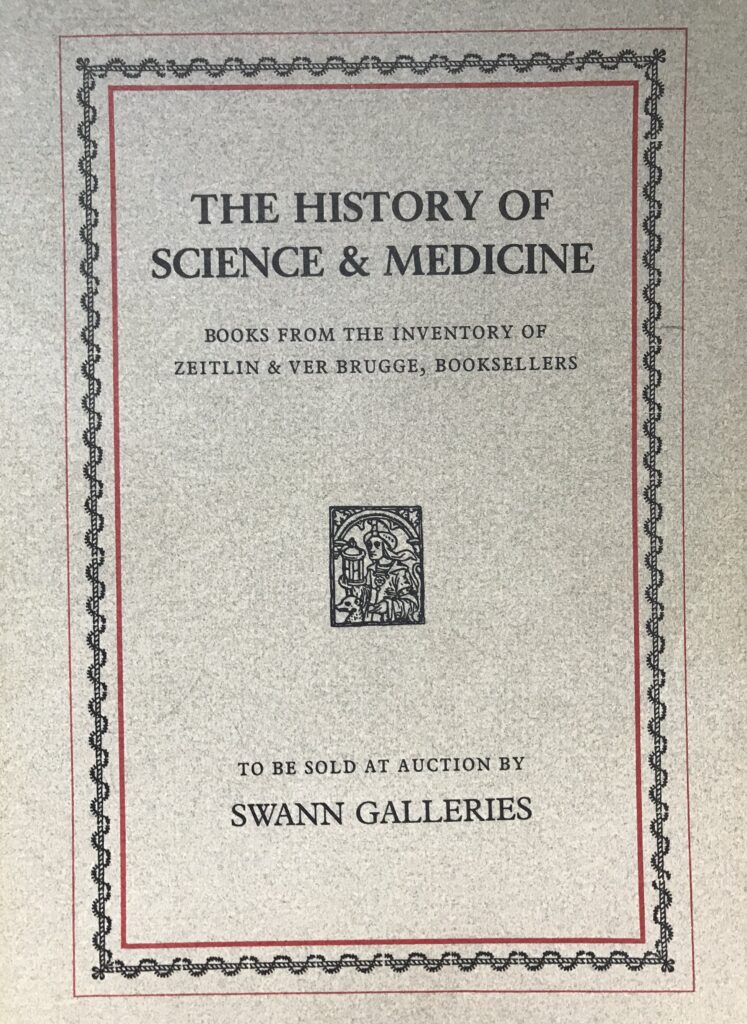
Catalog for the sale of Jake Zeitlin’s stock at Swann Galleries, 1988
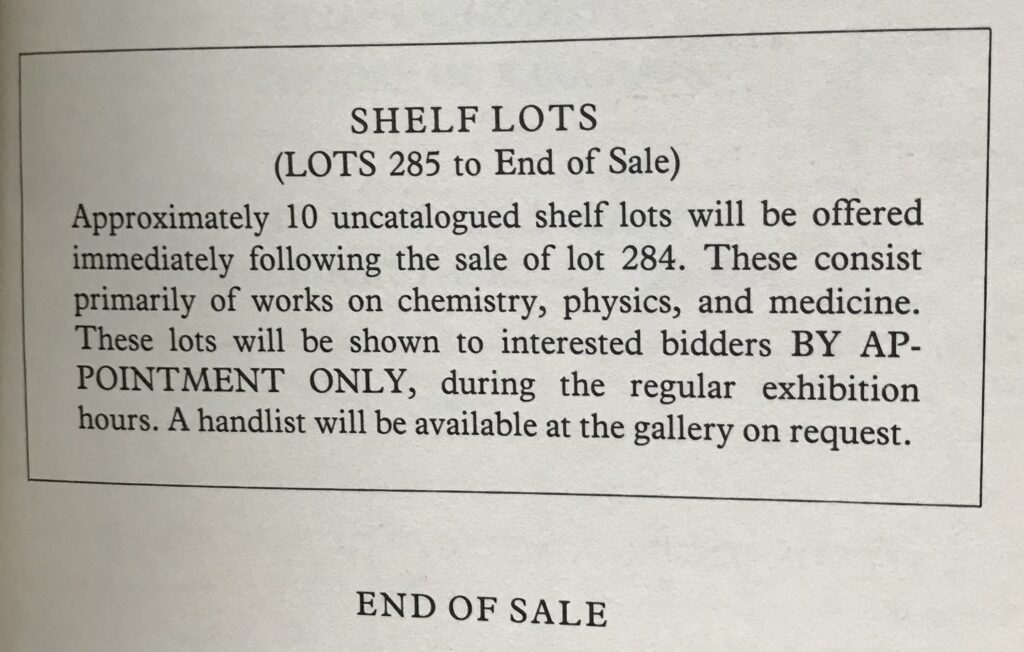
Shelf lots at the end of the Swann Galleries Part 1 Sale

Upon Jake Zeitlin’s death, his stock went to Swann Galleries to be sold. This sale took place in two parts in 1988. We were able to consult a copy of the catalog for Part 1, and asked a library holding the catalog for Part 2 (University of Washington Special Collections) to consult their copy, which they graciously did despite having very limited access to collections during COVID. 

The Libavius title is not listed in the catalogs to either Part 1 or Part 2 of this sale, but could have appeared in one of the “10 uncataloged shelf lots” listed at the end of Part 1, which consisted “primarily of works in chemistry, physics, and medicine.” OSU’s Special Collections department was founded in 1986, and librarians at the time were building history of science book collections through bulk purchase.  

While we don’t have direct evidence of an OSU purchase, we do have indirect evidence that an OSU special collections librarian was at the Part 1 sale in April 1988, in the form of an unrelated piece of correspondence from that time. It is likely that this item was purchased at the Swann sale to add to our growing history of science collections. (If this is true, the item has stumped catalogers and lingered in our backlog for over thirty years!)

Excerpt from correspondence in internal files showing OSU presence at sale

In Part 4, we will reflect on what we have discovered and the research skills helping us arrive at these answers.

Hints of Gold in the Backlog: Part 2 of 4

This is Part 2 of a research exploration by Cataloger Vance Woods and History of Science and Rare Books Librarian Anne Bahde. Find Part 1 here.

From here, we could branch our research into different directions to expand our knowledge of the work. We now had pending questions about the title’s content, production, context, and story, as well the physical item’s origin and provenance. First, Vance reached out to the other holding library in Germany. They responded to Vance’s message, but did not have any more information than we did about the piece. (However, after our own discoveries, Vance reached out to them again to share what we had learned; they are in the process of updating their own records accordingly.)

We began filling in our gaps in knowledge about the historical context of the item. A typed bibliography of history of science holdings at OSU produced in 1988 identifies the piece as an “introduction to Libavius’ response to Thomas Erastus’ attack on Paracelsus and the Ioatrochemists. Erastus had attacked Paracelsus in his Disputation Concerning Potable Gold, Basel, 1578.” 

This note gave us some excellent starting points to dig deeper. We confirmed that description and built our contextual understanding by quickly finding a few other secondary sources. Our crash course in early modern alchemy yielded a deeper understanding of the significance of this item.

Andreas Libavius was a most eminent figure in early chemistry, an alchemist who attracted his share of controversy during his career. As an alchemist, he was interested in the transmutation of metals into gold. As a physician, he was also interested in the practical value of medical chemistry and the particular medicinal qualities of gold. 

His emphasis on pharmaceutical applications put him in opposition to Paracelsus, another physician and alchemist who emphasized the more mystical elements of alchemy. Thomas Erastus, a Swiss physician and defender of medieval Galenic medical practice, was also an outspoken opponent of Paracelsus, and attacked the Paracelsian belief in the transmutation of metals. But Libavius did believe transmutation was possible, and passionately so. He refuted Erastus’ position in a series of publications around the time our pamphlet was published. Our pamphlet seemed to be related to this exchange. 

While we began to understand more about the historical context of the item, we also continued to look for the title or fragments of it in Google, HathiTrust, and other digital repositories. 

This title presented a common challenge when seeking information about books published in Latin during this time. In the Roman alphabet, there was no distinction between the letterforms V and U. By the time this book was printed, printers were beginning to distinguish between the consonant V and the vowel U, and the rules for using these letters in printing varied over time. 

Later catalogers of these items may or may not have transcribed these letters into their modern usage. These variations in spelling, printing, and cataloging practices over time, along with modern variability in optical character recognition of digitized texts, means that when U’s and V’s (or I’s or J’s) are involved, using a variety of spellings in keyword searches will yield the best results.

However, despite many different variations of the title searched across multiple platforms, we found only one result for a title fragment via Google Books (a further indication of the item’s potential rarity). This book, printed in 1600, lists our title among others in an index format. 

Vance determined that this book was a compilation of publications between 1593 and 1600, and that the marginal numbers were dates of printing. To test this, he looked for other titles listed in this book in Worldcat and found that they corresponded to the dates listed here. This title therefore suggests that our title was published in 1596.

Volume 1 of Elenchus seu index generalis in quo continentur libri omnes, qui … usque ad annum 1600 … prodierunt. Allgemeine Verzeichniße der newen BücherHenningus Gross

As we researched the historical context of the item, one name kept coming up in our secondary sources: Dr. Bruce Moran, a scholar of Libavius and early modern chemistry at the University of Nevada, Reno. Moran’s definitive scholarship on Libavius has included a number of Libavius’ known works and editions. Vance reached out to him with a scan of the title page to see if he could help us identify the piece. He graciously replied with some intriguing answers. 

Moran’s translation of the final line of the title page indicated that a copy of the Erastus text in question was meant to be attached to this counter-text by Libavius for the purposes of comparison and censure. However, Moran also indicated that he had never heard of this title before, and that the item was stumping him as much as us. While we now had some understanding of this piece, previous questions still lingered just as new ones had been raised. Part 3 follows next week.

Hints of Gold in the Backlog: Part 1 of 4

The title page of the pamphlet

Throughout the pandemic, catalogers at OSULP have been working hard to complete projects and make progress on others. One ongoing project for the Special Collections and Archives Research Center is the creation of new catalog records for our old books.

Most libraries have an imbalance between the materials needing to be cataloged and the professional resources devoted to that work. OSULP is no different, though we are proud in SCARC that our ‘backlog’ is fairly minimal after years of progress by dedicated catalogers. 

To prevent materials languishing between acquisition and cataloging, we proactively move acquisitions through descriptive processes at a steady rate. However, the backlog is still a place where mysteries can turn up, and one such mystery appeared there recently. 

A short, six-page pamphlet in an unassuming binding immediately presented more questions than answers when Cataloger Vance Woods set out to create its record. Vance and History of Science Librarian Anne Bahde teamed up to find some answers about what this intriguing item was and just how it ended up in our backlog. We will explore our research over four parts presented weekly in August.

From the title page, there were a few clues to glean about what this item could be. Though neither of us read much Latin, the title of the book presented familiar Latin word roots that could at least give us indications of the time period and subject matter. For example, ‘mineral-,’ ‘corpor,’ and ‘chymia’ suggested that we were dealing with something having to do with minerals, the body, and chemistry. 

A quick pass of the title through Google Translate allowed us to guess further at content and meaning in the title through a rough translation. We looked closely at the large printed mark near the bottom of the page. This spot is typically where a printer’s device would go, but in place of that identifying image, there is a decorative ornament instead. At the very bottom of the title page we typically find the publisher’s imprint, which often lists details such as the place of publication, publisher, printer, or date of publication. 

We found none of those details in this section, and instead spotted Latin roots such as “sincer’ (sound, genuine, true) and ‘censur’ (judgment, opinion) here. The contemporary handwriting at the very bottom of the title page “Libavius [–ind] Paracel—” associated these apparent names to the title, along with the name Erastus which appears on the page twice. All these details began to suggest an unusual item related to the history of chemistry.

Several physical material clues intrigued us as well. The typeface and printing style suggested a printing date of the late 16th century, but confirmation of that suspicion was not found in any other elements of the item. The paper used was of a rougher nature, and the pages are now age-toned. But, no obvious clue to publication place or date could be found among the few pages. 

Bindings can sometimes give hints about where or when an item was published, but in this case the binding was a simple set of brown marbled boards, probably dating to the late 19th or early 20th century given the style and condition of the binding materials.  Sometimes, this type of slim, nondescript binding can suggest separation from a sammelband or nonce volume, both types of collections of pamphlets. 

Though the piece lacked stab holes or other markers of prior gathering, a thin strip of discoloration does run down the length of the inner margin, suggesting that it was removed from some other binding environment at some point in the past.

The first place we both turn to when searching for items is Worldcat. Considered to be the most comprehensive catalog of materials in libraries around the world, Worldcat offers special insight when trying to track down a difficult title. A catalog record in Worldcat can tell us not only further bibliographical details about an item, but also which libraries around the world currently hold this item, thus giving a basic indiciation of distribution and rarity. 

Despite search experiments with different spellings and other searching efforts, we found only one record with one holding library, the Thüringer Universitäts- und Landsbibliothek in Jena, Germany. 

Deepening this line of inquiry, we followed the Libavius author entry in Worldcat, then examined each item in that list of 382 records. This is a laborious but useful Worldcat trick and can sometimes turn up some potential matches or clues for difficult-to-find items. But this effort still did not yield any further hints about this title. It slowly became clearer that we could be dealing with quite a scarce item.

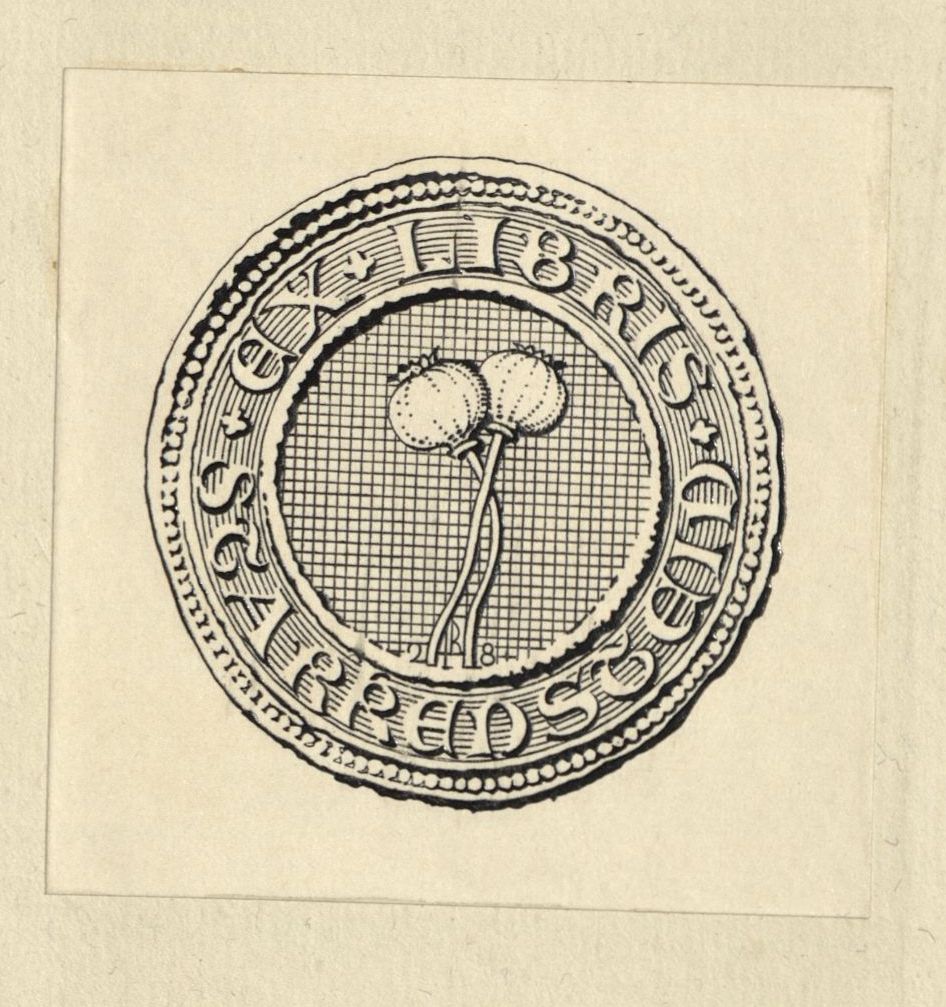
Bookplate of Emil Starkenstein

The item presented one further curious detail – the striking bookplate depicting two entwined poppy heads pasted inside the front cover. As physical signs of ownership, bookplates offer important evidence about the provenance of an item, and help later researchers track an item’s movements during its life. By searching for the name printed on the plate and looking at Google Image results, Vance discovered it was the bookplate of Emil Starkenstein, a Czech Jewish pharmacologist who was killed in the Mauthausen concentration camp in 1942. It was clear to us now that this was no ordinary book, and we began to pursue answers to the many questions the book had now invited. Part 2: Rare Books and Research follows next week.

Three New SCARC Finding Aids Added in December 2019

The three new collections added were received by SCARC in 2015 and are now available to researchers through the Archon finding aid database. Additionally, two out of these three new collections are electronic, as they were born-digital and digitized, representing 38.4 Gigabytes of new archival material. The addition of these finding aids brings the total number of collections available through the Special Collections and Archives Research Center to 1,026 as of January 1, 2020.

Read more about these new collections below:


Raul Peña Collection, 1968-2005 (MSS Peña)

The Raul Peña Collection consists of Peña’s personal scrapbook and a compilation of video-recorded news stories depicting the struggles of migrant farm workers in Oregon during the late 1980s and early 1990s. Peña served in the U.S. Army and Oregon Army National Guard in the 1970s and 1980s, and advocated for migrant worker rights through his work for the Bureau of Labor and Industries in the late 1980s and 1990s.  This collection consists of digitized versions of the scrapbook and video content.

Roy Philippi and Beth Miller Philippi Scrapbooks, 1915-1943 (MSS Philippi)

The Roy Philippi and Beth Miller Philippi Scrapbooks were assembled by Oregon Agricultural College student Roy Philippi and his daughter-in-law, Beth Miller Philippi, herself an alumna of Oregon State College. The scrapbooks document student life at Oregon State College during World War I and the beginning of World War II, primarily through candid snapshots and newspaper clippings.

The Beth Miller Philippi scrapbook is in fragile condition and a digital surrogate should be consulted as a primary source of access. This surrogate is available in the Special Collections and Archives Research Center Reading Room, or remotely upon request.  The collection includes 232 photographs.

Oregon State University Libraries and Press Oral History Collection, 2018-2019 (OH 041)

The Oregon State University Libraries and Press (OSULP) Oral History Collection primarily consists of audio-recorded interviews conducted with current employees of the OSU Libraries and the OSU Press, all of which were structured using a set script of interview questions. A smaller subset of the collection is comprised of more individually tailored interviews with former employees of the OSU Libraries. Members of each OSULP branch and department are represented in the collection, which includes interviews with library faculty, staff and student workers. Online access to the interviews, as well as a promotional video, is provided through a dedicated project homepage.  The collection includes 50 oral history interviews.

Pearl Spears Gray: OSU’s Director of Affirmative Action 1973-1987

Thanks to Mary Williams, SCARC student worker for this post on Dr. Pearl Spears Gray!

Screen Shot 2019-02-18 at 2.41.25 PM

Pearl Spears Gray, born August 19, 1945 in Selma, Alabama, worked with OSU as an instructor for the Education Department for the Portland Urban Teach Education Program and the Affirmative Action Director from the years 1973 to 1987.  Her time at the school allowed for great strides in the Affirmative Action program, and aided Oregon State in becoming a more diverse and inclusive campus.

Dr. Gray was born in Alabama but grew up and went to high school in Washington D.C. After graduating she attended Wilberforce University for her undergrad then Antioch Putney University, where she got her Master’s in Secondary Education with an emphasis on African American history. Dr. Gray then went on to teach government, history and sociology at different high schools in the Washington D.C. area from the years of 1968 to 1973. In 1969. She received a grant from Rockefeller Family fund to study at different African universities  such as University College Cape Coast, along with Ghana and University of Ibadan. During this time she met her then husband, Eddie Gray, and had two children, Don and David Gray.

She came to work for Oregon State University as an instructor for the Portland Urban Teaching program in 1973.  This program was a “cooperative effort between the OSU school of Education and the Portland public schools to train minority students in education for teach in urban schools”. After three years, Dr. Gray decided to move to Corvallis and take the position as Affirmative Action officer, where at the time there were 250 African American students. In an article from the Oregon Stater she states, “I view this office as a service to the university…we can broaden the awareness of the university population about what is discriminatory. We can be a source of information, a force of change, and in integral part of this university in terms of developing programs that speak to the needs of women and minorities.” Through her hard work and dedication she the Black Journal placed her on a list called “100 Most Influential Friends” in 1977. Around this same time, she began to create a report for Oregon State’s compliance with Title IX and found that there were some shortcomings in the athletic department, requiring that they change their department to be more inclusive.

During this time Dr. Gray was also working to complete her PhD. Between 1976-1979 she took multiple courses including Statistical Methods, Historiography, Anthropology of Africa, and Adv. Cultural Anthropology Reading & Conference. In 1985, she completed and presented her thesis African-American Folkloric Form and Function in Segregated One-Room Schools, earning her a PhD in Philosophy in Educational Foundations at Oregon State University.

In 1986, Dr. Gray was appointed as ACE Fellow, and was selected to spend most of her fellowship at the University of Virginia, Charlottesville. Oregon State granted her a two year leave in order to fulfill her fellowship, but she ultimately decides to take position offered to her as Associate Provost for Policy and Assistant to the President at the University of Virginia in 1987.

Dr. Pearl Spears Grey was and extremely active advocate for diversity in academia. During her career she was a part of Delta Sigma Theta and “instrumental in beginning a new chapter…at OSU”, a part of African Heritage Studies Association, National Council for Social Science, Associate for the Study of Negro Life & History, Daughter of Isis, Order of the Eastern Star, Urban League of R.I. (board member), and served on the Governor’s Commission on Black Affairs. She pushed Oregon State University to open the doors to those who were not originally given the opportunity and allowed them to feel accepted on a predominately white campus.

February 2019 Guide Additions to SCARC Collections

SCARC completed 10 new or updated finding aids in February 2019.  The following is a list and a little information about what we accomplished.  You will see a beer theme for this month!

These finalized finding aids are available through the Archives West finding aids database, and the OSUL discovery system (a.k.a. “the catalog”). These 39 guides represent  ~87 cubic feet of physical materials and 41+ Gbytes of electronic records and include ~2800 photographs.

All of these materials are now available to researchers.


Collections that were only minimally described and are now fully processed and described:

Herman T. Bohlman Photograph Collection, circa 1890 – 1928 (P 202)

p202-bicyclesb-600wThe Herman T. Bohlman Photograph Collection consists of images taken and assembled by Bohlman documenting bird species and his travels, primarily in the Pacific Northwest.  Bohlman was a lifelong friend and collaborator of renowned ornithologist, naturalist, and conservationist William L. Finley.   Many of the photographs are available online in the Oregon Digital collection Reuniting Finley and Bohlman.

Robert Daly Beer Publication Collection, 1978-2004 (MSS Daly)

daly-600wThe Robert Daly Beer Publication Collection is comprised of publications collected by Robert Daly about beer brewing, as well as guides to different varieties of beer found in the U.S. and worldwide. Included among the publications are several issues of the Oregon Brew Crew newsletter, which Daly edited.


Friendship Internationale Scrapbook, 1964-1977 (MSS FriendsInt)

mss-chatterclub-scrapbook-600wThe Friendship Internationale Scrapbook documents the programs and activities offered by this organization for the wives of male international students and staff as well as single international female students and staff at Oregon State University.  The organization was founded in 1964 as the Chatter Club and was active until 1979, when it merged with another organization to form Crossroads International.

Hop Research Council Records, 1943-2009 (MSS HRC)

hrc-600wThe Hop Research Council Records document its support of hops research projects. Much of the collection pertains to the development of new hop varieties and the management of hop diseases such as powdery mildew. The Hop Research Council was formed in 1979 to fund hop research by soliciting and providing funds for scientific investigation and research related to the agricultural production of quality hops in the United States.

Kenneth C. Minnick Papers, 1945-2000 (MSS Minnick)

p46-296-minnick-600wThe Kenneth C. Minnick Papers document Minnick’s career as the Benton County 4-H Extension Agent from 1947 to 1974 and his establishment of the roadside clean-up program in Benton County in the late 1960s.  Minnick earned B.S. (1939) and M.Ag. (1954) degrees from Oregon State College.


New Collections:

Denny Conn Papers, 1998-2017 (MSS Conn)

headshot2 0815Denny Conn is a homebrewer, author, educator, and advisor in the Oregon brewing community. The Denny Conn Papers is an all electronic collection and consists of born-digital materials (.mp3, video, documents) and items digitized by Conn. These materials document Conn’s work, including documentation related to Conn’s two books Experimental Homebrewing: Mad Science in the Pursuit of Great Beer (2014) and Homebrew All-Stars: Top Homebrewers Share Their Best Techniques and Recipes (2016).

Bonnie B. Hall Botanical Prints, 1989-2003 (MSS HallB)

b-hall-flags_newBonnie B. Hall Botanical Prints consist of serigraphic screen prints created by Bonnie Hall, a scientific illustrator and artist.  Hall was well known, particularly for her botanical prints and was a scientific illustrator for the Department of Entomology at Oregon State University from 1963 -1993.

Zoller Hop Company Records, 1900-2006 (MSS Zoller)

zoller hop farm imageThe Zoller Hop Company Records consists of records and materials created and assembled throughout the first half of the 20th century. The collection contains records of business operations: correspondence and management files, photographs of fields and community events, and digitized versions of two films.  The Zoller Hop Company was located in Independence, Oregon, the “Hop Capital of the World’ during the first half of the 20th century. The company was later owned by Donal MacCarthy and the name was changed to “D.P. MacCarthy & Son.”  The two films have been digitized and are available online: “Spring hop field operations and fall harvest,” 1931 and “Harvesting and processing,” 1945.

Updated Guides:

William L. Finley Papers, 1899-1955 (MSS Finley)

mssfinley-birds-cap-600wThe William L. Finley Papers document the wildlife conservation work of Finley and his wife Irene, and the photography work of Herman T. Bohlman, who worked with Finley in the first decade of the 20th century. Finley was a photographer, filmmaker, and author who wrote and lectured extensively on wildlife conservation issues. The collection includes published and unpublished manuscripts, lecture and field notes, reports, correspondence, photographs, and motion picture films.  Manuscript items and photographs from this collection have been digitized and are available in Oregon Digital. All of the films held in the collection are also available online.

Thomas B. Searcy Collection, 1889-2013 (MSS Searcy)

mss-searcy-600wThe Thomas B. Searcy Collection documents the land in Sherman County, Oregon, homesteaded by Thomas B. Searcy in 1889; Searcy’s financial interactions with the Moro Grain Growers Association and the Pacific Co-operative Wool Growers Association; and the Searcy family.

Jeanne Dost, Economics, and Women at OSU

Thanks to SCARC student Mary Williams for this post on Jeanne Dost, who among many other things was a Professor of Economics and Director of Women’s Center AND Director of Women Studies. 

Cover of "The Birth of the Women's Center," MSS MC 57.20: Dost, Jeanne, 1990.

Cover of “The Birth of the Women’s Center,” MSS MC 57.20: Dost, Jeanne, 1990.

Born in Walla Walla, Washington on August 12, 1929, Jeanne Dost is well known as the warrior at the front lines of women’s rights in the state of Oregon’s universities. She spent most of her career fighting for her rights on Oregon State’s campus opening up opportunities for all women entering the world of academia.  Dr. Dost came to OSU in 1967 as a part-time Assistant Professor in the Department of Economics and was given the title of Professor Emeritus when she retired in 1991 after helping to start the Women Studies program and Women’s center.

Jeanne and Frank Dost married in 1950 after meeting at Washington State University where she completed her undergraduate degree in Economics.  From there the two moved to Massachusetts for Dr. Dost to complete her A.M. in Economics at Harvard University between the years if 1951 and 1953.  Once obtaining her graduate degree, Dr. Dost continued to work for her PhD at the same university, which she completed six years after her A.M. Between the years of 1953 to 1959, she worked as a Research Assistant at Harvard, an Instructor in Economics at Kansas State, and gave birth to her two children Karen, 1955, and Frederick, 1959. Finally, the family found their way to the Pacific Northwest when Dr. Dost acquired as position as an instructor at Washington State University in Economics.     

The Dost’s ultimately came to Oregon State University when they were both offered positions in their field of academia, but Dr. Dost was only hired as a part-time instructor for Introductory Economics.  This differed highly from her other at WSU, where she recalls teaching graduate level courses. From the years 1967 to 1972 she attempted to be hired in a full-time position as an Associate Professor for Economics.  In 1969, the opportunity arose when a position opened up for a full-time Associate Professor in Regional and Urban Economics, which she focused on when study for her PhD at Harvard. With multiple years of experience, involvement in different committees, and a vast education background, it was easy to assume that she would get the job. To her dismay, Dr. Dost was passed up for a man who was completing his Master’s degree in economics, and only after he decided to pass on the offer she was offered the position at part-time.  After this she began to research the treatment of female faculty for University of Oregon, Oregon State, and Portland State, to see if this was a common flow in Oregon’s academia. She returned with dismal results which showed how widespread this epidemics was. For Jeanne Dost, this was blatant sex discrimination and she voiced her opinion, to which she was fired soon after.

She formerly filed a complaint about the ordeal with Oregon State’s Faculty Review and Appeals Committee, the Federal Department of Health, Education and Welfare, and Oregon’s Bureau of Labor Civil Rights Division.  Oregon State’s Faculty Review and Appeals Committee found to no discrimination based on sex but rather on personality, claiming that she was considered “pushy” from others in the department, meaning they felt nothing needed to be down. In late 1971 though, the Bureau of Labor Civil Rights deemed it as obvious sex discrimination and highly recommended they hire Dr. Dost as a full-time Associate Professor with tenure. Six months later she was hired in that role but without tenure.

After this experience Dr. Dost knew there needed to a change on campus, she and colleagues advocated for the Women’s Center which opened the academic year of 1972-1973. In August 1973 she and the OSU President, were about able to create a position for her as Director of Women’s Center and Director of Women Studies. From there she pushed for the much needed change by making the Women Studies program grow so much that by 1978, a student could gain a graduate degree in the program.

Dr. Dost continued to make change on Oregon State’s campus until her retirement as Emeritus Professor in 1991.  Although she continued to be involved, her experiences left Jeanne Dost with a bad taste in her mouth when it came to OSU.  She decided to remove herself from the university completely, offering all of her works to the Archives at the University of Oregon.  After her retirement, she and her husband Frank moved to the British Columbia for about four years but finally settled into a home in Freeland, Washington around 1995.  During her retirement she wrote the book Women: Two Decades of Discovery where she examined the wage gap and other economic disparities between the sexes. Dr. Jeanne Dost passed away in 2012 from Leukemia and Alzheimers and is survived but her loving family, Frank, Karen and Frederick.

Oregon’s Lost Flax Industry – Part 2

This blog post, part two of two, highlights the recent work done by Rachel Lilley, Public Services Assistant in processing the Oregon Flax Fiber Collection and Oregon Custom Weavers Guild Linen Research Notebook, both of which are housed in the Special Collections and Archives Research Center.

This post is contributed by SCARC student archivist Hannah Lawson, a chemistry major with a passion for art, conservation, and preserving history.


Joan Patterson

Joan Patterson

The flax industry held a particular importance to Oregon State University. As one of the leading land grant universities, agriculture was a primary focus of OSU research, and naturally that included flax growing and processing. The impressive Home Economics and Extension Services programs offered at the time extended that research towards the textile applications of the flax fiber. Joan Patterson, a professor specializing in textile design and home furnishings, revolutionized a weaving process for linens that resulted in beautiful, clean textiles that could be used for upholstery. In a newspaper article titled, “Flax has a Future”, Patterson’s linen designs are described as revolutionary. When describing her vision for the future of fiber flax, Patterson’s enthusiasm for the product clearly shows through: “…Its eternal beauty, its exquisite feel, can’t help but make me believe it will find its way into American homes.”

Patterson’s hand woven patterns and techniques nearly landed her a multi-million dollar deal with Chevy automobiles. Unfortunately, while Patterson was featured in multiple magazines and newspapers for her fine linen patterns, the deal eventually fell through, due in part to the financial youth of the Chevy company at the time.

Jesse Harmond

Jesse Harmond

Another important contributor to the research of flax processing and production was Jesse Harmond, who came to OSC from the US Department of Agriculture. While at OSC, Harmond was involved with the design and manufacturing of new mechanical machines for processing flax fibers. Harmond released several publications on these machines, some of which mechanically deseeded flax, aided in harvesting flax, or dried extracted flax fibers. In one of these publications, Harmond acknowledges that the future of the flax industry hinged on the mechanization of flax processing.

Flax puller

Flax puller

Marilinn Fabric

Marilinn Fabric

Additionally, Jesse Harmond was the force behind the creation of a linen-wool fabric he called ‘Marilinn’, named after Marion County, where the linen originated, and Linn County, where the wool originated. The Marilinn fabric was yet another attempt to expand the commercial market for Oregon flax and linens. The combination of 80% wool and 20% flax made a fabric which was soft yet strong, and had better colorfastness, or the ability to retain dye colors, which linen alone did not.

Harmond and Patterson formed Oregon Custom Weavers, a company that specialized in the production of fine linens made from Oregon flax. Their hopes were to expand their business to a national market. Unfortunately for Jesse Harmond and Joan Patterson, their research was concurrent with the beginning of the end for commercial flax growing in Oregon.

The flax industry in Oregon reached its’ peak during World War II, when flax and linen were deemed essential war products. Oregon was once home to 14 different flax processing plants, and over 18,000 acres of flax crops. However, the removal of farm subsidies in the post-war years, as well as the introduction and expansion of new synthetic fibers like polyester and rayon in the early 20th century, were devastating blows to the once booming industry. The labor-intensive nature of flax production and processing prevented the industry from becoming an essential portion of modern Oregon agriculture, despite the efforts made to revive it at Oregon State University through Joan Patterson, Jesse Harmond, and many others. While Patterson and Harmond’s reports and research were promising – and Patterson’s linen products extremely well-received, the languishing flax industry proved to be too great of a hurdle to cross. Flax production was unable to match the demand for linens and yarns that Patterson’s designs created.

Joan Patterson weaving

Joan Patterson weaving

Today, Oregon flax maintains an important part of Oregon’s history and the history of Oregon State University. Independent farmers in Oregon still produce flax, both for its use as a textile and for its benefits as a healthy food product for livestock and humans. The Oregon Fiber Flax Collection in the Special Collections and Archives Research Center houses a rare array of flax yarns and products, a humble glimpse at what once was a signature product in Oregon agriculture and craft.


Citations:

Tobin, LA. A history and analysis of the Oregon linen industry. Oregon State University, 1960.

https://ir.library.oregonstate.edu/concern/graduate_thesis_or_dissertations/9019s737q


Oregon’s Lost Flax Industry – Part 1

This blog post, part one of two, highlights the Oregon Flax Fiber Collection and the Oregon Custom Weavers Guild Linen Research Notebook at the Special Collections and Archives Research Center, which were recently processed by Public Services Assistant Rachel Lilley. Stay tuned next week for the full story of flax fiber in Oregon.

This post is contributed by SCARC student archivist Hannah Lawson, a chemistry major with a passion for art, conservation, and preserving history.


man showing flax 1926


Man showing flax, 1926

The flax fiber is durable, soft, and breathable – great for a multitude of textile applications, including paint canvas, sails, and clothing. These are all made from linen, which is the general term for any fabric that is made from woven flax. Flax is one of the oldest known plants specifically cultivated for use as a textile – modern technology and analytical methods show us that linen was used to wrap mummies in Egyptian tombs as early as 3000 BCE. The fiber itself is extracted from the bast, or the woody stem of the flax plant. It is primarily composed of the polysaccharide cellulose, which allows the fiber to be hydrophilic, or water-absorptive, which aids the breathability of flax as linen. The rigid structure, which comes from the cement-like lignin and crystalline molecular form, gives flax fiber excellent strength – it can be 2-3 times stronger than other cellulosic fibers, such as cotton. The recyclability of the natural fiber and the ability to use the entire plant during processing made flax an extremely economical fiber in early agriculture.

In The United States, flax production flourished for decades in the North, in states like Minnesota and Wisconsin. But with the advent of the cotton gin, which made cotton farming vastly more profitable and efficient, the flax industry saw a sharp decline in those areas.

women wigwaming flax


Women wigwaming flax

But while flax production fell in most areas of the country, it flourished in the state of Oregon, where the well-drained Willamette Valley soil and temperate climate were perfect for growing high quality flax. Oregon flax, which was noted by explorers Merriweather Lewis and William Clark during their 1804 expedition to be superior to flax grown in other parts of the United States, quickly became renowned for its finer texture, longer fiber strands, and lustrous finish. Samples of Oregon flax and its products (linen upholstery, linseed, and yarns) were recognized repeatedly by World Fairs and various expositions. In 1876, a farmer in Marion County was awarded a bronze medal and a certificate of merit for his flax exhibition in the Philadelphia Centennial Exposition. This brought immense attention to Oregon flax, but the industry still faced international competition. Countries like Russia and Belgium were normally the top competitors for flax distribution, but during the chaos of both World Wars, the international flax market was halted. Oregon flax was able to take the spotlight.


Citations:

Tobin, LA. A history and analysis of the Oregon linen industry. Oregon State University, 1960.

https://ir.library.oregonstate.edu/concern/graduate_thesis_or_dissertations/9019s737q