Check out the new OSU Archives finding aids uploaded for January, 2010.
New finding aids for January: the more the merrier!
Leave a reply


Can’t get enough of historical research? Living history? Thinking about times past? This list was pulled together for the Society of American Archivists’ Reference, Access and Outreach Section newsletter.
Podcasts are audio broadcasts delivered via an RSS feed or through a website. You can listen to them on your computer, or you can listen to them on a digital audio player, such as an iPod or a Zune. There are usually presented in episode format and are published on a regular basis. There are two primary types of archival podcasts: podcasts that contain digitized audio material from their collections and podcasts of new material that are created by archives in order to promote materials, talk about events, and other similar things. Often, both of these types of podcasts are combined.
Here is a short list of archival podcasts that are available online.
What would you like to hear?
 A year of interacting, sharing, and celebrating what we have and what we know. We had a few big “Wow, thanks!” moments in 2009, but this year we want more …
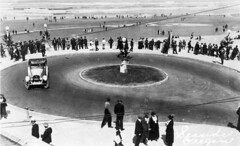
We begin again, appropriately back where we started last February, with images from the Gerald Williams Collection. It’s true—we’re going to have a whole month of weekly releases! And with the first, “Towns & Buildings,” we want to hear from you.
At a loss where to start? You can always begin with the simple browse method, scanning through the images in this Flickr set … But for those who would like a little more direction, those who like “assignments,” those who feel comfortable with a list – here you go!
You can start simple … What can you find about the history or Astoria, Clatskanie, Timber, or Amity Oregon? Or you can dive into this list and let us know what you learn about:
Research until you can’t learn any more. Just make sure you include your factoid treasures with us in the comments field. No matter what, share, share, share!

“The oldest active member of the Chemistry Department, Ken Hedberg, turns 90 today. As an emeritus professor, Hedberg still remains very engaged in his research, which involves the determination of the structures of molecules by analyzing the scattering of electrons by them. Hedberg is acknowledged as the world’s leading expert in his field and his work has been continuously supported by the National Science Foundation for more than 50 years. He received his BS degree from OSU in 1939 and has the distinction of having four OSU athletic letters, as an outstanding tennis player.”
Elizabeth Nielsen, Senior Staff Archivist and generally fast & furious finding aid creator, has compiled her “best of” / status report list for the state of the Archives’ world at the end of 2009. It is an impressive thing to read!
Here are a few highlights:

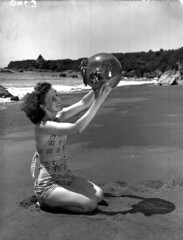
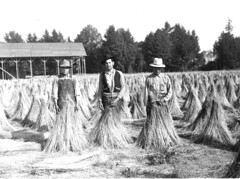
That’s right, it’s time for the next addition to the “People Doing Stuff” collection in Flickr Commons. This time we’ve gathered some of the best images of people doing stuff “Through the Seasons.” Unlike the majority of our Flickr Commons collections, these images are from a variety of photographic collections, all of which depict the beauty of the Pacific Northwest’s four vibrant seasons.
Basking in the sun …
Working in the fields …
Getting really cold …
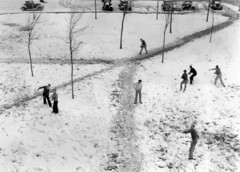
Enjoy all the seasons — and check back in 2 weeks for even more fun …
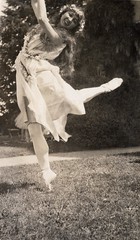
We’re wishing you all a hearty “happy new decade” from the OSU Archives! Wondering when we are here?
University Archives Academic Year Hours
Monday — Friday: 9am – 5pm
Maps & Microforms Academic Year Hours
Monday –Thursday 9am – 9pm
Friday 9am – 5pm
Saturday 1pm – 5pm
Sunday 1pm – 9pm
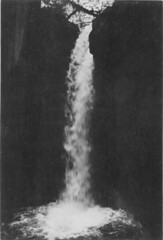
It’s nearing winter in Oregon, so we think a lot about the water that falls from the sky … But what about the glorious drops that tumble over rocks, under bridges, and through the woods?
To celebrate the rain (?), we’ve released the last set in our “Western Waters!” collection, appropriately called “Water Falling.” What is it? It’s a set is dedicated to all that falling water, of the waterfall kind!
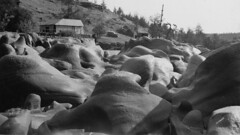
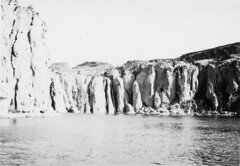
The images in these sets are from our “Pacific Northwest Stream Survey” digital collection, which includes over 1000 field images taken between 1934 and 1945 and spanning the 390 streams in the Columbia River Basin.
‘Tis that time of year — you know, the time when our hours are shorter … From December 14th through December 31st, we will be open 9am to 3pm.
We will be closed Friday December 25th and Friday January 1st.

Who doesn’t love a guest blogger? Monique Lloyd, who staffs our desk 2 days a week and is a prolific blogger in her own right, sent me this report on her journey to Portland last Friday to attend the “Local Treasures — Special Collections and Archives in the Portland Area” workshop. sadly, I couldn’t go — happily, Monique could and she’s written a wonderful post (yes, with pictures attached).
First off, always the archivist, I have to establish the historical context by answering the question “What was this event?”
Workshop Description: The Portland area is rich in primary documents and historical records. Learn about the wonderful resources available in local archives and special collections, and their availability to the public, in this training at Multnomah County Central Library. Archivists and librarians will be available to talk about their collections.
I had the pleasure of attending this workshop, sponsored by PORTALS (Portland Area Library Association for Continuing Education), and held at the Central Branch of the Multnomah County Library on December 4th. The three hour program was organized by Roberta Richards, and the discussion was moderated by Bob Kingston, who are both librarians at Portland Community College. Presenters from archives, museums, libraries, and special collections discussed their institutions and treasures.
The Oregon Historical Society Research Library

Shawn Gandy informed us that the Library was founded in 1899 and began as a way to collect stories related to Oregon and Oregon Country. She explained how OHS is involved in the Oregon History Project which is online and organized around subject searches and that 100% of their books and 95% of their serials are cataloged online.
The City of Portland Archives and Records Center
Diana Banning shared that the archives began in 1851 beginning with mayoral records and the collection now includes a quarter of a million photographs, many of which are contained in project records.

Terry Baxter told us that records were first kept by the County Clerk, mainly on microfilm, and in the late 1970’s began using records management. Most records began in 1915 and there are some large gaps. They are considering using targeted digitization in the future.
Central Library’s John Wilson Special Collections

Jim Carmin described the Special Collections as having six primary collections: the history of the book from mid 13th century to the present; children’s literature, both contemporary and historical; Oregon history; natural history with a focus on ornithology and roses; English literature, and Native American literature. The collection began in 1964, has over 10,000 items and their primary goal is increasing access. They are also in the process of pulling books, as appropriate, from the library collection and putting them in the archives.

Anne Prahl explained that this museum is 20 years and started with volunteers showing exhibits in different locations. In the 1970’s they merged with the Jewish Historical Society. The museum collects art and artifacts that illustrates the story of the Jewish experience in Oregon. They have 350 oral history interviews of Jewish community members going back to 1880. Their focus is on exhibits and they work often with Portland schools. The collection includes photographs, correspondence, scrapbooks, ephemera, diaries, minute books, ledgers, and family papers as well as organizational records.

Dave Hegeman began with discussing the OSL in general, stating that it was founded in 1906, and that its mission is to preserve Oregon documents and serve state officials as well as citizens. Their Special Collections include historic Oregon documents and WPA federal worker’s projects including manuscripts, photographs, and local histories. They also house historic photographs, with more than 5,000 online, the Oregon Index which is card index to Portland and Salem newspapers from 1900-1986, as well as maps of Oregon and the Northwest from the 1850’s to the present.
Lewis and Clark College Special Collection

Robyn Ward (for Doug Erickson). Robyn is a Serials Technical Specialist at Lewis and Clark and a fellow Emporia Oregon-7 graduate who earned an Archives Studies Certificate as well as her MLS. She graciously offered to fill in for Doug at the very last minute. Lewis and Clark has a large collection on the Lewis and Clark expedition as well as collections of Pacific Northwest poetry and literature, and the William Stafford archives.

The workshop ended with a discussion about digitizing and the importance of developing a collection policy to determine what to accept and what not to accept. Following the workshop, Jim Carmin invited participants to tour the Central Library’s collection. Special treats included Beatrix Potter’s scarce first illustrated book, the exquisite A Happy Pair, held in only a dozen public collections worldwide, and The Birds of America by John James Audubon.
A wonderful resource page for the workshop is available on the Northwest Central webpage and can be found here.