
By Lorelle Sherman, OSU Extension Forester
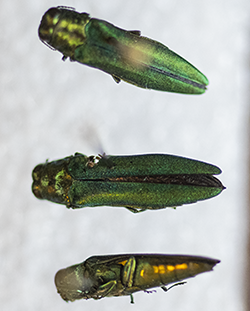
Emerald ash borer (Agrilus planipennis), or EAB, is an invasive beetle that infests and kills ash trees. EAB has killed hundreds of millions of ash trees in the eastern United States since its first detection in 2002. In 2022, EAB was confirmed in Oregon. EAB threatens habitat types that are dominated by Oregon ash, including sensitive riparian zones. This pest has proven deadly to all ash in North America, including non-native species planted as street and park trees. While this news is alarming to Oregonians, it’s important to consider all options before removing ash from the landscape. Oregon ash plays an important role in western Oregon forests and it may take quite awhile for loss to occur.
The good news is, given EAB’s longevity on the east coast, there is an abundance of information on EAB biology, management options, and what to expect (see resources below). This led to the development of a rapid response plan by Oregon state agencies. While we will not dive into this here, we are going to take a look at potential impacts of EAB on our riparian ecosystems and the wildlife that call them home.
What are riparian ecosystems?
Riparian areas are the transition zone between fully terrestrial and fully aquatic systems. Think streambanks, floodplains, wetlands, estuaries, etc. The ecosystems that develop in this transition zone are often adapted to periodic flooding which deposits an abundance of organic matter and nutrients. High nutrient deposition usually leads to high productivity and biodiversity, which makes these systems complex and essential across the landscape.
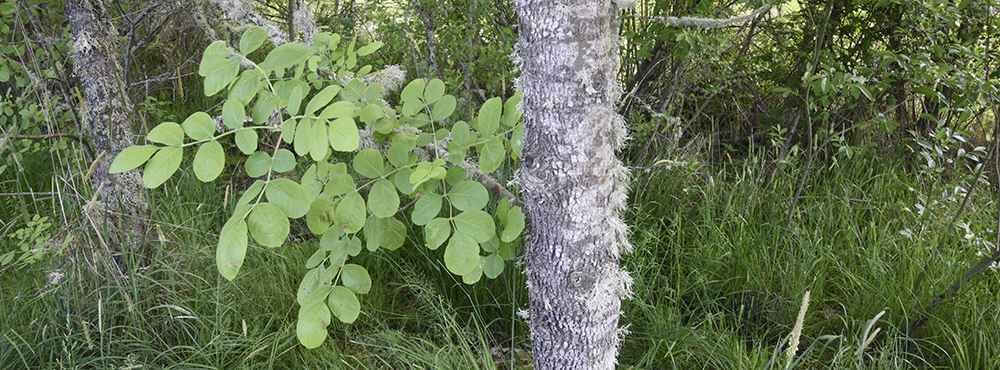
The dynamic nature of riparian ecosystems makes it hard for most trees to survive here. Tree roots are submerged for long periods of time during the winter and subject to dry soil in the summer. Most trees in Oregon are unable to withstand flooded roots because of the low-oxygen conditions… plant cells need Oxygen! Oregon ash has adapted to withstand these low-oxygen conditions, which means it is often the only tree lining seasonally flooded stream and riverbanks, and wet prairies or wetlands. Other species that can tolerate these conditions and are often seen alongside or just uphill of Oregon ash are black cottonwood, bigleaf maple, red alder, and various willows.
Why are Oregon ash so important for wildlife?
You may wonder how aquatic and terrestrial wildlife will be affected once EAB makes it to your county. You may also wonder if other riparian tree species may serve as good substitutes. To answer this, we will have to look at a few ecosystem functions provided by Oregon ash.
Stream Shading
Oregon ash have broad, sprawling canopies which block sunlight from hitting the water’s surface when they are fully leafed out. This canopy shading can lead to a drastic reduction in water temperature. Water temperature is important in aquatic systems because it regulates aquatic organism stress, dissolved oxygen concentration, and evaporation rates. Increases in water temperature can lead to a whole onslaught of bad things from increased spread of disease to forced migration of aquatic animals to toxic algal blooms.
Stream temperatures exceeding 16°C (60.8°F) cause heat stress in salmonids (salmon, trout) because their metabolic rates and energy expenditure increase with increasing water temperature. Warmer waters hold less dissolved oxygen, which is stressful on salmonid respiratory systems. Heat and respiratory stress can lead to increased disease, halted migration, and even death. While salmonids get all the attention, these impacts are also seen in other fish species, like the Oregon chub, and aquatic invertebrates, like freshwater mussels and caddisflies. What does this mean? The loss of Oregon ash may lead to a shift in aquatic wildlife community composition.
The impacts on stream temperatures that result from Oregon ash loss in riparian ecosystems will be complex. Streams less than 12 ft in width can get away with shade from riparian shrub layers, like willow species. Larger streams will need overstory tree cover for adequate shade. While there is no one-for-one replacement of the Oregon ash, other deciduous tree species contribute to stream shading. In mixed species stands, increase in stream temperature may be minimal to none where species like maples and cottonwoods can continue to provide shade. While we can expect stream temperature increases in riparian zones with pure ash, the magnitude of increase will depend on what’s upstream. A recent study predicted huge variability in stream temperature rise. We can also expect variability in the spatial magnitude and rate of EAB effects on riparian ecosystems.
Are you a property owner with Oregon ash stands lining your riparian areas? Consider planting other riparian tree species in between your ash now, so they are already established when EAB reaches your property.
Terrestrial Wildlife Habitat
Oregon ash supports a myriad of land-dwelling species as well. It produces copious winged seeds, also called samaras, which feed a diversity of small mammals and birds. Bigleaf maple also produce samaras and birds that eat ash samaras will also utilize those from bigleaf maples. Evening grosbeaks and purple finches utilize both kinds of samaras, so they may not be as negatively impacted in areas with abundant bigleaf maple as in pure ash stands. The loss of Oregon ash will likely shift patterns of feeding and nesting of these seed eating species. Sapsuckers are birds that probably don’t eat the samaras, but instead drill into the bark of Oregon ash to access the sugary sap as a food source. Fortunately, sapsuckers feed on the sap of a wide variety of tree species and will likely be okay without ash sap in their diet.
In the spring, deer and elk feed on new ash shoots that emerge through the soil in huge numbers. Deer and elk forage on a diversity of nutrient-dense forage in the spring and will likely be able supplement with other species. Beavers will commonly use Oregon ash for dam sites given their proximity to the water. Will beavers use other riparian tree species, like bigleaf maple and alder? Yes they will. The concern arises when pure ash stands are lost and replaced by invasive species, like Armenian blackberry and reed canarygrass. In some cases, the habitat may shift to shrubs and grass for the long term.
Oregon ash is host to the caterpillar phase of several butterflies, including the two-tailed swallowtail. Butterflies like the two-tailed swallowtail lay their eggs on ash twigs, which hatch into caterpillars that snack on ash leaves. I am unsure how butterflies and moths will fare after the arrival of EAB, but the more specialized a species is towards one tree species, the more at risk they are given loss of that tree species. Oregon ash appears to be the main host of the two-tailed swallowtail, but it may also use cherry where possible. Interactions like these are complex and it is often difficult to predict outcomes.
Nutrient Inputs & Cycling
EAB–driven loss of Oregon ash in riparian forests is likely to substantially alter nutrient inputs and cycling by disrupting one of the primary pathways linking terrestrial and aquatic systems. In streams, nitrogen is a key limiting nutrient that fuels microbial growth, primary production, and the aquatic invertebrates that form the base of the food web, making both its availability and timing critical for ecosystem function. Oregon ash contributes large amounts of relatively high-quality, nitrogen-rich leaf litter that decomposes quickly, supporting microbes and accelerating nutrient release. As ash declines, this input is reduced or replaced by litter from other species that often has lower nitrogen content and decomposes more slowly, potentially decreasing rates of nutrient cycling and altering when nutrients become available.
Ready for some good news?
Woodpeckers and other birds that forage for insects on tree bark (ex. white-breasted nuthatch) have proven to be natural predators of EAB on the east coast. One study from Ohio found that woodpeckers and other birds were using canopy decline as visual cues for which Oregon ash would be filled with nutritious EAB larvae. While woodpeckers will not stop the spread of EAB in Oregon, they may help regulate EAB populations. You can encourage woodpeckers to your property by leaving large snags in your woodland. Woodpeckers excavate cavities in snags for nest sites and other EAB-eating birds sometimes use old woodpecker cavities for nest sites.
So, what now?
One thing we’ve learned from EAB’s expansion east of the Rockies is this: ash loss unfolds over many years, not overnight. That means we have time to monitor, to diversify, and to plan thoughtfully. Healthy ash will continue to provide critical shade, wildlife habitat, bank stability, and nutrient inputs. Consider focusing on building resilience into your riparian areas now. Increase tree and shrub diversity where appropriate. Protect natural regeneration of other flood-tolerant species. Control invasive plants early and often, especially in ash-dominated stands where canopy gaps may eventually form.
Keep in mind that disturbance is not new to riparian systems. Floods, landslides, fire, and channel migration have always reshaped these areas. Wildlife communities are dynamic and adaptable, but the trajectory of change matters. A diverse, well-managed riparian area is far more likely to transition to another functioning forested system than to an invasive-dominated one. With informed stewardship, we can influence that outcome by maintaining cool water for fish, structural habitat for birds and mammals, and the complex web of life that depends on these transition zones.
Resources:
Emerald Ash Borer (EAB) in Oregon – OISC, ODF, ODA resources
Emerald Ash Borer Resources – OSU Extension Resources