Scholars update: Ian Heller (2010)

Summer Scholar at CERF2010 Summer Scholar Ian Heller presented a poster earlier this month at the Biennial meeting of the Coastal and Estuarine Research Foundation in Daytona Beach, FL.

Ian was co-author with Chelsea Woodworth (Clemson University, a US Environmental Protection Agency intern in 2011), Tedd Dewitt and David Young (EPA scientists who were Ian’s mentors during his Summer Scholars assignment).

The poster, “Nekton Species Distribution Within and Among Four Oregon Estuaries,” presented a first look at field data collected as part of a large project to measure how different different estuarine wetland habitats contribute to the production of Dungeness crabs and fishes. Ian helped collect and analyze the data as an Oregon Sea Grant Summer Scholar in 2010 and returned to the project as an EPA intern this summer. In the process, he learned different hypotheses about how habitat might affect the distribution of crabs and fishes, trawled  for nekton, and synthesized the data into the results presented in the poster.

At the CERF meeting, Ian had a chance to present the research and field questions from scientists and students. “I was able to see the scientific method to the end, and it was satisfying to see a product come out of my summer work,” he wrote.

Besides flying to exotic places to talk about crabs, Ian is back at Vassar College working on his senior thesis on sea anemone development and fretting about life post-graduation. He hopes to spend the next year assisting with biological research and applying to graduate schools. Perhaps he’ll once again find himself on the Oregon Coast!

Howdy!

I’m Chris Eardley, a Natural Resources Policy Fellow for Oregon SeaGrant. I’ve been paired up with Oregon Department of Fish and Wildlife’s Marine Reserves program, and I’m excited to be gaining agency experience in management of marine resources. I’ll be putting the inter-disciplinary training I received from OSU’s Marine Resource Management to work on both the biological and social sides of management. On the social side, I’ll be developing a socio-cultural profile of a local fishing community that will seek to inform future ocean management discussions (not just marine reserves).

With the biological side, I’ll be contributing to the development of pre-reserves baselines by analyzing footage gathered using a variety of underwater video survey techniques. This includes supporting field deployment of video equipment such as ROVS and video sleds, reviewing video footage, and helping to develop protocols. I’ll focus largely on invertebrates and I’ll also be supporting GIS work. Hopefully, I’ll even get one of those cool ODFW winter hats.

In a nutshell, I’m going to be busy and I’m learning a ton–including what sideways rain looks like and how many types of precipitation are possible in the span of an hour on the Oregon coast.

Should make for an interesting winter!

Cheers,

Chris

Hello from Newport, OR….

Hello OSG Community,

I wanted to introduce myself and give you a brief summary of what I’ll be up to.

So…hello and nice to meet you!  I am one of the two new Natural Resource Policy Fellows.  I joined the ranks in October and  I am now working with Oregon Department of Fish and Wildlife’s (ODFW) Marine Resource Program (MRP) in Newport, Oregon.

Generally speaking, over the next year I will provide support for the current statewide marine spatial planning effort.  More specifically, I will assist with the development of the “Nearshore Ecological Data Atlas” (NEDA), a GIS-based resource that will be displayed on Oregon MarineMap. NEDA will feature a collection of ecological data sets (biological, oceanographic, habitat, etc.) and will be an important resource for current and future planning and management efforts.  I will also help with public outreach efforts and serve as MRP’s primary coordinator between NEDA and Oregon MarineMap project partners.

That is a general overview of what I will be up to.  But, if I’ve learned anything over the last month or so….everyday is a new day, and everyday brings something different and exciting.  My fellowship is just beginning to pick up steam and I look forward to keeping you abreast of exciting highlights and accomplishments over the next year!

Cheers to all,

Ben

Greetings From the new Malouf Scholar

Hi All,

IMG_1150

My name is Leif Rasmuson and I am graduate student at the University of Oregon’s Oregon Institute of Marine Biology, OIMB.  I am just beginning my second year as a PhD student in Dr. Alan Shanks lab.  I am interested in how hydrodynamics affect the larval stages of commercially important marine invertebrates. For my PhD I am focusing my research on the larvae of the Dungeness crab, Cancer magister.

Dr. Shanks has been using a light trap (see the image below) to capture Dungeness crab megalopae for 10 years.  In Dr. Shanks’ work he has found a strong correlation between the number of returning larvae and the commercial catch four years later.  The number of returning megalopae was found to be negatively correlated with the date of the spring transition, which is an atmospheric shift in winds causing the ocean currents to shift from southerlies to northerlies.  With this change in winds comes a seasonal switch from downwelling favorable conditions to upwelling favorable conditions.  Furthermore, in Dr. Shanks work a negative correlation was found between the number of megalopae recruiting and the Pacific Decadal Oscillation (PDO).  The PDO is decadal oscillation in water temperature from warm to cold temperatures off Alaska caused by variation in the flow of the West Wind Drift as it enters the California Current.  During cool, or negative phase years, more cool water is shifted into the California current causing the southward flowing California current to be stronger.  In negative phase years there were far more megalopae caught in the light trap (about 20 times more), larval return was very strong, suggesting that the increased southward flow may strongly influence the dispersal of the larvae.


IMGP0574


For my PhD I intend to use an individual-based couple biophysical computer model to mimic annual hydrographic conditions to examine the correlations talked about earlier. The output from the computer model will be tested against ongoing and historic light trap data to ensure that the model is accurate and provides a realistic description of the movement of larvae.  Since the light trap has been in operation for ten recruitment seasons, I will be able to model many years of ocean currents and PDO regimes allowing me to ground truth the models with historic larval return data ensuring that it is providing an accurate depiction of larval movements.

Since I am just entering into my second year of my PhD I am in the process of preparing for my oral defense that will be occurring this coming fall. Unfortunately this means the majority of my time I will be reading and writing which do not lend themselves to interesting blog posts or pictures. However, I will be sure to post any interesting happenings that occur and fun pictures.


Finishing touches

Faithful blog followers: I regret to inform you that today’s post will most likely be my last post on the Sea Grant Scholars blog. I know, I know, what are you going to do with your spare time now? Do not fret, you can receive your weekly dose of AnnaRose adventures at AnnaRose and the Sea. This week marks my final week of working with Oregon Sea Grant. Come Friday, I will be leaving Corvallis and preparing for my journey

In regards to last week, I do not have much to report. My work days right now are pretty predictable. I’ll answer a lot of emails, make a couple phone calls, and go to a meeting or two. My main task for myself is to move forward on as many logistical details as possible before I finish at the end of this week. That said, a lot of my tasks have been getting contracts signed and preparing documents. One large, and slightly tedious, project I am working on is creating a comprehensive list with all the faculty from the Oregon University System that we want to try to invite to the workshop. While it is repetitive, it is interesting to learn about faculty doing marine research who I did not know about. Hopefully, by the time I leave at the end of this week, the major logistical kinks will be worked out so that thing will run smoothly for others that will be planning the event.

Thanks to those who followed my posts! Stay tuned to my other blog for updates on my continued adventures in marine science and policy. As part of my final post, I will leave you with a section of my Reflection Essay for the final portfolio of my internship:

The sum of both my summer experiences with Oregon Sea Grant has significantly shaped my career aspirations. In short, I have learned that I find marine policy very interesting, particularly CMSP, but in order to be at a level of influence to where I am satisfied with my job I need to obtain a PhD and more career experience. The policy world is very hierarchical and my experience has made it very apparent to me that I need at minimum a Master’s degree before I can make a meaningful contribution towards marine management.

An ongoing internal debate I had throughout my last couple years of college was whether I was going to choose a graduate path in science or policy. Largely as a result of what I have learned from my Sea Grant experiences, I have decided that I am going to pursue a PhD in the sciences and spend my early-career as a research scientist. Quite often, scientists who are established in their field will be called to contribute to policy and management decisions. My hope is that by starting in science, I will later be able to contribute to policy in a meaningful way.

Another way Oregon Sea Grant has significantly influenced my career decision is by exposing me to Coastal and Marine Spatial Planning. Throughout this past year, I had been entertaining the idea of incorporating geospatial science into my academic repertoire. Learning about CMSP and the importance of science that orients marine data geospatially has prompted me to pursue a Graduate Certificate in Geographic Information Systems (GIS) this coming January. After obtaining my GIS certificate, I intend to apply to graduate school next fall. My plan is to pursue a PhD in coral reef biogeography, studying spatial patterns in reef ecosystems in response to climate change and habitat fragmentation.

Pasa bon dia,

AR

Summer Scholar’s work displayed at NOAA open house

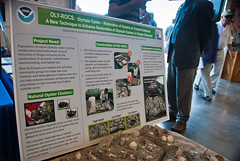
Joanne Choi's OLY-ROCs project on display at NOAA open houseCongratulations to Summer Scholar Joanne Choi, whose poster on her OLY-ROCS project was prominently featured in this weekend’s open house at the new NOAA Marine Operations Center in Newport!

Joanne’s work on a new kind of artificial breeding structure for oysters was front and center at the South Slough National Estuarine Research Reserve exhibit, alongside exhibits from NOAA units ranging from the National Weather Service to National Marine Fisheries Service.

Dr. Steve Rumrill, South Slough research coordinator, had great things to say about Joanne and her work this summer. He’s an enthusiastic supporter of the Sea Grant Summer Scholars program, and hopes to host additional undergrads in the future.

Several thousand people toured the exhibit area over two days as part of the weekend’s official dedication/welcoming/open house for NOAA’s newest, most state-of-the-art marine operations center, which will be home port for the agency’s Pacific research fleet.

End of session update… a bit late

Hello all,

Having decompressed from what was a long and exhausting legislative session, I thought I’d share a little bit of what I wrote in my final report to Sea Grant. It gives a (relatively) brief overview of what was a long and, at times, stressful six months of my life.

I will break it up into chunks, so as not to bore you with a block of text. Without further ado, what follows is a brief introduction to the Oregon Legislature:

Never in a million years did I imagine I would ever be working in politics. Yet when I applied for the Oregon Sea Grant Legislative Fellowship, I had no idea how deeply immersed I would become in Oregon politics generally, and coastal Oregon politics specifically. It certainly has been an experience I will carry with me, and put lessons learned to use, for the rest of my life. What follows is my report on the 2011 legislative session through the eyes of the Oregon Sea Grant Legislative Fellow.

The Legislature

To begin, it is worth mentioning the unique political climate that existed in Salem during the 2011 session. While the Senate was narrowly controlled by Democrats (by a 16-14 majority) he House of Representatives was split evenly (30-30) between Republicans and Democrats, something that had never happened before. Much of January was spent determining how business of the House would be conducted. Every House committee would have a Republican and Democrat co-chair, who would each need to agree to hear a bill in committee. There would be a Republican and Democrat co-Speaker of the House, who would alternate days presiding over floor sessions.

Needless to say, in order for a bill to pass the House, it had to have bipartisan support. While theoretically this created an opportunity for Republicans and Democrats to work together to solve Oregon’s problems, in practice it made it all too easy for one party, or even one member, to kill a bill that they didn’t want to see passed.

The Coastal Caucus

Operating as usual in this unique environment was the Oregon Coastal Caucus, which the Oregon Sea Grant Legislative Fellow is assigned to support. A bipartisan and bicameral group of legislators, the Coastal Caucus is unique in Oregon politics. It consists of the Senators and Representatives from coastal districts, as well as the Senator from the Klamath basin (due to the region’s dependence on salmon and other oceangoing fish). The members are, for the most part, long-serving; all are in at least their third term. For the 2011 legislative session, the Coastal Caucus consisted of: Rep Cowan (chair), Rep Krieger, Rep Boone, Rep Witt, Rep Roblan, Sen Verger, Sen Johnson, Sen Kruse and Sen Whitsett.

The group meets weekly during session, for an hour in the morning, to discuss issues of concern. The Coastal Caucus operates on a consensus-only basis: if they have consensus on an issue, they weigh in on it. If even one member disagrees with the group, no action is taken. There is a sense among members that the coast is often overlooked in Oregon politics, and they feel strongly that it is their duty to protect their constituents. While there are both Republicans and Democrats representing coastal Oregon, party lines are often blurred, and issues stretch across individual districts.

Because of the composition of the group, they are able to have tremendous influence on issues that they choose to weigh in on. In an evenly divided House of Representatives, that influence should have been even stronger. 

Over Already?

Phew!  This is the first time that I have sat down at my computer for any substantial amount of time all week!  As I begin my final week here as a Sea Grant Scholar at the EPA Newport, OR, Research and Development Branch, I find it hard to believe that these are my final days of my internship.  Early last week was spent wrapping up with field work, lab processing, and data entry.  I was planning on spending the rest of the week prepping for my presentation on at the Final Symposium on Thursday, but was caught off guard when I was thrown into more field work for the week.  So last week was more of the same – making artificial sea water, filling bladders, taking nutrients, deploying chambers, gathering chambers, taking nutrient samples again, measuring volumes, etc. etc.  I did though, demand some time to work on my presentation.  Thursday morning rolled around, so I waiting anxiously for the start of my symposium all the while making adding the final touches to my Power Point.  At lunch time, my mentor, Ted, and I headed to the Hatfield Marine Science Center for lunch before the presentations began.  It was enjoyable to see everyone again, since I haven’t seen some of the other scholars since June when we first met. 

I felt that the presentations went great!  Everyone worked on a vastly different type of project that all pertain to and are important to the marine science field, especially in the northwest.  I found giving my presentation to be a bit complicated.  The details of my project are so in depth that I still have a hard time wrapping my head around them myself, never mind trying to explain them to an audience, many of which do not have a scientific background.  I could have spent my whole 15 minutes explaining how the experiment was run, never mind trying to tell a story with results and a conclusion.  I got some great feedback though and after talking with my mentor, I had a few moments to change a couple of things before my second presentation with the EPA the next day.  I felt that it went much better.  I think that the only way that I would be satisfied with giving a presentation on this project is if I had an hour to do so! 

Adding the final touches to one of our deployments. Here I am taping a nalgene bottle to the side of one of the chambers that will fill with water as the tide comes in. We will use this water to take a nutrient sample of the high tide water to compare to our artificial sea water.

At the beginning of this week, we immersed ourselves into another experiment.  This experiment involved a total of 32 chambers in 3 days.  That’s 32 bladders of water plus one more for the control!  My feet hurt from standing all day, but I’m glad that I was able to venture out in the field for part of it.  These past few days have been beautiful on the coast!  We have been running into another issue with this project – I know, surprise, surprise.  The day after we ordered 12 new bladders, they started tearing around the nozzle!  We’ve had four tear already!  This is problematic because we are already pressed for time, so taking the time to refill another bladder puts pressure on us to get everything deployed before the tide comes in.  I’m afraid that one of them will break after it’s been out in the field and our artificial sea water will be contaminated! 

Anyway, field work will be over tonight – this is my last day in the field!  The next two days will be spent completing lab processing and data entry.  I’ll have to take time to write my final paper so that it gets in on time on Friday.  I’ll probably post some if not all of my reflection paper to this blog so you all can read about my final thoughts of this internship.  Please feel free to contact me if you have any questions! 

As always, my weekends are filled with fun Oregon adventures.  Check out what I’ve been up to here: sarasoregonadventure.blogspot.com

This is it |wk.9|

This is it – the last week!

So last week was pretty busy. I finished up my online physics II class and compiled my presentation for Sea Grant in addition to my ODFW work. I was pretty impressed with my fellow scholars’ presentations. We recieved many compliments; if you came out and offered feedback I would like to thank you because we appreciated it!

This week at ODFW I plan on creating more transect highlight clips and a rocky reef marine habitat classification video (at the very least). I’m also taking surf lessons with Margaret and Betty! Today was our first day and it was sooo fun. A bit tiring, but fun. I was pretty worried about the cold Pacific upwelling ;) but our 10(?)mm wetsuits kept us nice and comfortable. Two more days of lessons! :)

What an amazing experience I’ve had this summer. I sincerely want to thank Oregon Sea Grant, and more specifically, Sarah, Eric, and Jenna for giving me this opportunity. I have had many memorable firsts this summer. For instance, actually seeing the Pacific Ocean, surfing, sandboarding, crabbing, ‘musseling’, tide-pooling, going on my first research cruise (thank you Mike and ODFW!), hearing sea lions bark as I’m going to bed, eating rockfish, and much more.

In addition to all of the exciting recreational activities I’ve had the opportunity to enjoy, I have also learned a bit about the workings behind a government agency in marine management. I think what stands out the most to me is how much communication and cooperation there is among the agencies at Hatfield. Also apparent to me is the amount of research/projects being done here. All for the benefit of the general public and particular marine species. Communication, communication, communication!

I want to thank the Oregon Department of Fish and Wildlife for welcoming me in. In specific, I would like to thank Michael Donnellan, my advisor, Erin Cooper, Bill Miller, and Bob Swingle. Thank you for allowing me to help you out with the public outreach aspect of your project! I very much enjoyed exploring the habitat and species diversity in the footage. There are many more people who gave me ideas and contributed input as this summer progressed so I thank you as well!

I’m definitely going to miss the other Sea Grant Scholars. I’ve made some great friends this summer. We’re a pretty cool bunch. :)

Saturday I begin the three-day drive home. I know that most of the time will be spent reflecting upon this summer.

(Oh, and if you know of any good audiobooks, let me know!)

St. Perpetua Trail view, Cape Perpetua

Final Days: Fishing and Writing

ODFW Adventures: IX

I can barely believe that ten weeks has already passed by, and I will spend the next 4 days wrapping everything up at ODFW. Last week was a short week for me, as I had Friday off to travel to Vancouver, WA to be in my Cousin’s wedding for the weekend. But I spent the time I had working hard on the presentation I gave on Thursday and reading and writing more for the annotated bibliography. My presentation turned out very well, thanks to the practice run I had in Ali’s office with the Nearshore Team as my audience. At the symposium I had some technical difficulties to begin with, as my presentation saved in a very wonky fashion, but after downloading it one more time, the pictures and titles were all perfectly in place. And after my presentation, my team congratulated me on my presentation and the professional answers I gave to questions asked after my presentation. All the previous and following presentations were just as good, and it was fantastic to hear in-depth descriptions of all the other Sea Grant interns’ internships. It was a great ending to the Summer Scholars program, and I hope that all the years to come with new scholars turn out as good as this one!

I was only able to add a few articles to the annotated bibliography due to my limited schedule, but that seems to be the story with this document–slow and steady gets the job done. I hope to pick up the pace and read all of the last articles and add them to the bibliography this week, but with my other work items taking priority, I will simply do my best to finish the bibliography in the next 4 days.

I wasn’t able to write this blog yesterday because I spent the day FISHING on a boat in Port Orford! Although I have a lot of work to finish up this week, it was nice to take a break and get some fun cross training. Besides, I need to practice my fishing skills if I really want a career in this field! I ended up catching 5 black rockfish for the Marine Reserves Program to measure and weigh. They were looking at the different fish species that live at Redfish Rocks, where a Marine Reserve will soon be put into place. All in all, it was a windless day with many flies and just a few fish pulled onto the boat. But beyond that, we saw some amazing wildlife–several species of fish, tufted puffins, jellyfish, whales (even a tail out of the water!), and porpoises right next to the boat! It was a great way to start my last week and I will remember that trip for the rest of my life.

This week I will also be writing up the protocols for the Herring project for determining the spawning biomass and quota, making the maps, and likely revising the egg counting protocol after our Herring meeting this Thursday that we are having with people that are/have been involved with the project. Even though this meeting is on my second-to-last day of work, it will likely be one of the most significant meetings of my internship, as (hopefully) changes will result from the hour of vigorous discussion.

Last, but not least, I will be spending some time putting together my final report for Sea Grant. Evaluating and reflecting on this internship will not be difficult, as I have learned so many things about myself and my interests that I could likely write a chapter in a book, but it will take more time to get my thoughts organized and write a flowing essay on the topic. But I have confidence that this, and my other two tasks, will be accomplished before 5 pm on Friday.  

I had such an amazing and memorable summer, and it wouldn’t have been the same without my mentors of the Nearshore team, Greg, Ali, and Delia, or the other Summer Scholars, Sea Grant staff, and the rest of the staff at ODFW. Thank you everyone so much for such an amazing experience!