Sustainability at Tofurky

Since my last update, I have learned so much from a professional development standpoint as well as how to fail successfully.

Failing

These last few months have also given me what I’m sure I’ll call the “Scale Problem” for the rest of my career. As we have been trying to better manage our material wastes, one key piece of information that we have been missing is data regarding where and why we are producing waste in our production. To address this issue, the sustainability team and I decided that we would get back to the practice of weighing the waste bins on the production floor. The only issue was that the scale was broken and needed parts to be fixed.

I talked with several people, got the ball moving and was excited to get the scale fixed and begin measuring our wastes. A month later, the scale was still broken, and nothing had changed. I had wasted a lot of time chasing something that was simply wasting everyone’s time. At this point I had to reevaluate my goals and find a new path to get where I needed to go. I created a new measurement template that would go off volume rather than weight. This proved to be successful and allowed us to see where we are producing the most waste so that we can focus our efforts based on data.

My biggest lesson from all of this is that I can’t just wait on things to be fixed or anchor on the idea that something can’t be done because something is broken or not working as it should. I learned to be more flexible and to always be ready to find another solution to the same problem.

Another change that has come from the work I’ve been doing is that we may not have all the positions at the company that we need to be able to make the changes we want to see. When going through our production process and trying to make changes, one of the biggest realizations we had is that there was no single person in charge of continuous improvement of our process. This realization showed us an opportunity, as no one at the company has the capacity to pick up that work right now. Because of this, Chris, my mentor, decided to move onto trying to get someone to oversee continuous improvement. Now, we will be looking for a process engineer within the next year or so to help us continuously improve our process. Hopefully, this will help us to reduce our material waste and take some steps towards the 2030 goals we set as a company.

Managing capstone projects

Another fun development that has happened since my last post is that I worked with a capstone group from PSU to help me get a head start on Scope 3 emissions at Tofurky. Scope 3 emissions refers to all emissions that take place outside of a company’s own manufacturing (i.e., supply chain and distribution). For their project, they looked at our largest suppliers and through analysis of our sales and purchases last year, were able to give us a series of recommendations to get more thorough data around Scope 3 emissions. This has set us up for 2022 where we will be able to start asking our suppliers more questions as well as using more software to help organize the data we collect.

SEM

One of the coolest advancements so far in my time at Tofurky is that we are now a part of the Oregon Energy Trust’s Strategic Energy Management (SEM) program. This program has around 9 other businesses from around Oregon all participating to become more mindful about their energy usage.

With our team that we created; we have already set goals for reducing our energy usage with this program that will help us to achieve our 2030 goals. In November, we conducted a leak sweep where we walked around with an air leak detector that could help us locate any pipes that were leaking air. In one building alone we were able to find over 25 air leaks, showing us just one of the many opportunities we will have with this program to improve our energy performance.

Using the leak detector on packaging equipment

The next steps with SEM are the biggest for the program and Tofurky. Within the next couple months, we will be conducting what they call a treasure hunt. This will involve the entire Tofurky SEM team and any other employees who wish to join in walking through the manufacturing facilities and pointing out any opportunities that we may have to reduce energy use. I really like Oregon Energy Trust’s approach to this as they look for a large quantity of ideas at first and then narrow it down to the low cost, high impact projects. Through this, we should be able to reduce our energy use drastically within the next year and into the future as well.

The final part of this program that has been cool to me is that it has allowed for me to network with similar businesses. I recently got to talk with the Sustainability Manager at Bob’s Red Mill, and we talked about participating in each other’s treasure hunts. Not only is it allowing our businesses to build a community of practice, but it also serves as a great way for me to get more knowledge and experience from someone who has walked a similar path to what I want to do. I look forward to all that this program can give.

Spanish class

The final thing that I decided to do during my fellowship is join the Tofurky bilingual program. This program is a 16-week class of 8 English speakers and 8 Spanish speakers at the company. Each week we have time to learn vocabulary and grammar from a Spanish teacher, and then we are paired up to speak with someone native in the other language. This has been a wonderful experience so far because not only have I gotten to practice Spanish, but I have also gotten the chance to meet some people from the production floor that I’ve never met before. Most of our production employees also primarily speak Spanish, so this program really helps to bridge the language gap.

Composting Project

The final thing that I’ve done within the last few months is a composting project. Recently, Tofurky discontinued a few products from our product line and as a result, had a bunch of the dry mix that we used leftover. We didn’t want to just throw all that product out so instead we worked with a local composting facility to take all of it. We emptied pallets of ingredients into giant dumpsters and sent it away to be composted. This was just a small one day project but it was cool to see how much waste could possible be diverted in the future.

One of the dumpster bins filled with soy waste

Razor Clams in Oregon

For my master’s project, I am working on the ecological, economic, and socio-cultural impacts of razor clams for Oregon coastal communities. I am excited to partner with Oregon Sea Grant to continue my project into its final year. Though I will say, time is flying.

It’s hard to believe that I’m over half finished with my master’s project. Last summer, I interviewed razor clam harvesters, business owners, and communities leaders in Northern Oregon for part of my project. I am excited to add their thoughts and knowledge to my research! I believe that knowledge gained through science and experience are both valid, and there are many benefits to having both in the conversation. The importance of the razor clam fishery in Oregon hasn’t ever been studied, which is one of the reasons why I am so interested in this project. I get to add both scientific and ecological knowledge to help fill this gap in our understanding of the impacts of a healthy fishery.

That also means that I get to take trips up to Seaside and Astoria every now and again. For example, this past summer, I got to see the Peter Iredale shipwreck for the first time and go to the Astoria Column.

The months ahead will be filled with final data analysis and the preparation to defend next summer. I will also be preparing materials for ODFW to use for outreach to better connect with the razor clam harvesting community as part of my public outreach. Busy days are ahead, but I look forward to working with OSG and other OSG scholars in the coming months.

Aquaculture in Oregon

As I wrap up my first year as a fellow, I am reflecting on what I have learned about aquaculture in Oregon. From conducting a survey with the aquaculture industry, agencies, and researchers, I gained new perspectives on perceived barriers to expanding production, which I wrote about in my last blog. I have also done a lot of research on regulatory structure and ways to streamline permitting processes for new aquaculture operations, which I plan to write about in a future blog post after finishing up a report on this topic. Getting back to the basics though, I thought it might be useful to talk about the different types of aquaculture in Oregon. I am currently working on some educational content for the Oregon Sea Grant website that will go into detail about this information, and wanted to share some highlights here. 

What is aquaculture and what is going on in Oregon?

Aquaculture is commonly defined as the farming of aquatic and marine animals and plants. This farming can take place in tanks on land, or within aquatic and marine environments. For example, kelp is often grown in the open ocean connected to long ropes. Aquaculture products or species have different purposes as well, such as food and other products, larval breeding, stocking, ornamental breeding, and restoration. A lot of farmed species are consumed directly after harvest, or in many cases go through additional processing. For example, Pacific oysters from Oregon are sold to be consumed raw on the half shell, or may be shucked and packaged before selling. Several aquaculture operations focus on producing larval or juvenile organisms. For example, Oregon has salmonid hatcheries that breed juvenile fish for stocking lakes, ponds, or rivers to supplement recreational and commercial fisheries. These fish are raised and released into natural systems to increase numbers available for fishing, or in some cases to restore populations. There are also private farms that produce and sell fish to private property and business owners who want to raise fish in ponds, lakes, or tanks. Lastly, fish and other species are commonly produced for public and private aquariums which is known as ornamental fish aquaculture. For all types of aquaculture, special permits from Oregon Department of Fish and Wildlife, and other state agencies, are required prior to obtaining, transporting and/or raising organisms. 

What are some species grown in Oregon for food?  

Pacific oysters provide the highest economic value for aquaculture in Oregon. They are grown directly on mudflats, or in nearshore waters, using various techniques. For example, oysters can be grown using bottom culture, where they are grown directly on the ground with no equipment, and rack-and-bag culture, which involves keeping oysters in mesh bags attached to racks that elevate them off the ground. Oyster aquaculture requires no inputs to feed the animals, since the bivalves eat phytoplankton in the surrounding water, and can provide benefits to the environment, such as improved water quality and structured habitat for other organisms. 

Pacific dulse is a red seaweed that is native in low intertidal and upper subtidal rocky habitats from Alaska to California. In Oregon, dulse is grown in recirculating tank systems on land that are outside and open to sunlight for photosynthesis. The seaweed is tumbled around the tanks using heavy aeration. Dulse is currently produced in Tillamook and Port Orford. When dulse is cooked in certain ways, such as pan frying, it can have a bacon-like flavor. 

Purple sea urchins are a unique aquaculture species in Oregon with an unconventional production method. Wild purple urchins are highly abundant in Oregon’s nearshore environments, where they have decimated many kelp forests by voraciously feeding on the kelp. Urchins can live for long periods of time without eating, but they are not commercially viable when harvested in this state. Using a method called, “urchin ranching,” wild urchins are caught and fed seaweed in recirculating tanks to fatten them up until they reach a marketable size. A couple of pilot projects for urchin ranching are currently underway in Oregon. The Oregon Kelp Alliance (ORKA) has a great website with more information. 

What about larval production, stocking, and ornamental aquaculture? 

Some common fish species that are produced in hatcheries and released to the wild are Salmon (e.g., coho, chum, chinook) and trout (e.g., rainbow, cutthroat). Oregon Department of Fish and Wildlife manages 33 public hatcheries that produce anywhere from 27,000 – 576,000 pounds of fish per year. 

The Whiskey Creek Shellfish Hatchery is a prominent supplier of shellfish (oyster, clam, mussel) larvae in Oregon. They provide oyster larvae for commercial production along the West coast and internationally.

Ornamental aquaculture consists of several small businesses that don’t show up in formal data collection of aquaculture numbers, such as the USDA census of aquaculture. Therefore, it can be difficult to find specific information about these businesses and the types of fish they produce.  

These are just some examples of aquaculture species grown in Oregon. Check the OSG Aquaculture website in 2022 for more details, and contact me if you have any questions (ehrharta@oregonstate.edu).

Information Sources:

Environmental Sustainability at Tofurky

As of June of this year, I started my 11-month journey at Tofurky as its Environmental and Sustainability Program Coordinator Fellow. At Tofurky, my role is to not only create an environmental management system (EMS), but also to create a series of programs and practices to create more sustainable culture overall. Given enough time, I may also delve into measuring Scope 3 emissions to help the company to not only record their impacts from our supply chain, but to also set goals to work towards over the next decade. 

I may only be a couple months in, but I already couldn’t have asked for a better experience from this program. From the people I’ve met to what I’ve learned, I have been able to develop my skills, both technically and interpersonally. In this blog I’m going to talk a bit about what I’ve completed so far as well as some of the lessons that I’ve learned during my time.

Starting out:

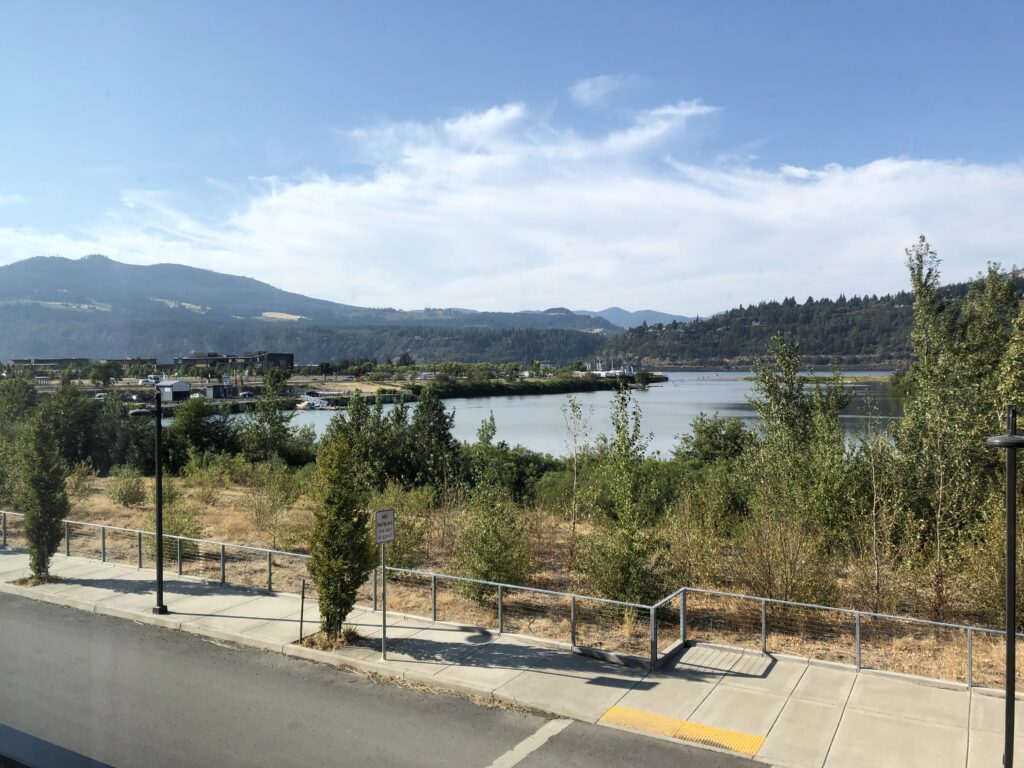
Hood River

The first couple of weeks felt like I was trying to drink from a fire hose. Adrienne (another OASE scholar) and I were loaded up on everything about Tofurky. We learned all about the history and culture of the company and as well as receiving an introduction to the production floor, where we learned all about the process that goes into making every Tofurky product. All of this information was super useful, but also made the work I needed to do a bit more daunting.

Something that really helped me to get past the daunting feeling of all the work I would need to do was the support of my mentor, Chris. His professional experience has helped guide me to success on my projects, ensuring that I have the support I need while still allowing the work to be my own. During our meetings, Chris always ends up dropping some useful life tips on us. Some of these have even guided how I approach a lot of the work I am doing now. One of the most common tips that we heard was to Keep It Simple Sweetheart (K.I.S.S.). This helped us to not only put the proper amount of time and effort into projects, but also encouraged getting feedback throughout a project rather than only at the end.

I truly began to feel more confident and knowledgeable in my position once I started creating prototypes and showing them to other people. Chris always emphasized the importance of getting something out there. Without it, we have nowhere to start, and that just delays our projects even further. This also encourages failure and growth, showing me that I need input and help from others to truly create a well-functioning tool.

Environmental Management System (EMS):

The overall purpose of an EMS is to have all of our environmentally related data in one place so that we can both track and manage it in an effective way. In turn, this allows us to make data-driven decisions throughout the company. As a mission-driven company and a B-Corp, Tofurky wants to be a leader in the plant-based proteins industry. This means that we want to be able to show others all the things that we are doing in order to either inspire them to do better, or to hold other companies accountable to their responsibilities to the planet.

My first EMS prototype was super rough, but as Chris advised me, it was somewhere to start and would allow us to move forward. To get input on the EMS and to create a pattern of talking about it, I created a monthly meeting with key stakeholders. We spent our first meeting talking about data, how it could be used for analyzing our position, and discussing what people thought about it, where it could improve, and how useful these meetings would be in the future. Although I was pretty nervous going into this, I found that many of the people who I thought would be critical were actually more excited that we were finally looking into all of this again. What I learned from this is that change requires initiative as well as someone to own it. Without these, many things that people may have an interest in will actually go untouched.

Going into my second EMS meeting I was a lot more excited. Not only did we have our 2030 sustainability goals completed by Adrienne, but we had also completed our first waste audit that morning. When talking about the future of this meeting, I could see a process emerging. These monthly meetings would be to talk about data, but we would need more meetings to go in depth on other topics. I could see the web of effort expanding, that we would soon have sustainability talked about throughout Tofurky on a much more regular basis. On top of all of this, I was also excited to talk about our new goals that show our commitment to a better planet.

Waste Audit:

My most recent achievement was the completion of Tofurky’s first every waste sort. Last week, seven volunteers and I went to the Hood River Garbage transfer station to sort through the pile of trash from our compactor at our main production facility. Not only did we get to see all of the garbage that our facility had produced for the last 2-3 days, but we also got to enjoy all the wonderful smells associated with it.

This entire experience was super useful for several reasons. One of the first is that both the COO and CEO of Tofurky were volunteers at the sort. Having them both there was great because it let our top-level management see what our impact really looks like. Doing a waste sort is also great because it creates a platform for change. Because of this sort, I will now be able to show with data how we can divert from landfills, change our process, and overall reduce costs purely through changing how we work with waste.

Waste sort set-up
The Waste Sort Team

Up Next:

My next few months are going to be jam packed with a ton of work. Not only am I going to be working on processing, analyzing, and reporting the data on our waste audit, but I also have to begin working on our material waste management. A project related to is observing and developing a plan for our production floor to try and help reduce our material waste percentage or to at least help divert more waste from landfills. To do this I will be talking with supervisors as well as employees to try and figure out what will and won’t work. Something that is also exciting is that I will be reaching out to a number of groups to develop end of life destinations within our production process. All of this work combined with looking upstream will hopefully lead to a large reduction of waste produced as well as ending up at a landfill.

Overall, these first few months with Tofurky have been truly amazing, and I’m super excited for the future to see all the new things I learn, the people I meet, and the change I create.

Barriers to Aquaculture Expansion in Oregon

This summer is really flying by, which is fine by me! I am one of many Oregonians without air conditioning and am therefore looking forward to the cooler fall weather. In the past few months I have been focusing most of my time on the needs assessment project which I introduced in my first blog. As I briefly explained there, aquaculture in Oregon is limited to a few species and a relatively low economic value compared to neighboring states. In the past few years, federal legislation and funding have been enacted to increase domestic aquaculture in the U.S. to meet growing seafood demands. This may open up opportunities for aquaculture expansion in Oregon, but there is a lack of information on the current status, interest in expansion, and barriers. The goal of this needs assessment was to address some of these unanswered questions and establish some informed actions. 

For those of you unfamiliar with the term “needs assessment,” NOAA has a great tutorial that I have found very helpful. Essentially, a needs assessment is a study conducted to identify and address a particular issue, usually to inform project planning within an organization. For this needs assessment, we set out to identify barriers to aquaculture expansion and recommend outreach and engagement strategies based on these barriers. In May 2021, I distributed an online survey to all of the stakeholders I could identify in Oregon that are involved in marine aquaculture. This included current growers, prospective growers, agency staff, and researchers. With the help of Oregon Sea Grant’s Social Media Specialist, the survey was also shared through Facebook, Instagram and Twitter posts. The survey was active for about two months and we received 38 full responses. This may seem low, but the aquaculture industry in Oregon is really small so it was challenging to get a higher sample size. 

Even though the survey got a low response rate, the information has still been really helpful. Several people who filled it out left thoughtful comments about their experiences in Oregon aquaculture that have helped me get a better idea of the current status and challenges from multiple perspectives. I learned that there is definitely interest in expansion among current growers, which mainly produce Pacific oysters. They were interested in adding new technologies and adding other species to their operations. There were also prospective growers that want to produce oysters and other marine species that haven’t been produced in Oregon, such as kelp and abalone. 

Header for the Oregon aquaculture needs assessment report that is in the final stages of publication by OSG.

Right now, I am working on finalizing a short report that will highlight the main takeaways from the survey. This document will be available on the Oregon Sea Grant Aquaculture website in the near future, but I thought I would share a snapshot of results here as well. In the figure below, you can see the responses to the question, “What are the major barriers to aquaculture expansion in Oregon?” from different sectors (growers, prospective growers, agency staff, researchers, other). Each respondent was able to choose multiple barriers.

Perceived aquaculture barriers chosen by respondents from each sector that filled out the aquaculture needs assessment survey. Percentages are out of the number of responses within each sector. Other barriers listed: dairy pollution, plat specific regulations about growing/harvesting/planting (current growers): hatchery training, seaweed seed production (prospective growers); available land and water, coastal public perception, ocean acidification (agency personnel); time-consuming process for permits/leases, lack of partnerships between researchers and producers of emerging products (researchers).

The top barrier chosen by respondents was permitting/regulations, which is not surprising. When aquaculture growers want to set up a business, they are required to apply for various permits from state and federal agencies. The process for doing this can be challenging to figure out and because so few businesses are initiated each year, there is a lack of information about how to navigate the laws and requirements. Several respondents shared details about this experience indicating that there is a need for more information and education about going through this process. Creating outreach materials that outline the permitting process may be a good next step to address this particular challenge.

If you want to learn more, check this short report on the OSG Aquaculture Page, or reach out to me at ehrharta@oregonstate.edu.

Tool to increase coastal hazards preparedness in Oregon

I mentioned in my last blog post that I was working on the development of a tool – a library and mapper of case studies on coastal hazards preparedness in Oregon – similar to the Washington Coastal Hazards Risk Reduction Project Mapper.

This tool will compile and geographically display case studies on alternatives to traditional shoreline armoring (e.g., nature-based designs) and on practical approaches to acute and chronic coastal hazards (e.g., tsunami caches). There, individuals, communities, and tribal and local governments will be able to share their work and learn from each other. I created a list of existing projects and approaches, and I am drafting case studies for the mapper. I also started using the ArcGIS Online StoryMap app to design a mock-up of this future tool.

I would like to clarify that nature-based or soft shoreline armoring aiming to reduce coastal erosion and flooding are not a panacea, and are specific to the local environment (natural and man-made) where they would be located. Resources, capacity, and political and community leadership will also often influence and determine the design and implementation of a project.

In this blog I will introduce you to three local programs and initiatives aiming to increase tsunami preparedness, and one project that used nature-based approaches for shoreline protection to erosion (I briefly mentioned this one in my last post). These case studies will be part of the mapper.

  1. The Emergency Volunteer Corps of Nehalem Bay (EVCNB)

EVCNB is a non-profit organization dedicated to building personal, community and regional resilience, developing programs to ensure readiness, and promoting a culture of emergency preparedness. EVCNB was founded and is run by local community volunteers.

EVCNB was formed in February 2008 following a storm that brought hurricane-force winds, flooding, and a total power outage to the north Oregon Coast, temporarily isolating the three small communities and surrounding areas of Manzanita, Nehalem and Wheeler. Therefore, EVCNB found it critical to have their community members be trained and prepared to respond in a self-sufficient manner.

To learn more about EVCNB, go to https://evcnb.org/.

2. City of Rockaway Beach, Tsunami Resilience Planning Project, Tillamook County, Oregon

The geography, older infrastructure, and human settlement patterns in Rockaway Beach have created challenges for timely evacuation from a local tsunami. Coastal lakes, non-retrofitted bridges, manufactured homes, residents over 65 years of age, and visitors who tend to stay close to the ocean all create evacuation concerns for the city.

The City of Rockaway Beach undertook a risk-based and community-specific approach to tsunami resilience planning, which resulted in a Tsunami Hazard Overlay Zone and a Tsunami Evacuation Facilities Improvement Plan (TEFIP), both of which were adopted into the Rockaway Beach Zoning Ordinance through a plan amendment process.

You can read the Rockaway Beach TEFIP Planning Commission Draft (April 2019) here.

3. City of Seaside, Tsunami Supply Barrel Program, Clatsop County, Oregon

The City of Seaside provides emergency supply caches in high ground areas throughout the city.  The supplies are stored in preparation for the aftermath of a Cascadia Subduction Zone earthquake and tsunami or other major disaster.  In 2013, with the help of state and federal grant funding and dedicated volunteers, the City filled 119 supply barrels (50-gallon recycled corn syrup barrel) with medical supplies, water purification systems, emergency rations, tarps and radios. Each barrel has enough supplies to last 20 individuals for at least 3 days. They are stored in private residences above the inundation zone in all five evacuation assembly areas throughout Seaside, and will be placed on the curb in the event of a tsunami.  In the summer of 2020, the city restocked the barrels with fresh food, water purification tablets, batteries and medical supplies.

You can find more information about the Tsunami Supply Barrel program here. If you are interested in creating your own community tsunami cache, information can be found in ‘Earthquake and Tsunami Community Disaster Cache Planning Guide,’ a report prepared for the Oregon Department of Geology and Mineral Industries and the Oregon Office of Emergency Management.

4. Cape Lookout State Park (CLSP) dynamic revetment, south end of Netarts Spit, north of the Cape Lookout headland, Tillamook county, Oregon

The Oregon State Parks and Recreation Department, in partnership with Oregon State University and the Oregon Department of Geology and Mineral Industries, constructed in 2000 a dynamic revetment or cobble berm and artificial dune in response to extensive erosion of the primary dune, which separates the beach from a campground located immediately landward of the eroding dune. State Park’s officials rejected the idea of a “hard” structure in the Park, a high mound of rocks between the campground and the recreational beach.

Gravel was extracted from the natural cobble beach in areas where it was believed that more than sufficient volumes were present to protect the dunes and where no park infrastructure was present. The artificial dune was overlaid with a jute coconut fiber cloth, on which native grasses were planted. The sand for the reconstructed dune came from an area south of the park, where there had been problems with sand blowing onto the roadway.

Since its construction in 2000, the CLSP structure has withstood multiple large Pacific Northwest winter storms. However, the Oregon Parks and Recreation Department (OPRD) has had to add additional cobbles to the dynamic revetment at least three times in the decade following the project completion.

The choice of a cobble berm backed by an artificial dune for shore-protection in the eroding state park proved to be cost effective, the expense being a small fraction of what it would have cost to construct a revetment or seawall. The construction was also simpler than that of a conventional revetment, and the material used more readily available than armor stones. In addition, the completed cobble berm and artificial dune are nearly indistinguishable from their natural counterparts on the Oregon coast, such that the visitors have little or no notion that these are in fact shore protection structures.

If you want to learn more about this project, read the report ‘Design with Nature” Strategies for Shore Protection: The Construction of a Cobble Berm and Artificial Dune in an Oregon State Park’ written by Paul Kolmar, Oregon State University, and Jonathan Allan, Oregon Department of Geology and Mineral Industries.

We need your help!

Do you know of projects, programs, initiatives, and research in your area I could add as case studies in this mapper? If you do, please contact me at olmetasf@oregonstate.edu. I am also looking for any existing projects and initiatives taken by individual homeowners/landowners.

Other work

Regarding my other tasks for the fellowship, I completed the design of the training needs assessment survey for the lodging industry and I am currently piloting the survey. This needs assessment asks questions about overall training needs and logistics, but mostly focuses on two trainings: the new OSG free online 30-minute Practical Customer Service Training, and the Office of Emergency Management (OEM) free online 30-minute Tsunami Safe Training. I aim to distribute this survey in the coming month. We waited for the busy summer season to be over so hotel managers would have more time available to complete the survey.

We are taking small steps with this project and decided to start with Curry County and the City of Seaside before expanding it coastwide. We may also expand this survey to other sectors in the hospitality industry.

I also continue my efforts in reaching out to tribal, state and federal agency staff, university researchers and staff, local government staff, and hotels to let them know about the Oregon Mapper and the lodging industry needs assessment projects, and to discuss their needs and how OSG could support them. So far, I had Zoom, phone, and email exchanges with a little over 50 people across Oregon State and a couple in Washington State.

I hope you enjoyed reading about this brief update on my main two projects! Do not hesitate contacting me at olmetasf@oregonstate.edu if you have any questions and suggestions.

A truly shrimp-tacular summer

Looking back, this has probably been the best summer of my life! Although it started off rough leaving my family and friends behind, it progressively got better with time. I got to meet so many new and wonderful people, visit places I’ve never been, and experience things that I never imagined for myself. I mean, it was my actual job to go out and play in the mud like a little kid! This summer internship has truly been an amazing experience and I recommend it to anyone looking to get a foot in the door with marine sciences.

blog5a
Top left: John and me on my very first day out in the field. Bottom left: Exploring a lake in Alaska with Mattias. Middle left: John on the first day of Alaska field work. Right: Phoenix and me at the Bayfront before the program started.

Hearing from my roommates and the other Sea Grant Scholars has helped me to narrow down my future aspirations. I know that my summer experience has been a bit different than others in the program by being more of a scientific research experiment rather than scientific community/policy outreach. Working with Oregon State University and USDA-ARS has given me the chance to work with a real research team instead of a classroom research team. Not only has it led me to meet and work with other students and professors from OSU and CU Boulder, but it has allowed me to visit and make professional contacts in Washington and Alaska. While I would like to work with a government agency in the future, I would prefer to do a similar role as here that has less interactions with the public and more hands-on science.

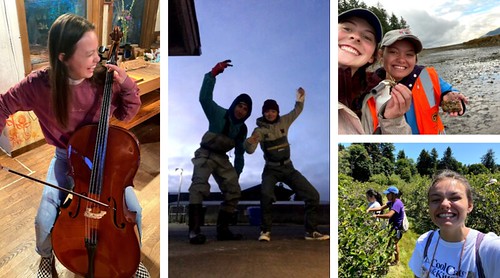
blog5c
Left: learning to play the cello with the Banks family. Middle: Joshua and me psyching ourselves up for field work with Brett at 4:45am. Top right: Emily and me with several Alaska mud shrimp. Bottom right: blueberry picking with the roomies.

The next step in life for me is heading off to graduate school for the Marine Resource Management master’s program at OSU in September. At OSU I’ll be continuing working with Brett, John, the Upogebia, and the Orthione for my master’s thesis to try and keep that balance between economy and ecology. I’m thrilled to be a part of a program that focuses on so many of the things that I care about. It will be an interesting transition to go back to school, especially in-person school. No matter what happens, I am extremely excited and nervous to start this next chapter of my life and see where it takes me. 

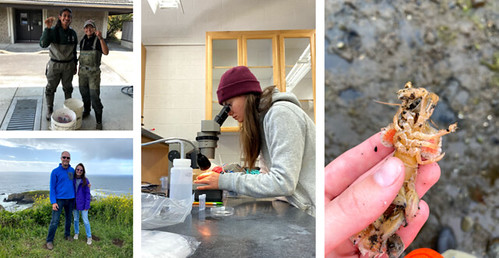
blog5b
Top left: last Yaquina Bay field day for Joshua and me. Bottom left: exploring Yaquina Head Lighthouse with Mattias. Middle: a typical day of lab work. Right: a double infested mud shrimp from Alaska.

An end to an amazing summer

It always amazes me how quickly 10 weeks can just fly by. I wasn’t sure what I was expecting when I came into this internship, but everything has been above and beyond anything I could have imagined. During my undergrad, I was very focused on building my skills in scientific research which lead me to participate in various research opportunities. However, I felt that I lacked the skills to apply and communicate that scientific knowledge in a way that would make it useful for policy and management. Throughout this summer, after talking with various professionals and participating in a variety of meetings with my mentor, I can definitely say that I’ve gotten a pretty solid grasp on how to apply and communicate science. I’ve learned how to read and summarize scientific papers so that I am only pulling out the major key points. I got to build my artistic skills and participate in creating various outreach materials to communicate the scientific knowledge in a manner that is easier to digest to the target audience. Additionally, I got to see and interact with some of the “middlemen” between the scientific and the policy-makers to firsthand see how science helps inform policy and management. All the skills and knowledge I have gained throughout this summer will definitely benefit me as I continue with my education and solidify my career path.

Another important thing that I learned from this internship is that your degree doesn’t define what your future career is. I was pleasantly surprised to find just how many people working in the policy realm had a scientific background in biology, marine science, ecology, etc. While I originally thought I wanted to get my Ph.D. and only do research for the rest of my life, I soon realized that academia wasn’t really for me. It was comforting to hear just how many paths that a background in the biological sciences could give you and that it doesn’t necessarily have to take you down the path of academia. Talking individually with various professionals has really helped me start to see all the possibilities I can do with my degree. As I continue on to my master’s program at UC Davis in the fall, I will continue to look for interdisciplinary opportunities that will allow me to explore a career in the intersection between science and policy.

One of the grad photos I took at the blueberry farm where I conducted research during my last term at UO.

Alaska is shrimply amazing

Interning with USDA-ARS and OSU through Sea Grant has been an absolute blast. It made all the difference to have such great mentors and an awesome lab partner. The summer may be coming to an end, but the next two weeks still have a chock-full schedule here in Alaska. Oh yeah, you totally read that right. We’re in Alaska!! I’ve learned so many things from this internship that I honestly can’t remember them all. The most important thing that I’ve learned is how to be a good lab manager. One of my mentors had to be away for an extended period of time and since we’ve worked together virtually since last summer, he left me in charge of the lab. I got to take on and learn more serious responsibilities, such as schedule making, coordinating, and even a bit of mentoring.

Alaska Views
Top left: views of Alaska from the plane. Bottom left: some sea stars from the mudflat. Right: views from the mudflat

A really interesting thing that has surprised me about this summer has been learning about all the other people and projects that are involved in the mud shrimp system. I mean, it makes sense, this has been a 10+ year project with lots of collaborators. John and Brett have folks all over the world (like Colorado, Japan, Russia, and Australia) who have worked or are currently working with Upogebia and Neotrypaea. A completely unrelated thing that completely surprised me however, is the fact that using the yabi guns (slurp guns, as I call them) hurts my back waaayyyyy more than using the sediment/clam cores to obtain shrimp!

Alaska field work day 1
Top left: me wearing my field work vest from University of Colorado, Boulder (CU). Bottom left: Joshua and our new CU collaborator. Top right: everyone checking out our first mud shrimp in the field. Bottom right: John and our CU collaborators analyzing shrimp in our “Alaska Lab.”

Knowing what I know now, I would only do a couple of things differently if I could restart my summer. First and most importantly, I would have things a bit more organized and set-up at the beginning of the summer. It was mostly fine, but I feel having a slightly more detailed schedule would be beneficial and less stressful. Next, I would make sure there was allotted time to go to the Art in Science meetings. As it was, I was travelling for field work both times. And finally, I would have made Joshua come to movie nights sooner with my awesome house mates, Lisette and Phoenix, so we could have all finished watching She-Ra together.

Lessons Learned: Week 8 at HRAP

The most important thing that I have learned during my time at Haystack Rock Awareness Program (HRAP) is just how important setting a schedule and sticking to it is. Because I was working so independently on my project I was fully responsible for the timeline and pace that I was working at. As someone who is used to having timelines fully set up by school or work this was a big change and it definitely took me a few weeks to get settled into but now I feel like I’ve gotten the hang of how I spend my time to make sure that I am getting everything done in a timely manner. I have also gotten to learn about grad school and the various career paths in environmental science that I hadn’t really had much exposure to before this summer. Getting to meet and talk to so many different people that all got where they are by taking so many different paths definitely really opened up my view of how I can get to the career that I want in a variety of different ways. 

One of the most surprising things about working at HRAP is that everyone has an opinion on education. Every time I talk to someone about my project whether they work in education or not, they always seem to have some sort of feedback or information about educational techniques or what they would want to see. Initially I was really surprised that everyone had so much to say but then I realized that every single person is a stakeholder in education. We all go to school and then people send their kids to schools so it is actually not surprising to see that everyone cares about how we are teaching kids. This also reframed the way that I thought of education as a much broader part of our daily lives. 

I think that if I could redo this summer the only thing I would do differently is to incorporate more interviews into my project. I only ended up doing two interviews with teachers but I feel like they both had really valuable input and having the chance to talk to more teachers would’ve given me a different perspective that would have strengthened my overall project.

IMG_3158
A collection of things found during a field trip by walking in Cannon Beach including a shore crab, squid eggs, and sand dollars