Farewell from the Tribal Federal Consistency Policy and Processes Fellow!

Hello all!  I am writing with the final update on my project to develop procedures for how the Oregon Coastal Management Program (OCMP) coordinates with tribes during federal consistency reviews, as I finished up my fellowship last week. 

To return to the cliffhanger of my last blog post, I am happy to report that our proposal to incorporate additional policies related to archaeological resource protection and Native American grave protection into the suite of policies considered during federal consistency reviews was approved by NOAA.  With this change, the OCMP will be able to further highlight and raise awareness of the state of Oregon’s commitment to the protection of these sites of significance to the tribes.  During a federal consistency review, the OCMP will provide applicants with information to help them learn more about these standards.  This includes resources about inadvertent discovery of human remains on the Legislative Commission on Indian Service’s website and guidance about the issuance of archaeological permits from the State Historic Preservation Office’s guidance on the issuance of archaeological permits.

I am also pleased to say the tribal coordination procedures were distributed to tribes via formal consultation letters at the beginning of October, marking a significant milestone in this fellowship project.  The OCMP’s goal in implementing these procedures is to bring the tribes to the table during federal consistency reviews and management decisions to ensure their voices are heard and their expertise is considered.  To ease implementation and sustainability, the procedures are designed to be simple and common sense, and nested naturally in existing processes.  They are built on a few commitments to standardize communication and coordination which we shared with the tribes: 

Do the “pre-work”

As federal consistency comes with a unique lingo and timelines established by federal regulations, it can be difficult to step into the federal consistency “world” without some orientation.  In February of 2022, the OCMP took an early step in the “pre-work,” to provide some background on federal consistency and how it “works.”  We also provided the tribes with summaries and graphics to describe the process with our formal consultation letters.  Those letters also requested specific information from the tribes to tailor the procedure as appropriate: 1) confirmation that the tribe wants to be informed of federal consistency reviews; 2) types of activities of interest, whether there is particular geographic extent or topic area; and 3) who should be the primary contacts the OCMP should include in our mailing lists.

Early notification

Upon initiation of a federal consistency review, the OCMP will provide notification to tribes.  This will be as early as possible in the process to ensure the tribe has enough time to review.  It will be separate from the public comment period, as the federally recognized tribes are not members of the public – they are sovereign nations.  This notification includes standard and clear information; templates have been developed to support.

Communication and coordination

The notification message specifically requests comments on the project, but we leave the door open for different levels of coordination.  This means that there could be informal staff-to-staff coordination and communication up to formal consultation between OCMP leadership and the Tribal Councils, whatever the tribe requests.  Any comments received would be acted on.  This might mean facilitating coordination between the federal agency issuing the permit or taking the action and the tribe. 

Follow-up

This last commitment is about “showing the work.”  The OCMP is maintaining records of communication with the tribes.  Any actionable comments will be documented in decision letters, though we will be mindful of not including potentially sensitive information.  Copies of decision letters will also be provided to tribes if they provided comment or upon their request.

As I wrap this up I want to say thank you to everyone at the Department of Land Conservation and Development and the Oregon Coastal Management Program for the opportunity to work on this project!  It has been a real privilege to be able to dig into these issues and develop some processes that will hopefully work in the long-term.  

Post Fieldwork Reflections: The Summer of Sharks

Well, after a whirlwind summer, I am officially finished with my first field season of shark sampling. All in all, I sampled from a whopping 71 sharks and tagged 20 of them with acoustic tags. I’ll have another field season next year, but until then I’ll be sorting through samples and thinking of ways to make my research go smoother and easier. One way I’ll be doing this is redesigning our shark sling — currently, it’s like a U shaped piece of fabric that is 8 feet long (we also like to call it the “shark taco” if that helps you picture it, but you can also watch a video of a shark release below). It does great at holding the shark in place but with the winds and currents in Willapa Bay, however, the sling often turns into an underwater sail, swinging out or pulling the boat around. So, with that in mind, I’ll be creating a “version 2” which will hopefully be able to restrain the shark AND stay solidly in place next to the side of the boat.

I also spent a lot of time talking with fishermen this summer, which is always one of my favorite parts of research. Walking the docks in Willapa Bay allows me to meet with people face-to-face and talk to them about the things they see on the water….particularly because they spend a lot more time out there than I do (unfortunately!). Some of my favorite interactions were with 2nd or 3rd generation fishermen who didn’t know that there were sharks in Willapa Bay at all. Most of these fishermen were oyster farmers and therefore never use gears to catch these large animals. Still, being able to talk about some of the top predators in their local waters is a great opportunity to spread awareness and understanding about the impact that sharks have, particularly in a positive light.

I wouldn’t have been able to conduct this research without the generous support of Oregon Sea Grant, and I just wanted to thank the amazing team of people there who answered questions, connected me with resources, and have continued to inspire me to make the greatest impact possible.

Jess Schulte and Dr. Taylor Chapple, head PI of the Big Fish Lab, release a broadnose sevengill shark back into the waters of Willapa Bay after collecting samples.
Jess Schulte holding a sevengill shark in place for sample collections.
Jess Schulte handlining for sevengill sharks in Willapa Bay, WA.

Fisheries and Aquaculture Workshop in Petersburg, Alaska

I can’t believe it’s already June! The second year of my fellowship is really flying by. The highlights of the past few months have definitely been the opportunities to interact with my colleagues in person. In April, Oregon Sea Grant held a two-day program meeting in Newport and I really enjoyed “meeting” everyone who I’d previously only seen in a tiny square on my computer screen. In May, I had the amazing opportunity to spend a week in Petersburg, Alaska for a workshop with West Coast Sea Grant Programs on connecting fisheries and aquaculture across the region. The workshop brought together folks from Oregon, Washington, Alaska, and California Sea Grant programs to share our work on aquaculture and fisheries. We participated in training, went on field trips, and worked on collaborative regional projects. 

First of all, let me tell you about the small fishing town of Petersburg which sits at the tip of an island. The five hour flight to get there makes two stops on the way, and the airport building is about the size of a gas station. The population is about 3,000 people, and almost everything is within walking distance. The town features Scandinavian architecture and on our last day there, they were starting the annual Little Norway Festival which celebrates Norwegian Constitution Day and brings in about 1000 visitors every year. The harbor boasts hundreds of fishing boats and Petersburg is known for its diverse fishing industry that includes salmon, halibut, blackcod, herring, crab, shrimp, clams, and more! 

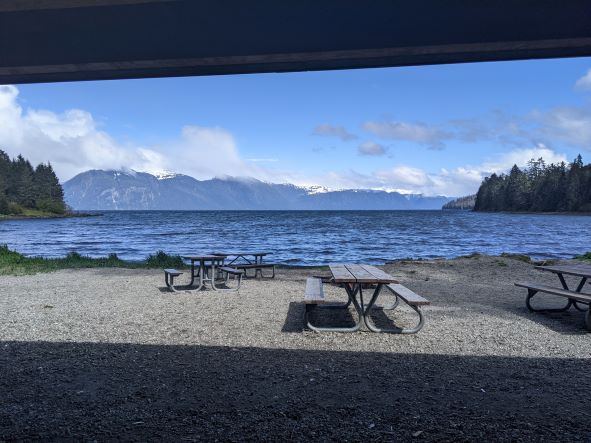
On Monday, the first day of the workshop, we met at a local beach park to get to know each other and share updates on our work. While we were there the tide at the beach continued to recede and show a dramatic change, which was really cool to watch. The pictures below show the change within just a few hours.

The next day we spent the morning in training about “Best Practices for Adult Education.” All of us attending the workshop conduct outreach and engagement with primarily adult audiences in fishing and aquaculture communities so this was really useful. After spending the morning on Zoom, we headed outside to tour a local fish hatchery that raises juvenile Salmon to support recreational and commercial fisheries. We were lucky enough to be there when they were releasing juveniles into the adjacent river through a large tube that transported the fish from holding tanks into the water. The picture below shows the fish emerging from a tube into the river in a swarm. 

Hose releasing juvenile fish from a hatchery into the river.

Next we went on to tour river restoration sites with a researcher from the U.S. Forest Service. These sites have been restored in recent years to provide better and more diverse habitat for salmonids that live and/or spawn in freshwater. There are some pictures of the restored site below. 

On Wednesday, we spent the day indoors and listened to presentations over Zoom, worked on projects, and interacted with folks from the local fishing community. The highlight of this day for me was a panel on “Advocacy and the Role of Extension Agents.” At Sea Grant, extension agents work on a lot of controversial issues in coastal communities, but our role is to remain neutral and serve as facilitators of information and exchange. In practice, this is really challenging, especially when residing in small coastal towns where everyone knows each other. It can be difficult to separate your personal and professional affiliations. While my fellowship has been remote and I haven’t experienced living in a small coastal community, I have had challenges with determining an appropriate role to not advocate for aquaculture, but instead provide information from a neutral place. This panel made me feel less like an imposter, as others have similar struggles, and provided some practical advice for how to navigate these situations. 

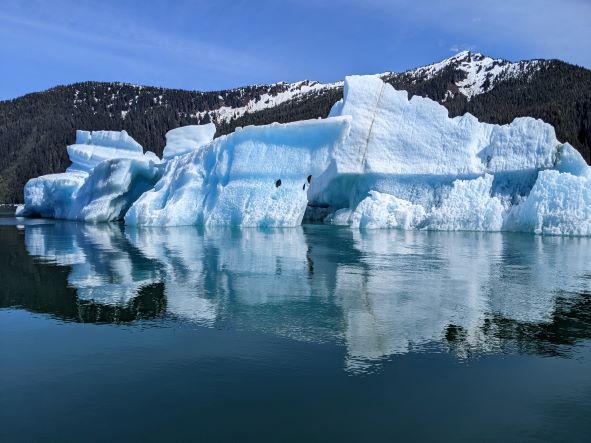
On Thursday, we gathered for a half day to wrap up, and then some of us went on an optional boat tour to the LeConte Glacier. This was absolutely the highlight of the trip. We spent about 5 hours on the boat with a local tour guide and coincidentally, a whale biologist. The wildlife on this tour was incredible! We saw humpback whales, porpoises, seals, sea lions, bald eagles, mountain goats, and a black bear. Traveling on the boat to the glacier through sea ice was an experience I will never forget. While we didn’t get very close to the glacier, we did get quite close to two-story icebergs, including one that had recently flipped over. According to our guide, icebergs will rotate, and the ice underneath will be more blue and vibrant, while the ice above the water will be white and look more like snow. Once the iceberg rotates, the blueish ice will change to the whiter, snow-like ice within a few hours. We were lucky enough to see a flipped glacier on our way back from the glacier.

Overall, this trip was an incredible experience and I’m really grateful that Sea Grant provided the resources for me to get there! 

Updates from the OCMP: Minding the Federal Consistency Review Shop

Since my last post, the direction of my fellowship has shifted yet again.  I have hinted in previous posts that I have been given a lot of latitude to take the work in any direction I see fit – so the project has grown and shrunk and grown again as I learn more about the system in which I’m working.  This is really my favorite type of environment to work in – I like dynamic work, following random threads, learning new things, and not always knowing what’s next.  That being said… this latest shift was not as welcome because it came as a result of the departure my mentor from state service: over the last three months, I have been taking on a lot of the tasks of the State-Federal Relations Coordinator and minding the federal consistency review shop while the Oregon Coastal Management Program (OCMP) has been hiring my mentor’s replacement.     

Though it has been unfortunate I have not had as much time to dedicate specifically to the further development of tribal coordination procedures, I’ve been leaning into the opportunity to learn the ins and outs of a federal consistency review.  I thought I had a decent grasp, but I’ve found I was just scratching the surface.  (hubris!)  With my new appreciation for the complexity of the position and requirements of a federal consistency review, I feel better positioned to generate procedures that will work for the next Coordinator. 

For example, being in the Coordinator’s shoes has really underlined the importance of developing effective, clear, and fairly simple procedures for involving the tribes.  The reality of the position (and, really, I think this is true for lots of dynamic/ high-tempo professions) is that things sometimes have to fall off the plate.  Therefore, procedures have to be realistic and mindful of varying levels of bandwidth for them to outlast their creator.  So, I have been thinking quite a bit about where I can create efficiencies – generating message templates, simplifying methods to identify who needs to be contacted, and updating checklists that help the Coordinator track where they are in the process.  My appreciation for reasonable and sustainable processes is a common theme throughout my professional career so far, and has probably already come up in a previous blog post…

In other news, I am really happy to report that a major component of my main project has been able to continue during these last months.  Working with one of my Tribal advisors and the Oregon State Historic Preservation Office (SHPO), I have been developing a proposal to add more policies related to archaeological resources into the suite of policies that are considered during a federal consistency review.  Policies must meet certain criteria to be called “enforceable” and be approved by NOAA for inclusion in a coastal management program.  Enforceable policies are the backbone of a federal consistency review – federal permit applicants and federal agencies proposing actions must make a statement that they believe their project is consistent with these policies. The OCMP then concurs, concurs with conditions, or object to the applicant’s determination that their project is consistent based on our independent review and the input of our network partners

For this reason, the inclusion of these additional enforceable policies of importance to the Tribes is a substantial step forward in emphasizing the OCMP’s commitment to the protection of archaeological resources.  I am currently developing letters to distribute to the Tribal Councils to provide notification about the change, discuss the significance, explain the implementation process, and request their feedback.  This is a months-long process that will very likely outlast my tenure with the OCMP, so I am excited to get it moving! 

Tofurky Developments

Since my last update, I feel like I’ve been able to grow significantly within my environmental knowledge as well as gaining several practical professional skills. As my fellowship is coming to an end, I’ve not only had the chance to look at all the work I’ve completed, but also get to look where I’m going next.

B Corp

Ever since figuring out what a B Corporation was, I knew that I wanted to work for one. Whether that was a business that was already certified or a company looking to become certified, I knew that the requirements for a B Corp certification aligned with my own values and vision for the future of business.

I was excited when I learned that Tofurky was a B Corp because it was like a cherry on top of a business that I believed was already doing so much for the environment. Tofurky was first certified in 2017 as a B Corp and as a requirement, it is required to recertify every 3 years. While there was a team assembled and ready in both 2020 and early 2021 to complete the recertification, we didn’t end up getting any word until 2022. This meant that as the sustainability person at the company, I got to help with the entirety of the environmental section. I’ve previously looked through B Corp’s Impact Assessment but this time I was able to actively enter all the work that our company and I have been doing.

I think going through this process of recertification was insightful and made me appreciate the certification and its value so much more. Several times during our verification stage, we were required to show proof of certain practices and behaviors at the company. This meant that we needed to not only confirm the practices we have, but also show the formal written policy for each one.

Career Development

One of the most exciting parts of my work recently has been looking at where I want my career path to go. I know I want to stay within sustainability at businesses, possibly even manufacturing companies, but now I see so many more options for where I can specialize. Two of the most enticing paths right now are moving towards being a sustainability analyst or gaining some knowledge on process engineering.

I really like the idea of being a sustainability analyst mostly because I have enjoyed working with data at Tofurky. Since beginning my fellowship, I’ve keeping track of and working with the company’s utility and waste data. Over time, I’ve discovered better ways to not only model and present the data, but ways to overlay that data to make it more useful. One of the biggest changes that we’ve made is looking at the data from an intensity perspective. This allows us to look at how we’re doing while still accounting for growth.

Process engineering is another interesting path because it would give me the tools to make the change that I want to see in companies. Right now, I have some difficulties being able to make changes at Tofurky purely because I don’t have the background and knowledge to analyze a process and identify how we can make it more efficient. Getting further education in this would allow me to walk onto production floors, acknowledge areas for improvement, and subsequently offer solutions that we can test. As of right now I feel as if there is a large barrier to entry with this kind of work and requires further education.

I think the main reason I’m excited about both career paths is because they would give the skill sets, I need to make meaningful change at a company. Currently, I feel like there is value in learning some project and program management skills to deal with work, but there’s something missing when it comes to making change. That missing piece comes in the form of having the right people or information. Without having someone specialized in process engineering, there is a gap in our capability to drive change. While it would be nice to simply have someone else with these skills on the team, I’ve learned I feel most comfortable as a team member when I have some shared knowledge with those I’m working with.

Program Management

One of the biggest changes that has occurred in the new year is within the management of our sustainability program and the work that we are doing. I’ve struggled a lot in this experience with finding an effective way to work that not only establishes clear objectives, but also works for our diverse set of departments. Initially, most of the work we were doing revolved around a monthly meeting with occasional check-ins in between, but there were problems with this. While I and several others believed our monthly meetings were meant to function as working meetings, others in the group viewed it simply as a time for reporting progress. This breakdown in communication and understanding showed me that I needed to restructure the way we work.

The solution was transitioning over to a more formal program structure. This involved not only a steering committee/executive sponsors, but functional teams that each have their own meeting cadence, goals, and work structure. Already, this has felt way more productive and functional than the previous ways we were working. This has also allowed me to gain some valuable project and program management skills that I’ll be able to use in the future.

The track of a ‘non-traditional’ graduate student

I have found that most people feel like COVID has affected their sense of time. This has been especially true for me — the last two years have been marked by beginning graduate school, getting married, a global pandemic, and having a child. The last two years have gone by in a blur. As I write this, some of the students that I began school with are completing their master’s degrees while I am returning from a six-month parental leave of absence after the birth of my first child. I am hoping that this blog post resonates with some folks who do not feel like the “traditional” student, that by speaking more openly about my journey I may be taking a step towards helping myself and/or others find a sense of community and understanding.

Despite everything (decades of education, scholarships, internships, global travel, field work) I still find myself constantly questioning my validity as a scholar, as a contributing member of the scientific community, or even as a Sea Grant Scholar. When the time comes to “perform” and I need to complete an application for funding or write a blog post my instinct is to say to myself that “I haven’t done anything,” that I am unworthy. I know many of my peers feel similarly, where does this seemingly never-ending doubt come from and how do we conquer it?  I try to remind myself that thoughts aren’t necessarily facts (in my case, thoughts are frequently not facts), sometimes thoughts are just thoughts. Looking back upon my previous blog posts and reflecting upon this last year as a Sea Grant Scholar, the truth begins to come forward and become clearer… So, what is true?

  • Fall 2019: I began my journey as a master’s student in Fisheries Science at Oregon State University two years ago this fall. In fact, I got married on the second day of classes!
  • March 2020: A global pandemic has worked its way around the world multiple times over in the past 1.5 years. Which means I was on campus for only six months before everything changed.
  • I formed a collaboration with ODFW Marine Reserves Program and California Collaborative Fisheries Research Program (CCFRP) to sample during their hook-and-line surveys in the fall of 2021.
  • December 2020: As mentioned in my previous post, I formally drafted a plan for my research project and successfully defended my research review and formed my committee last winter.
  • I got pregnant!
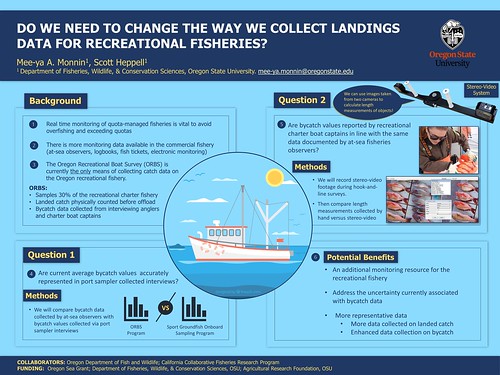
  • I started working on part II of my project. Began conversing with ODFW regarding access to Oregon Recreational Boat Sampling (ORBS) program data as well as data collected as part of ODFW’s Sport Groundfish Onboard Sampling (SGOS) program.
  • March 2021: I then organized a session for a professional conference, which is a first for me. My lab mate, Claire Rosemond, and I brought together a theme and list of speakers for a symposium at this year’s Oregon Chapter of the American Fisheries Society.
  • April 2021: ODFW cancelled their hook-and-line surveys originally scheduled for fall of 2021. ☹ Good thing I secured a collaboration with CCFRP to sample in September! 😊
  • May 2021: It may be a small win, but it felt big to me! I won best graduate student poster at our locally sponsored conference RAFWE.
Monnin_RAFWE_2021
My winning poster at Research Advances in Fisheries, Wildlife, and Ecology Symposium (RAFWE) 2021 provides a quick overview of both aspects of my project.
  • I found that most people I knew (fellow graduate students, advisors, faculty, student union, etc.) did not have any familiarity with the parental leave policy at my university, let alone how to guide a graduate student through the process. Identifying the steps and personnel to communicate with felt a little like reinventing the wheel. Eventually I not only completed the process but also chronicled it and created an informational document (doc attached below for anyone who may benefit) that hopefully helps other students in the future. This process took weeks and continued beyond the birth of my child.
  • June 2021: I left for parental leave and had a baby!
Monnin_newmember
My son and I shortly after he entered this world.
  • September 2021: Realized that trying to leave for field work 8 weeks after having a child was simply not possible (at least for me). Canceled my field work with CCFRP.
  • I signed back up with ODFW for their 2022 hook and line surveys.
  • December 2021: Return from six months on parental leave

Assessing Ocean Acidification and Hypoxia impacts in Oregon

Hello Everyone! My name is Kaegan Scully-Engelmeyer and I am thrilled to have joined the Oregon Sea Grant Scholars as the 2021-22 Ocean Acidification and Hypoxia (OAH) Fellow with the Oregon Department of Environmental Quality (DEQ). Since starting this fellowship in December I have joined the water quality assessment team at DEQ and have been supporting the coordination and organization of a recently formed OAH scientific-technical workgroup. The workgroup has been convened to assist DEQ in developing procedures for assessing the biological impacts of OAH in Oregon’s territorial waters (which extend three nautical miles from the shoreline). In this post I’ll give a simplified overview of Ocean Acidification and Hypoxia as water quality stressors, and then share some of the details of DEQ’s water quality assessment process. In future posts I’ll get more in depth about each of these areas.

Ocean Acidification and Hypoxia as water quality stressors (simplified):

Ocean Acidification (OA): As carbon dioxide (CO2) is released into the atmosphere, around 30% of it is stored in the ocean. In the simplest terms, Ocean Acidification refers to a series of carbonate chemistry reactions in which increasing levels of CO2 in the ocean lowers the pH of the water. This change in chemistry has been shown to negatively impact certain types of ocean dwelling species, particularly those that form a calcified shell. In recent years OA research has seen a swift rise in the coastal and oceanographic scientific community, as scientists work to understand current and future impacts to ocean health and ocean-reliant economies.

Hypoxia: Hypoxia in this case refers to low dissolved oxygen conditions. In Oregon’s marine waters these conditions occur mainly because of a process called upwelling, wherein low oxygen/nutrient rich water from deep in the ocean is brought into the upper water column. As nutrient rich water is exposed to light, phytoplankton (microscopic plants) bloom and their resulting decomposition uses oxygen, lowering the amount of dissolved oxygen available in the water column. As you can guess, these low oxygen conditions can have a negative impact on aquatic species. These processes are naturally occurring phenomena here off the coast of Oregon, but in recent years climatic shifts controlling the extent and duration of upwelling have led to longer upwelling seasons, expanding the area and duration of these low oxygen events.

If you’re interested, here is link to two short videos that dive a little deeper into these processes and how they relate to Oregon, I highly recommend checking them out.

Water quality assessment:

The Water Quality Assessment Program at DEQ is responsible for assessing and reporting to the U.S. Environmental Protection Agency (EPA) on the condition of Oregon’s surface waters every two years. The water quality assessment team relies on water quality data collected internally at DEQ as well as data and information submitted during a public call for data. These data are assessed and compared to existing water quality criteria to determine if a waterbody is not meeting the criteria or impaired. A list of impaired waters is submitted to EPA as a part of the DEQ’s Integrated Report every two years. If you’re interested in a more detailed breakdown, DEQ’s assessment team created a great story map that walks through the assessment and Integrated Report process.

DEQ does not (yet) have a defined procedure to assess the impacts of OAH on biological life in Oregon’s marine waters. As you can imagine, it is a uniquely challenging endeavor to assess biological impacts related to OAH conditions in an environment such as the ocean, one that is constantly changing and influenced by so many large-scale processes and factors. This is why the assistance of this technical workgroup is so critical in developing a robust and scientifically sound assessment procedure. We’ve had one full workgroup meeting so far and are currently working in a subgroup format to develop a draft assessment procedure to workshop with larger group. Thus far working with the assessment team at DEQ and the technical workgroup members from across the region has been an excellent experience, and I am looking forward to continuing to make progress towards OAH assessment procedures.

Update from the OCMP: Tribal Coordination Procedures Development

Since my last post, the scope of my project has shifted to developing tribal coordination and consultation procedures for the entire Oregon Coastal Management Program (OCMP), rather than just for federal consistency reviews.  In part, this is because it was proving difficult to separate the activities of the federal consistency review program from those of the larger OCMP.  The project team also recognized that the strategy for tribal engagement during federal consistency reviews is somewhat limited by nature.  As my recently departed (and sorely missed) mentor, Deanna Caracciolo, likes to say… the federal consistency review is usually the “caboose” of a federal permitting process.  By the time the OCMP initiates its review, the federal agency and any OCMP network partners with permitting responsibilities (i.e. state agencies) may have already communicated with potentially impacted Tribes about the proposed action.  Therefore, to limit duplication of effort and respect the limited resources of our partners – including the Tribes – the OCMP will aim to “complement” any previous tribal engagement efforts and offer an opportunity for a final double-check for any emerging concerns.  This strategy roughly mirrors that of our neighboring coastal management program in California.  As this is a fairly common sense and straightforward solution, there is fortunately bandwidth in the scope of this project to branch out to the wider OCMP!

As I move forward in this project, my approach to the development of the tribal coordination and consultation procedures is to:

Use the existing Department of Land Conservation and Development policy for government-to-government relations as the framework: This policy is required per Oregon Revised Statutes 182.162 through 182.168.  My project is essentially implementing the policy through the development of procedures specific for the OCMP.  It is an important – and complex – distinction that the requirement is to set up a program that promotes positive relations between the state and the Tribes through cooperation and communication.  Big “C” consultation (formal consultation) is part of it, but the wider focus on cooperation recognizes that ongoing opportunities for collaboration and coordination between the state and the Tribes are critical to developing the underlying relationships.

Normalize communication:  Establishing a fairly standardized cycle of routine communication and coordination helps with the building of relationships and pathways for information flow.  These relationships and pathways can then be leaned on as the need for non-routine communication arises or when there are emerging issues.  More frequent communication also means more opportunities to get feedback and adjust, as needed.  In setting up this communication cycle, it is my goal to leverage existing processes to maximize sustainability and not create more work than is necessary.  For example, each agency is required to submit an annual report to the Legislative Commission on Indian Services regarding the previous year’s tribal engagement activities: we are aiming to set up reporting and monitoring forms that can easily be fed into the annual report.

Clarify roles and responsibilities:  Part of this project has been seeking to understand what the OCMP is currently doing when it comes to tribal engagement – identifying who is currently coordinating with the tribes and any future opportunities for coordination.  We don’t want to fix anything that isn’t broken and want to build on whatever is already working.  Ultimately, the goal is to develop a structure of roles and responsibilities internal to the OCMP for monitoring and advocating for tribal engagement opportunities.  Again, we want to make this as painless as possible – so we are proposing relatively simple solutions like a standing agenda item at the all staff meeting regarding tribal engagement to keep this at the front of everyone’s minds.

Develop robust but flexible procedures: Uncertainty can be a hurdle to efficient and effective communication, so we are developing procedures and best practices to help staff determine what type of coordination is appropriate for different types of activities.  For example, the process of initiating formal consultation through letters to the Tribal Council can feel a little stressful.  We want to get in front of this (and the possible stress) by identifying the types of activities that are generally suitable for staff-to-staff coordination.  These procedures will also capture communication strategies and roles and responsibilities.

We shared our proposed framework for procedure development with the Tribes during a workshop in late February 2022.  We were extremely grateful and excited that representatives of seven of the nine federally recognized Tribal Nations in Oregon were able to attend.  This was an opportunity to share more information about the OCMP, its authority, its programs, and federal consistency reviews and get some feedback from the attendees.  The workshop was advertised as the first of many opportunities to communicate and coordinate with our tribal partners.  Over the next few months, I am looking forward to facilitating further conversations between the OCMP and tribal staff to learn more about the Tribes’ interests in the coastal zone and ensure the procedures we are developing meet their needs.  

Aquaculture Updates and Resources

I am back for another year of aquaculture adventures with Oregon Sea Grant, after taking a short break in December. Thanks to my very supportive and flexible mentors, I was able to take some leave and focus on self-care, a very important aspect of work-life balance. To my fellow fellows, if you’re struggling with burnout, don’t be afraid to ask for what you need to recover. I rested A LOT, enjoyed the holidays at a slower pace, and visited Maui for the first time. The highlight of the trip was seeing a mama Gray whale with her baby on a snorkeling trip (where I also saw a SHARK and so many turtles and fish). After being stuck at home so much for the past couple of years, this trip was a good reminder of why I decided to study and work in marine science. 

Right now I am finishing up and launching some new projects for this year. Last November, I completed a draft of an aquaculture white paper that summarizes the Oregon aquaculture needs assessment, and reviews the regulatory framework for aquaculture in Oregon. I sent the full draft to some Sea Grant extension specialists in Oregon and Washington for review and am working with my mentor to address their comments and improve the report. Another project I am working on is a “Guide to Oregon Aquaculture” which will feature the different types of species, methods, and products in Oregon. I have been working on putting the information together, and my next step is to put it online, potentially using an ArcGIS StoryMap. I am looking forward to learning a new skill and making a visually appealing product to showcase this information. A new project that I am working on is creating some permitting guidance. The needs assessment pointed to a lack of information about permits and regulations as a major barrier to both starting and expanding aquaculture operations in Oregon. Right now I am meeting with folks that have created permitting guides in other states, doing research, and setting goals and timelines for completing the project. With all of these projects in progress, and several meetings and professional development opportunities to manage, I am strengthening my skills in task prioritization. 

One of the exciting things about aquaculture in the U.S. right now is that new tools and resources are constantly being developed to advance sustainable aquaculture. In the past few months, several new items have been released that provide information about siting, permitting, and business planning for new operations in Oregon, and along the U.S. West coast. I’ve provided links and descriptions of these new products that compliment what I am working on for Oregon Sea Grant. 

Oregon Aquaculture Landing Page: In December 2021, this webpage was launched on the Oregon Explorer Natural Resources Digital Library. The landing page links to several other resources that were developed concurrently, like the Estuary Shellfish Mariculture Explorer and the Oregon Aquaculture Explorer Platform. 

Estuary Shellfish Mariculture Explorer: This is a spatial tool to help with choosing a site for growing shellfish within estuaries in Oregon. The tool was created by the Department of Land Conservation and Development, Oregon Explorer, and Oregon Department of Agriculture and includes approved growing areas for shellfish and locations of current leased tidelands, among other resources.

Oregon Aquaculture Explorer Platform: This platform provides spatial and financial tools for setting up inland aquaculture operations for Tilapia, Sturgeon, and Hybrid Striped Bass. Users can use the map viewer to look at different spatial factors that are important for setting up an onsite aquaculture operation, such as water resources, land ownership, and climate, and create a site report for a specified location. The platform also has financial planning tools with specific information for each fish species. Funding from Oregon Sea Grant will support expansion of the tool to include marine species in the near future.

NOAA Permitting Resources: The National Oceanic and Atmospheric Administration (NOAA) has released several federal and state level permitting resources. Two websites for the U.S. West coast with lists of permitting information and siting resources for Washington, Oregon and California went live in fall 2021. NOAA also produced a Federal Permitting Guide for Marine Aquaculture in February 2022 that includes the major federal agencies, permits, and laws, and has links to a state permit and lease summaries for shellfish, finfish, and seaweed

It’s exciting to see so much progress and change in just the last year, which keeps me motivated to work on Oregon specific resources. Looking forward, I am really excited to potentially meet my co-workers in person in the next month. OSG is planning an in-person program meeting in Newport in April. I hope I can get out to the coast again and meet the awesome folks that I’ve been fortunate to work with.

Hitting the ground running!

Hi there! My name is Jess Schulte and I am part of the newest batch of 2021 Oregon Sea Grant Scholars. I am working to gather data on the movement and foraging ecology of shark predators – specifically the broadnose sevengill (Notorynchus cepedianus) – in the Northern California Current System (NCCS). My research will provide the first insights into how this predator – and likely others – maintain these productive marine ecosystems through top-down interactions. My project focuses on integrating data from satellite and acoustic receivers and stomach content and stable isotope analyses from broadnose sevengills to better understand the ecosystem dynamics of NCCS systems, and will finally enable shark predators to be incorporated into our understanding of the area and wider NCCS (which has never been done before!). In other words, where do they go, what are they eating, and how does it affect us AND the fish that we eat here in the Pacific Northwest (salmon, halibut, crab, etc.)?

I am a first year PhD student at Oregon State University and before classes started this year, I was able to get out into the field to kick-off my research. We spent three days out on the boat, dropping hooks in the water baited with discarded salmon heads. We didn’t have to wait long to catch sharks…almost every time we dropped a line down, we’d quickly pull it back up with a sevengill on the end! For this field trip, we focused on deploying our acoustic tags. These tags provide fine-scale information on where/how the sharks are moving within a smaller, defined area (such as a bay). This summer, we will be deploying satellite tags that will track the sharks as they leave their summer bay residences in Oregon and head elsewhere. We will also be collecting stomach contents as well as tissue samples to do stable isotope analysis. The former will provide data on recent feedings, and the latter will provide foraging information on a longer scale – dating back weeks to months!

Additionally, my research will collaborate with local tribes through the incorporation of tribal youth into my fieldwork. We will be taking interested tribal youth members into the field to teach them techniques about shark catching and tagging while also helping me to better understand the cultural context around the research itself. I’m also looking forward to continued outreach and engagement, including a display at OSU’s Hatfield Marine Research Center! We’ll be setting up social media platforms soon so keep an eye out for those as well (in the meantime, those interested can check out the Big Fish Lab Instagram page. We’re also doing other great research on the movement of other shark species as well as shark physiology and stress responses!).

I am excited and proud to be one of the newest Oregon Sea Grant Scholars and contribute to OSG’s mission and values by informing methods for ecosystem-based management and promoting community and industry outreach and engagement. While I’m still getting a handle in first year of graduate school, I’m eager to full-steam ahead on my Big Fish Lab research in the spring and summer!

Myself, preparing a broadnose sevengill for an acoustic tag deployment in Coos Bay, OR