Planning an Annual Webinar with OCOIN

I am one of the three selected interns to work for the Oregon Coastal Ocean Information Network (OCOIN) this summer. I am very excited to get some experience managing large project and its moving parts. OCOIN hosts an annual meeting to bring together partner agenicies, researchers and decision makers. My main tasks this summer will be to assist the OCOIN planning committee in completing and managing tasks related to planning an online conference.

I hope to be a very vital team player this summer. Planning the annual meeting takes a considerable amount of time and collaboration and I hope to help by taking on some of the tasks that committee members would usually have completed.

I think providing the most successful annual meeting possible is one of the best ways to achieve OCOIN’s and the Oregon Sea Grant’s vision and mission statements. OCOIN was created to bring scientists, decision makers, and partners together for the objective of effective coastal management and conservation which compliments the goals of the Oregon Sea Grant very nicely!

Summer Roles and Summer Goals at the South Slough in Charleston, Oregon

So far, in my experience as a Sea Grant Summer Scholar, I have been presented with the opportunity to be involved in a variety of projects, research, and activities at the South Slough National Estuarine Research Reserve (SSNERR). I have been working for a little less than two weeks, but have already had the chance to work closely with the science team at the Oregon Institute of Marine Biology (OIMB) to monitor eelgrass beds, water quality, and green crab populations (an invasive species) in Charleston. In addition to assisting the science team this summer, my main task is to help improve the education outreach at the SSNERR. I will help plan, coordinate, and lead educational summer camps throughout the summer that teach kids about estuaries, ecosystems, and biology. In the past week, the education team at the Slough Slough (including myself) has begun planning all of the logistics for how to run the camps while ensuring a safe and sanitary environment for the kids. This summer, I am also tasked with updating and improving educational materials at the South Slough Interpretive Center. For example, in the past couple of weeks, I have been creating plant identification guides that visitors can use on the trails at the South Slough once the interpretive center is allowed to open up again (it is closed to the public right now because of COVID). 

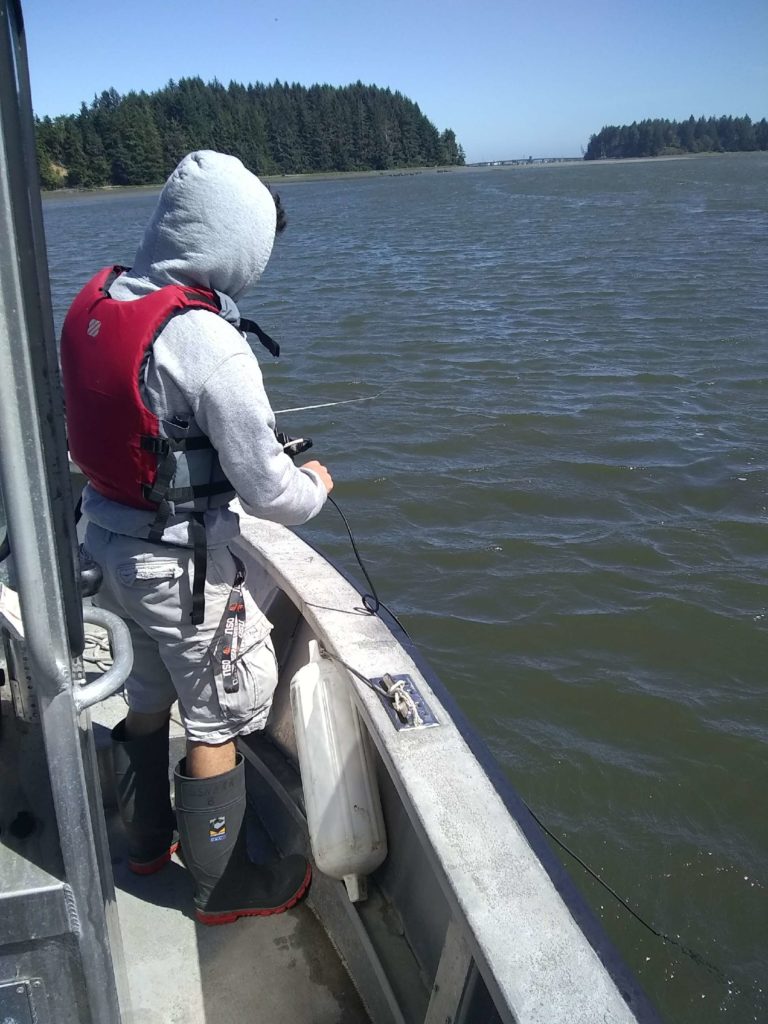
Student researcher Lucas Parvin stands on a boat lowering monitoring equipment into the water of the South Slough.
Assisting in water quality monitoring.
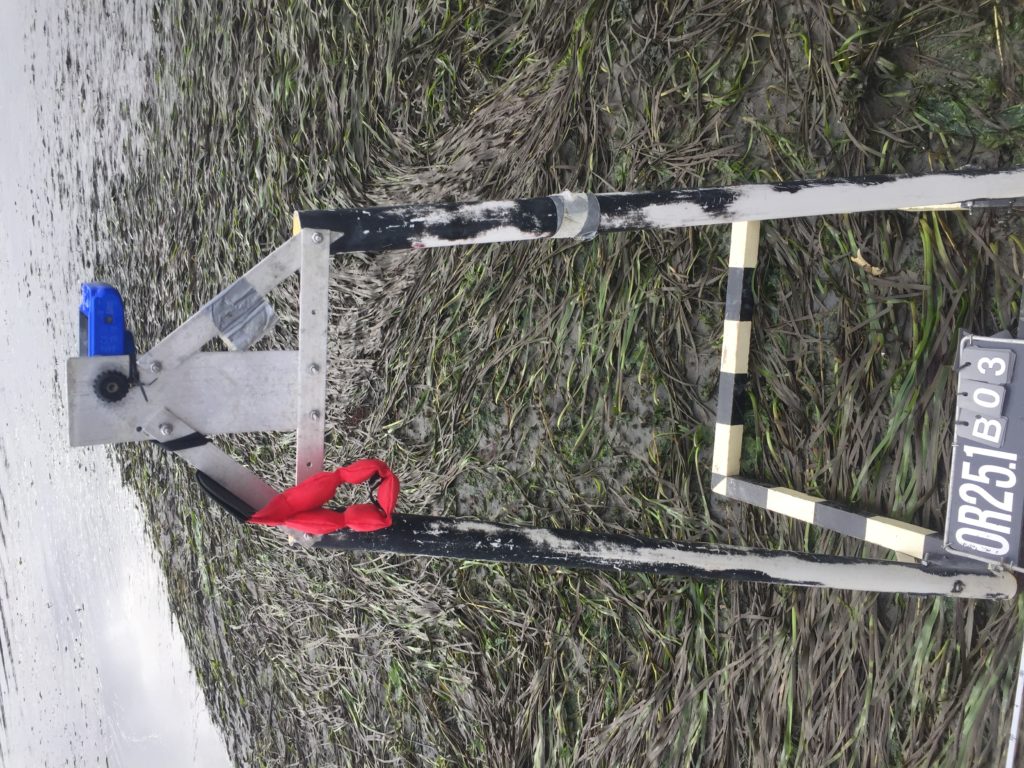
Equipment used for estimating population and health of eelgrass.

I hope to develop an in-depth understanding of estuarine ecosystems this summer, while also learning about how wildlife reservations are managed. These goals will be accomplished while working diligently to achieve the goals of our education team: to improve locals’ understanding of how estuarine systems work and why they are so important. If my summer internship is successful, I will help also enhance the materials that the South Slough has for delivering education in the future.

The work I do this summer will help improve educational outreach because I will be directly teaching and leading groups of local kids. I will also add to the educational materials that the South Slough has to deliver education by working on projects ― like the creation of the plant guide that I have been working on. In addition, I will add to the pool of information known about the South Slough Estuary by assisting in data collection with the science team.

These project goals will help advance Oregon Sea Grant’s mission because for coastal communities to flourish, citizens of coastal communities must understand how to properly utilize and care for their natural environments. Specifically, improving the understanding amongst youth can increase levels of interest in fields such as biology, conservation, and sustainability. Influencing future generations in this way can help achieve healthier coastal communities.

Similarly, my project goals help advance SSNERR’s mission, which is to serve as a model for how to properly manage coastal communities on regional, national, and global levels.  Part of management involves public outreach, education, and data collection.  These are the aspects of coastal management that I intend to improve in any way I can over the course of this summer. 

Jenna Livingston: Intern at OCOIN

As a Summer Scholar, my primary duties will include communicating with researchers to update information on Oregon Coastal and Oceanic Information Network’s (OCOIN’s) Research Explorer tool, aiding in finding speakers for our annual meeting, and collaborating on blog posts and newsletters. The summer project I am working on will help connect researchers and policy makers to make sure that decisions are made with the most up-to-date information. My personal duties will help with OCOIN’s mission statement by making sure that all the information on the Research Explorer tool is up-to-date to make it easier to access for the general public. I know that OCOIN’s goals align with Oregon Sea Grant’s mission because the research primarily focuses on the Oregon Coast to help shape policies in the Northwest.

Collaboration is key: Efforts to identify co-occurrence between whale and fishery effort in Oregon

The current pandemic and stay-at-home orders have disrupted so many plans and events, but the crab chronicles continue! (Thanks for the cool name, Stephanie!) I am fortunate to be writing this from the safety of my home, where I’ve slowly been adjusting to this new normal. My work remains much the same, with the majority of my time dedicated to drafting a conservation plan for the Dungeness crab fishery to reduce the risk of whale entanglements in crab gear. While the conservation plan timeline itself remains uninterrupted, there have been impacts to other aspects of the state’s whale entanglement management timeline and certainly impacts being felt throughout the crab and broader fishing industry.

One activity related to whale entanglements that is unfortunately being impacted by current events, is a collaborative research project that has been working to collect whale distribution data in Oregon waters since 2019. The project is a collaboration between Oregon Department of Fish and Wildlife (ODFW), Oregon State University, and the U.S. Coast Guard, funded during its first year by the Oregon Dungeness Crab Commission and through Section 6 grants under the Endangered Species Act since. The study is utilizing bi-monthly aerial surveys to collect whale presence and absence data over a two year period. However, surveys have not been able to be conducted since March due to the current public health crisis.

The impetus for this project was a significant information gap identified early on by the Oregon Whale Entanglement Working Group (OWEWG), which was convened in 2017. The OWEWG found that knowledge of seasonal whale distribution in Oregon waters is lacking and must be addressed to better understand the spatial and temporal patterns of whale entanglement risk in Oregon. By combining improved data on whale distribution with relatively high-resolution data on fishery effort from ODFW fishery logbooks, maps of entanglement risk can be developed and used to guide more targeted management. In the meantime, preliminary presence/absence data have already been used to inform ODFW staff recommendations for risk reduction management measures that are being proposed to the Oregon Fish and Wildlife Commission this year.

Additionally, the project involves a citizen science outreach component which encourages ocean users, including fishers, to participate in reporting opportunistic whale sightings through a Whale Alert mobile application. Aerial survey data will inform predictive distribution models describing species distributions relative to environmental conditions, and citizen science data will contribute to model validation. Additionally, vessel-based photo identification and tissue sampling will provide information on whale population structures.

The whale distribution study is critical to making informed management decisions in the future that maximize effectiveness of protecting whales while minimizing impacts to industry. It is also a great example of a collaborative approach to address a challenging issue. I hope that surveys are able to resume soon, when it is safe to do so, to continue collecting this critical information.

Connecting During COVID-19: Research and Communication

Much has changed since last fall! To echo many other recent posts, much of my recent life has been adjusting to the new normal. We are about two months into Oregon’s initial stay-at-home orders. All things considered, I am feeling lucky in my situation. With plans to defend this summer, I am nearing completion of my Master’s research on the adaptive capacity of small-scale fishermen in Baja, Mexico. I am lucky to be able to continue to analyze data and write from home without having to change my research plans.

I have been wondering about the effects of current events on science outreach and collaboration. Although my research wasn’t disrupted, I am bummed about missing out on some outreach opportunities in the spring and summer. Back in February, I presented a poster of my research at the Ocean Sciences Meeting in San Diego. I was also planning to present at the Marine Socio-Ecological Systems Conference in Japan this week, but it was cancelled. I know that many people’s experiences are similar to my own: cancelled conferences, talks, meetings. These missed opportunities can challenge us towards developing new ways of disseminating science remotely. I recently presented via Zoom at the People and Nature virtual seminar here at OSU, and I quickly realized that presenting over Zoom (as opposed to in person) is a new skill in itself! I would imagine that this remote lifestyle affects collaborations too. I observed an (in-person) Marine Protected Area Sizing and Spacing workshop back in March that showed me how valuable it can be to gather experts in the same room to discuss ideas. Running this type of workshop remotely would absolutely still be useful but calls upon a different strategies and skillsets. As I ponder these ideas, I am finding myself continually impressed by the quality and variety of webinars, games, and other online resources that already exist or are actively being created to communicate science. It is encouraging, and it has been interesting to think about outreach and collaboration in this way.

Next fall, I am excited to be continuing on for a PhD in the Geography program here at Oregon State University. Working with my current OSU and NOAA mentors, I will likely be continuing my research into the adaptive capacities of coastal communities by focusing here in the Pacific Northwest. Some questions I am interested in are: How can coastal communities adapt to changes in ocean conditions? and How does collective action of fishing communities result in cooperation or conflict in fisheries? When planning out what my PhD research will look like moving forward, I will consider what is feasible with in-person interview methods that I hope to use. As Brittany mentions in a previous post, studying people recently has become much more complicated.

For now, I’m grateful to be continuing on as planned with my Master’s research and looking forward to wrapping it up this summer. Until the next post, take care!

Navigating Human Subjects Research in a Time of Social Distancing

If you were to ask me what I study as a graduate student, my simplest response would be, I study people. The inspiration for my current research was a desire to understand the human dimensions of marine and fisheries related science fields and a desire to connect with people. However, due to the pandemic, I’ve been forced to reevaluate something that seems so simple and essential to my research just a few months ago. How do I continue to connect with people, in a time where we are encouraged to keep our distance?

Prior to this year, all of my data collection for my dissertation research has involved in-person human interactions. My research examines how life experiences and social identities shape marine and fisheries science related career decisions, and semi-structured in-person interviews had been my method of choice. I spent a large portion of 2019 traveling to marine/fisheries related science conferences/meetings and interviewing students and professionals who were all gracious enough to share their experiences. For my research with marine and fisheries science related professionals, I’m examining whether there are differences in perceptions of natural marine resource management across social identities by incorporating cognitive mapping card sorting into my interviews. And while I was able to collect a large portion of my data last year, I entered 2020 with plans to continue in-person interviews and the goal of completing my data collection by the end of Spring term. However, as winter term slowly began to come to an end, I quickly realized that things were not going to work out as planned, and that I would need a new approach for data collection.

Contingency planning

The week leading into the official stay at home order was rough. I spent a few days being frustrated and disappointed about all the plans that were canceled or rescheduled, but quickly realized I needed to focus on what I could control. Since my research deals with human subjects, my first stop was OSU’s Institutional Review Board’s (IRB) webpage for guidance about conducting research with human subjects during the pandemic, which stated that all non-critical in-person studies should be suspended or cancelled. My next step was to review my initial IRB  application, and while I initially planned to conduct the majority, if not all of my interviews in-person, I realized that I’d included a data collection contingency plan which stated that  “a combination of in-person and online interviews will be used… when in-person interviews are not an option, we plan to use online platforms. This simple entry in my application saved me the stress and time of having to submit a revised IRB application, and allowed for a somewhat smooth transition to online data collection. However, while video conferencing made it easy to move my semi-structured interviews to a virtual platform, moving my card sorting exercise online, presented a new challenge.

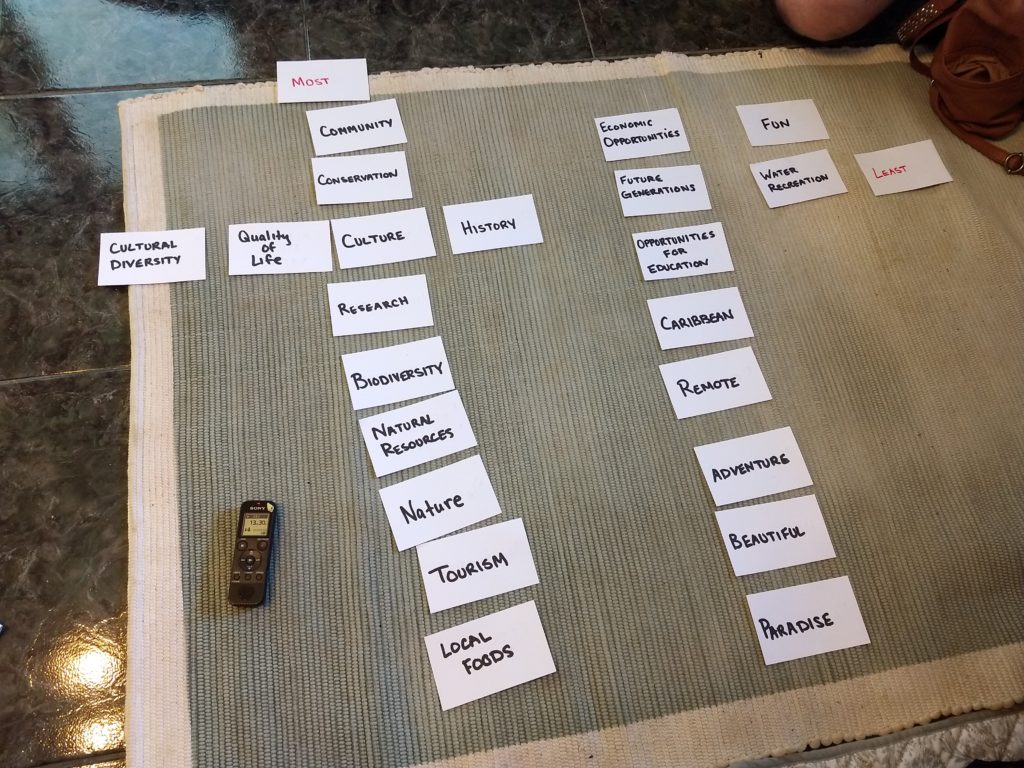
Example of a completed in-person cognitive mapping card sort

Card Sorting Data Collection with Qualtrics

My first task, during the first week at home, was to figure out how to move my card sorting exercise online. I spent the first day looking into various online card sorting platforms that I could potentially use. While there were multiple available, none of them completely met my project needs. Then I decided to explore Qualtrics to figure out if I could use its platform to develop a card sorting survey. Of all the platforms I’d researched, Qualtrics seemed the most promising. After a week of online searches for codes, multiple calls to the Qualtrics help desk, and a few test trials, I was able to develop and interview survey format that mimicked my in-person card sorting. With the use of multiple question formats and a lot of skip logic, I was able to design a survey platform that allows participants to select, group, label, and rank concept cards, as they would do in an in-person card sort, and was able to launch my card sorting survey and continue data collection at the beginning of April.

The Value of using Qualtrics for my card sorting.

Not only has Qualtrics allowed me to continue parts of my dissertation research during this time of uncertainty, I also noticed a few advantages to using the online platform compared to in-person interviews.

  1. Confidentiality Protection – In order to schedule in-person interviews, I was required to collect direct identifiers (names and emails) so I could contact participants to schedule interviews. While all direct identifiers are removed or stored separately from interview or card sorting data, they still exist, and require additional steps to protect the participant’s confidentiality.  By using an anonymous Qualtrics survey link to recruit participants, the collection and storage of direct identifiers was no longer needed.
  2. Broader Reach – The number of interviews and card sorts collected in-person were limited by my capacity to conduct one-on-one interviews. Using a Qualtrics survey for the card sorting eliminates the one-on-one scheduling needs and allows for more people to conduct the card sorting exercise at their own convenience, in various locations.
  3. Data Storage and Access – Once a participant completes the survey, the data is stored to the Qualtrics cloud, and I am able to access it immediately across multiple devices. This minimizes the need for manual data entry.

Lessons Learned 

While I’m still navigating how to push through during this time of uncertainty and how to connect with people, one lesson I learned over the past few weeks is the importance of having some form of a contingency plan. Having the option of conducting parts of my research online has truly saved me time and stress, and in some ways, has worked out for the best. While contingency plans are not always a catch all (there were definitely plans that I had to cancel or postpone), there are cases where they can come in handy and give you one less thing to a worry about, especially in a time of uncertainty.

So, although I’m taking a slightly different approach to connecting with people than I initially planned, it seems like I’m still on track to complete data collection this term. I’ll keep you all posted. Until then, stay safe!

A Data Scavenger Hunt for a Geographic Location Description

Wow! I can’t believe I am already 8 months into my Fellowship with DLCD, it really has flown by! As I look back, I think one of the main things that have stuck out to me is how close-knit this community really is. It takes several different entities to have a coastal “blue economy” up and running, including resource managers, fishermen, hotel and recreational employees, etc. Each of these people give a unique perspective to coastal management, and I am very excited to continue to grow these relationships in the final 4 months of my fellowship!

My main project has involved looking at the reasonable coastal effects of offshore seafood processing discharge, and writing a document known as a Geographic Location Description (GLD). This GLD will allow the state to review federal activities or federally authorized activities listed in the document, and approved by NOAA. Over the course of my fellowship, I have been able to gather a majority of the data necessary for the state to begin to understand these effects, and map areas of concern. For example, we are aware that land-based processing facilities discharge high impact wastewater; meaning this wastewater has a high Biological Oxygen Demand (BOD). Research has shown that certain areas that are being discharged into have also seen a recurrence of low dissolved oxygen waters. One of the concerns is that these waters mix with state waters resulting in larger hypoxic events along the shelf. While these discharge events are not the sole cause of the hypoxia, we can infer that it most likely cannot help. Issues like these have been at the heart of my project, and it has been very interesting collaborating with resource managers, academic professionals, industry officials, and others to help gather the information necessary for the GLD. (I like to think of it as a scavenger hunt!)

Due to the pandemic response, I am also blessed to be working from home on my project. It was definitely an adjustment at first, but I feel like I am more used to working from my living room now! As I am rounding the corner of my fellowship, I hope to have a GLD ready to turn into NOAA. If not, I hope to have DLCD much closer to having one, than when I began!

“A PhD for High School”: partnering with a local high school teacher during the COVID-19 pandemic

To echo many of my fellow Sea Grant Scholars, much has changed since my last post. It feels like COVID-19 is changing the world every day. The pandemic has asked us all – nations, communities, and individuals – to make decisions under great uncertainty. Many of us try to stay informed about best practices, infection rates, and scientific breakthroughs related to COVID-19, but they seem to change before we can even make sense of them. Recently, I read an article in The Atlantic entitled “Why the Coronavirus is So Confusing” (Yong 2020). The article summarizes several major sources of confusion about COVID-19 and explores key miscommunications that have compounded the uncertainty we feel. This pandemic has highlighted the importance of science communication for scientists, our nation, and the world. As I reflect on the role of scientists during this time, I am motivated to a) expand my science communication skills and efforts, and b) identify pathways for scientists to support our local communities.

Like many other field researchers, COVID-19 has caused major disruptions to my sampling season, potentially shifting the focus of my dissertation. It is easy to feel discouraged that I’ve been pulled away from my research – especially this time of year. May marks the beginning of a long and exciting field season to collect juvenile nearshore fishes from offshore moorings and tide pools.

Megan Wilson and Will Fennie (past OSG Malouf Scholar) get ready to snorkel in Port Orford, Oregon, to collect juvenile nearshore fishes. The flag in the background marks the location of a fish aggregating device (called a SMURF: Standard Monitoring Unit for the Recruitment of Fishes) that lies five feet below the surface.

Instead, I’ve chosen to use this time to strengthen and expand my science communication skills by partnering with a local high school teacher, Mr. Andy Bedingfield, to build marine ecology coursework and facilitate project-based learning during the pandemic. I’ve found this partnership to be extremely timely, fulfilling and synergistic – not only do I have to opportunity to practice science communication and education during a time when quality science communication is so desperately needed, but I also feel that I am able to use my training as a scientist to help my community during a time of need. Andy and I are working together for the remainder of Lincoln City High School’s academic year, and we hope to publish an article in the National Science Teaching Association journal so that other teachers can benefit from the coursework we’ve developed and our lessons learned.

Our goals are in this partnership are threefold:

1. Develop a marine ecology curriculum for high school students that can be delivered virtually

Andy and I have been working together for the past two months build online curriculum to meet the Next Generation Science Standards (NGSS) relevant to his Ecology class. We developed learning outcomes from each Disciplinary Core Idea (e.g. “LS2.A: Ecosystem dynamics, functioning, and resilience”) and identified specific marine ecology concepts that illustrate the core ideas. With this as our roadmap, we then searched for or developed videos and online content to meet each learning outcome. Using open source software like EdPuzzle and ScreenCastify, Andy annotated and personalized the educational videos we found and embedded questions sets in the videos to check for understanding. Andy refers to this part of his course as “The Workout”, where students put in time and effort to build their knowledge base such that they will be capable of carrying out an independent project of their choosing.

2. Engage students in project-based choice learning

Working with Andy and the high school students has shown me that for them, choice = motivation. Andy’s teaching philosophy centers on the idea that children and students are curious scientists by nature, and that a teacher’s role is to provide guidance, structure, and direction to facilitate their scientific process. To this end, Andy asked me to brainstorm several marine ecology projects that both pertain to the Disciplinary Core Ideas and develop NGSS core competencies (e.g. “Use mathematical equations to explain energy transfer”). I generated a list of activities and materials for marine ecology lessons that I had accumulated throughout my undergraduate career, and Andy and I worked together to hone these projects into manageable, grade-appropriate activities for the students. Andy has taught me several key teaching strategies to make projects more manageable for students including “chunking” or only assigning parts of a project at a time (e.g. Week 1 Introduction, Week 2 Methods) and using student examples to show students the caliper of final project we are hoping for, rather than reading them a rubric. The students have several marine ecology projects to choose from: Investigating trade-offs in marine spatial management using SeaSketch, Modeling sustainable fishing in tuna populations, Energy transfer in plankton food webs (thanks to help from the OSU Plankton Ecology Lab), and investigating human impact and resilience in the rocky intertidal zone (thanks to help from the OSU PISCO Lab). Each of these projects can be delivered online, is relevant to local, coastal Oregon ecology, and is flexible to meet each student’s individual interests. Andy refers to this aspect of his course as “a PhD for high school”, and emphasizes the importance of engaging his students in real, tangible science projects instead of canned labs, where they experience the joy of innovation and discovery, and gain confidence in their science identify and ability.

3. Document the process of integrating scientists and researchers into high school education

Andy and I hope to document the lessons learned through this process to facilitate collaborations like ours for other scientists and educators. Thus far, we’ve found that the more interaction the students have with the scientists (me), the better. In oppose to a visiting scientist giving a single lecture, we hope that having the visiting scientist work with students (e.g. office hours) and engage with them about their ideas and interests over the course of several weeks will build the student’s confidence and motivation. Last week, we introduced the projects and this week, we will be working on a literature review and methods description. They will they carry out their projects for two weeks, and complete a final presentation afterward.

I am very excited to continue working with Andy and the students. They are constantly challenging me to communicate my science in relevant and innovative ways. I am grateful for this opportunity to connect to my local coastal community and to inspire, equip, and empower the next generation of marine scientists. Stay tuned for a project update in the coming weeks!

Planning for uncertainty in a changing world

As another Sea Grant fellow pointed out, a whole lot has changed since our last blog posts. The world seems to have turned upside down in response to the Covid-19 pandemic. Our everyday lives have shifted dramatically, and many of us are struggling with a deep sense of uncertainty for what is to come. This pandemic has put a spotlight on our national (as well as personal and global) need to improve flexibility, planning, and response times in the face of current and future change.  On both large and small scales, we are asking ourselves how we can best cope with the crisis at hand, and how we can better prepare for inevitable future surprises. On the bright side, this tumultuous time has created space for us assess our societal, personal and professional priorities as we move forward. In particular, many of us are looking for tools to increase our resilience and adaptive capacity as time goes on.   

Although completely unrelated to Covid-19, the members of the Oregon Marine Team at The Nature Conservancy (TNC) have been asking similar questions for almost a year, but in the context of fisheries. The team has been examining uncertainty through a process known as Scenario Planning, focused on the future of West Coast fishing, management, and the communities that rely on that industry. 

Scenario planning is a tool that was first created by the US military during World War II, later modified for use by the oil industry, and more recently been applied to a wide array of business and agency contexts, including the stock market and natural resource management. In essence, this method explores what may happen under different sequences events by helping managers and decision makers develop strategies to meet uncertainty. Under the direction of a consultant, TNC is collaborating with the Pacific Fishery Management Council (PFMC) (https://www.pcouncil.org/) on a multi-phase Scenario Planning process that examines climate change scenarios and related impacts on fisheries along the California Current System (CCS).  

The process includes 5 distinct steps: “Establish, research, create, validate and apply”. The “create” phase involves a scenario planning workshop, which took place in January 2020 in Orange County, California.  The workshop brought together upwards of 80 West Coast fishermen, managers, tribal members and scientists for an interactive brainstorming session that examined a central question: How will climate change impact West Coast species and coastal communities over the next 20 years (PFMC 2020)? By the end of the workshop, participants had successfully created a set of narratives (or scenarios) describing what the marine environment may look like in 2040. Since then, these scenarios have been refined and results will be ground-truthed and further researched over the coming months. (If you’re interested, click here for detailed information on the January workshop.)

As the PFMC process continues, The Nature Conservancy has launched another Scenario Planning initiative, this one with the state-managed Dungeness Crab fishery in Oregon. While Covid-19 related complications have delayed the process, we are deep into the planning process and we are remaining flexible in regards to timing as we plan our next steps.

There are a number of reasons why TNC is focusing their efforts on scenario planning for the Dungeness crab fishery:

  • The fishery is important to coastal economies: In most years, Dungeness crab is the most economically important single species fishery in Oregon and across the entire US West Coast (Rasmuson 2013; Lee & O’Malley 2019).
  • Dungeness crab stocks are projected to be impacted by a series of climate change components over coming decades, including marine heat waves (remember the ‘warm blob’), Hypoxia and Ocean Acidification (OA), and Sea Level Rise.
  • In addition, the fishery itself will likely be impacted by increasing harmful algal blooms (HABs) containing toxic diatoms like domoic acid (DA), as well as whale entanglements.

These factors of change point to a significant access reduction to the fishery in coming decades, which may create ripple effects across cultural and socio-economic aspects of Oregon’s fishing communities. Over the coming year, TNC will utilize existing data, and gather knowledge from fishermen, managers, scientists and community members, to develop scenarios for fishing communities 20-50 years from now. The goal of this process is to contribute to future planning and decision-making abilities in coastal communities, in management and in the fishing industry itself (Borggaard et al 2019; Peterson et al 2003). 

Like many of us in the environmental sciences, I’m keenly aware of how climate change components are creeping into local, regional and global systems, and I am awaiting more dramatic shifts in my lifetime. Even so, the projected state of our planet in 20, 50 or 100 years remains abstract in my mind because of my limited scope of direct experience. Although COVID-19 may not be related to climate change, both pandemics and climate change have been intricately studied, and experts openly share concerns of issues to come. Our global response to Covid-19 spotlights how ill prepared we are for the abstract, but inevitable. For me, this pandemic has cemented the importance of tools like scenario planning to better prepare for our future.

References:

Borggaard, D & Dick, D & Alexander, M & Bernier, M & Collins, M & Dudley, R & Griffis, R & Hayes, S & Johnson, M & Kircheis, D & Kocik, J & Morrison, W & Saunders, R & Sheehan, T & Saba, Vincent. (2019). Atlantic salmon climate scenario planning pilot report. 10.13140/RG.2.2.20713.85604.

Lee, E and O’Malley, K (2020) Big Fishery, Big Data, and Little Crabs: Using genomic methods to examine the seasonal recruitment patterns of early life stage Dungeness crab (Cancer magister) in the California Current Ecosystem. Frontiers in Marine Science. Doi. 10.3389/fmars.2019.00836

Peterson, G., Cumming, G., Carpenter, S. (2003) Scenario Planning: A tool for conservation in an uncertain world. Conservation Biology. Vol. 17, No. 2.

Pacific Fishery Management Council (2020) Follow up from a workshop co-sponsored by The Nature Conservancy and the Pacific Fishery Management Council in support of the Fishery Ecosystem Plan Climate and Communities initiative. https://www.pcouncil.org/documents/2020/03/g-3-a-supplemental-cci-workshop-presentation-1-follow-up-from-a-workshop-co-sponsored-by-the-nature-conservancy-and-pacific-fishery-management-councilin-support-of-the-fishery-ecosystem.pdf/

Rasmuson L (2013) The biology, ecology and fishery of the Dungeness crab, Cancer magister. Adv Mar Biol 65:95–148

Working through a pandemic

Times have certainly changed since my last blog post. With all of the COVID-19 health measures in place, the agency I work for (Oregon Department of Fish and Wildlife [ODFW]) has moved to primarily telecommuting. For me, this isn’t a huge difference since I was already working mostly remotely and have developed a routine to maintain productivity and minimize distractions throughout the day. However, I imagine that it is quite a big change for most of my coworkers that are used to working in the Newport office.

One measure my team, the Marine Reserves Program, has taken to ensure connectivity during these social distancing times is weekly virtual meetings. We start the meeting by each sharing a tip we have learned to improve this isolating experience or a suggestion we’ve heard for how to help out our community during this difficult time. Given the active nature of my team, tips often include taking the dogs on long early morning walks, setting up virtual exercise classes with friends, and making time for lunchtime yoga to keep routine and movement in your day. Suggestions for helping the community include purchasing food from local businesses and getting involved with volunteering where possible (e.g. helping distribute meals or groceries to those unable to leave their house).

Starting our weekly meetings on a positive, team-focused note makes me look forward to these Wednesday afternoon get-togethers. We’ve even started adding in silly components to distract from the seriousness of the real world and allow for us all to have a laugh. Last week we donned silly hats for our meeting, which allowed me to see my boss (Tommy) wearing his daughter’s bunny ear beanie with wire cat ears on top. Quite a sight!

While these meetings are used to keep us informed of any ODFW COVID-related changes, their primary purpose is really to keep our team connected. During this time of social isolation, staying intentionally connected is more important than ever for our mental health. I feel very lucky to be part of a team that takes the time to check in with their coworkers in both a personal and professional manner.