SCARC completed three new finding aids from July – September 2022!
These finding aids are available through the Archives West finding aids database, website, and the OSU Library discovery system a.k.a. “the catalog.” The links below are to the guides in Archon.
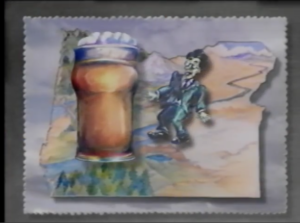
The Widmer Brothers Brewing Company Records includes brewing records, photographs, marketing materials, office files, ephemera, and audio video content.
Widmer Brothers Brewing Company was founded in 1984 in Portland, Oregon by Kurt and Rob Widmer. Kurt Widmer retired in 2016, the Gasthaus closed in 2019, and Anheuser-Busch InBev acquired the company in 2020.
The Rock Bottom Brewery Records document the brewing operations at the SW Morrison Street, Portland, Oregon facility. Rock Bottom Brewery is a Denver-based chain of brewpubs. They opened the Portland pub in 1994 at 206 SW Morrison Street.
The Oregon Trail Brewery Records document the brewing and company operations, finances and shareholder involvement, transitions to new ownership, marketing and promotion, and reporting about the brewery in the press.
The Oregon Trail Brewery Company was incorporated as Brewing Northwest, Ltd. on March 20, 1985 in Corvallis, Oregon and began beer production on July 15, 1987. When Oregon Trail Brewery opened in 1987, it was the first new brewery in the Willamette Valley outside of Portland since Prohibition was repealed.
The Regional Politics and Policies in SCARC LibGuide is your guide to all things local politics in the archives. The guide is substantial, providing information and resources in five categories: politicians and public servants, civic engagement groups, legislation and ballot measures, clubs and organizations, and the Oregon Legislature and political process.
Dawn Marges, Helen Berg and Atta Akyeampong, recipients of the Women of Achievement Award
Thirty-two politicians – with public service dating from 1849 to the present day – are included in the guide, complete with abbreviated biographies, details of their career, and documentation of their political pursuits. Where more information exists about their career (often in the form of political papers) at another institution, links to finding aids are provided. Links are also provided for any substantive information that exists for each politician outside of SCARC’s various portals and collections, whether that be an online exhibit (in the case of particularly influential historical politicians) or current campaign websites for those politicians who are still active.
Considering that SCARC doesn’t consider politics one of its collection areas, the sheer amount of information available within our holdings was admittedly a bit of a surprise to me. Many of the collections featured are not explicitly political in nature, but politics appear nonetheless – alongside a subject’s interests, passions, and expertise. Clearly, politics are bound up in nearly every aspect of our lives. In exploring collections that are not explicitly political, the nuances of public service, the importance of a rich civic engagement, and the entanglement of politics with nearly every feature of life in the Pacific Northwest come to the fore. Perhaps it will inspire you to think more about the indivisibility of politics from your life, much like it did for me.
Urban League of Portland staff
The activities and activism of several civic engagement groups are included in the guide as well, accompanied by short histories and information about each of the organizations. While some organizations, like Colleges for Oregon’s Future, no longer exist, most of the organizations are still active and influential around the state.
A number of laws, ballot measures, and initiatives are included in the “legislation and ballot measures” section. The bulk of the legislation included in this section is environmental policy and legislation introduced and passed at both the federal and state levels in the 1980s, 1990s, and early 2000s and was influenced by the struggle between environmentalists’ interest in preserving spotted owl habitat in the Pacific Northwest, the interests of timber companies, and the role of the U.S. Forest Service in the mediation of these interests. In addition, the struggle for LGBTQIA+ rights in Oregon in the 1990s and early 2000s is documented in this guide and throughout SCARC collections in discussion of ballot measures eight, nine, and thirty-six, activism in opposition to the Oregon Citizens Alliance, and the legal battle over the legalization of same-sex marriage.
The activities and political passions of OSU’s student body and the Corvallis community are well documented in SCARC’s collections – 54 politically-inclined student groups and community organizations are represented in the research guide.
State Capitol Building
The guide also includes a wealth of resources and information surrounding the Oregon legislature – its establishment and evolution, as well as the proceedings and happenings of 33 assemblies of the Oregon Legislature, are documented in our rare books collections. The general history of the Oregon Legislative Assembly, legislative procedure, and information about the legislative membership is also documented in the guide, as is the history and proceedings of the Oregon Constitutional Convention.
I hope you enjoy using this guide as much as I enjoyed researching, writing, and organizing it!
This post is contributed by Carlee Baker, designer and author of The Regional Politics and Policies in the Special Collections and Archives Research Center Guide. Baker is a graduate student in the School of Writing, Literature and Film at Oregon State University (2022).
SCARC completed five new finding aids from January to March 2022!
These finalized finding aids are available through the Archives West finding aids database, our website, and the OSUL discovery system a.k.a. “the catalog.” The links below are to the guides on our website.
The Robert Dalton Harris, Jr. Collection of Atomic Age Ephemera consists of printed ephemera produced from the late 19th century to the present day. The materials comprise broad coverage of many scientific, religious, cultural, industrial, political, environmental, and other aspects of nuclear history. Items are arranged chronologically by date of creation. Robert Dalton Harris, Jr. and his partner Diane DeBlois are authors, editors, historians, independent scholars, and long-time proprietors of aGatherin’, a business that deals in ephemera and original source materials.
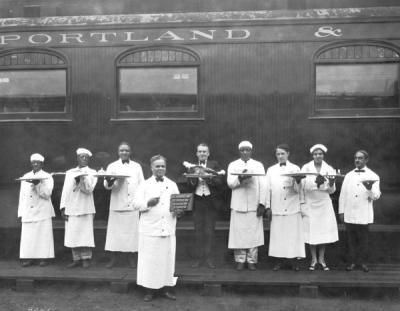
The African American Railroad Porters Oral History Collection is primarily made up of thirty reel-to-reel sound recordings containing interviews between filmmaker Michael Grice and African-American railroad porters employed in the Portland area. The interviews cover a variety of topics, including the day-to-day work of porters, labor unions, and racism in the Portland area. These recordings formed much of the background research used for Grice’s 1985 film, “Black Families and the Railroad in Oregon and the Northwest.” Copies of the film are included in the collection and is available online.
The College Bulletins consist of bulletins published by Oregon Agricultural College, and later Oregon State College, to promote the academic programs and outreach activities of the College. Almost 500 bulletins were published over 30 years from 1902 to 1932. Items from this collection have been digitized and are available in Oregon Digital.
The Anne Frewerd Scrapbook consists of mementos from her time working at Los Alamos, New Mexico for the Manhattan Project in 1945. Included are souvenir and personal photographs, newspaper clippings covering the bomb dropped on Hiroshima, and other ephemera related to her work in Los Alamos, including a telegram and pin.
The Annual and Biennial Reports consist of reports from the earliest years of Oregon State University in the 1870s through the early 2000s and document the administration and all functions and activities of the institution.
SCARC completed 6 new or updated finding aids October – December 2021. The following is a list and a little information about what we accomplished.
These finalized finding aids are available through the Archives West finding aids database, our website, and the Valley Library catalog.
Four New Collection Guides Were Created
Karl F. Drlica Papers, 1909-2018 – The Karl F. Drlica Papers are comprised of materials generated and collected by Oregon State College alumnus, physical education professor, and crew coach Karl F. Drlica. This collection documents Drlica’s management of the Oregon State University crew teams, instruction of courses, involvement in organizations, and work as an educator for the United States Military in post World War II Japan. Among the materials included in this collection are correspondence, game programs, meeting minutes, newspaper clippings, photographs, a scrapbook, artifacts, and a thesis. Drlica graduated from Oregon State College with bachelor’s and master’s degrees in education in 1940 and 1952, respectively. From 1950 to 1983, Drlica coached and coordinated crew activity at OSU.
Barometer Campus Newspaper (PUB 015-11b) – The Barometer Campus Newspaper consists of Oregon State University’s student-published newspaper and documents the full range of campus programs and activities, as well as local and regional news and events. The first issue — The College Barometer — was published in March 1896 in a magazine format. In 1906, a weekly publication in a newspaper format was launched and by 1923 the Daily Barometer was published every weekday during the academic year. Many issues of the Barometer are available online in Oregon Digital. Comprehensive digitization of the campus newspaper began in 2020 and will continue until completed; issues are added to the site regularly.
Hmong at OSU Records (MSS HmongOSU) – The Hmong at Oregon State University (OSU) Records provide insight into the operations of the Hmong at OSU student organization. This student organization was founded to foster awareness of Hmong culture at OSU, as well as provide social support and skill-building opportunities for members of the organization. The entire collection is digital and fully available upon patron request or for use in the SCARC reading room.
Memorial Union Records (RG 099) – The Memorial Union Records document the administration of this organization and its role in managing services and events at the two student union facilities at Oregon State University: the Memorial Union and the Memorial Union East (also known as Snell Hall). Spanning the years 1922 to 2012, these records include: annual reports, correspondence, course materials, digital files, financial records, flyers, handbooks, meeting minutes, photographs, posters, publications, scrapbooks, and sound recordings. The Memorial Union has served as OSU’s official student union facility since 1928. Items from this collection have been digitized and are available in Oregon Digital.
Two Existing Collection Guides Were Updated
Oregon State Yank Collection, 1942-1945 (MSS Yank) – The Oregon State Yank Collection consists of correspondence from Oregon State College alumni serving in the military during World War II to Elaine Kollins Sewell and Jane Steagall, editors of the Oregon State Yank. Digitized versions of all the letters are available for use in the Special Collections and Archives Research Center Reading Room or upon request.
Japanese-American Association of Lane County, Oregon, Oral History Collection, 1994-2008 – The Japanese-American Association of Lane County, Oregon, Oral History Collection consists of digital recordings of oral history interviews of Japanese Americans living in Eugene, Lane County, Oregon, and the vicinity. These oral histories document the immigrant experiences of the interviewees’ parents and grandparents; the World War II experiences of the interviewees in internment camps; and their lives in Eugene and neighboring communities in the years following the war.
In celebration of Oregon Archives Month, SCARC staff have pulled together a few of their favorite things in our collections. This is the fourth in the series.
The Barometer is an amazing resource for learning about Oregon State through the years…and also other news like:
An opinion headline in January 27, 1995: “Internet Surfing, Home Computer Craze: Is It Worth It?”
News from the summer of 1969: major protests, arrests, and convictions of protestors related to the denial of promotion to English instructor Frank Harper and subsequent dismissal of same. Also, continued protest against closing women’s dorms at night.
More fun: November 6, 1969 Barometer was printed with blank pages except ads in protest of ASOSU senate effort to review editorial board to potentially change editorial staff. The bill passed but was vetoed by ASOSU president.
In Fall 1968 MU board of directors exclude military recruiting inside MU.
November 7, 1928: It is official, Corvallis voters have lifted the ban on Sunday movies by a 2 to 1 margin. Also, Hoover wins in a landslide!
It was reported in the Barometer May 19, 1981 that the investigation into a graduate student that disappeared off a research vessel off the coast of Hawaii ended after 18 months, concluding the student was alive and well, though whereabouts unknown. He seems to have not wanted to go home.
Cases of measles on campus in April, 1973. Yikes!
April 19, 1996, the Barometer included a story from the Associated Press titled, “Expert says police in need of ethics training.” Whelp…
November 15, 1990: It was reported that a 6 year old boy in France shot his mom in the stomach with a rifle after she refused him a Coca-Cola. And that’s the way it is.
Kevin Jones is SCARC’s metadata and digitization specialist extraordinaire. SCARC would be lost without him! He likes to play all kinds of games, run, and play ultimate Frisbee.
In celebration of Oregon Archives Month, SCARC staff have pulled together a few of their favorite things in our collections. This is the third in the series.
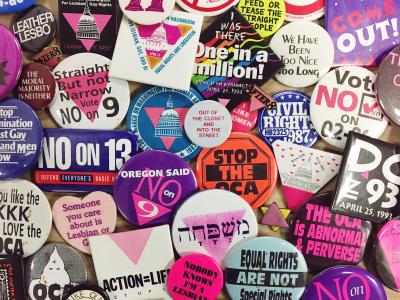
The After 8 pins are part of the After 8 Records, a collection that documents the political activism and community outreach work of the After 8 organization, an group which operated in Benton County from 1989 to 2002, but was primarily active during the 1990s.
“After 8” is in reference to and a response to Ballot Measure 8. In November of 1988, Ballot Measure 8 passed in the state of Oregon, effectively rescinding Governor Goldschmidt’s 1987 Executive Order 87-20 prohibiting discrimination on the basis of sexual orientation in the executive branch of the state government. In addition to the dismantling of this previous protection, Ballot Measure 8 introduced a new law allowing state officials to take the sexual orientation into account in making personnel decisions, and preventing them from acting on reports of such discrimination. Thus, the ballot measure effectively made it legal to discriminate at all levels of state government on the basis of sexual orientation, then defined as homosexual, heterosexual, and bisexual.
In response to Ballot Measure 8, a group of women in Benton County met in the week following its passage to discuss the potential for mobilization within the local gay and lesbian community. By December of that same year, a group of lesbian and gay community members and their allies were meeting bi-weekly, and in January of 1989, the group was given a name—”After 8″. Their mission became “To create conditions which ensure that all persons are protected from any discrimination based on sexual orientation.” Throughout the group’s lifetime, After 8 sought to achieve this mission through education and advocacy—working with members of the community, engaging in political activity, networking with individuals, organizations, businesses, and institutions, and effectively making themselves visible as active participants of the local community. After 8 operated in Benton County from 1989-2002.
Pins are an easily visible, portable, and effective form of community activism, and the After 8 pins are both fun and informative. Some of the pins such as “Stop the OCA” reference the Oregon Citizens Alliance, a conservative Christian political organization that proposed the anti-LGBTQ+ rights Measure 9; some pins like “Straight but not narrow, vote no on 9” show the allyship from non-LGBTQ+ community members; and some pins like “leather lesbo” are timeless.
In addition to their historic value for researchers to incorporate in their scholarship, the After 8 pins are always a hit when used as part of SCARC instruction sessions and they make for great exhibit pieces.
Natalia Fernandez is currently serving as SCARC’s Interim Director. In her permanent role, she is the curator of the Oregon Multicultural Archives, OSU Queer Archives, and OSU DisAbility Archives; she also serves as the Supervisor of the OSULP Diversity Scholars Program. She has been with OSU for over 10 years and her office is located in the 3rd floor archives workroom.
In celebration of Oregon Archives Month, SCARC staff have pulled together a few of their favorite things in our collections. This is the second in the series.
When I first learned of Professor Betty Lynd Thompson and saw photographs of the enigmatic and graceful modern dance movements that were part of her instruction from the 1930s through the 1950s, it was truly an enchanting moment. One of the joys of being an archivist for me is the chance to discover different worlds of knowledge and art through the lens of preserving OSU history. If seeing those images was fun and inspiring, receiving examples of Thompson’s “danceramics” to add to the Betty Lynd Thompson Papers took that sense of enchantment to a whole another level!
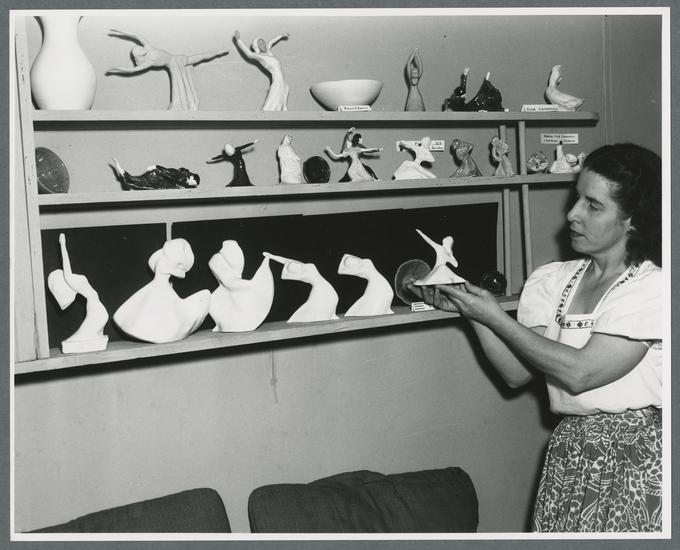
Thompson taught modern dance in the Physical Education Department from 1927 until 1972. During a sabbatical leave in New York City in the 1930s where she studied with modern dance pioneer Martha Graham, Thompson also developed an interest in clay sculpture. In a wonderful fusion of interests, Thompson started to form clay figures engaged in modern dance moves. She called this new art form “danceramics.”
This image documents the amazing range of danceramic figures that Thompson sculpted. The example that Thompson is holding in this view was produced in multiple quantities and given as awards to outstanding student members of the Orchesis National Honorary Society.
This actual example of one of Professor Thompson’s sculptures was awarded to alumna Phyllis Brown in 1950. It was donated to the Special Collections and Archives in 2017 by the OSU Alumni Association and is now described as part of the Betty Lynd Thompson Papers.
As someone who has dabbled in clay craft for a number of years, these sculptures speak to me on many different levels. Aware of how tricky handbuilding sculptures in clay can be, I recognize Thompson’s skill in creating these figurines while at the same time admire that she formed a wonderfully creative way to document her legacy of instruction and dance to the university!
Karl McCreary is a Collections Archivist, and has the opportunity to review, transfer, and describe many of the incoming additions to the collections. His particular specialty within SCARC is working with materials documenting the OSU community and the myriad facets of it’s world-alumni, faculty, departments, clubs, and associated organizations. The variety of subject matter is bewildering!
In celebration of Oregon Archives Month, SCARC staff have pulled together a few of their favorite things in our collections. This is the first in the series.
I love Maud Wilson. I sense in her a kindred spirit – the spirit of the Virgo.
Maud Mathes Wilson was born in Pike County Illinois on July 6, 1882. In 1913, she graduated from the University of Nebraska, and subsequently spent the next five years there, working as a Professor and Extension Agent. In 1925, having received funding from the U.S. Office of Experiment Stations to conduct a study concerning itself with the “character of the job of the homemaker,” she joined the staff of the Oregon Agricultural College. More specifically, Wilson’s “time study” sought to “show in what respects and to what degree homemaking is affected by certain circumstances under which it is done, such as the location of the home, the occupation of the chief income earner, the number and the ages of children and the equipment of the house.” Wilson was the first faculty member at OAC to conduct research full-time in home economics; specializing in the study of housing design, she also served as head of Home Economics for the Agricultural Experiment Station.
Between 1940 and 1944, she worked with the Oregon Experiment Station’s Department of Agricultural Engineering to develop architectural plans for homes suited to the conditions specific to rural Oregon, using space standards determined in previous studies. This work helped to establish nationwide housing construction standards for essentials such as kitchen cabinets and appliances.
Wilson retired from OSU as Professor Emeritus of Home Economics Research on June 30, 1950. In 1951 she spent five months in Japan, where she helped the Japanese Agricultural Improvement Bureau with plans for setting up a department of Home Economics Research. Maud Wilson died October 31, 1972 in Portland, Oregon.
Like so many of the papers of home economists in SCARC’s holdings, Wilson’s papers unequivocally illustrate the scientific nature of Home Economics as a discipline. Consequently, I felt hard pressed to pick any single favorite thing from Maud’s papers. I was sorely tempted by several of the “Station Bulletins” she published as part of her work for the Experiment Station: Planning Kitchen Cabinets and Patterns for Kitchen Cabinets, to name just a few. Both are representative of the decades of work and research Wilson invested in rural home design efficiencies and standards. That being said, deep down I know my favorite item in Wilson’s collection is…The Peanut. Featured in an article entitled, “This is the House that Not Much Jack Built,” from the January 1949 issue of The American Home, the Peanut was the Tiny Home of the 1950s. Designed by California architect Albert Henry Hill, the Peanut cost just $4,100 to build ($46,804.77 today), and came in at just under 500 square feet (485, to be exact). With its floor-to-ceiling windows in the living room / bedroom, and wood paneling throughout, it’s both a Mid-century Modern Fanatic’s paradise, and a Tiny Home Dreamer’s, well, dream.
Rachel Lilley is the Public Services Unit Supervisor (PSUS) for SCARC, and has been a member of the department – and the OSU community – since 2017 (and is a proud OSU alumna!). In her role as the PSUS, she manages SCARC’s Reading Room on the 5th floor of the Valley Library, supervises student employees, and assists with research requests, both in-person and remote. She loves long walks on the beach unironically.
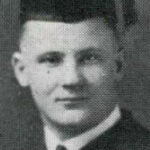
The Harold W. and Charles H. Johnson Collection consists of materials documenting the student experiences and careers of father-and-son Oregon State alumni Harold William Johnson and Charles Harold “Woody” Johnson. Harold Johnson graduated from Oregon Agricultural College in 1923 and studied Industrial Arts. His son Charles completed two degrees from Oregon State College in Engineering (1957) and Business (1958).
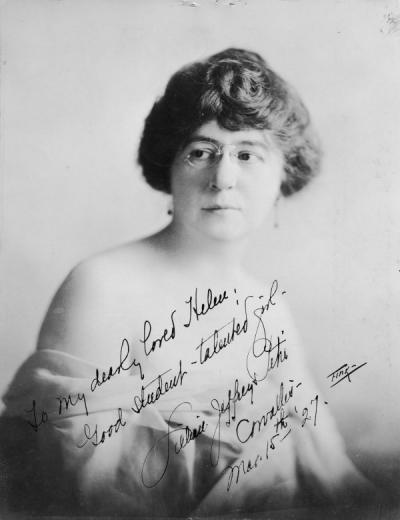
The Lillian Jeffreys Petri Collection consists of piano instruction and technique publications, Mind Over Muscle and Music Fundamentals Correlated, written by Petri. Lillian Jeffreys Petri was a faculty member in music at Oregon State College from 1924 to 1947.
The Virgina Esther Simmons Sewing Book was assembled by alumna Virginia Esther Simmons as an assignment for a home economics class. Simmons graduated from Oregon Agricultural College in 1896.
The Donald Snyder Scrapbook was assembled by alumnus Donald E. Snyder and documents his student experience at Oregon State College. In addition to event programs and dance cards, the scrapbook contains greeting cards, ticket stubs, grade reports, newspaper clippings, photographs, watercolor drawings, and decals. Snyder graduated in 1938 with a degree in engineering.
The Mark V. Weatherford Papers consists primarily of reproductions of documents created in 1851-1856 pertaining to interactions between Native Americans and the U.S. Army, local militias, and volunteers in the Rogue River Valley region of southern Oregon. Mark V. Weatherford graduated from Oregon Agricultural College in 1907 and was an attorney in Albany, Oregon, from the 1910s through 1950s.
One guide is for a new collection received in 2015 that is now fully processed and described:
The Oregon Brewers Guild Records offer a look into the early, formative years of one of the nation’s oldest craft brewer associations, as well as their work in more recent tyears.
The Oregon Brewers Guild was founded in 1992 and is a non-profit trade, marketing, and lobbying association that represents the Oregon craft brewing industry. It’s mission is to protect the brewing industry of the state and the interests of Guild members through education, advocacy, and events.
For Oregon Archives Month, OSU Special Collections and Archives Research Center has shared history in many different ways and this year is no exception!
OSU Library History Self-Guided Scavenger Hunt!
Visit the OSU Valley Library for a self-guided exploration of the past lives of this dynamic building and collect random stickers too! Historic images of the Library will be posted as a part of “Finder Fridays” in October. There will be clues with these images as to their current location (which in most cases look very different today!). At these spots, there will be envelope “sticker stations.” Take a sticker or two as a reward for being a history sleuth and share your adventure! Share with selfies of your adventure or places you’ve seen change on campus with us on Instagram.
This will be both an online exhibit through blogposts and an onsite exhibit in our mini display case outside our Reading Room in the Valley Library.
Find out what particular items in the SCARC collections get us really excited as we describe our “faves” in a series of posts on our “Speaking of History” blog (that’s right here!). Each week in October, we’ll feature a post from a different archivist in SCARC writing about something they really like and why. There will also be an onsite exhibit about these “faves” on the 5th floor of the Valley Library.
We’re Celebrating 10 years as SCARC!
Did you know SCARC used to be two separate departments? Did you know that SCARC was established ten years ago? Did you know we have a veritable treasure trove of old photos to share with you?
Check us out on Instagram every Wednesday when we share a photo from our past!