Category Archives: Uncategorized

A Nisei Who Said ‘No’

This post references a report from the United States War Relocation Authority Reports. The collection is comprised of more than fifty mimeographed reports  detailing the operation of War Relocation Authority (WRA) concentration camps used to house Japanese American incarcerees during World War Two.

Series 2 is composed of 14 “notes” published by the Community Analysis Section (CAS) between 1944 and 1945. The notes are short reports on subjects including marriage customs, healing practices, and “block” self-governance within the concentration camps. The notes series includes several reports documenting interviews with incarcerees. It also includes a series of reports on areas within the exclusion zone including Fresno County, Imperial Valley, the San Francisco Bay Area, and San Joaquin County.

The item reference in this post (Box-Folder 1.20) and the entire contents of the collection have been digitized and are available upon request.

After the United States declared war on Japan on December 8, 1941, racism and xenophobia against Japanese Americans grew. White Americans suspected Japanese Americans of espionage and loyalty to the Japanese Empire. In response, President Franklin D. Roosevelt infamously established internment camps through Executive Order 9066, intending to imprison Japanese Americans living on the West Coast. Importantly, this order targeted not only Japanese immigrants (“Issei”), but also their descendents who were United States citizens (“Nisei”). 

This mass incarceration caused major organizational chaos. Military commanders were given the authority to create incarceration centers for individuals considered a threat to national security. Soon after, Roosevelt signed another executive order into effect, establishing the War Relocation Authority (WRA). More than 125,000 Japanese Americans were first removed from their homes to military-run “assembly centers”, and later, to one of the ten prison camps established by the WRA. 

Between 1942 and 1946, the WRA Community Analysis Section published reports intended to document the social backgrounds of the prisoners and their reactions to conditions in the camps.

Among these reports is a document dated January 15, 1944, entitled “From A Nisei Who Said ‘No’”. 

In the document, a community analyst working at the Manzanar internment camp in California documents an exchange between a young Japanese American man and a hearing board authorized to pass upon questions of segregation at the camp.

The analyst writes that the young man, who remains unnamed through the document, replied “no” to Question 28 of the Army registration form submitted to all male evacuee citizens in 1943. The question read, “Will you swear unqualified allegiance to the United States of America and faithfully defend the United States from any or all attack by foreign or domestic forces, and forswear any form allegiance or obedience to the Japanese emperor, or any other foreign government, power, or organization?”

The question was controversial. By asking Japanese Americans to forswear allegiance to the Japanese emperor, to answer “yes” would imply that they had previously held allegiance to this foreign power. This implication stung Issei and Nisei who held no such allegiance. However, by answering no, a Nisei revoked their American citizenship. The man’s answer resulted in a hearing wherein board members confirmed that the man was an American citizen who had always lived in the United States and that he understood the consequences of answering “no”. 

In the hearing, he stated:

“I thought that since there is a war on between Japan and America, since the people of this country have to be geared up to fight against Japan, they are taught to hate us. So they don’t accept us. First I wanted to help this country, but they evacuated us instead of giving us a chance. Then I wanted to be neutral, but now that you force a decision, I have to say this. We have a Japanese face. Even if I try to be American I won’t be entirely accepted.”

The hearing ended shortly after, when he had convinced the board that his mind was made. He was not willing to serve a country that had imprisoned innocent American citizens. The community analyst who authored the report reached out to the man for a fuller statement on his views, a portion of which are included below:

“Before evacuation, all our parents thought that since they were aliens they would probably have to go to a camp. That was only natural – they were enemy aliens. But they never thought that it would come to the place where their sons, who were born in America and were American citizens would be evacuated. We citizens had hopes of staying there because President Roosevelt and Attorney General Biddle said it was not a military necessity to evacuate American citizens of Japanese ancestry.”

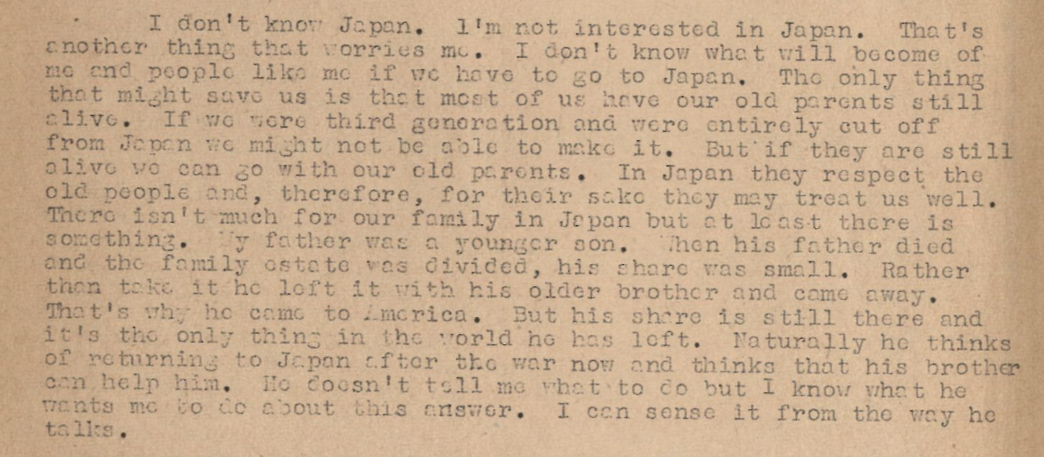
“I don’t know Japan. I’m not interested in Japan. I don’t know what will become of me and people like me if we have to go to Japan.”

“I tell you this because it has something to do with my answer about that draft question. We are taught that if you go out to war you should go out with the idea that you are never coming back. That’s the Japanese way of looking at it.”

“In order to go out prepared and willing to die, expecting to die, you have to believe in what you are fighting for. If I am going to end the family line, if my father is going to lose his only son, it should be for some cause we respect. I believe in democracy as I was taught in school. I would have been willing to go out forever before evacuation. It’s not that I’m a coward or afraid to die. My father would have been willing to see me go out at one time. But my father can’t feel the same after this evacuation and I can’t either.”

This report is a rare occurrence, wherein a Japanese American was able to voice their views to a government authority. Moreover, the young man’s decision and statement represents radical protest by Japanese Americans against United States policy during the war. The young man was not alone; it is estimated that twenty percent of all Nisei responded “no” to Question 28. The WRA also found a sharp increase in the number of repatriation and expatriation applications from Nisei and Issei during this time. By refusing to serve the United States, these individuals were practicing the very democracy they had hoped to defend.


This post is contributed by Grace Knutsen. She is a student archivist at the Special Collections and Archives Research Center. She studies history, French, and German.

A Peek in the Box: Dance Cards

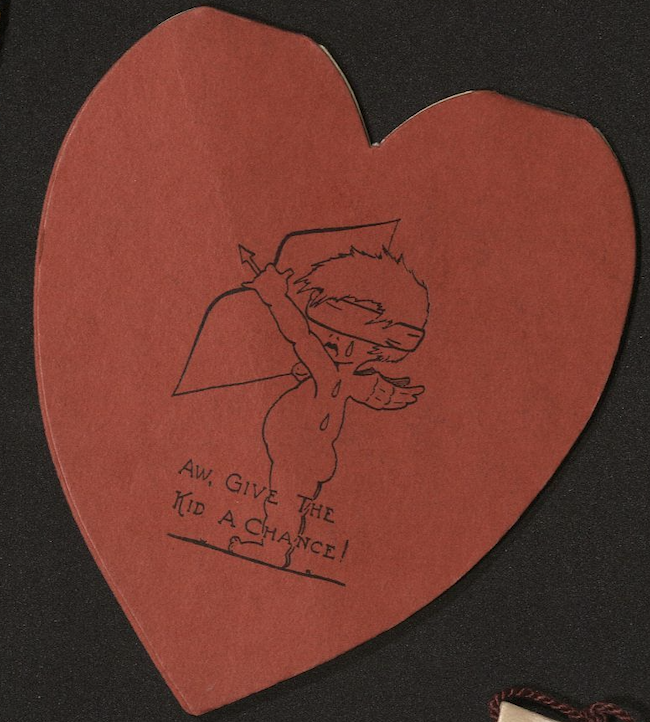
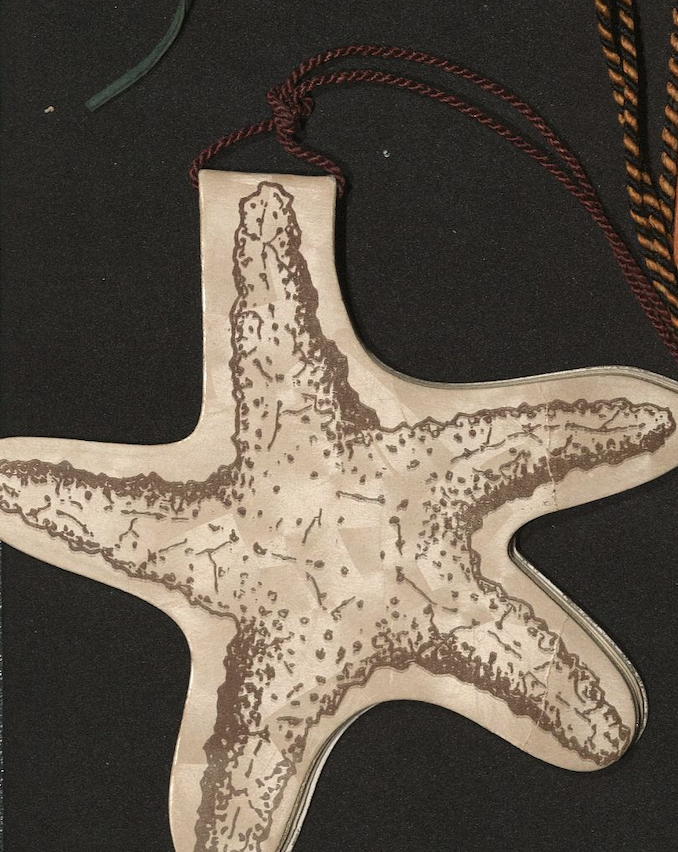
Chances are, if your campus experience here was characterized by a social whirlwind of activity where you went to nickel hops, picked up “paw paws,” saw a stunt show, or joined your fellow students in a serpentine formation at a football game, then, you are familiar with dance cards!

Dance cards were a longtime fixture of campus life that reflected an era where social interaction between women and men was much more regulated than today. Handed out at the beginning of events where live music and dancing were the primary attraction, these cards were often little booklets that contained blank spaces to jot down names with a tiny pencil that was usually attached. These names were to correspond with dance partners that the attendees would sign up for in advance.  

During the mad scramble to sign up prospective dates on the card (and possible future spouses), this ritual offered an opportunity for women and men to mix socially in a world where this activity was, more often than not, officially discouraged by the college.       

To put this practice in perspective, during the dance card golden age (roughly 1910 to 1960), student housing was segregated by gender, women living in cooperative houses often needed permission to leave their residence after hours, and physical education courses were held in separate buildings that did not mix men and women together.   

It is little surprise then, that dance cards became such a treasured memento among students. These little souvenirs of the good times on campus (dating, bands, and breaks from homework) occupy a lot of scrapbook space in collections that have found their way into the OSU Special Collections and Archives Research Center!    


Post contributed by Karl McCreary, SCARC Collections Archivist.

New exhibit on display!

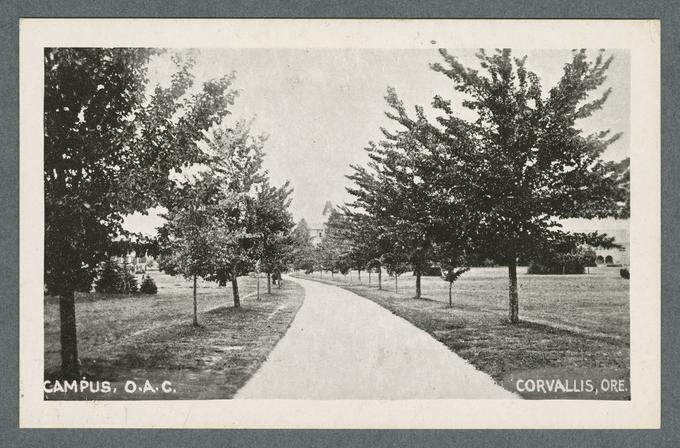
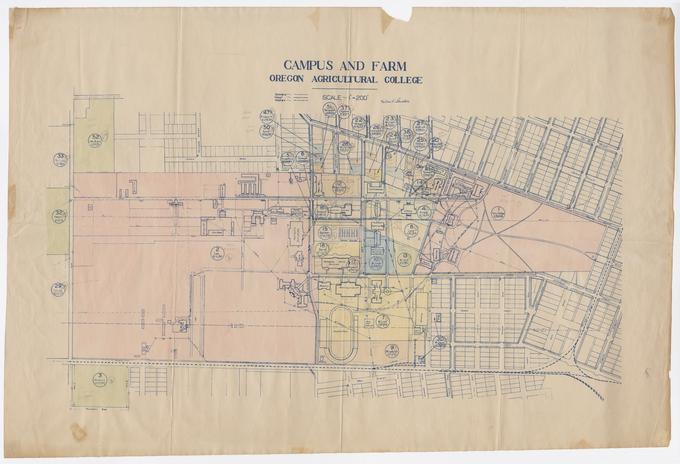
Our newest mini exhibit, “The Beaver 1923: Oregon State’s Campus 100 Years Ago“ is on display in the alcove outside our Reading Room on the fifth floor of the Valley Library.  In this new exhibit put together by Public Services Assistant Anna Dvorak, she shares a glimpse of what campus was like a hundred years ago.  Inspired by the surprise she experienced when she found a photo of the tennis courts in the Memorial Union quad, the new exhibit is centered on a map of campus.  Anna selected images that show things that no longer exist on campus and photos that show how campus has changed over the years.


When walking around campus, much of what we see on the Oregon State campus today seems like it has been a part of campus for a long time, but what wasn’t on campus in 1923?

  • The Memorial Union (would be completed in 1929)
  • The gates at the east edge of campus (construction began 1939)
  • The Valley Library 
  • Weatherford Hall (completed in 1928)
  • Gill Coliseum (completed in 1949)
  • Plageman Student Health Center (completed in 1936)
  • Even the Pharmacy Building wasn’t completed until 1924!

Campus is always changing and evolving.  What has changed in your own time as a student?  What will campus look like in another 100 years?


All information in creation of this exhibit was found in SCARC portals, including:

New Finding Aids: October – December 2022

SCARC did not complete any new finding aids October – December 2022. However, we do have two new LibGuides!


Oral History Interviewing Methods & Project Management 

The Special Collections and Archives Research Center (SCARC) at Oregon State University Libraries is home to an active and well-established oral history program that is populated by collections from long ago, collections that SCARC faculty have created, and collections built by external partners. This guide is meant to serve as a resource for individuals who are interested in working with SCARC as an external partner. It assumes that the reader is already enthusiastic about collecting oral history interviews, but needs help with one or more aspects of the process. Importantly, the guide also details some of the specifics that we ask of our external partners if they wish to deposit their content with SCARC.

Home Economics at Oregon State 

This guide is not meant to be the definitive history of the study of Home Economics on Oregon State’s campus.  Instead, it serves as a starting place to explore this history on your own through the information contained in this guide and links to other resources, both in SCARC collections and outside Oregon State University.

It’s Oregon Archives Month!

We’ve got some big fun planned to celebrate Archives Month this year.

Oregon Mementos Open House: Archives house many things! Come by to check out buttons, beanies, and maybe a postcard or two.

  • Wednesday October 12th
  • 11:00am-1:00pm
  • 5th Floor of the Library

Beer Zines Crafternoon: We’ve got too many duplicate magazines in the Oregon Hops and Brewing Archives! Stop by and make a beer themed zine or collage (what’s a zine??)

  • Thursday October 13th
  • 4:00pm-5:30pm
  • Lobby, Main Floor of the Library

Film Fest: Watch some historic films from the 1920s and 1930s — and yes, you can bring your lunch or just eat popcorn.

  • Friday October 27th
  • 12:00pm-1:00pm
  • West Classroom, Main Floor of the Library

New Finding Aids: July – September 2022

SCARC completed three new finding aids from July – September 2022! 

These finding aids are available through the Archives West finding aids database, website, and the OSU Library discovery system a.k.a. “the catalog.” The links below are to the guides in Archon.


New collection guides created this quarter:

Widmer Brothers Brewing Company Records, 1984-2013 (MSS Widmer)

The Widmer Brothers Brewing Company Records includes brewing records, photographs, marketing materials, office files, ephemera, and audio video content.

Widmer Brothers Brewing Company was founded in 1984 in Portland, Oregon by Kurt and Rob Widmer. Kurt Widmer retired in 2016, the Gasthaus closed in 2019, and Anheuser-Busch InBev acquired the company in 2020.

Rock Bottom Brewery Records, 1994-2010 (MSS RockBottom)

The Rock Bottom Brewery Records document the brewing operations at the SW Morrison Street, Portland, Oregon facility. Rock Bottom Brewery is a Denver-based chain of brewpubs. They opened the Portland pub in 1994 at 206 SW Morrison Street.

Oregon Trail Brewery Records, 1951-2020 (MSS OregonTrail)

The Oregon Trail Brewery Records document the brewing and company operations, finances and shareholder involvement, transitions to new ownership, marketing and promotion, and reporting about the brewery in the press.

The Oregon Trail Brewery Company was incorporated as Brewing Northwest, Ltd. on March 20, 1985 in Corvallis, Oregon and began beer production on July 15, 1987. When Oregon Trail Brewery opened in 1987, it was the first new brewery in the Willamette Valley outside of Portland since Prohibition was repealed.

A new LibGuide is up and ready for research! 

The Regional Politics and Policies in SCARC LibGuide is your guide to all things local politics in the archives. The guide is substantial, providing information and resources in five categories: politicians and public servants, civic engagement groups, legislation and ballot measures, clubs and organizations, and the Oregon Legislature and political process.

Dawn Marges, Helen Berg and Atta Akyeampong, recipients of the Women of Achievement Award

Thirty-two politicians – with public service dating from 1849 to the present day – are included in the guide, complete with abbreviated biographies, details of their career, and documentation of their political pursuits. Where more information exists about their career (often in the form of political papers) at another institution, links to finding aids are provided. Links are also provided for any substantive information that exists for each politician outside of SCARC’s various portals and collections, whether that be an online exhibit (in the case of particularly influential historical politicians) or current campaign websites for those politicians who are still active. 

Considering that SCARC doesn’t consider politics one of its collection areas, the sheer amount of information available within our holdings was admittedly a bit of a surprise to me. Many of the collections featured are not explicitly political in nature, but politics appear nonetheless – alongside a subject’s interests, passions, and expertise. Clearly, politics are bound up in nearly every aspect of our lives. In exploring collections that are not explicitly political, the nuances of public service, the importance of a rich civic engagement, and the entanglement of politics with nearly every feature of life in the Pacific Northwest come to the fore. Perhaps it will inspire you to think more about the indivisibility of politics from your life, much like it did for me.

Urban League of Portland staff

The activities and activism of several civic engagement groups are included in the guide as well, accompanied by short histories and information about each of the organizations. While some organizations, like Colleges for Oregon’s Future, no longer exist, most of the organizations are still active and influential around the state. 

A number of laws, ballot measures, and initiatives are included in the “legislation and ballot measures” section. The bulk of the legislation included in this section is environmental policy and legislation introduced and passed at both the federal and state levels in the 1980s, 1990s, and early 2000s and was influenced by the struggle between environmentalists’ interest in preserving spotted owl habitat in the Pacific Northwest, the interests of timber companies, and the role of the U.S. Forest Service in the mediation of these interests. In addition, the struggle for LGBTQIA+ rights in Oregon in the 1990s and early 2000s is documented in this guide and throughout SCARC collections in discussion of ballot measures eightnine, and thirty-six, activism in opposition to the Oregon Citizens Alliance, and the legal battle over the legalization of same-sex marriage. 

The activities and political passions of OSU’s student body and the Corvallis community are well documented in SCARC’s collections – 54 politically-inclined student groups and community organizations are represented in the research guide. 

State Capitol Building

The guide also includes a wealth of resources and information surrounding the Oregon legislature – its establishment and evolution, as well as the proceedings and happenings of 33 assemblies of the Oregon Legislature, are documented in our rare books collections. The general history of the Oregon Legislative Assembly, legislative procedure, and information about the legislative membership is also documented in the guide, as is the history and proceedings of the Oregon Constitutional Convention.

I hope you enjoy using this guide as much as I enjoyed researching, writing, and organizing it! 


This post is contributed by Carlee Baker, designer and author of The Regional Politics and Policies in the Special Collections and Archives Research Center Guide. Baker is a graduate student in the School of Writing, Literature and Film at Oregon State University (2022).

New Finding Aids: January – March 2022

SCARC completed five new finding aids from January to March 2022! 

These finalized finding aids are available through the Archives West finding aids database, our website, and the OSUL discovery system a.k.a. “the catalog.” The links below are to the guides on our website.


Five New Collections:

Robert Dalton Harris Jr. Collection of Atomic Age Ephemera, 1897-2017

The Robert Dalton Harris, Jr. Collection of Atomic Age Ephemera consists of printed ephemera produced from the late 19th century to the present day. The materials comprise broad coverage of many scientific, religious, cultural, industrial, political, environmental, and other aspects of nuclear history. Items are arranged chronologically by date of creation. Robert Dalton Harris, Jr. and his partner Diane DeBlois are authors, editors, historians, independent scholars, and long-time proprietors of aGatherin’, a business that deals in ephemera and original source materials.

African American Railroad Porters Oral History Collection, 1983-1992

The African American Railroad Porters Oral History Collection is primarily made up of thirty reel-to-reel sound recordings containing interviews between filmmaker Michael Grice and African-American railroad porters employed in the Portland area. The interviews cover a variety of topics, including the day-to-day work of porters, labor unions, and racism in the Portland area. These recordings formed much of the background research used for Grice’s 1985 film, “Black Families and the Railroad in Oregon and the Northwest.” Copies of the film are included in the collection and is available online.

A website for the oral history interviews including digitized audio along with interview transcriptions can be found at: http://scarc.library.oregonstate.edu/oh29/index.html

College Bulletins, 1902-1932

The College Bulletins consist of bulletins published by Oregon Agricultural College, and later Oregon State College, to promote the academic programs and outreach activities of the College.  Almost 500 bulletins were published over 30 years from 1902 to 1932.  Items from this collection have been digitized and are available in Oregon Digital.

Anne Frewerd Scrapbook, 1945

The Anne Frewerd Scrapbook consists of mementos from her time working at Los Alamos, New Mexico for the Manhattan Project in 1945.  Included are souvenir and personal photographs, newspaper clippings covering the bomb dropped on Hiroshima, and other ephemera related to her work in Los Alamos, including a telegram and pin.

Annual and Biennial Reports, 1872-2007

The Annual and Biennial Reports consist of reports from the earliest years of Oregon State University in the 1870s through the early 2000s and document the administration and all functions and activities of the institution.

Items in this collection are available online in Oregon Digital.

New and Updated Finding Aids: October – December 2021

SCARC completed 6 new or updated finding aids October – December 2021. The following is a list and a little information about what we accomplished.

These finalized finding aids are available through the Archives West finding aids database, our website, and the Valley Library catalog.


Four New Collection Guides Were Created

  • Karl F. Drlica Papers, 1909-2018 – The Karl F. Drlica Papers are comprised of materials generated and collected by Oregon State College alumnus, physical education professor, and crew coach Karl F. Drlica. This collection documents Drlica’s management of the Oregon State University crew teams, instruction of courses, involvement in organizations, and work as an educator for the United States Military in post World War II Japan. Among the materials included in this collection are correspondence, game programs, meeting minutes, newspaper clippings, photographs, a scrapbook, artifacts, and a thesis. Drlica graduated from Oregon State College with bachelor’s and master’s degrees in education in 1940 and 1952, respectively. From 1950 to 1983, Drlica coached and coordinated crew activity at OSU.
  • Barometer Campus Newspaper (PUB 015-11b) – The Barometer Campus Newspaper consists of Oregon State University’s student-published newspaper and documents the full range of campus programs and activities, as well as local and regional news and events.  The first issue  — The College Barometer — was published in March 1896 in a magazine format.  In 1906, a weekly publication in a newspaper format was launched and by 1923 the Daily Barometer was published every weekday during the academic year. Many issues of the Barometer are available online in Oregon Digital.  Comprehensive digitization of the campus newspaper began in 2020 and will continue until completed; issues are added to the site regularly.
  • Hmong at OSU Records (MSS HmongOSU) – The Hmong at Oregon State University (OSU) Records provide insight into the operations of the Hmong at OSU student organization. This student organization was founded to foster awareness of Hmong culture at OSU, as well as provide social support and skill-building opportunities for members of the organization. The entire collection is digital and fully available upon patron request or for use in the SCARC reading room.
  • Memorial Union Records (RG 099) – The Memorial Union Records document the administration of this organization and its role in managing services and events at the two student union facilities at Oregon State University: the Memorial Union and the Memorial Union East (also known as Snell Hall). Spanning the years 1922 to 2012, these records include: annual reports, correspondence, course materials, digital files, financial records, flyers, handbooks, meeting minutes, photographs, posters, publications, scrapbooks, and sound recordings. The Memorial Union has served as OSU’s official student union facility since 1928. Items from this collection have been digitized and are available in Oregon Digital.

Two Existing Collection Guides Were Updated

  • Oregon State Yank Collection, 1942-1945 (MSS Yank) – The Oregon State Yank Collection consists of correspondence from Oregon State College alumni serving in the military during World War II to Elaine Kollins Sewell and Jane Steagall, editors of the Oregon State Yank.  Digitized versions of all the letters are available for use in the Special Collections and Archives Research Center Reading Room or upon request.
  • Japanese-American Association of Lane County, Oregon, Oral History Collection, 1994-2008 – The Japanese-American Association of Lane County, Oregon, Oral History Collection consists of digital recordings of oral history interviews of Japanese Americans living in Eugene, Lane County, Oregon, and the vicinity. These oral histories document the immigrant experiences of the interviewees’ parents and grandparents; the World War II experiences of the interviewees in internment camps; and their lives in Eugene and neighboring communities in the years following the war.

Items from this collection have been digitized and are available in Oregon Digital. The collection materials are also available via the Japanese-American Association of Lane County, Oregon, Oral History Collection website.

Hidden Gems in the OSU Barometer

In celebration of Oregon Archives Month, SCARC staff have pulled together a few of their favorite things in our collections. This is the fourth in the series.


The Barometer is an amazing resource for learning about Oregon State through the years…and also other news like:

  • An opinion headline in January 27, 1995: “Internet Surfing, Home Computer Craze: Is It Worth It?”
  • News from the summer of 1969: major protests, arrests, and convictions of protestors related to the denial of promotion to English instructor Frank Harper and subsequent dismissal of same. Also, continued protest against closing women’s dorms at night.
  • More fun: November 6, 1969 Barometer was printed with blank pages except ads in protest of ASOSU senate effort to review editorial board to potentially change editorial staff. The bill passed but was vetoed by ASOSU president.
  • In Fall 1968 MU board of directors exclude military recruiting inside MU.
  • November 7, 1928: It is official, Corvallis voters have lifted the ban on Sunday movies by a 2 to 1 margin. Also, Hoover wins in a landslide!
  • It was reported in the Barometer May 19, 1981 that the investigation into a graduate student that disappeared off a research vessel off the coast of Hawaii ended after 18 months, concluding the student was alive and well, though whereabouts unknown. He seems to have not wanted to go home.
  • Cases of measles on campus in April, 1973. Yikes!
  • April 19, 1996, the Barometer included a story from the Associated Press titled, “Expert says police in need of ethics training.” Whelp…
  • November 15, 1990: It was reported that a 6 year old boy in France shot his mom in the stomach with a rifle after she refused him a Coca-Cola. And that’s the way it is.

Check out more from the digitized collection!


Kevin Jones is SCARC’s metadata and digitization specialist extraordinaire.  SCARC would be lost without him! He likes to play all kinds of games, run, and play ultimate Frisbee.