Category Archives: Northwest Archivists Conference

Reflections on the NWA 2026 Conference

This year’s conference for the Northwest Archivists (NWA) was held in Tacoma, Washington. The theme was Grit and Memory. Lasting three days, the annual meeting included workshops, panels, presentations, and special events like a screening night and a tour of the Washington State Historical Research Center. As a Student Archivist here at OSU and an MLIS student at the University of Washington iSchool, attending the conference was an exciting and valuable experience.

This event was my first in-person NWA conference, and my first time being on the Program Committee for NWA. The process began in November of 2025, when our first Program Committee meeting was held, and we continued with regular meetings through June of 2026. I was able to offer the perspective of MLIS students to the committee, as well as my connections to the University of Washington student population through our listservs and social media. The bulk of our work consisted of outreach for session proposals, fielding said proposals, organizing the schedule, and putting together the program, among many other tasks. Having had event planning experience in my previous roles, being on this committee was a very nice bridge connecting my past work to my current work.

On the first day of the conference, I attended a tour of the Washington State Historical Research Center and the opening reception at the University of Puget Sound. The tour included an overview of the research center’s stacks, and we got a peek at their methods for digitization and scanning. We took a brief trip into their cold storage room, which was incredible and spacious. Our group was also lucky enough to see a wagon from the Oregon Trail:
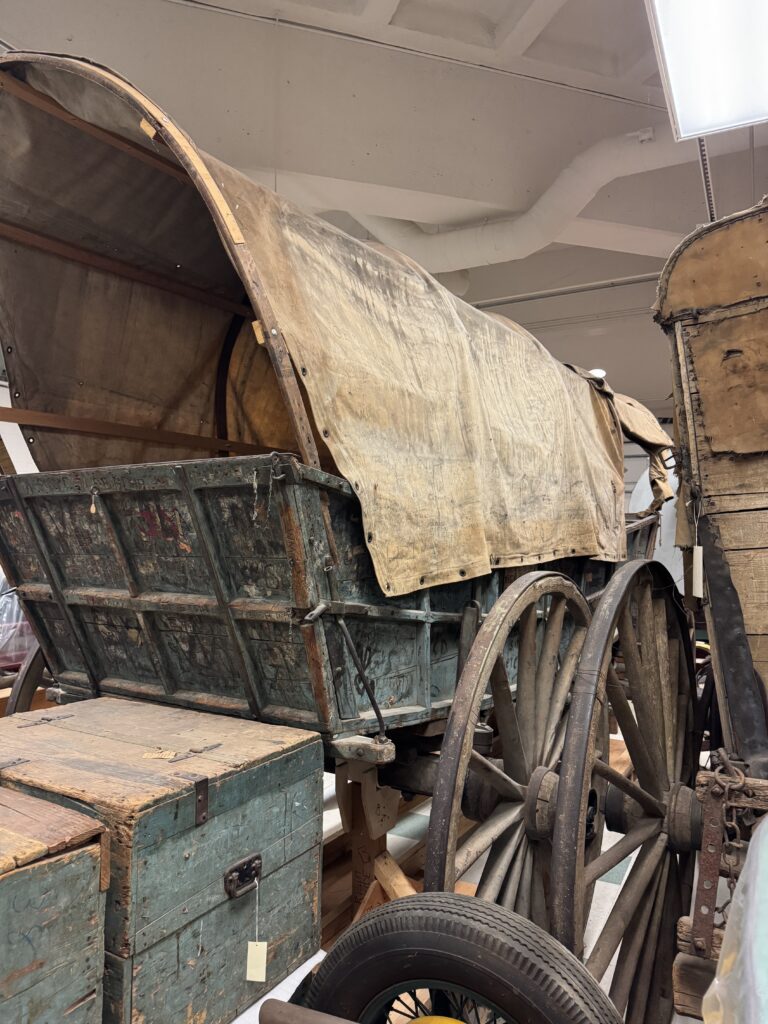
Oregon Trail Wagon
Oregon Trail Wagon

It was all in all, a very fun tour and a very interesting look at how one institution handles such a large volume of items!

The next event I attended was the opening reception, held in the Collins Memorial Library at the University of Puget Sound. It was a casual networking event, where I was able to meet several wonderful people! Among them were Stephanie Plowman, the Special Collections Librarian at Gonzaga University, Alexis Hickey, the Archivist and Head of Special Collections at Whitman College, and Hannah Morrison, the Archivist at the University of Puget Sound.

The following day, I started by visiting the Washington State Library booth, where I met Shawn Schollmeyer, who is the Washington Digital Newspapers Coordinator there. She shared her work with me, and also talked briefly about the Washington Talking Book & Braille Library, which has come up in my coursework at UW as well. There was then a wonderful keynote by Jill La Pointe, who spoke about archives and cultural preservation, followed by several conference sessions. The first session I attended was Carlos Pelley’s talk, titled ‘Using Archival Resources for Public History’. He shared the ways that his institution has used archival resources to encourage library engagement and to aid in community needs. He also provided guidance on how other institutions can use specific language and data points to validate their requests for various resources like funding. This was one of three sessions for which I was a liaison as part of my role in the Program Committee. This included aiding in setup and takedown, being on hand for any IT issues, keeping time, taking headcounts, and facilitating questions as needed.

The next session was another I was liaising for, and was from our very own Karl McCreary, and was a joint case study session in which Steve Bingo and John Klint were also presenting. Karl’s presentation, ‘Bird Nerds’ discussed four of our collections within SCARC that relied on citizen science, emphasizing the importance of community-based collections. Steve and John, both from Eastern Washington University, presented ‘Geography of Hope’, discussing the process of their work on the Turnbull National Wildlife Refuge collection. Their case study tied in nicely with Karl’s, examining the perseverance of those who worked on the refuge.

For the final session of the day, I attended another joint case study, this time between Stephanie Lamson and Claire Kenney on conservation services at the University of Washington, and Tish Stringer showcasing 1930 Kodacolor film from the University of Oregon. The first case study followed the process of UW’s conservation over the past few years, while the second looked at a rare type of color film that had recently been preserved and made accessible. Besides one presentation hosted at OSU, this was my only encounter with digital preservation. Tish gave a brief review on how this type of color film worked, and how the UO team was able to convert it from black and white to color.

The last event of the night was a screening hosted by the Moving Image Preservation of Puget Sound (MIPoPS), held in the Collins Memorial Library at the University of Puget Sound. The evening featured archival film from a variety of institutions, including OSU. A few of my favorites included a film from the 1930s of Alaska’s west coast, another 1930s clip of a home movie from the Williams Family of Celilo Falls, and two University of Puget Sound student films from the 1980s.

On the last day of the conference, I attended the Native American Collections Roundtable (NACR) session. This was the first archival round table I had ever experienced, and was also my first encounter with NACR. Topics of discussion included reviewing priorities for the group, looking at how to connect various groups of shared interest, how NACR can support various archival institutions, and how NACR can further integrate with NWA. I really enjoyed how so many people of different positions pushed to support each other while advocating for their own needs as well.

Next, I attended my last liaison session, which was for Libby Hopfauf from the Seattle Municipal Archives and MIPoPS, and Andrew Weaver from the University of Washington. This session was another round table, this time for the Audio and Moving Images interest group. The group discussed needs and concerns, ways to share resources and information that is localized to the northwest region, creating a service and repair directory, supporting networking and professional development opportunities among digital preservationists, and ways that the group could support other interest groups and round tables.

The final session of the conference was a case study by Heather Mulliner from the University of Montana, who was also on the Program Committee with me. She presented on the creation of oral history kits for student use at her institution, covering the entire process from funding to implementation. This presentation was fantastic and gave me much to consider when it comes to OSU’s oral history projects.

Closing thoughts on the conference:

Being able to attend this year’s NWA meeting, and to be involved on the Program Committee, was a wonderful experience! I learned so much, not only about how a conference comes together and all the work that happened behind the scenes, but during the actual conference, I learned about how wide the range of archival work really spans. The best part was meeting so many people who clearly have such passion for their work, and who have dedicated so much time and energy into this field. It really widened my perspective on what archives and preservation work can look like, and gave me hope that I’ll be able to find my own niche in the future.

~ Sabrina She, SCARC OSQA/OMA Student Archivist

P. S. I collected as much merch as I could:
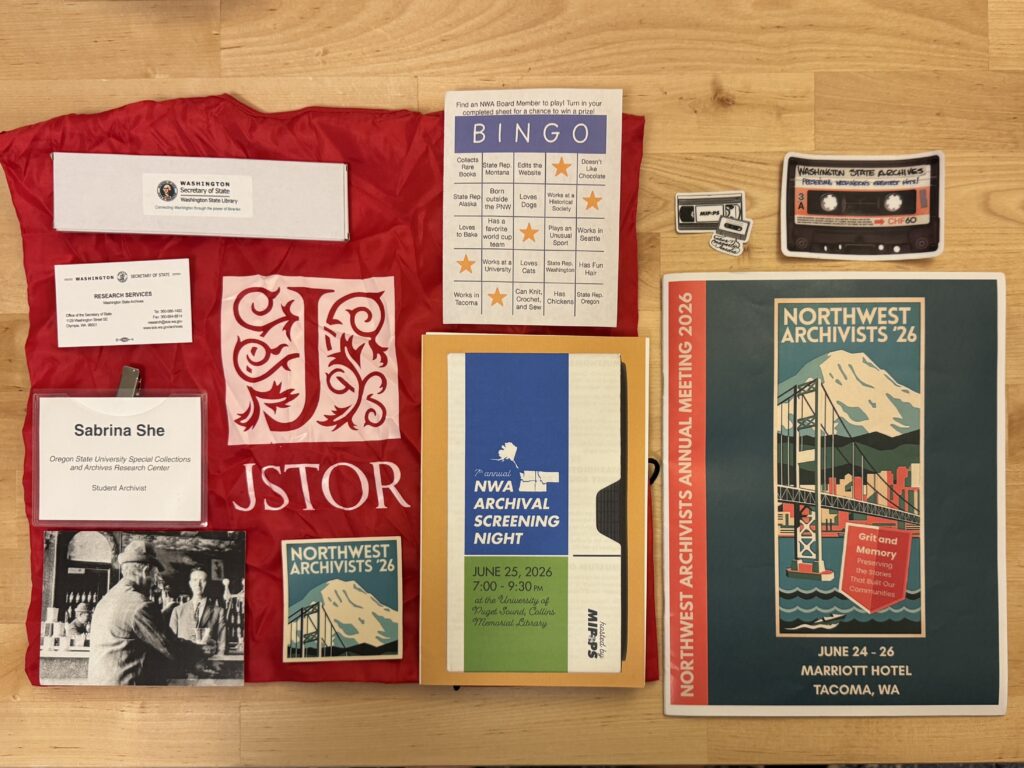
Merchandise gathered at the NWA Conference

The ABCs of OSU Cheer!


Karl McCreary, OSU Archives accessioning expert and generally arty guy, put together this fun “The ABCs of OSU Cheer” for the NW Archivists annual meeting this year in Helena, MT.

The slides are delightful works of art and were begging to be converted to images and into Flickr-worthy set … Resulting in a veritable A-Z of emotions from applause to zeal — enjoy!

An eclectic assortment of links…

book.jpgIt’s mid-week, with the grand History and Heritage Extravaganza (the 2009 NW Archivist joint conference) looming on the horizon and a lot of archives instruction happening this week! What to do? A blog post full of links to keep you all busy reading!

The World Digital Library will launch on April 21, 2009

The World Digital Library will make available on the Internet, free of charge and in multilingual format, significant primary materials from cultures around the world, including manuscripts, maps, rare books, musical scores, recordings, films, prints, photographs, architectural drawings, and other significant cultural materials. The objectives of the World Digital Library are to promote international and inter-cultural understanding and awareness, provide resources to educators, expand non-English and non-Western content on the Internet, and to contribute to scholarly research.

The History Engine: Tools for Collaborative Education & Research

The History Engine is an educational tool that gives students the opportunity to learn history by doing the work—researching, writing, and publishing—of a historian. The result is an ever-growing collection of historical articles or “episodes” that paints a wide-ranging portrait of life in the United States throughout its history and that is available to scholars, teachers, and the general public in our online database. Learn more!

Adair Village Blockhouse: witness to the Cold War, Adv07-08, OR: Who can resist this teaser?

Right in the middle of Adair Village squats a massive, rectilinear pile of concrete. Unmarked and nearly windowless, its perimeter guarded by a cyclone fence topped with three strands of barbed wire, the three-story structure known locally as “the Blockhouse” is a weird sort of contradiction? it’s the biggest thing for miles around, but it’s so utterly featureless that it seems to blend into the background, going almost unnoticed by the steady stream of motorists flowing past on Highway 99W. Today it stands cold, dark and silent. But flash back a half-century, and the Blockhouse was a concrete beehive called SAGE, its corridors filled with men and its rooms crammed with electronic surveillance equipment that constantly scanned the skies. The building was a sentinel standing watch against the looming threat of nuclear annihilation… Read more!

OHSU Historical Collections and Archives celebrates National Public Health Week!

It’s that time of year again: magnolias blooming, grass growing, and folks whooping it up for the annual celebration known as National Public Health Week! Check out their resources …

Northwest Archivists 2008 Annual Conference: New Frontiers in Archives and Records Management

Session 10: Breaking the Ice: Protocols for Native American Archival Materials and Archivists in the Northwest.

(submitted by OSU Staff Archivist Karl McCreary)

A provocative examination of proposed protocols for Native American archival materials from three different perspectives formed the focus of this session. The protocols emerged from a 2006 meeting of 15 Native American and aboriginal information professionals and four non-native archivists. They were developed in large part to encourage dialog between Native American and non-Native American archivists regarding the best practices for the culturally responsive care and use of Native American archival material held by non-tribal organizations. The Northwest Archivists board has committed to revisiting these protocols at every annual meeting for at least five years, a process that began in 2007.

The session began with a presentation by Linda Wynne, records manager for the Sealaska Corporation, who illustrated through stories from her native Tlingit nation the importance of the repatriation of Native American artifacts to tribal cultures and identities. Telling the story of artifacts from her tribe sold to private collectors that were later returned (after years of lawsuits) to form the core of a tribal cultural heritage center, Linda emphasized that Native Americans view their historical material culture as having real value in contemporary society, and “don’t want to see our artifacts as something of the past” by being inaccessible in a distant museum.

Monique Lloyd, the second presenter in this session and a member of the Ojibwe nation and MLIS candidate in the Emporia State University program, gave a basic overview and history of the protocols that included some personal thoughts regarding what she’s learned “working in two worlds” as an archivist/librarian. Monique voiced the hope that the protocols can lead to a greater understanding of the different traditions of information access between the Native and non-native cultures, and that these differences can be respected over time. Emphasizing further communication as the key element in this process, Monique described how a tribal member might answer a question with a story rather than a linear “yes” or “no.” This presentation seemed to re-iterate the importance of historical materials to Native American culture, which was summed up by Monique’s comment: “We belong to the property; the property doesn’t belong to us.”

John Bolcer from the University of Washington offered a very different perspective on the protocols in the third and final presentation in this session. Looking at the protocols from the position of a non-tribal archives, John expressed concern that the protocols as currently written challenge the autonomy of archivists working in Non-Native American repositories and museums. According to Bolcer, one of the major problems is that the protocols define key concepts like “culturally sensitive” materials so vaguely that non-tribal institutions are forced to regard anything affiliated with Native American history or culture as culturally sensitive. Bolcer coupled this concern over the lack of guidelines for non-tribal archivists to follow with opposition to the protocols’ central assertion that Native American communities have primary rights to all materials referencing their culture, rather than just those directly generated by them. In Bolcer’s view, this basic tenet seeks to “control what is studied and written about Native American communities” and threatens “the practice of free and open inquiry upon my own institution depends.”

Despite voicing serious reservations about the protocols, John ended with several suggestions for their revision. One of the suggestions centered upon defining the concepts of “culturally affiliated” and “culturally sensitive” in much more detailed and “nuanced” way and recognition of the fact that being respectful of Native American perspectives and knowledge systems does not necessarily mean adaption of them.

The common theme throughout all three presentations seemed to be that further communication and understanding between Native American communities and non-tribal heritage professionals needs to continue and be encouraged. All the presenters agreed that the Protocols have definitely helped in starting and stimulating the discussion about tribal artifacts and archival materials.

Northwest Archivists 2008 in Anchorage

Northwest Archivists 2008 Annual Conference
New Frontiers in Archives and Records Management
Anchorage, Alaska

Following are summaries for two of the sessions that I attended:

Session 1: The Integrated Digital Special Collections (INDI)
This session introduced the Integrated Digital Special Collections (INDI), an open-source archival management application developed at Brigham Young University. INDI is a web-based system designed with an emphasis on archival workflow and distributed processing activities. The session included an introduction to the project and demonstrations of the functional application modules and the INDI sandbox, and discussion of future directions for INDI development. Presenters were Brad Westwood, Cory Nimer, and Gordon Daines.

This application has some of the same goals as other open-source archival management applications, such as Archon and the Archivist’s Toolkit — but with a stronger emphasis on workflow and project management. The application currently has no public interface and is intended for staff use (BYU special collections has a permanent staff of ~15+ and employs about 40 student assistants).

Modules that were described or demonstrated:

  • Contact management system is used to to track donors and creators; using a single tool for both creator management (authority control) and donor/contact management has been problematic.
  • Help feature has been useful to staff; includes both “application assistance” (how to do something) and “data entry assistance” (what information and in what format is appropriate for a given field). Usability testing showed that staff use latter more than former.
  • Desktop search tool; have been retrospectively entering accessioning data, so this can serve as “one stop searching” tool.
  • Project management (with e-mail feature that allows e-mail discussions that are preserved within the system, linked to the project/collection); this is one of the most robust areas of the application.
  • Appraisal; breaks down appraisal of potential purchases/donations into detailed tasks. Probably most useful for a repository with an active acquisitions program in many areas.
  • Accessioning; this has been useful because many of the accessioning steps are actually done by student assistants.

The project team has experienced issues because several different programmers have worked on the project which have had different approaches to documentation and varying programming styles. The BYU Library is currently evaluating how to proceed with the project — whether to continue to invest in programming or to migrate to another system. They are especially interested in a system being developed by/for the ICA (International Council on Archives).

Session 7: New Modes of Access: Challenges and Opportunities for Archival Collections
This session focused on the development/implementation of WorldCat Local at University of Washington Libraries. Presenters were Nicole Bouche (UW Special Collections); Jennifer Ward (Head of Web Services for UW Libraries) and Mela Kircher (OCLC).

The session especially focused on the impact of WorldCat Local on archives/special collections. Several issues that were raised are:

  • “duplicate” titles — “split” collections at different repositories that the WorldCat Local algorithm considers as different editions …
  • duplicate records for a record in WorldCat submitted by a repository and a record for the same collection submitted by NUCMC (which were previously only in RLIN … but are being migrated to WorldCat).
  • WorldCat local does not serve as a collection-management system … does work well as a “discovery” tool
  • very limited notes displayed

Future enhancements to WorldCat Local will be:

  • more articles metadata
  • branch scoping (driven off 4-character location codes)
  • simple language facets
  • additional fields displayed (this is especially important for notes fields in archival MARC records)
  • federated search (may be able to search NWDA finding aids database)
  • reviews
  • FRBR/editions display improvements
  • improved WorldCat account authentication
  • tagging
  • improved reports

Elizabeth Nielsen
OSU Archives

The Archivists Join Friends & Colleagues in Moscow, Idaho

dance.jpgIt’s that special time of year, the time for NW archivists to congregate for our spring conference. Several OSU Archivists are heading east to the greater Pullman/Moscow area for the Northwest Archivists Conference this week: “Dynamic Archives: Preserving the Past and Speaking to the Future” will take place from May 17-19, in Moscow, Idaho.

On the program are two plenary sessions by Thomas E. Mills & Augusta Rohrbach, as well as sessions that address leadership skills for archivists, coordinating national and regional projects, online tutorials, disaster planning resources, the challenges in working with ephemera, MPLP processing standards, and how archivists can flourish in a Web 2.0 world.

Our hours on Friday, May 18th will be shortened, so please contact the desk at (541) 737.2165 or archives@oregonstate.edu with questions.