
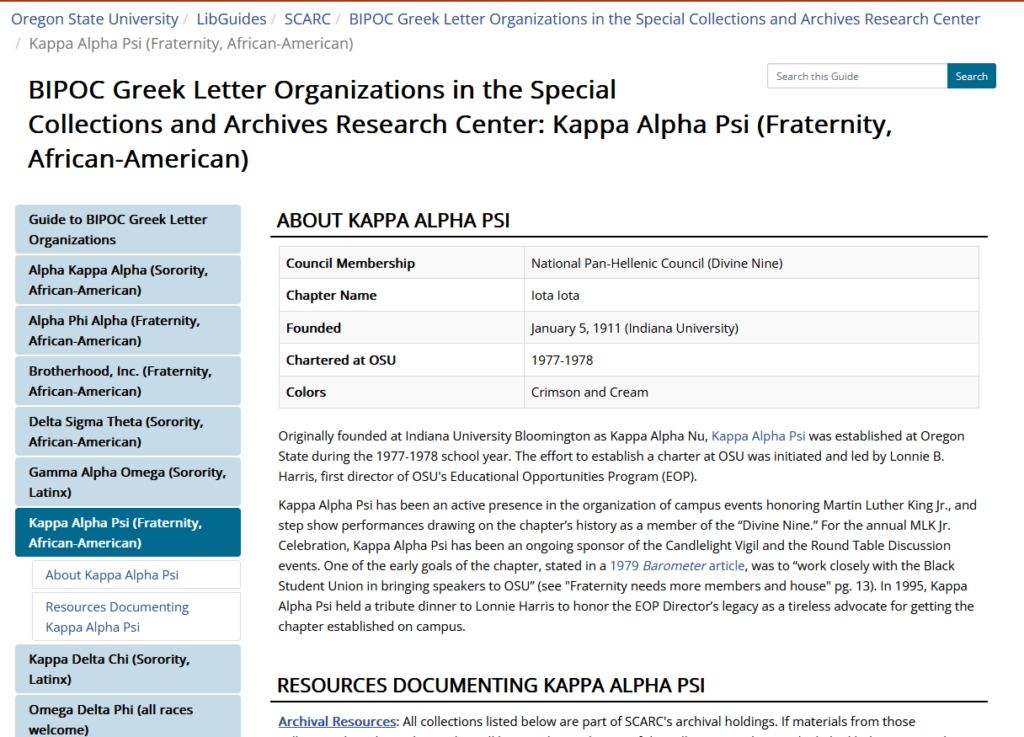
A post featured on this blog in June 2025 announced a new Libguide “BIPOC Greek Letter Organizations in the Special Collections and Archives Research Center: Guide to BIPOC Greek Letter Organizations” highlighting SCARC collections that document the history of BIPOC (Black, Indigenous, People of Color) Greek letter organizations at OSU. In addition to listing the BIPOC sororities and fraternities represented in SCARC’s collections, the Libguide provides historical context for these chapters, as well as some of the campus traditions and events that have brought them together as a community. Gathering this information was a collaborative effort that involved many hands, keyword searches and dives into many different collections via the SCARC website, with the digitized issues of The Daily Barometer student newspaper playing a particularly important role in filling in some of the gap – it was an invaluable resource! The specific steps taken by the SCARC Anti-Racist Description Team in moving from historical research to the completed Libguide, is what this post will explore as a follow up to the June 2025 blog post.
In November 2023, myself and other members of SCARC’s Anti-Racist Description Team began to explore how OSU’s BIPOC Greek community is documented in SCARC’s archival collections. Motivating this project was the acknowledgment that the history of multicultural Greek chapters at OSU, while being reflected in our collections, was not being curated or highlighted on our website or in our collection guides. We needed to change that. I’d first encountered documentation of BIPOC sororities and fraternities at OSU when I processed the records of the Greek Life Office back in 2017 and my curiosity about them lingered. When the call was made for new projects to pursue in the Anti-Racist Description Team, I remembered my work on these files and proposed the idea of highlighting the BIPOC Greek community in our collections through enhanced description in finding aids. The team agreed and we began our journey!
In anticipation of our work on this project, I compiled a list of the OSU Greek chapters whose membership was primarily African-American or Latin-American referenced in the Greek Life Office Records. With this list of seven chapters (later expanded to eight), we began compiling in a shared Google doc all the details we could find from searches of SCARC collections.
Our initial searches returned results in collections that explicitly referenced BIPOC Greek chapters; for example, as part of folder titles, or in a collection’s Scope and Content note. We also found, however, that these chapters were documented in more collections than we expected, and this recognition reinforced our project’s goal: to create a Libguide highlighting the rich history of OSU’s BIPOC Greek community, and the documentation of those communities in our collections.
Our approach in tackling this research as a group involved each of us “adopting” a chapter or two on which to focus our research (full disclosure: mine were Gamma Alpha Omega and Kappa Alpha Psi). We gathered basic details about each chapter (e.g. year chartered at OSU, chapter name, colors, council membership), as well as references to chapter events and activities that appeared in OSU media and historical records. With this information, we constructed historical sketches which detailed outreach activities, philanthropic foci, and traditions on campus for each of the chapters.
Another important goal of this project was to enhance the ways in which materials documenting the BIPOC Greek community at OSU were described. In some cases, these materials were not called out in a collection’s online guide, and we wanted to be sure that a simple keyword search using the search box on our website would return as many results as possible about a given chapter.
Want to learn more about the BIPOC Greek community at OSU, and explore the archival collections in which they’re documented? Reach out to our Public Services team by email at scarc@oregonstate.edu! They’re happy to help you navigate our online research portals, and can get you set up with an appointment to do in-person research. To learn more about the primary sources available in SCARC, how to find them, and the logistics of in-person appointments, visit our online Guide to SCARC.
Written by Karl McCreary, SCARC Collections Archivist, on behalf of the SCARC Anti-Racist Description Team