Organic Hazelnut Farm Tour E-Handout, Aug. 19, 2022
Nik G. Wiman (+ Team), Orchard Specialist & Associate Professor
contact: Nik.Wiman@oregonstate.edu

- Organic Pest Management
- Aphids
- Aphid management tactics
- Aphid biological control
- Filbertworm
- Organic sprays
- BMSB
- Organic sprays
- Biological Control
- Aphids
- Cultural Practices
- Production levels with no sucker controls compared to single trunk
- Grafting to reduce suckering
- Cover crops – new soil health project
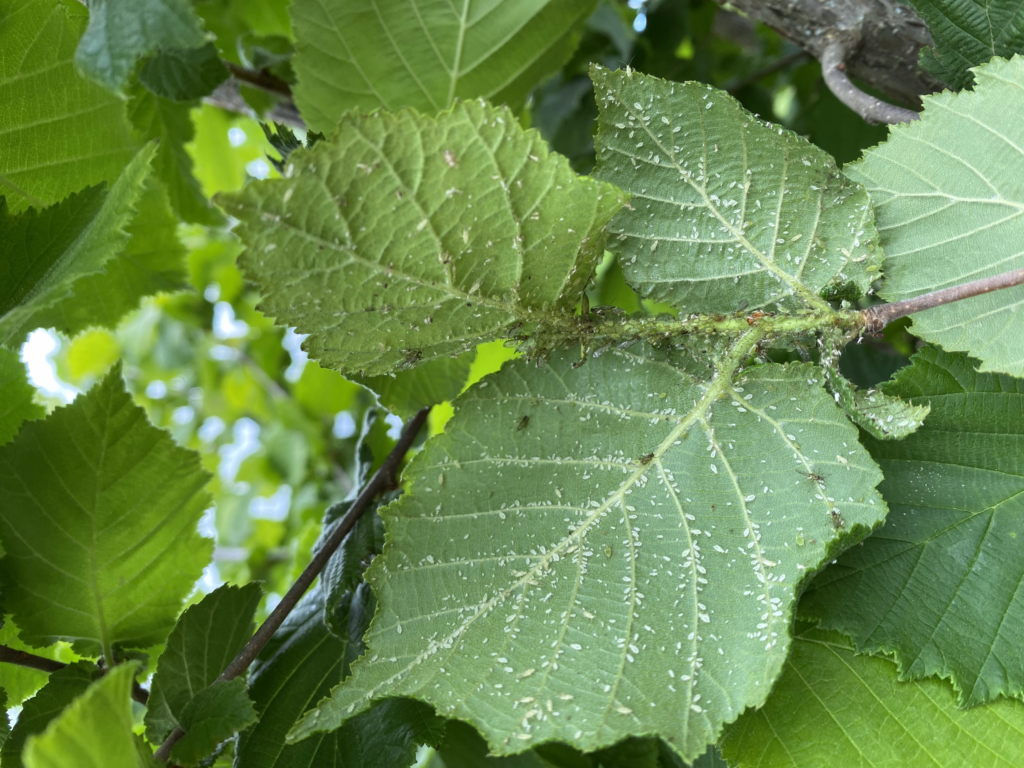
1.A.i. Aphid managment tactics. Aphids may not normally be a problem in organic hazelnuts. In an older study that took place in unsprayed hazelnut blocks, aphids were not a pest, the populations were kept at low levels by the natural enemy community. However, certain organic insecticides that are used to control pests such as filbertworm (such as spinosad) can be disruptive to the natural enemy community and can increase risk that aphids will become problematic. Aphids can impact yields (reduced fill) and impact tree health and vigor. There are two species that affect hazelnuts; filbert aphid (Myzocalis coryli) and hazelnut aphid (Corylobium avellanae).
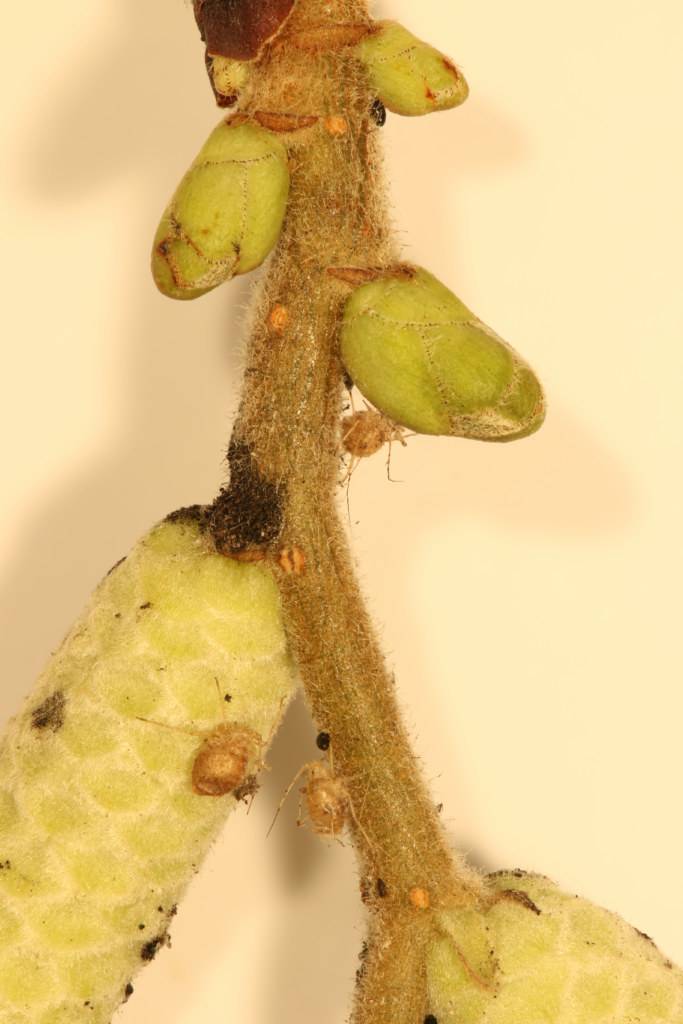
Both species spend the winter as eggs on twigs and branches and begin hatching around budswell. As they hatch they begin feeding on the buds, before moving to the underside of the leaves. At that point, the two species begin to occupy separate niches, with the filbert aphids staying on the leaves, and the hazelnut aphids start moving on to the leaf petioles and shoots and eventually hazelnut aphid move to the husks. As soon as these overwintered aphids make oit to the adult stage, they start giving live birth to nymphs and populations increase rapidly.
While OSU has developed thresholds for treating aphids based on the number of aphids per leaf, we wanted to try some other tactics. Instead of waiting for aphids to increase, could we spray organic crop oils to knock back the aphid populations early in the season before the natural enemy community becomes active? We have had good success with this tactic. Oils smother aphid eggs and early nymphs. We hope to see superior spray oil be registered for hazelnuts as it will be very useful for organic growers. Meanwhile botanical oils (such as neem) can be used for organic and there are a number of these registered for use in organic hazelnuts. A big question for this research was regarding the safety of using oils on hazelnuts because they are not widely used, but we have not seen any phytotoxicity issues.



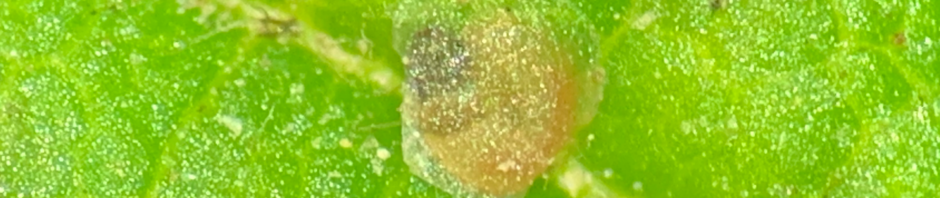
1.A.ii. Aphid biological control Growers should be aware that filbert aphid used to be far more problematic before the parasitoid wasp Trioxys pallidus was imported from Europe and released in the 1980’s. As a parasitoid, this tiny wasp stings the aphids and lays its own egg inside. Once the larva completes development in the aphid, turning it into a “mummy”, a new adult wasp emerges. Mummies are swollen brown aphids and are a sure sign the wasp is at work.This wasp resulted in a major decline in insecticide use against filbert aphid after its introduction.
Since the introduction of the wasp, the hazelnut aphid was also introduced and aphid problems seemed to worsen. While the natural enemy community of filbert aphid was thoroughly studied in the 1980’s, little work has been conducted since and very little information exists about hazelnut aphid natural enemies. We are now in the third year of an intensive study of the phenology of both aphid species and the natural enemies of these species. This will help us understand how best to enhance biological control and understand any shifting dynamics in the natural enemy community. We have made some exciting discoveries along the way including some important new natural enemies. Thanks to the OHC for supporting this research.
1.B.i. Filbertworm organic sprays. Filbertworm can be a challenging pest for the organic grower. There are few organic options that are truly effective, and the materials can be be expensive. A diverse approach will be most successful. Mating disruption with meso dispensers can be helpful. Apply dispensers before moths begin flying in the upper canopy. Disruption will be most effective on larger orchard blocks that have a high ratio of core to edge and a low to moderate population of filbertworm.
There are relatively few spray treatments that are effective. To make these work as hard as possible, you will need to have good timing, so proper use of the phenology model and trap threshold methods is very important. Organic materials target eggs and the freshly hatched larvae, but may cause some moth mortalilty.
Some good treatment options are:
Entrust (spinosad) – Probably the most relied upon material for organic growers. It has many desirable qualities and it is relatively safe for the environment and the applicator. It does have some broad-spectrum activity and can harm beneficial insects. It can act on moths and larvae. Apply at first egg hatch.
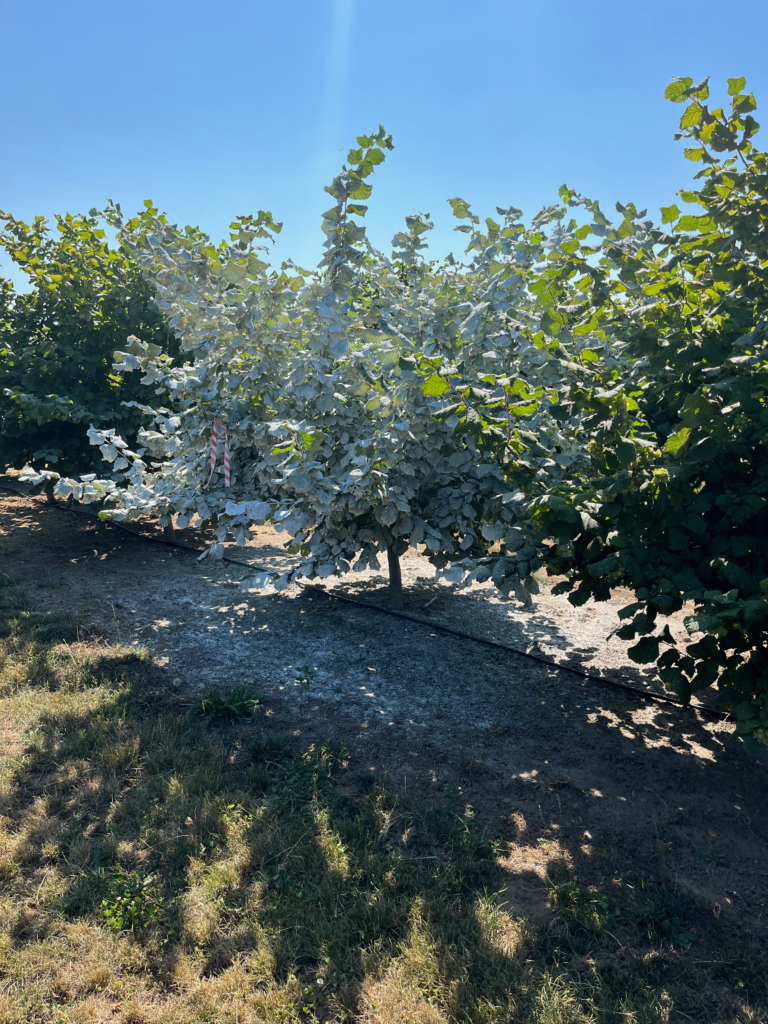
Surround (kaolin clay) – I see very little use of Surround in hazelnuts in the Willamette Valley. It does turn trees white, which will definitely attract attention (from human neighbors). However, it can be an effective deterrent for filbertworm and also BMSB. It is a particle film, not an insecticide, so you can’t expect 100% control. But it does have a significant effect, consider using it as part of your overall management strategy. It is a bit hard to keep in suspension for spraying, agitation is key. It does not harm the tree, in fact it can help trees resist drought stress. It washes off the tree and nuts with water, perfect for use against filbertworm in the dry season. Reapplication are necessary to maintain coverage, applications can begin prior to egg laying.
Grandevo (chromobacterium) – We have seen it work effectively, and we have some new trials with it. Marrone (the manufacturer) has new formulations.
Oils – Oils can be very effective for smothering eggs. There are a number of oils that are available to organic growers. These are botanical or vegetable oils. Light oils are preferable and will be least likely to damage leaves. Superior 440 mineral oil is ideal, but not yet registered for organic or conventional. Read labels carefully about applying oils in-season (as opposed to dormant). Time these for first egg hatch or max eggs.
Other organic-compatible materials:
Bacillus thuringensis Kurstaki (BtK) – BtK is a fantastic material for leafrollers but will not be effective on filbertworm.
Pyganic (pyrethrins) – although this is a great natural knockdown material it has virtually no residual activity and will not be very effective on filbertworm.
Virus (codling moth granulosisvirus, Cyd-X and others) – experimental only. We think it works and we hope to have it registered some day soon.
| Filbertworm Degree-Day Accumulation | Application Notes | Appropriate organic materials |
|---|---|---|
| 815-955 | Products with ovicidal activity (kills eggs) are applied between first egg laid and first egg hatch (815-955 DD) | Oils and Surround (reapply according to label or coverage) |
| 955 | Products with larvicidal activity (kills larvae/worms) should be applied just prior to first egg hatch (955 DD) | Entrust Grandevo |
| 1188 | Peak moth emergence should be reflected in peak trap captures. | |
| 1393 | Reapply ovicidal/larvicidal products | Entrust Grandevo |
| 1533 | Some larvae will already be in nuts and cannot be managed by this time. |

To get the best timing out of the filbertworm model it is ideal to have your own in-orchard weather station and enter the data into a degree day calculator using max and min temperature after April 1 with a lower threshold of 50 degrees F. Some of the companies that sell weather data services can set up your weather data feed to calculate the model automatically. If you don’t have on-farm weather, try the custom CropConnect website to find the location nearest to your farm. One final option is to select a public weather station and filbertworm model from USPest.org.
Traps are very useful to check against the model or the trap threshold method can be used. Place traps at roughly 1 per 2.5 acres in the upper 1/3 of the canopy. If you average 2-3 moths per trap or have 5 or more in any single trap treat 8-12 days later to target the hatching eggs produced after the moths mate and lay eggs.

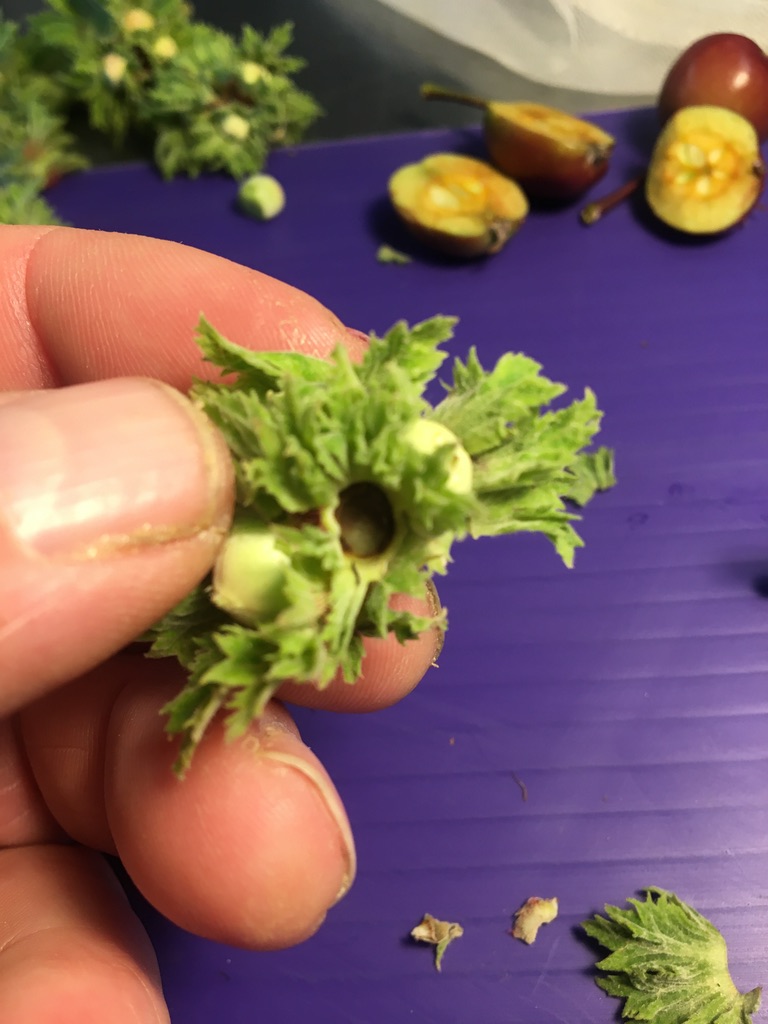
1.C. BMSB Management. BMSB populations are high this season. For organic management Surround may be the best option. We are currently evaluating some promising alternatives.
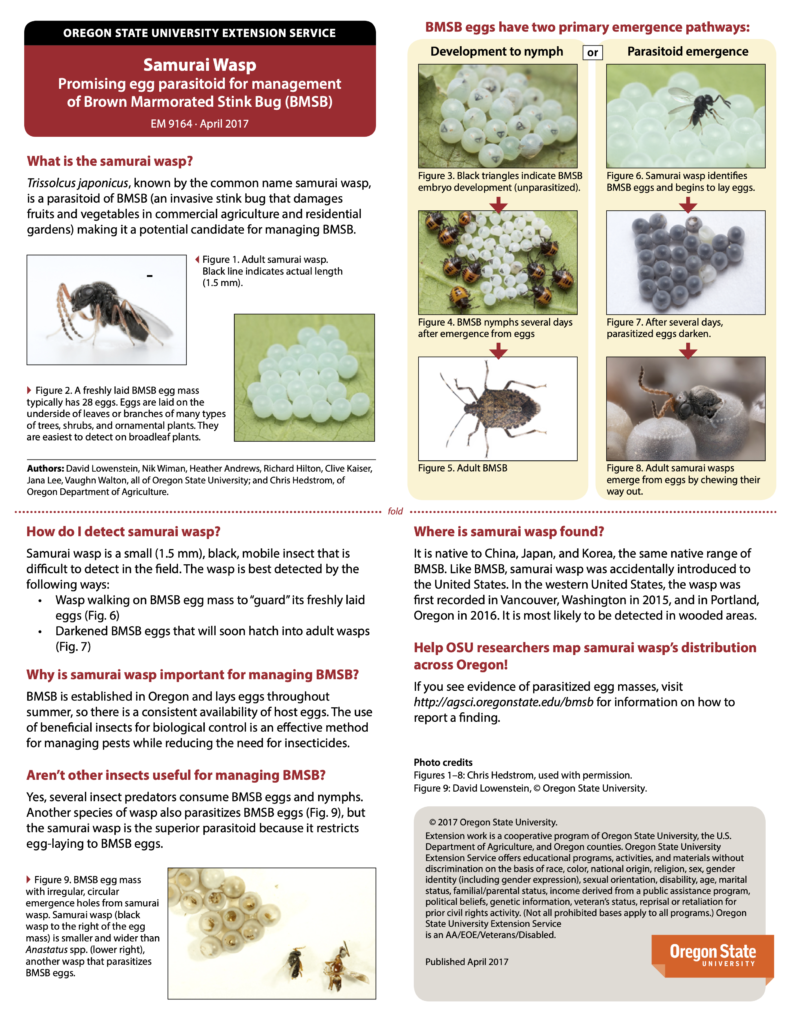
Trissolcus japonicus, the egg parasitoid, is becoming widely established in the Willamette Valley.
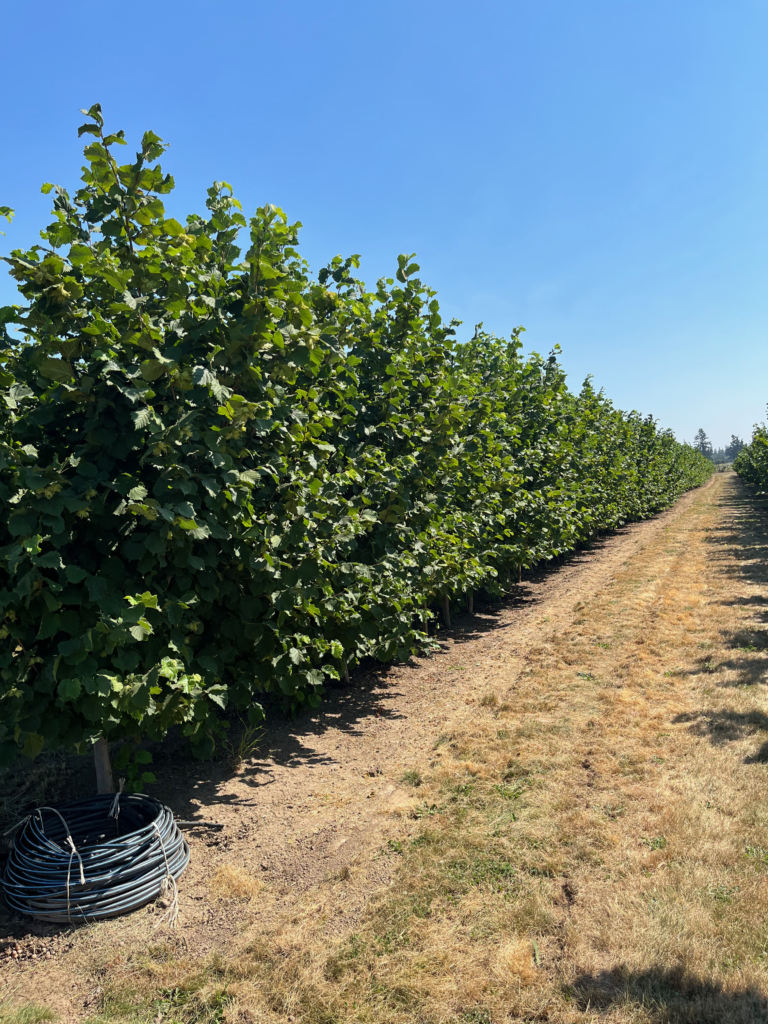
2A. Cultural Practices-Production levels with no sucker controls compared to single trunk. Organic growers are particularly challenged by suckers. One of your research questions is: Are multistem plants or hedgerows a cheaper, more productive method of production?
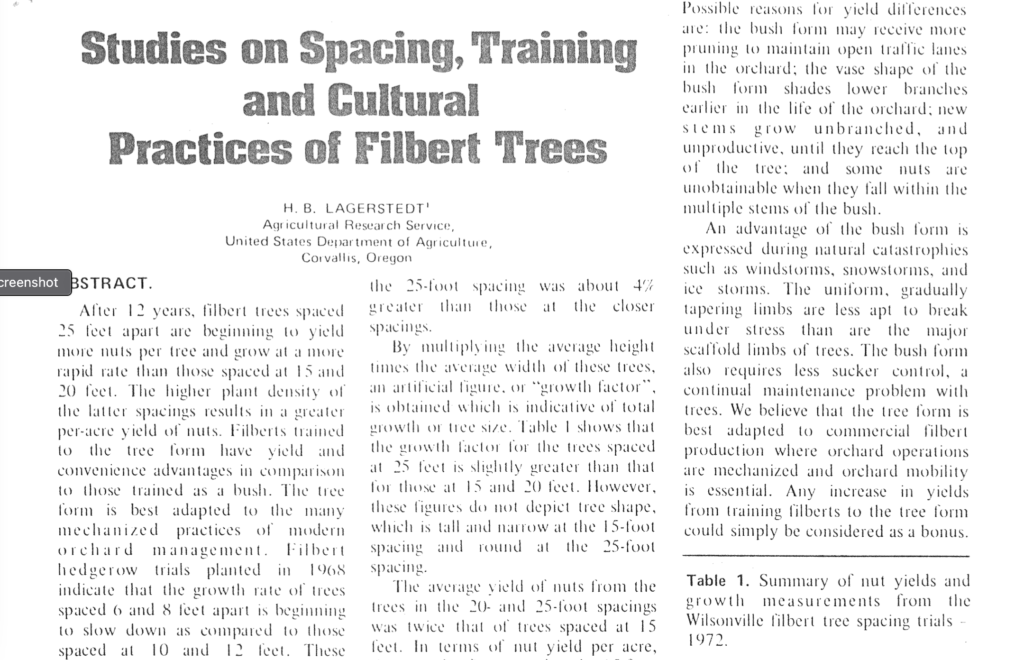
In a long-term study from the 1960’s, multistem hazelnut trees produced not as well as single trunk and were more challenging to harvest. Hedgerows were highly productive but were not monitored long-term. Over-the-row harvest could be a good option if hedgerow trees can be maintained at a small size.
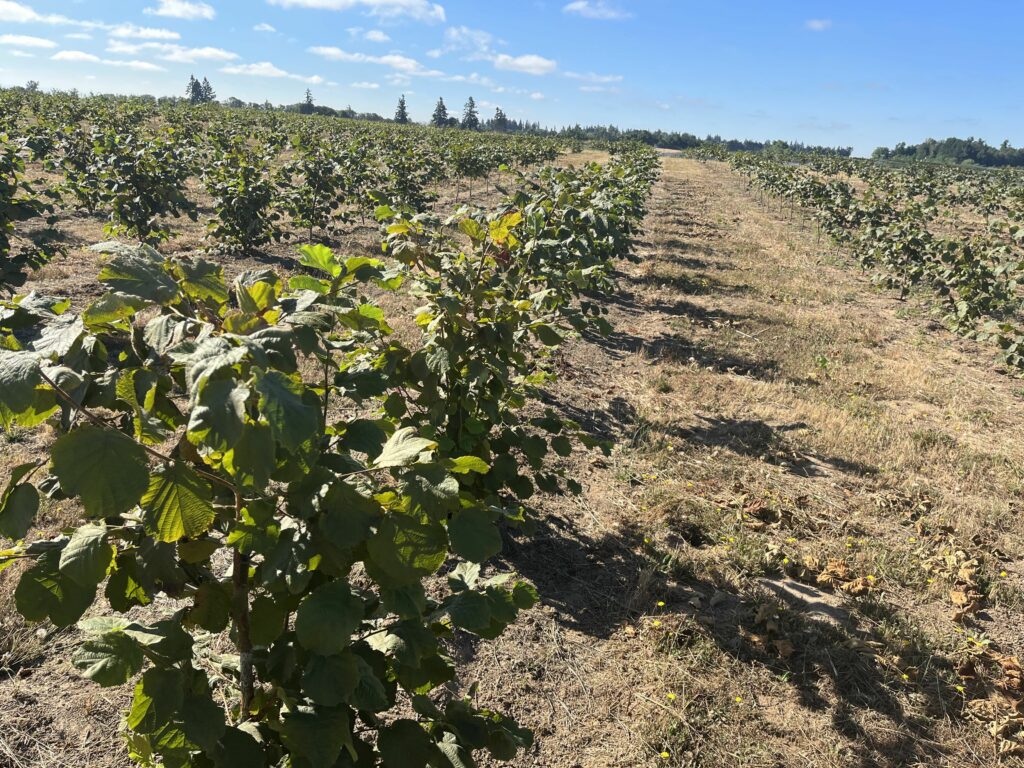
Our study is designed evaluate production of 3, 6, and 8 ft spacing of trees, with sucker control on half of each treated block. Summer pruning is used to keep higher density trees smaller. Research is in the initial stages.

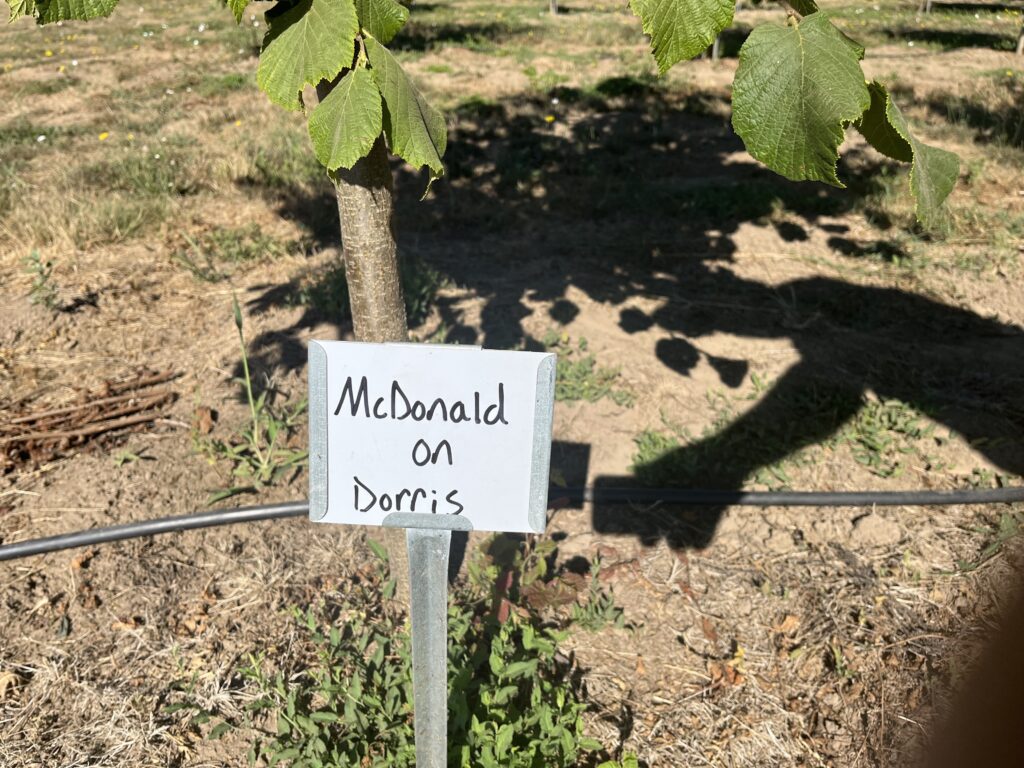

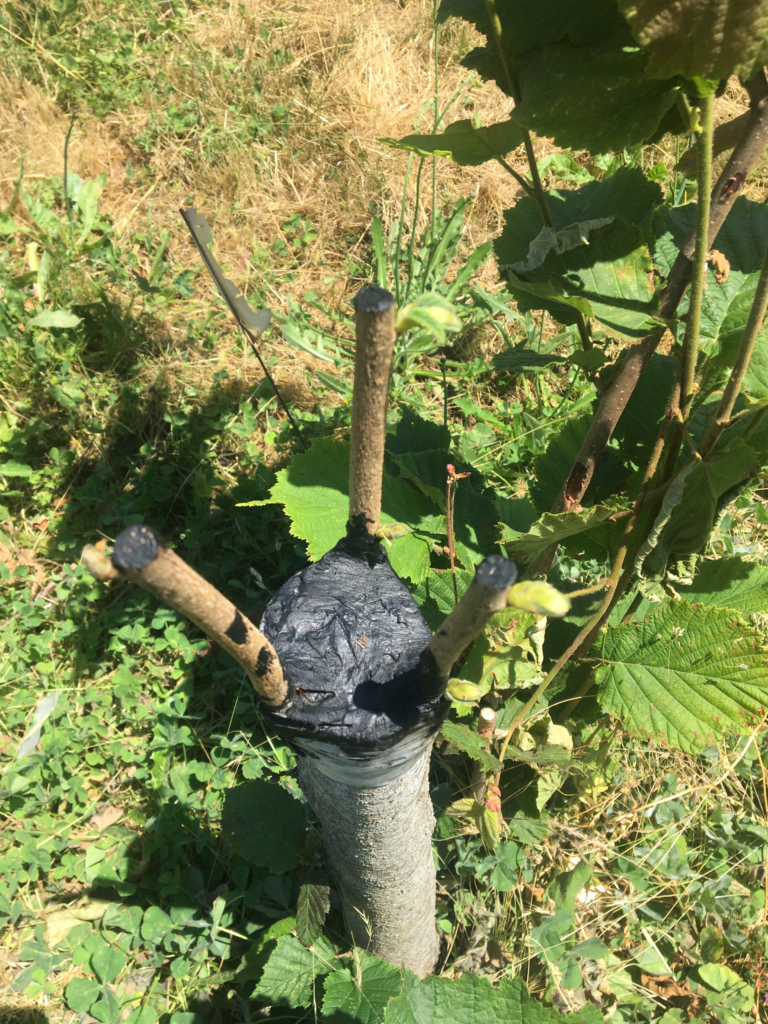
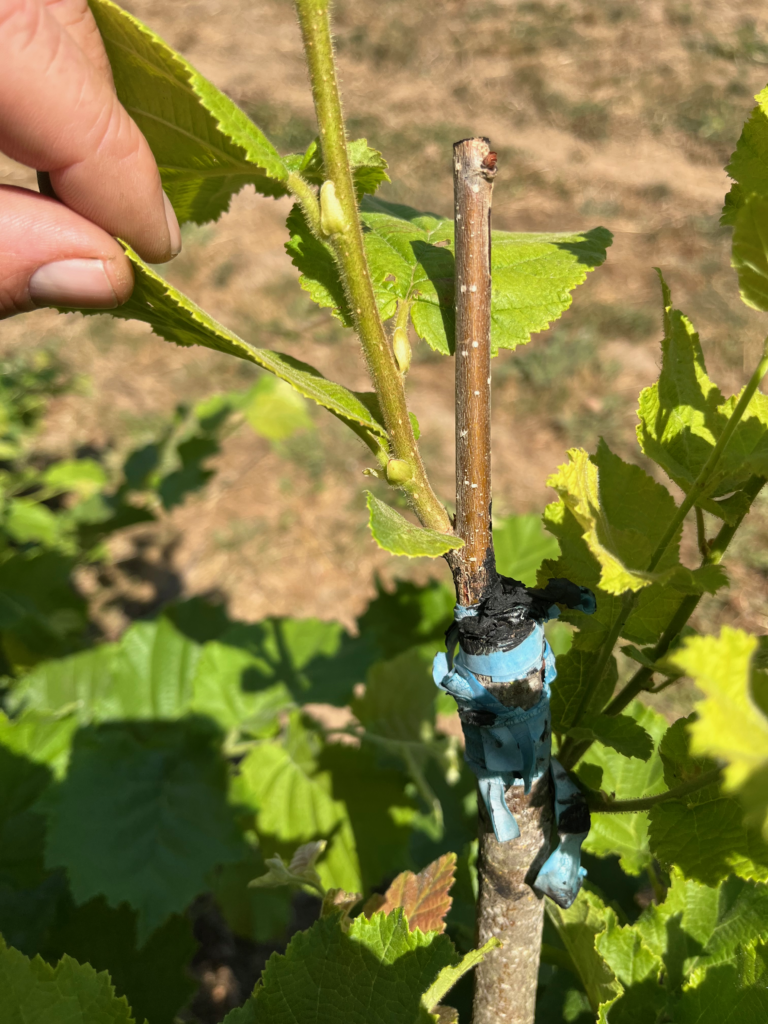
2B. Cultural Practices – Grafting to reduce suckering. One objective of this project is to evaluate potential use of OSU hazelnut varieties with genetic resistance to eastern filbert blight as rootstocks. Among the characters we are looking for in the rootstocks is reduced suckering. Of course there must also be good compatibility between the scion production variety and the rootstock. Special thanks to Bruck Nurseries, our major collaborator for this project. We are just getting to the point where we can evaluate some of the rootstock effects.
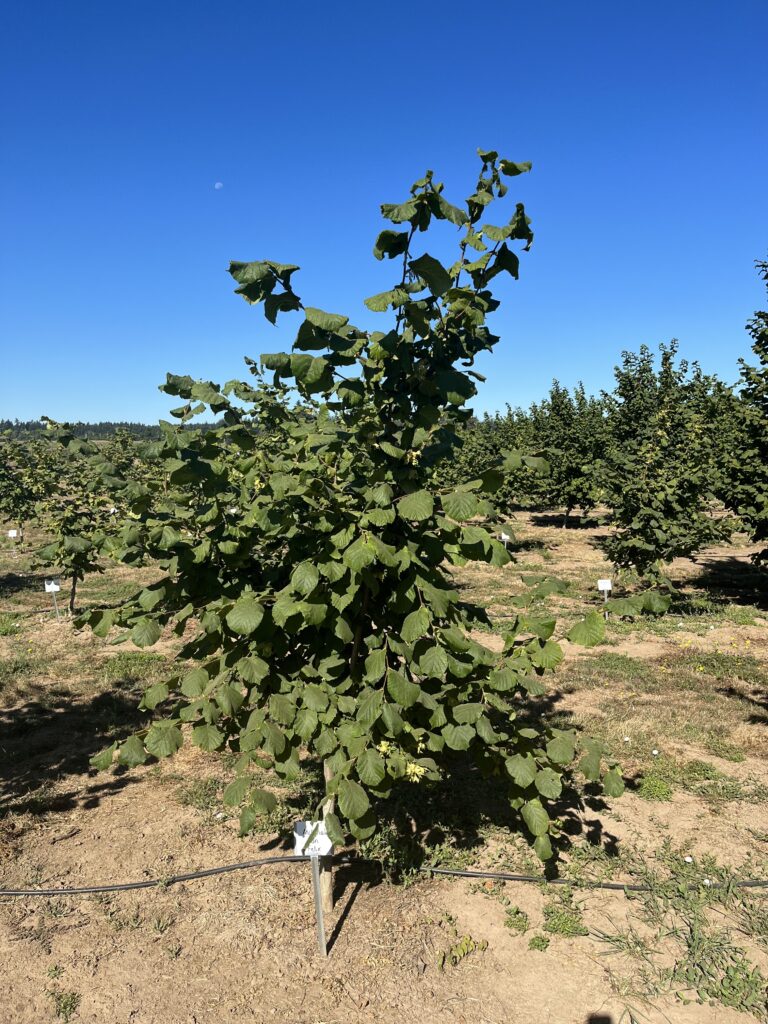
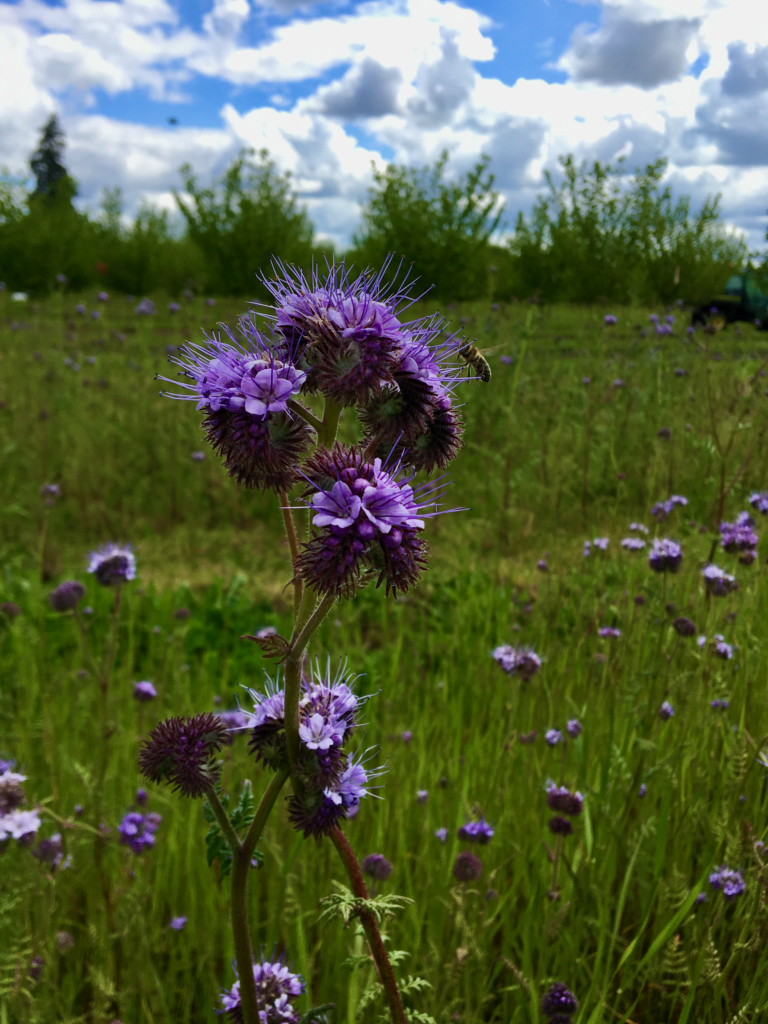
2C. Cultural Practices – cover crops and soil health. The Oregon Specialty Crop Block grant program recently awarded our team with a grant to study barriers to cover crop adoption and soil health benefits of cover cropping in hazelnuts. We need research sites, please contact me if you are willing to allow some research in your orchard where you are using cover crops. Blocks need not be organic.