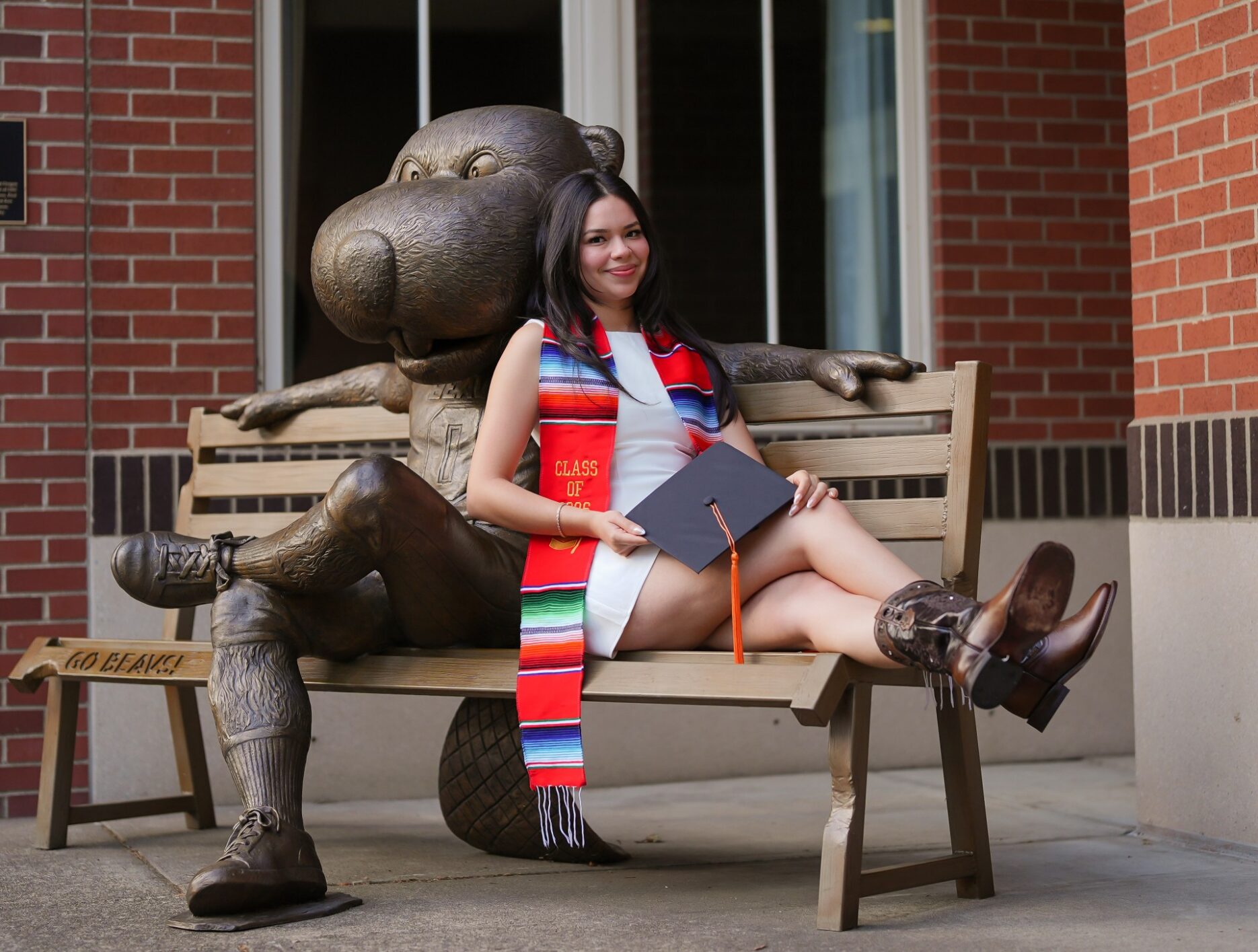
BioResource Research Major, toxicology option, with minors in toxicology and chemistry
Question: So, my first question is; what can you tell me about yourself and what drew you to the major?
“I’ve always been interested on like the biology aspect and the health aspect and the research component [of science] and what better major than BRR. After talking to Wanda, I think they sold me to the major. I started off as a kinesiology major, and then I really didn’t find myself with the classes. I knew that I wanted to conduct research, and adding the research to the kinesiology major would have been [a lot], so… I found BRR as the best kind of major for myself. What drew me to the major was the hands-on experience in designing my own research, while also building strong science communication and learning all about that. At the beginning I thought it was going to be completely different to what I think of it now. I think it’s challenged me in a lot of ways, like I have learned to be a better science communicator, but also learned what it is to conduct research and… use scientific language, if that makes sense.
I also obviously want to shout out Wanda. I think without Wanda this would have not been possible… She has helped me with like personal stuff and academic stuff. I think of BRR and I think of Wanda immediately.”
Question: Can you tell me a bit about your project and what you would like the average person to understand about your research?
“Yeah, so my research focusses on HPV vaccination, specifically the reasons why people are not getting vaccinated… I did this through surveys and interviews and I have been looking at factors like how misinformation or lack of awareness or cultural influences or access to healthcare can shape a decision making for HPV vaccine.
What I would like an average person to understand is that the vaccine decisions are often more complicated than simply choosing to get vaccinated or not. Many students have not received enough education on HPV or face many barriers and I think that college students specifically, this is one the first times they are making decisions for themselves without their parents. So I think figuring out that point [why they are making these decisions] can lead us into greater solutions as to how to better approach having conversations like this. I feel like at the beginning of this research, I looked at it through a science perspective of statistics and data and numbers, and through literature review, conversations that I’ve had, and just like learning more about my project itself I have also learned a lot more about the decision making and the holistic approach. I think that’s like the key word that I want to get out of all of this. Like there is just so much to just vaccination and I think there’s so many more conversation that need to be had besides just pushing people to get the vaccine.”
Question: What do the next steps in continuing this work look like? Is this something you are thinking of continuing yourself?
“Oh, I think I would love to continue this into my career and the next steps I see it going are in evolving or expanding the research to a more diverse student population. Looking at the data and the numbers we received I believe that like 65% of the data obtained was from white males. That speaks hugely about so many other factors that are not just relating to the vaccine to be honest. For example universities and health providers could use this information to improve educational campaigns, or make vaccine information more accessible and building stronger trust with students. And I think this doesn’t just start in college, but also expanding it to maybe even high schools or middle schools… at least getting them educated for when they make those decisions themselves, they know what they’re facing and the type of research or conversations they need to have before making such big decisions. I think that we could be doing so much more for the prevention aspect, before it [exposure to HPV] happens. I think there’s a lot we could be doing with educating and having conversations that might be hard to have but I think are important to have.”
Question: Do you have any advice for students considering or recently joining the major?
“Oof… BRR is such a fun major. I don’t regret taking it, but it’s a hard one for sure. My biggest advice is to take advantage of what the major offers and to not be afraid to step out of your comfort zone. I think it’s one of those majors where you get back what you put in. So if you’re going to be doing the bare minimum and not having a lot of conversations and not talking to advisors and not getting connected to clubs and resources like SACNAS and MANNRS it’s hard to isolate yourself and feel like you’re the only one, and for a little while I did that and it wasn’t until I started connecting specifically with other BRR majors that I realized ‘oh my gosh, you guys are like the best study buddies, like you guys really know what I’m going through’. Our research may not be the same, but we can help each other in so many different ways… We have the same common denominator, which makes us more unified.
I think the BRR program gives students the unique chance to gain hands-on research experience and build relations with mentors, or even develop like beyond the classroom, like building those relationships. I think even if you’re not sure your exact career path, going into BRR I think is like opening a new door and exploring so many different things that can be done. So for those who are interested or considering the BRR major I say give it a try. It’s one of those majors where you can really take it wherever you want to go. I mean, I’m a pre-med and I’m in BRR, College of Agricultural Sciences, which is CRAZY. And I’m not the only one, there’s a few other people but there’s also BRR College of Agriculture pre-vet or zoologist or scientists who take the major and run with it.”