My Year as a Malouf Scholar Coming to a Close

My year as an Oregon Sea Grant Malouf Scholar has been truly a year of growth. Going into the fall of 2018, I had little to no outreach experience. During the last year, I learned about the process of developing, funding/supporting, delivering, evaluating, and reporting outreach activities. My experience as a graduate teaching assistant and completing the course requirements for the OSU GCCUT (Graduate Certificate in College and University Teaching) program proved useful in designing my activities. For instance, I utilized my knowledge of backward course design, which is a technique for designing course content by starting with outcomes in mind. When choosing content and creating my lesson plan for the SMILE events, I based all decisions on my desired learning objectives for students. In addition to learning how to apply my formal teaching skills to outreach education, I learned skills specific to engaging with the public. I did this by reading materials provided by OSG and SERC (the Science Education Resource Center at Carleton College), but I also sought advice and guidance from others along the way. I talked with graduate students in my program who have extensive experience developing K-12 educational products and outreach activities (Sophie Wensman, Dani Miller, and Ian Black), I spoke with outreach coordinators from my college (Abby Metzger and Nancy Steinberg) and from the Marine Geology Repository (Cara Fritz and Maziet Cheseby), and I asked for advice from a number of OSU outreach organizations (Precollege Programs and the Center for Research on Lifelong STEM learning). However, no matter how much I prepared for my activities through reading and reflecting, I needed the actual experiences of delivering my sediment core activities and displays in a number of formats – to coastal community members at Hatfield Marine Science Day, to the middle and high school students in the OSU SMILE program, and to Corvallis community members at da Vinci Days. These experiential learning opportunities taught me what works, what doesn’t, and how to quickly assess and adapt as the situation required. Just like being a research scientist and college and university teacher, being a member of the STEM community who effectively delivers outreach activities requires passion, practice, and a lot of self-assessment. I’m so thankful for Oregon Sea Grant’s support at the beginning of my outreach and engagement career!     
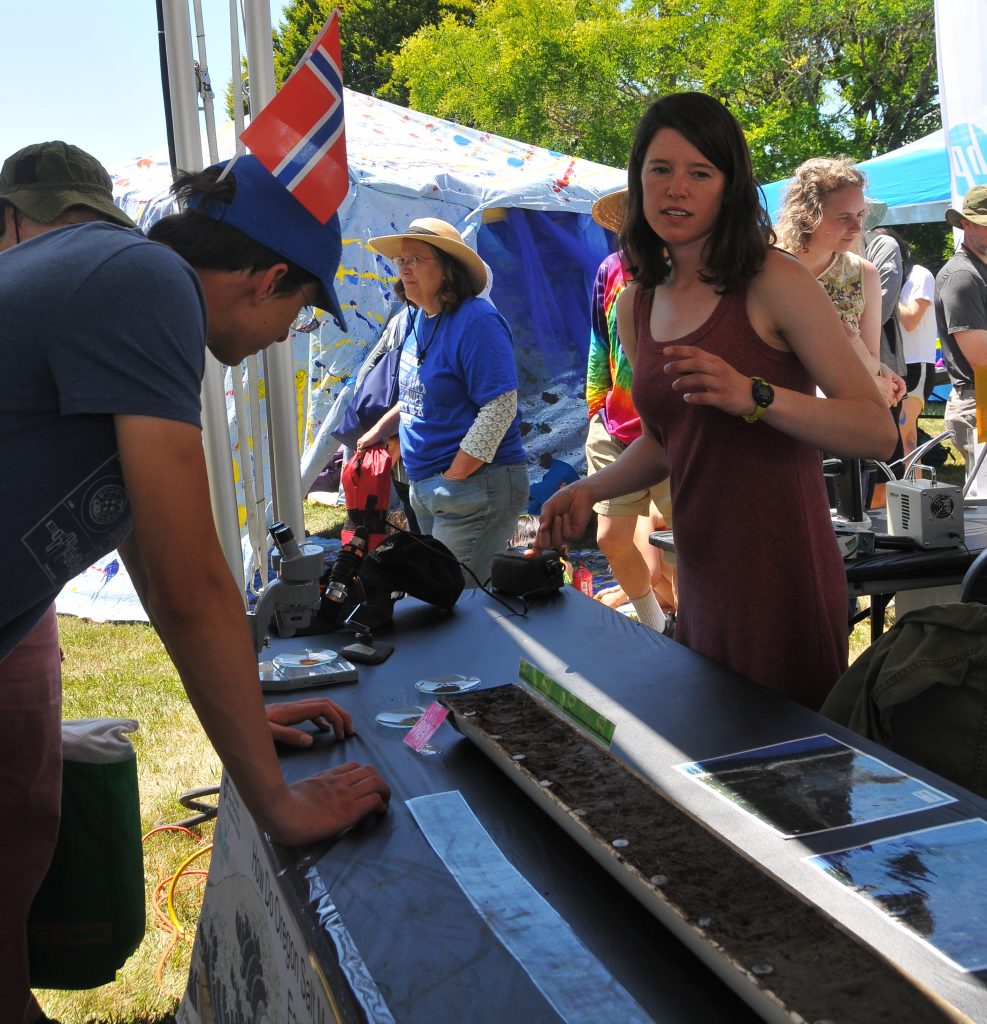
Me showing off my sediment core display at Corvallis da Vinci Days.

So, what does the next year hold for me?

I will be a fellow in OSU’s Risk and Uncertainty Quantification in Marine Science National Science Foundation Research Traineeship (NRT) program. In association with this program, I will be working with a transdisciplinary group of graduate students from different STEM backgrounds to assess the health of Oregon’s coastal sediment routing system. Specifically, we will work to better understand the connectivity between freshwater and saltwater systems by combining knowledge of hydrologic landscape classification schemes with estuarine morphology. This topic is of extreme importance for assessing the vulnerability of these systems to climate and land-use change. My experience as a Malouf Scholar will certainly provide useful in this project as much of the project will focus on the human dimension – both how Oregon coastal communities are influencing these systems through land-use change and also how Oregon coastal communities will be impacted by degradation and loss of coastal ecosystem services. The NRT program incorporates a significant professional development aspect, and I hope to further develop my newfound community engagement skills through collaboration with Oregon marine resource stakeholders, development of outreach products, and delivery of public presentations of our results.  

Additionally, over the next year, I will be starting a new project with funding from the Geological Society of America to determine the recovery times of Oregon’s salt marshes following the 1700 Cascadia Subduction Zone earthquake. I hope to disseminate the results of this project at the end of next summer. I also look forward to presenting my OSG-funded research at the CERF (Coastal & Estuarine Research Federation) 2019 conference in Mobil, AL this fall and continuing to attend OSG sponsored events, such as the State of the Coast conference and OSG Site Review.

Signing off for now!

Erin
a hui hou — until we meet again

When I first decided to apply for the Oregon Sea Grant Summer Scholars Program, one of my initial thoughts was “Itʻs only ten weeks — I can go without surf for that long.” I soon began think of other fun summer activities on Oʻahu that I would be missing and convinced myself that I exploring the unknown in Oregon was a much better use of my time. I was right.

The past ten weeks have been absolutely amazing and went by way too fast. One of the best parts about working with HRAP was that I used so much of what I learned in school when answering visitors’ questions. Ironically, most of the questions were biology or geology related — I specialized in chemistry. I also found myself explaining the State and Federal laws that protect the wildlife and habitat at Haystack Rock. Knowing the details of specific regulations not only gave me a certain amount of authority, which can be helpful when you are not actual law enforcement, but also helped me to explain the importance of what is being protected. Overall, the experience that HRAP provided me was the perfect opportunity for me to successfully apply marine science and policy to educating the public. 

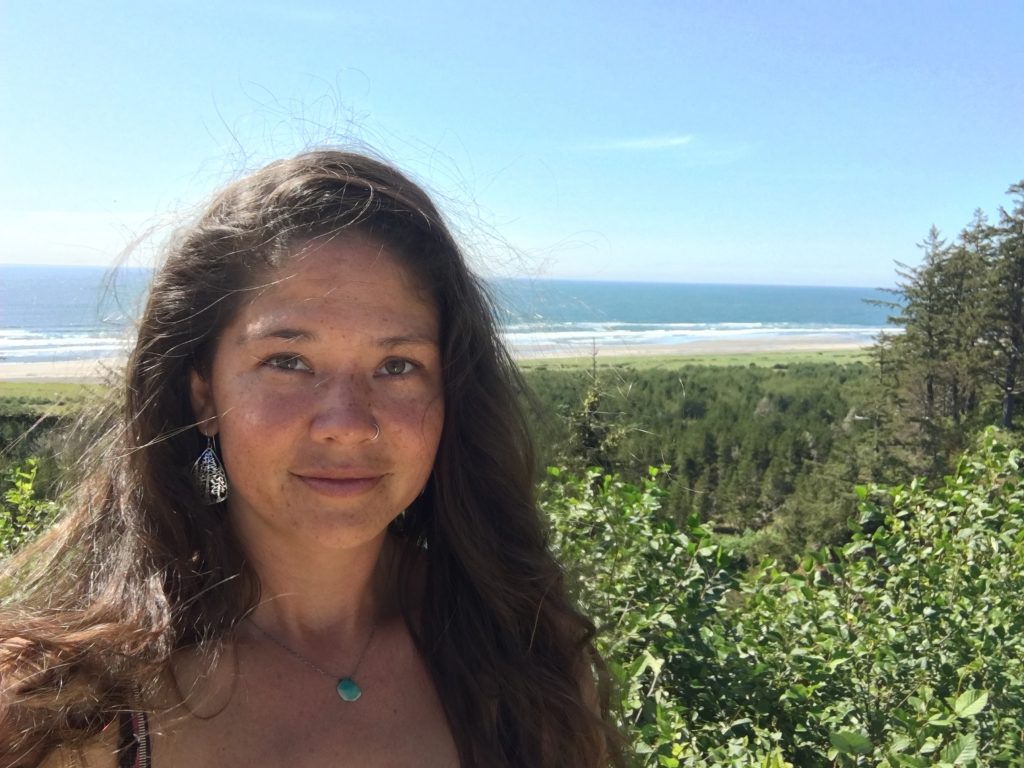
At Cape Disappointment…The view was not disappointing at all.

This summer, I also learned a lot about myself. My travel has been very limited in the past six years that I have been in school. I forgot how exhilarating new terrain can be. These ten weeks spent in Oregon reminded me that I am capable of independent travel and the unknown is often more exciting than scary. I will miss my weekend escapades to Portland, Seattle, Longview, and Newport, and being able to choose the route I had not driven yet. 

Prior to this summer, I had never really spent much time on the Eastern Pacific Coastline. Sure, I have lived in San Francisco and surfed a little in Santa Cruz but other than that I have had a blind spot in the area. Getting to see what the coastline looks like from Newport to Astoria, and even further North in Ilwaco and Long Beach, was such a treat and I looked forward to exploring more of the coastline in the future. 

All good things must come to an end :(

So these last few weeks have been pretty busy. It was a little hectic trying to finish my poster while doing field work but it all came together in the end. This time around I didn’t have to digest any shrimp so it was nice to help out with the other projects going on in the field. I was very nervous for the poster session and the lightning talk but I think everyone did a great job. Overall I think it went really well and was definitely a learning experience. It was also nice to get feedback from the scientists at HMSC.

I’ve really enjoyed all the food that I’ve eaten in Washington and Oregon and I think I’ll really miss it when I go home. Last week we walked to Chalet and I had the most amazing strawberry pancakes. I was in a serious food coma afterwards but it was so worth it.

I’ll really miss Oregon and HMSC but I’m so grateful for the experience that I’ve had here and I’ll for sure never forget it. I’ll be sure to keep in touch and hopefully cross paths with you guys again!

Farewell Post

It’s just hit me today that I’m really leaving the Oregon Sea Grant Summers Scholar program this week. It’s really felt like home the last few weeks. The people I’ve gotten to know here have been some of the kindest, funniest, and most passionate people I’ve met. I’m so glad I got to participate in this program.

Research Symposium

This past week has been a lot of fun. Our research symposium was on Friday, where we presented our research poster and did a five minute lightning talk to introduce our research. Autumn and I split up our projects at the EPA and I presented on the Zostera Marina mesocosm experiment, seeing how changing temperatures affects the relationship Zostera Marina has on carbonate chemistry in estuarine waters. It was a lot of fun to talk about and try to explain in five minutes. I had a blast talking with people about the research. Afterwards I made a blackberry pie and invited the Summer Scholars who were still in Newport after the conference, as well as Suhn’s roommates, to eat! It was a great time.

We went to the beach!

On Sunday, Nikki, Autumn, Suhn and I went to the beach! Suhn and I thought it would be a great idea to bury me in sand. Meaning, he said “Can I bury you in sand” and I said “sure.” By then time he was done the only thing emerging from the sand was my head and my cap. I would not say the experience was worth it, per se, but I don’t regret it.

Suhn and I then rented a canoe and we spent two hours on the lake. We were zooming the first hour, feeling pretty great about ourselves and our innate athletic abilities, and then when we had to turn back, Oregon decided to make us work for it. The wind was blowing so hard that if we stopped we’d start moving back very quickly, so we rowed like crazy until we got back! We also met an adorable corgi named 2020 (that’s what his nametag said) who was chilling in the shade near the docks, living his best life. All in all, a wonderful sandy Saturday.

Leaving the EPA

I’ve started the process of paperwork to end my internship at the EPA and I’m so sad about it. I am stunned by how warm, friendly, and inviting the members of the Newport Western Ecology Division of EPA were to Autumn and me. I couldn’t have asked for a better environment to do summer research, and I’m going to miss this place very much.

Thank you!!

So many people made this summer absolutely incredible! Thank you to my mentors, Jim Kaldy, Cheryl Brown, and Stephen Pacella, and to Beth Rutila and T Chris Mochon Collura! The people we worked with at the Oregon Sea Grant, including Jenny Engels, Stephanie Ichien, and Sarah Kolesar, were so friendly and fun! Finally thank you so much to my fellow Summer Scholars Autumn Herrington, Dominique Zuk, Naomi Scott, Suhn Brown, Hannah Sinclair, Honour Booth, and Melissa Wood, for being amazing and welcoming and making me feel at home! And thank you to everyone reading the blog, we really appreciate it!

Whirlwind Week in Kentucky

Sadly, I had to miss the Oregon Sea Grant Summer Scholar presentations that happened last week. I had a good excuse however. I was presenting the research that I completed last summer at the annual Ecological Society of America conference. This year, the conference was located in Louisville, Kentucky. My research was looking at the burrowing habits of the Northern Idaho ground squirrel.

With an attendance just shy of 3000 people, I was a bit intimidated at the thought of presenting a poster. I was pleasantly surprised by the reality however. Everyone was very friendly and I received some great feedback on my poster. 

I only spent one of the days presenting, so I had the rest of the week to attend various talks and workshops. There were so many things going on at once, it was hard to choose how to spend my time.

The week was not all work however. I made sure to take some breaks and explore the city. One of the highlights of my Kentucky experience was the river cruise I went on. It was a 2-hour ride down the Ohio river, which is bordered by both Kentucky and Indiana. I also had a great time exploring the city at night with my fellow Doris Duke Conservation Scholar cohort. It was great to reconnect with this group of wonderful people. The last time we were all together was in 2018 at the National Conservation Training Center in West Virginia.

I want to thank Oregon Sea Grant, Jim Kaldy, Cheryl Brown and the Doris Duke Charitable Foundation for making this trip possible and being so flexible.

The end :(

Last Week in Newport

Wow, I can’t believe it’s the last week already. Last week flew by, and I just finished my last full weekend in Newport.

This post will be bittersweet: bitter because I don’t want to leave the people I’ve met or this amazing little town, but sweet because I’m ready to go back to school and am looking forward to life after school.

Last Week of work

We had our final symposium for Oregon Sea Grant on Friday! I think it went really well. Everyone’s posters and presentations were soooooo good!

I went to the last Oregon Coastal Management Staff meeting that I could attend last week. It was saddening to say goodbye to them, but I’m hoping to see them all again one day ;)

I hope to see everyone I have worked with again some day, including (especially) the other scholars!!

One of the last things that I’m doing is finalizing the displays for the king tides project, and I’m honestly not ready for it to end.

But, if you are ever in Oregon during the winter season, I encourage you to go out and take pics of the king tides and submit them! And keep an eye out for the travelling display, and when it’s up on the web, check out the virtual display!

Last week of fun

I forgot to mention that I went to the Oregon Coast Aquarium two or three weeks ago! It was super cute and the shark tunnel was amazing (of course, sharks are the best)!

Here are some cute lil jellies :)

Over this past weekend, Ariana, Autumn, Nikki, and I went to Devil’s Lake again! Ariana and I canoed on the lake, which was super fun!!

Before that, we made a stop at Taft to check out the beach there. It was pretty windy, so we didn’t stay long, But, I got to bury Ariana in the sand before we left :)

For her last pie, Ariana made an amazing blackberry pie (shoutout to Nikki for the handpicked, perfect blackberries)!! It was great and bittersweet (get the theme yet?). So, I rescind my previous pie comment haha.

Farewells

I’ve never been the best at saying goodbye, so we’ll see how this goes. My time here has been incredible, and definitely formative and informative. It’s helped me figure out what I want to pursue in grad school and future careers. I found some of my favorite people here. I found one of my favorite places I have been to. I want to say the biggest of thank you’s to everyone who has contributed to my experiences here – everyone at Oregon Sea Grant for making this possible; everyone at the DLCD for being accommodating and warm; Meg and Hui at the Newport office for being the best; and all of the other scholars for great conversations, hugs, laughs, love, and good times. :)

For the last time, sea ya!

Goodbyes and Blackberry Pie!

August 19th, 2019:

As predicted in my last blog, I blinked and it’s Week 10. So much has happened these past few weeks no wonder they completely sped by. For one, we had our final symposium and poster session last Friday! The day before that, my mentors and some members of the Marine Reserves program took me out for a farewell lunch at Local Ocean and got me the sweetest gift (plus a bag of sweet & salty kettle corn—my absolute favorite!!) I’m really going to miss the people I’ve gotten to work with these past 10 weeks; I seriously don’t think I could’ve dreamed up a better work environment. I’m extremely thankful for everything and everyone who has made this summer so memorable!

Though we wrapped up our last round of field days a few weeks ago, I still have things to keep me busy in the office before I officially head out. With whatever down-time I’ve had this summer (when I wasn’t in the intertidal, SMURF-ing, coordinating Sea Star Surveys, or creating my poster and presentation for the final symposium), I was down a Google Scholar rabbit hole sorting through all the research articles I could find that were published on rocky intertidal habitats along the Oregon Coast. The Marine Reserves will be presenting a huge progress report to the state legislative body in 2023 and they’ve asked for my help in making an Annotated Bibliography. Essentially, my job is to compile all the research that has ever been conducted in rocky intertidal habitats both inside and outside the Marine Reserves, before and after their implementation in 2012. As I’ve basically finished it off at this point, I can definitely say I know way more than I ever thought I’d know about Oregon rocky intertidal life.

As I began my series of blogs with dessert, I feel it absolutely necessary to conclude with it as well. Just to preface a bit before I dive completely in: before this summer, I had only been to Oregon once. I was 12 and stayed in a really cute beach town up north—Manzanita. During my stay, I had a genuinely life-changing dessert at a Mom & Pop restaurant on the coast: a slice of marionberry pie. Since then, I’ve deemed the marionberry as my ULTIMATE favorite fruit and marionberry pie as my ULTIMATE favorite dessert. At the beginning of this summer, I vowed to have a slice of marionberry pie (as I’m now back in Oregon, marionberry-territory). Well, unfortunately Newport isn’t close to any wild marionberry bushes so I had to compromise for its less lavish cousin: the wild blackberry. There are hundreds of ripe blackberry bushes scattered around Hatfield, so last week I went on a 3-mile loop and picked as many blackberries as my bucket could carry. I brought them back to the apartment and my roommates and I made a fresh blackberry pie to conclude the amazing summer. Though nothing can ever compare to a slice of marionberry pie in my book, this pie came pretty darn close.

Some of the blackberries I picked along the estuary trail at Hatfield!
The blackberry pie straight out of the oven!! Gonna miss Ariana’s pie crusts </3

So I guess this is goodbye—goodbye to the amazing people I’ve gotten to meet, goodbye to the amazing foods I’ve gotten to eat, and goodbye to the amazing memories I’ve made in this quaint little beach town. I’m going to miss everything tremendously. Thanks for staying tuned with my life as a Sea Grant Scholar, and thanks for (hopefully) not rolling your eyes every time I’ve rattled on about food :) And thank you, Newport, for the most amazing summer!

-Dominique :)

Final Week

This is the last week of the Sea Grant program, which is both good and bad. It is almost time to leave Oregon and say goodbye to all of the great people I’ve met, which is sad. However, it is almost time to go home which means seeing my family and getting to sleep in my own bed again! This week will be finishing things up at our internships and then it will be time to leave. Last Friday was the symposium for our final presentations and posters for our summer experiences. This caused me to take a look at my reasons for being in the program this summer.

There were a couple of main reasons I applied to Sea Grant. First, I had my sights set on Oregon State for graduate school and this program was a good way to make contacts as well as experience Oregon for longer than just a vacation. Second, I have never done biology field work so I thought this would be a good way to get an idea of what that is all about. I am leaving Oregon having fulfilled all of those objectives and knowing all about the life of a field biologist. Tony D’Andrea and the rest of the SEACOR team (Bob, Tabatha, Joe, and Mo) have been instrumental in learning about fieldwork and future career opportunities. They have been an amazing team to work with and learn from this summer.

Everyone from Sea Grant and who lived in the yurt or ranch house has also been a pleasure to get to know this summer! I will miss all of you and cannot wait to see what great things you all accomplish!  

Video Time and Final Symposium

Early August I had to start working on my film that would be put on the South Slough National Estuarine Research Reserve YouTube channel. I had 2 video ideas that I wanted to to make so I spent some time with Shon Schooler documenting the SSNERR Green Grab and Ian Rogers eDNA project. When documenting the Green Crab project I filmed the team setting traps, collect traps, and marking green crab data entries. I also conducted 2 interviews Shon Schooler and Green crab expert Sylvia B. Yamada who wrote the book “Global Invader: The European Green Crab”. It was truly a fun experience! Later on I shot eDNA project with Ian Rodger collecting samples, discussing protocols, and doing an interview. Both of these topics were really interesting to shadow and film really giving me an true view of the SSNERR projects here.

Ian Rodgers

Fast forward on August 16, 2019 we had our final symposium where each fellow discussed what and how project was for this entire summer. It was really amazing to see all the hard work that each fellow did over the summer and how happy they seem to have learned from their mentors. It is a very bittersweet ending to this fellowship! I hope everyone had a wonderful time and hopefully will be able to see each other in the future… an OSG Alumni Meetup *cough-cough*

The Visitor

Do you remember the first time you saw the ocean? For someone who grew up on an island in the middle of the Pacific, this memory is often taken for granted. I only know that I was taken to the beach before I was a year old because my mom told me that it happened; my first actual memory of the ocean is as a toddler at Ala Moana Beach Park. The idea of going years without ever seeing the sea is…mind boggling. Yet this absence of the big blue is a reality for many land-locked individuals out there. I know because I have met some of these individuals during the HRAP beach shifts. Since my first meeting of an individual who has never seen the ocean before, I have been extremely cognizant of the visitor mindset. 

Yet, here in Oregon, I am a visitor. I may not be a “tourist,” but I am certainly not a local. While I try to put myself in the shoes of those who are unfamiliar with the ocean and marine environment, I also observe myself as a visitor here in Cannon Beach. Having self-awareness as a visitor, sometimes wielding authority at Haystack Rock can be difficult. I have talked to many a beach goer that remembers playing in the tidepools as a child without any government regulation and exploring the Rock without any restraint. Some of them cannot believe what they got away with — now as adults they see how their actions were irresponsible, and would never fathom doing those things now. Others resent me and see me as a barrier between them and reliving childhood memories. As a visitor of Cannon Beach, I feel a little uncomfortable about telling these people “No.” But then I remind myself that as a kiaʻi kai (ocean caretaker) it is my kuleana (responsibility) to protect all the invertebrates in the tidepools that do not speak human and therefore cannot scream “You are hurting me!” as they are poked, pried or smashed.

Saturday, August 3rd was the last day of data collection via survey for my project studying human dimensions at Haystack Rock. According to my data, one third of my respondents knew about Cannon Beach from their childhood. Of those individuals, 48.5% are from Oregon and another 35.6% are from elsewhere in the Pacific Northwest. I often compare Haystack Rock to Hanauma Bay, a Marine Life Conservation District that is probably the most popular snorkeling destination on the island of Oʻahu. Like Haystack Rock, Hanauma Bay is the responsibility of multiple levels of government: all of the land areas are a municipal park, but once you touch the water you are under State jurisdiction. Also like Haystack Rock, interaction with the environment is regulated and education is a major component of the visitor experience. Anyways, getting back to my point: if I were to do a survey of Hanauma Bay visitors, I highly doubt that many of those visitors would be locals that remember visiting as a child (although I am from Oʻahu and remember being seven years old, coming face to face with an uhu (parrot fish) and getting attacked by pigeons while eating Cheetos my first time at Hanauma Bay). A huge difference between Cannon Beachʻs visitors and Hawaiʻiʻs visitors is that the love that the former has for Cannon Beach comes from a deep seated sentimental place in the heart that can only be developed over time. Hawaiʻiʻs visitors may have love for Hawaiʻi, but it is a love that is developed during their short stay and on their own terms — they see and take with them the pretty pieces of Hawaiʻi that they prefer and leave behind the ugly real life parts that do not fit into their idea of paradise. 

There is a bumper sticker back home that says “I Love Kailua…Before You Came.” I think this phrase, though maybe hurtful to new comers or visitors, is completely justified. As the local of a particular place, one draws identity from the area: the place is a part of the person. This does not mean a person new to the area cannot also love the place, the love is just different and the relationship with the place is different. As a visitor of any place, one must remember that there were others there first — and not just humans but plants and animals too. As a visitor, one must keep in mind the places back home that they love, that define them and remember that this new place serves the same purpose for someone else. Almost like extending the golden rule so that “others” encompasses all nouns, not just humans.