Reflections of a remote intern

As the end of my internship encroaches I am feeling like I have accomplished my goals and completed my tasks. I learned a lot this summer and as I reflect on my last 8 weeks I am very happy with who I have met and worked with, and what I learned from them. I am also happy that I got to learn a little bit more about myself and how I might respond to a remote position in the future.
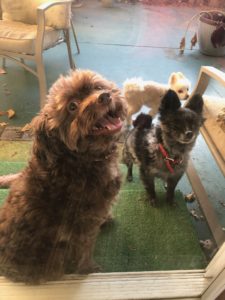
Our three dogs: Wolf the chocolate brown Pomeranian-Poodle, Kona the merle Pomeranian, and Einstein the white Pomeranian.

I was surprised about how productive I can be at home. There are so many distractions for me to get tangled up in like the pile of laundry in my closet, the dogs (we have 3!), or even the sudden urge to clean out my refrigerator but I was able to manage my needs and get my work done. Some days I was more productive than others and I definitely didn’t work a M-F, 9-5 either. I put in a full eight hours of work some days and other days I didn’t. I was lucky because although my organization operated on standard business hours, I could complete my tasks outside of the work day if I pleased.

Me on vacation last week in North Bend, WA visiting the Snoqualmie Falls on an early morning hike.

If I could start the summer over again before the internship, I would have dedicated a space for me to complete my work. This summer I worked on the back patio, the living room couch, my bed and even in the basement. Having a desk where I can keep my computer and notes would have been ideal to keep me focused for a longer period of time. I would also have planned my vacations after the internship because although my internship was remote, it was a little difficult to stay on the computer while everybody else is relaxing!

Science Policy and the Organization of the South Slough National Estuarine Research Reserve

Before I get to the real substance of this blog post, try saying “South Slough National Estuarine Research Reserve” five times fast… It takes some practice, so good luck!

Once you have mastered saying “South Slough National Estuarine Research Reserve,” you can move on to the remainder of this post.

Okay, games aside… For this week’s blog, I have answered questions related to science policy that can be seen below in bold.

Now that you’ve been on the job for several weeks, how has your view of science policy changed (if at all)?

My views on science policy haven’t really changed, though working for a state-run organization has given me a better understanding of the resources available to organizations like the South Slough National Estuarine Research Reserve (SSNERR). I’ve also heard more about what it takes to get additional funds through grants for various projects (and it doesn’t seem easy).

Do you have a better understanding of how policy organizations work?

One of my goals for this summer is to have an in-depth understanding of how the SSNERR is run. As of now, I have not had time to learn more about how it works on a macro-level, but I have definitely developed a better understanding of how the SSNERR team works on a micro/local level. I have had the opportunity to work with both the science and education teams this summer; as a result, I feel I have a solid understanding of how similar programs may be organized. I also have a better understanding of what positions are necessary to run a state-guided science organization.

Have you had a chance to attend any agency-level meetings?

I meet frequently with the education team, but have not yet attended an all-staff meeting or meeting of higher status. I will be attending the next all-staff meeting in order to learn about how the meetings and agenda-setting work, though my role at the South Slough (given my limited time) has not made it imperative for me to attend such meetings. I believe I will get to attend a National Estuarine Research Reserve (NERR) meeting this summer as well, which will help me understand the larger system as a whole. 

Does your agency have ties to other states, and/or to national-level organizations?  

The South Slough was the first location designated as a National Estuarine Research Reserve (NERR) and is affiliated with the National Estuarine Research Reserve System (NERRS). This system functions under NOAA. As seen on NOAA’s website, “The National Estuarine Research Reserve System is a network of 29 coastal sites designated to protect and study estuarine systems. Established through the Coastal Zone Management Act, the reserves represent a partnership program between NOAA and the coastal states. NOAA provides funding and national guidance, and each site is managed on a daily basis by a lead state agency or university with input from local partners.”

Logo for South Slough National Estuarine Research Reserve
Our logo at the South Slough!

A Day in the Life of Angela

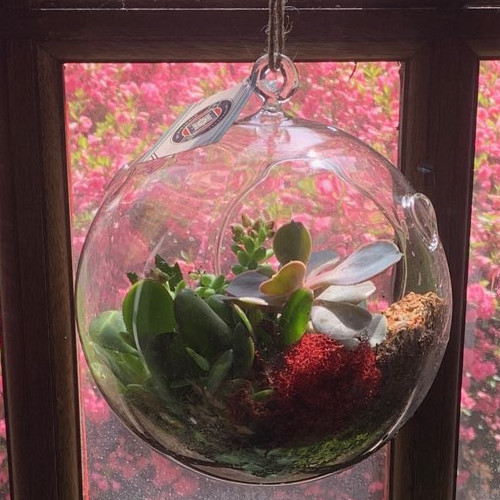
Succulent planter globe hanging in a window.
Succulent globe I received as a graduation present hanging in my window with my other plants.

Remind us what your project is:

This summer I am working for the Oregon Coastal Ocean Information Network (OCOIN) on outreach projects.

What have you been doing in your first few weeks on the job?

Lately we have been working a lot on the newsletter, annual meeting, and technical updates.

Describe your daily routine in the time of COVID-19 remote (or in person) work:

I usually start my day with a meeting either with OCOIN staff or a another agency. I then break for lunch then work the rest of the afternoon on my projects.

Do you work 8 hours straight?

I definitely try not to work 8 hours straight! I sometimes have to take a mid-day night just to give my eyes a break.

Do you multitask?

I like to listen to a podcast while I work. Some of my favorites are Crime Junkie, This Land, OPB (all things considered section).

Do you have “coffee” with colleagues/co-workers/other interns?

Yes! OCOIN has three interns this summer so meet every Friday morning and talk about our favorite books, our pets, our OCOIN projects and anything else that pops up. We don’t usually set an agenda which is nice because we just talk about what is happening in our lives. The Friday morning meetings help facilitate some of the interactions I would have hoped to have working with a team in the office.

How often do you check in with your supervisor?

I check in with my supervisors at least twice a week. The nice thing about the OCOIN committee is that there area several of them to ask for help or get guidance/advice from!

How often are team meetings?

We have at least one team meeting a week but as we get closer to the annual meeting we will probably have more.

How do you stay motivated (exercise breaks, phone calls with friends, walking meetings…)?

OCOIN uses a platform that organizes all the team members and their tasks which is ironically called Teamwork. This platform is very useful for staying motivated because it provides you with progress reports and details about your tasks at hand. I also take breaks and tend to my plants, I have attached one of my creations but there are many more!

What is one downside or your COVID-19 work routine?

I think the one downside to the COVID work routine is that the screen time is making me very tired when I log off for the day and I don’t stay up as late to do the personal things I want.

What is one upside of your COVID-19 work routine?

Because my project is remote I have enjoyed making my own schedule so that I can take care of things for myself and still get a days work in. I think most work a modified schedule right now which is super cool because you could email someone at 10 pm and they might get back to you right away!

Update on Current Research and Reflections on the 2020 Census

While I had hoped that this summer would be full of trips to sunny, salty, sea lion filled Newport to mentor ODFW’s Summer Scholars, unfortunately everyone is still working remotely. Though I have heard from my Newport-based coworkers that this pandemic is not stopping the hordes of tourists from flocking to the coast for celebrations such as the recent 4th of July.

One of the main projects that I’ve been working on this summer while stuck in Bend (there are worse places to be stuck!) is understanding if marine reserves have influenced socioeconomic conditions in communities located near them. To investigate this, I first had to gather information on the socioeconomic conditions of coastal communities over time. I used the Census Bureau’s American Community Survey 5-year estimates from 2010 to 2018. While accessing data prior to 2010 would be ideal, the first 5-year estimate summary tables were only released in 2010, so we work with what we got.

After collecting all of these data, the exploratory analyses began, as did the true test of what I can remember from those statistics courses long ago and how far my R coding skills can take me. These exploratory analyses include tests and visualizations such as correlation plots, non-metric multidimensional scaling plots, bubble plots, vector analyses, principal component analyses, PERMANOVAs, the list goes on. When working with complicated multivariate data, I have learned that exploration is key to understanding what is really shaping your data.

I have also been trying to figure out what my control and treatment communities should be. With this first approach, I am considering treatment communities as those that are located <15km from a marine reserve. Control communities are therefore all coastal communities located >15km from a marine reserve. Since the marine reserves were phased in over time, I have three separate treatment groups. The 2012 group includes communities located near Redfish Rocks Marine Reserve and Otter Rock Marine Reserve, the 2014 group near Cape Perpetua Marine Reserve and Cascade Head Marine Reserve, and the 2016 group near Cape Falcon Marine Reserve. While this approach is a good first step, I will likely need to consider if other groupings or controls would be more appropriate. One method I am currently researching is creating a synthetic control by weighting non-treatment communities based on socioeconomic similarities to treatment communities prior to marine reserve implementation. But I won’t get too into the weeds with that statistical discussion here for everyone’s sake!

As I’ve been working with these census data, I’ve been thinking about the unfortunate timing of the decennial census this year. The Census Bureau conducts a survey every ten years with the goal to obtain a comprehensive snapshot of households in the United States. Unfortunately, the census this year coincided with a massive pandemic leading to significant economic loss and unemployment and the consequences that follow that loss. When future researchers use the decennial census to look at change over time, they are going to see data from 2020 that is not representative of the previous ten years, which will likely impact their analyses. I’m assuming that this data issue will lead to many footnotes in future papers. Luckily I will only be using data through 2019 (once it is made available) since the 2020 data will not be made available until after the marine reserve synthesis report is due.

Connecting During COVID-19: Research and Communication

Much has changed since last fall! To echo many other recent posts, much of my recent life has been adjusting to the new normal. We are about two months into Oregon’s initial stay-at-home orders. All things considered, I am feeling lucky in my situation. With plans to defend this summer, I am nearing completion of my Master’s research on the adaptive capacity of small-scale fishermen in Baja, Mexico. I am lucky to be able to continue to analyze data and write from home without having to change my research plans.

I have been wondering about the effects of current events on science outreach and collaboration. Although my research wasn’t disrupted, I am bummed about missing out on some outreach opportunities in the spring and summer. Back in February, I presented a poster of my research at the Ocean Sciences Meeting in San Diego. I was also planning to present at the Marine Socio-Ecological Systems Conference in Japan this week, but it was cancelled. I know that many people’s experiences are similar to my own: cancelled conferences, talks, meetings. These missed opportunities can challenge us towards developing new ways of disseminating science remotely. I recently presented via Zoom at the People and Nature virtual seminar here at OSU, and I quickly realized that presenting over Zoom (as opposed to in person) is a new skill in itself! I would imagine that this remote lifestyle affects collaborations too. I observed an (in-person) Marine Protected Area Sizing and Spacing workshop back in March that showed me how valuable it can be to gather experts in the same room to discuss ideas. Running this type of workshop remotely would absolutely still be useful but calls upon a different strategies and skillsets. As I ponder these ideas, I am finding myself continually impressed by the quality and variety of webinars, games, and other online resources that already exist or are actively being created to communicate science. It is encouraging, and it has been interesting to think about outreach and collaboration in this way.

Next fall, I am excited to be continuing on for a PhD in the Geography program here at Oregon State University. Working with my current OSU and NOAA mentors, I will likely be continuing my research into the adaptive capacities of coastal communities by focusing here in the Pacific Northwest. Some questions I am interested in are: How can coastal communities adapt to changes in ocean conditions? and How does collective action of fishing communities result in cooperation or conflict in fisheries? When planning out what my PhD research will look like moving forward, I will consider what is feasible with in-person interview methods that I hope to use. As Brittany mentions in a previous post, studying people recently has become much more complicated.

For now, I’m grateful to be continuing on as planned with my Master’s research and looking forward to wrapping it up this summer. Until the next post, take care!

Working through a pandemic

Times have certainly changed since my last blog post. With all of the COVID-19 health measures in place, the agency I work for (Oregon Department of Fish and Wildlife [ODFW]) has moved to primarily telecommuting. For me, this isn’t a huge difference since I was already working mostly remotely and have developed a routine to maintain productivity and minimize distractions throughout the day. However, I imagine that it is quite a big change for most of my coworkers that are used to working in the Newport office.

One measure my team, the Marine Reserves Program, has taken to ensure connectivity during these social distancing times is weekly virtual meetings. We start the meeting by each sharing a tip we have learned to improve this isolating experience or a suggestion we’ve heard for how to help out our community during this difficult time. Given the active nature of my team, tips often include taking the dogs on long early morning walks, setting up virtual exercise classes with friends, and making time for lunchtime yoga to keep routine and movement in your day. Suggestions for helping the community include purchasing food from local businesses and getting involved with volunteering where possible (e.g. helping distribute meals or groceries to those unable to leave their house).

Starting our weekly meetings on a positive, team-focused note makes me look forward to these Wednesday afternoon get-togethers. We’ve even started adding in silly components to distract from the seriousness of the real world and allow for us all to have a laugh. Last week we donned silly hats for our meeting, which allowed me to see my boss (Tommy) wearing his daughter’s bunny ear beanie with wire cat ears on top. Quite a sight!

While these meetings are used to keep us informed of any ODFW COVID-related changes, their primary purpose is really to keep our team connected. During this time of social isolation, staying intentionally connected is more important than ever for our mental health. I feel very lucky to be part of a team that takes the time to check in with their coworkers in both a personal and professional manner.

Natural Resource Policy Fellowship with the Department of Land Conservation and Development

Posted on Behalf of Nick Tealer

I have truly enjoyed my experience at DLCD so far. We have been extremely busy with public engagement meetings, Commission meetings, state agency collaboration, and so much more! It is encouraging to see this many people passionate about conserving our oceans and protecting vital habitat for threatened/vulnerable species.

While there have been many highlights in my 4 months here, I can say that my experience in Florence was the pinnacle. Every fall and spring, the OCMP Team meets with Coastal City/County Planners to help inform them about legislative developments, agency developments, and other information helpful to urban planning in the coastal zone. The amount of enthusiasm and ingenuity at those engagement hearings were great to see, and be a part of. In that same trip, the OCMP team was able to explore the Heceta Head Lighthouse, and the Florence Dunes. While I have been in Oregon for three years, this was one of my first trips to the south coast, and I truly enjoyed learning about this region’s history.

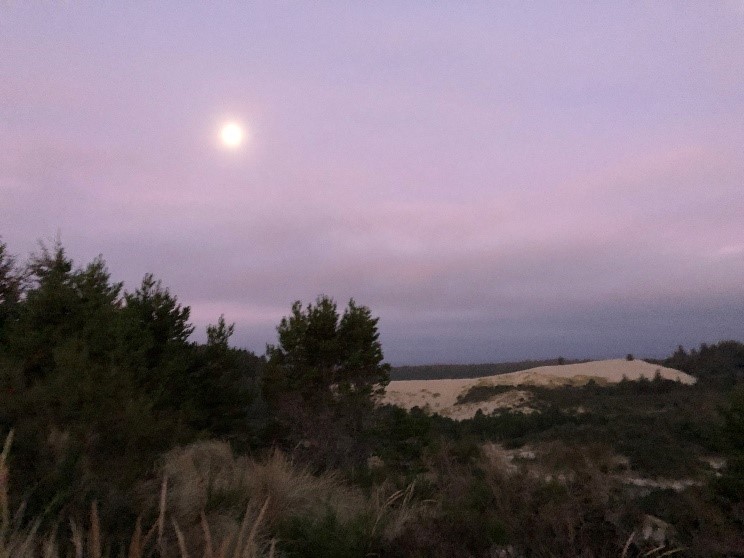
Blue and purple morning sky above the Florence, Oregon dunes.
Florence Dunes in the morning. Photo by Nick Tealer

The relationships I have made throughout this experience have been fantastic. The staff has been extremely accommodating and welcoming to me, as well as other state agency officials that I have had the pleasure of contacting. Ranging from DEQ to ODFW, my experience in coordinating with other state officials has been rewarding. I hope that this trend will continue as I become more experienced in the field of marine policy and habitat conservation.

View of the sunset over the ocean. Heceta Head sea stacks in the foreground.
Beach next to Heceta Head where we had burritos on the beach. Photo by Nick Tealer

From GNRO to OWEB, that’s a wrap

From one government acronym to another, my time as a policy fellow with the Governor’s Natural Resources Office is over, and I am moving on to the Oregon Watershed Enhancement Board as the Water Vision Coordinator-sounds cool, huh?

I was initially hired to work with marine policy, but I learned about so much more. Along with helping with the Ocean Policy Advisory Council, the Ocean Acidification and Hypoxia Council, and the Rocky Habitats Working Group, I was helped with legislative projects, as well as pesticides, wildfire, and water policy. I was lucky enough to learn an incredible deal about how the policy I learned about in the classroom, is actually applied on the ground. A plan for ocean acidification is great, but we have to be able to pay for it. How do you balance OAH and a carbon cap-and-trade market? Both address climate change, but both require substantial resources to implement. Luckily that wasn’t my job to figure that out, but it is fascinating to be privy to those conversations.

The most fascinating thing I found about my time in the Governor’s Office was the timescale on which things happen. During the 2019 legislative session, conversations about the 2021 budgets were already happening. In the meantime, strategic legislative decisions are made on the quickly, based on the best available information. The long-term planning and quick, savvy decision-making showed me how incredible of a beast government really is (so overwhelming).

My last project with the Governor’s Office, and new job, is the 100-Year Water Vision, and is a text-book example of long-term planning and quick decision making. The goal is to create strategy to invest in Oregon’s water infrastructure, to ensure that there is clean and abundant water for now, and 100-years into the future. To do that that state must first assess what information we have, and what information we need to make big management decisions, while also engaging local communities now, to develop trusting relationships for the future.

Serving Governor Kate Brown, and being a part of the 100-Year Water Vision has been such an honor, and something that I would have never been able to achieve without Sea Grant. The Natural Resources Policy Fellowship has given me the opportunity to learn from experts in virtually every field, from every agency, and witness policy making at the highest state-level.

This fellowship has allowed me to break into the field, and create invaluable connections. Along with jumpstarting my career in natural resources, Sea Grant has provided me with the skills and a support system to grow and thrive into the future. Thank you!

Mid-Summer Check In #tacos

Over this last week we had our Mid-Summer check-in! On the first day all the Oregon Sea Grant (OSG) Scholars gather to the Beverly Beach Yurt in Newport to have our picnic. It was really great catching up with everyone since we hadn’t seen each other together over the last six weeks.

Our next day we had our professional development workshop where we learned about the different dynamics of “hard power” at work and how to understand/develop “soft power” during our program and in the future!  And later on that day the OSG scholars and I went to one of the beaches around Newport and had a campfire and watch the sun go down.

Then finally we spent 3 days camping at the Rujada Campground in Dorena, Oregon where we had many burgers, Reese-Oreos Smores, and great laughs! This Mid-Summer check-in was simply amazing!

PS

Whoever many the sour pickles at the OSG Picnic is 10/10 and can you please give send me the recipe!

King Tides Washing Around My Brain

Hello and welcome back!

King Tides Along the Coast

The past few weeks have been busy busy busy. For the King Tides Project, I have been making a web display to celebrate the 10th season of the Oregon King Tides Photo Initiative! The purpose of the display is to highlight the successes of the project and to educate about climate change and sea level rise on the Oregon coast. Preparing this display has taken hours of planning the order and content of the information, brainstorming meetings with other members of the Oregon Coastal Management Program, and sorting through many photos on our Flickr page!

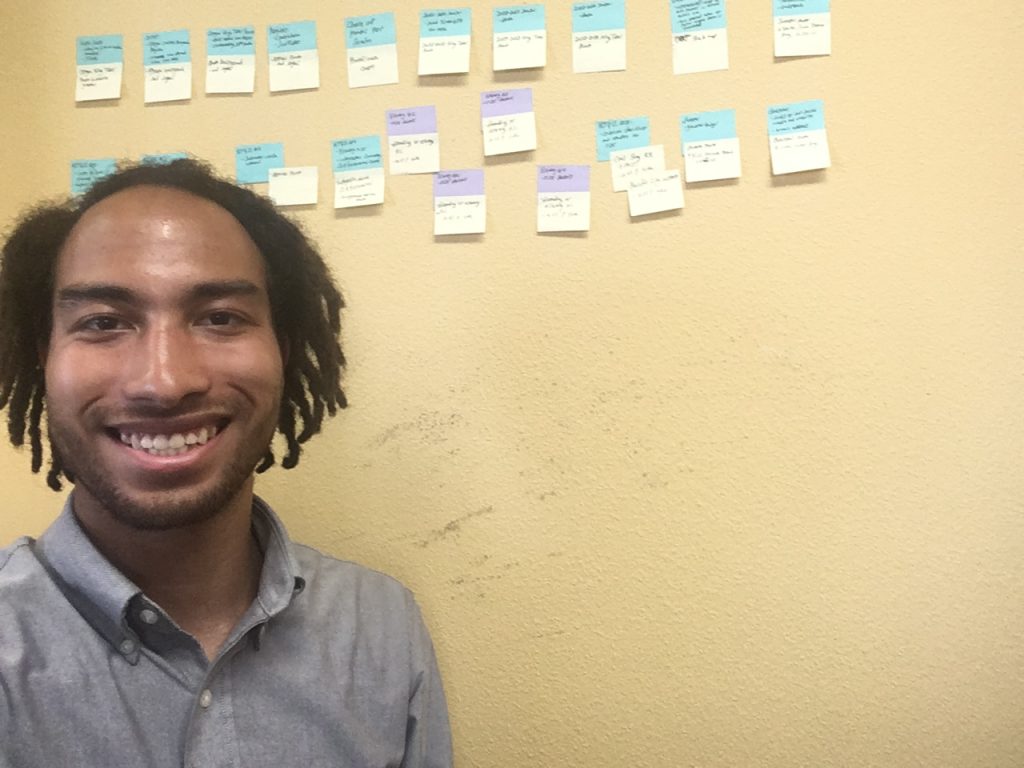
Here is a photo of me with a sticky note map of all of the slides for the presentation!

Another large part of what I have been working on is getting a physical display ready! Hopefully, it will be travelling around in three different venues on the northern, central, and southern Oregon coast (exact locations and dates hopefully in the next post)! In addition to the traveling display, I have been coordinating with the manager of Hatfield Marine Science Center’s Visitors Center to organize a semi-permanent display that will be held there after the king tides season this upcoming winter!

If you want to keep up with what’s been happening with this project, feel free to follow our Instagram, Flickr, and Facebook at the handle of @orkingtide and check out our website: http://oregonkingtides.net!

Okay, moving on from the work talk!

Camping and TACOS!!

Last week, we had our Sea Grant Summer Scholars midsummer check-in! It was really cool seeing all of the projects the other scholars are working on!

During this past weekend, we went on a camping trip as well! Camping in the Umpqua National Forest was beautiful, and especially so for my first time camping in Oregon! We experimented with ingredients in S’mores and I learned that peanut butter cups and graham crackers are some of the best inventions haha. We also had THE BEST TACOS OF MY LIFE at a place called Tacovore!! All in all, super fun trip.

Until next time, sea ya!!