Week 9: Symposium

This week was marked by the arrival of our symposium, the soft ending to this whole summer adventure. There is still one week left in which to wrap things up, but we have all summarized our experiences and communicated them to a small audience of our mentors and others who supported us. I really enjoyed seeing what everyone ended up doing, comparing it to my impressions of their projects from the beginning. It seems like everyone learned a lot! I found myself being jealous of what other people had done, before remembering that I did just as many cool things as they did. Unfortunately, I didn’t take any pictures of the event.

After it was over, my mentor and everyone in my lab went out to dinner, along with spouses and a couple other Hatfield people. It was great to experience my coworkers in a casual environment, with no projects to work on or requests to make.

Before the symposium, my week was a rush to put together my presentation, and try to get some data analysis done so I could present results from the videos we took. Unfortunately, just watching them takes too long, so it didn’t work out. However, this is my goal for this last week: to get at least a couple days worth of video watched in every habitat, so Daniel and I can start to analyze it together. He’s been showing me some useful commands in R, and I intend to take full advantage of his knowledge for the rest of the time I have here.

IMG_0488

A cabezon I saw while diving

This weekend, after the symposium, a couple friends and I went diving again, to relax! They had just taken finals in their classes this past Thursday, so we were all hankering to get out and have fun. We saw a ton of cool stuff, and it was the first time I really got to play around with my underwater camera. The visibility was only a couple of feet, but considering that, I think the pictures turned out pretty well.

IMG_0549

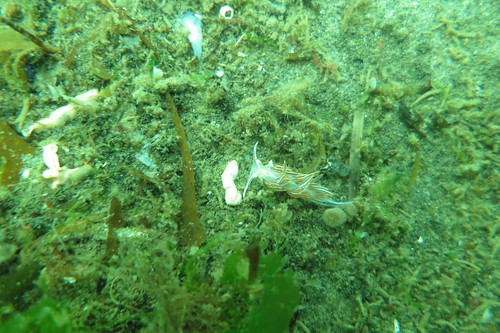
A nudibranch, Hermissenda crassicornis

So, on to the last week!

Winding Down

Wow, I cannot believe 8 weeks have come and gone already! Our final presentations are just two days away and as I work on putting everything together I am amazed by how much I have done this summer working with the EPA. This past week was a scramble to obtain as much data and results as possible and involved many days in the field.

DSCN1491

After going through all of our pictures, we found some interesting results! With our manipulative plots, the boxes we had put into the sediment were not showing many signs of sediment oxidation, so to see if anything was going on in the sediment we placed IRIS tubes into the center of each plot. We found that in the plots with the most algae, there was a large amount of sulfides in the sediment signaling anoxic conditions. Additionally, the plots that were placed in shrimp beds showed a lot of variance in how much sulfides the sediment there had. We found that the shrimp burrows act like highways for oxygenated water to travel down into the sediment, but we also found some differences between the two species of shrimp (ghost and mud).

P8121491 UH

In the ghost shrimp area the IRIS tube showed sulfides in sediment that were deeper than in the mud shrimp areas. One hypothesis for this is the fact that ghost shrimp burrows are not as stable as mud shrimp burrows. Mud shrimp create a glue like substance that holds their burrows together, thus they are not constantly having to re-make them and water is able to travel through their burrows longer. Mud shrimp on the other hand are constantly burrowing as they do not produce any substance that helps stabilize their burrows. This might cause them to collapse more easily and thus limit the amount of oxygenated water that can travel through them.

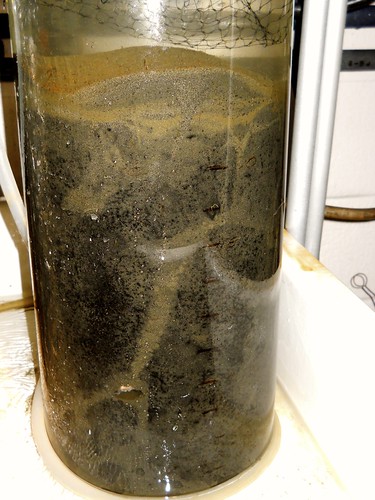
In the lab we have also been finding some telling results. After completely covering the glass cylinders last week, I noticed that some of the algae is beginning to rot. No large changes have been observed from the sides of the chambers, so we have placed IRIS tubes into each cylinder and we hope they will show us sulfide concentrations under the varying conditions of the cylinders.

DSCN1651

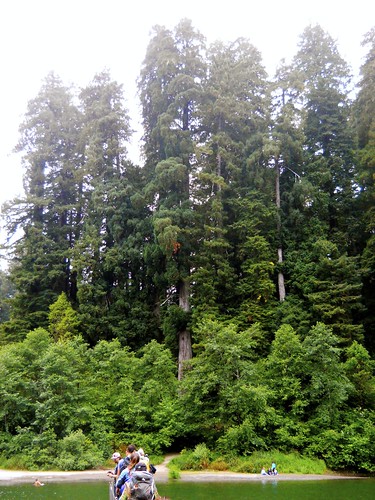
After a busy week at work, a group of interns from Hatfield trekked down to California for a weekend of camping and hiking in Redwood National Park. It was absolutely incredible to see such massive living things. The whole park seemed like it was in a different world and a far cry from reality. Standing next to a Redwood really puts your life into perspective!

DSCN1527

The goal for the weekend was to find the Grove of the Titans, a secret grove of redwoods that contains some of the world’s tallest. The location is kept secret and they are not located near any trails, so the group of us blazed our own trail through the magnificent giants with a list of clues we found online. I’m sorry to report that their location still remains a secret, as we were unable to find them. However no disappointment was felt among the group as we saw some others that I’m sure must rival the Titans in size!

DSCN1570

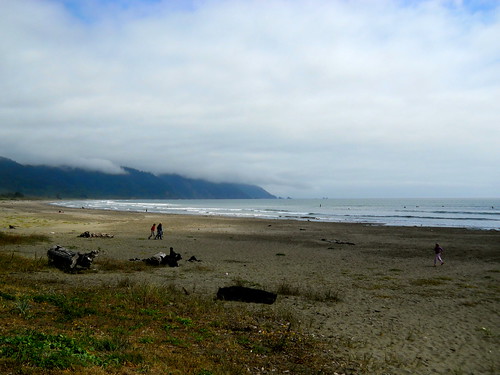
It wouldn’t be a trip to California without a little surfing! On Saturday and Sunday I was able to further practice my “skills” with some friends on the waves in Crescent City. I finally learned how to stand up and ride a wave all the way to shore! Plus the water was about 60 degrees which was much more pleasant than the 45 degree water off the coast of Oregon!

DSCN1627

My time on the west coast is winding down and I wish there was a big “pause” button I could push and just stay here in Oregon forever.  I’ve been having the best summer of my life and cannot wait to share with others on Friday about my research and exciting adventures I’ve been having in the Beaver State!

Hello again everyone. This past week consisted of more hook and line surveys. We were fishing out at Depoe Bay in the Cascade Head Marine Reserve. This time the volunteer anglers were Hatfield interns, some of whom experienced their first time ever fishing! It was awesome witnessing someone catch their first fish, and I know from my own personal experience that it’s a feeling that one never forgets. Fishing on that particular day was a bit slow, but we still managed to catch over 50 fish. Aside from this past week’s hook and line survey, I have not done too much else in the way of field work. My field work activities are slowly dwindling as my summer internship sadly approaches its end and I begin prepping data and content for the upcoming presentation. What isn’t fading, however, are my weekend adventures, with this weekend in particular standing out amongst the rest.

Around 16 of us Hatfield interns road tripped down south to California’s Jedediah State Park, situated in the midst of the giant redwoods. We spent the weekend hiking, surfing, laughing, and sharing stories. We attempted to bushwhack our way through the forest in search of a hidden grove of redwoods, alleged to be the single tallest grove in the world with trees standing over 320 feet tall. To put that into perspective, that’s approximately 9 school buses stacked vertically on top of one another! Unfortunately our search came up empty handed, as we found ourselves walking in circles and confused about where to walk. The location of this grove, known as the grove of titans, is unbeknownst to the public and is known only by a handful of biologist who keep its location undisclosed. One particular biologist wrote a book about his discovery of this mystic grove and referred to some geographical clues to give the adventurous sole some hope of finding it. We attempted to follow these clues, but our search still ended unsuccessfully. Nevertheless, we all enjoyed the challenge and the opportunity to unlock a long kept secret.

Week Eight

So, our final presentations are on Friday.

I am just about finished putting together my presentation. I practiced a few times starting yesterday, so I should be feeling pretty confident by Friday afternoon.  I used a new layout for the visual portion of my presentation.  Instead of putting the talking points up on the screen, like I am accustom to seeing in lecture and other presentation, the main focus of the slide will be a picture, framed by a heading and subheading.  The heading states the main idea of the slide and the subheading states by its important.  My fellow Hatfield residents and I were lucky enough to receive a seminar about how to use visuals more effectively in oral presentations.  We were told that the researchers and users of the new format we regularly voted best oral presentation at conferences.  So far I’ve gotten good feedback from my practice audience.

The angler surveys are continuing to come back, though the numbers seem to be tapering off. The due date was just last Monday so a few more should be trickling in.  So far I have about a 30% response rate which is great!  I was told to expect about 25% so I’m pretty pleased.  Reading through them as I enter the data into the computer is really encouraging.  It seems like anglers are more likely to be on the side of using the device and are concerned with the conservation of the fishery.

Last Friday I met with ODFW’s web designer, who usually works out of Salem but found himself on the coast last week. He has kindly offered his help in the production processes for the series on informational videos about rockfish conservation I have been working on. Having helped make a video form the black rockfish PIT tagging program, he experience will be invaluable for getting the videos finished.  He stopped in to hear more about how I envision the videos beyond the pictures on the story boards, as the filming will likely take place the first few weeks in September, after I have returned to Michigan. I am excited about seeing the final result post online.  It feels a little bit like the way I imagine it would feel to co-author my first publication.  I am excited and a little bit nervous.

This past weekend was a bit of a last hooray for the summer.  Some of my fellow Hatfield residents and I took a weekend trip to the redwood forest in California.  The trees were beautiful but driving down the coast was almost better. I’m going to miss Oregon when I’m gone.

Week 8: May the Forest Be With You

With week eight coming to a close I’m baffled at how little time is left and how quickly it’s gone by! Charleston has definitely become my home away from home. Scott has been laying off on some of the field work in order to let me finish up my end-of-internship responsibilities. However, neither of us can stand being at the desk for too long and so I was able to get in some outdoor time this week!

Wednesday we attempted to return the cockles from our free-range methods experiment back to their original site at Valino Island so that Scott and Jim can continue to monitor them after I have gone. However, the tide beat us to it so we ended up having to return them a different day.

Scott also left me in full charge of the boat, which put my skills to the test! I was to pick up the boat from the storage unit, hook it up to the hitch, and then after picking Scott up, back the boat down the ramp. It took me about 15 minutes to back the trailer down the ramp—much shorter than in my previous attempts—so I was pretty proud of myself! Scott even let me drive the boat around the bay for part of the time! Afterwards, I was in charge of cleaning the boat and flushing the engine and getting it back to storage. Boating skills: success!

On Wednesday evening, OIMB held their annual Invertebrate Ball in which all students, interns, and even professors dress up like invertebrates and participate in various invertebrate themed activities. At the end of the evening, all of the participants walked down a runway for a fashion show of everyone’s amazing costumes, but there was a catch: you had to locomote down the runway like the invertebrate you were dressed as! Prizes were given for several different categories such as: most anatomically correct, least effort, best locomotion, etc. It was the kind of fun evening only biologists could have thought up!
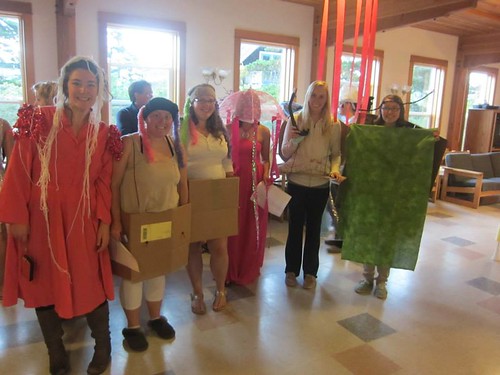
Invertebrate Ball 2013, I came dressed as a mesopelagic jellyfish!

Thursday, I traveled to Newport with the COSEE interns to tour Hatfield. We were given a tour of the grounds and even got to go into some of the NOAA and EPA labs, which were very cool. The Hatfield interns also showed us the projects they had been working on this summer. One of the interns was working on aging shrimp using their gastric mills which I became totally enthralled in!

The crowning jewel of this week, however, was my fabulous weekend that I spent with some of the other Sea Grant Scholars and Hatfield interns in the Redwoods National Park! On Friday evening, after work, we all drove down into California to the Jedediah Smith State Park. We took the 101, finally completing my dream of driving up and down the entire Oregon coast! Another check off my summer’s bucket list!
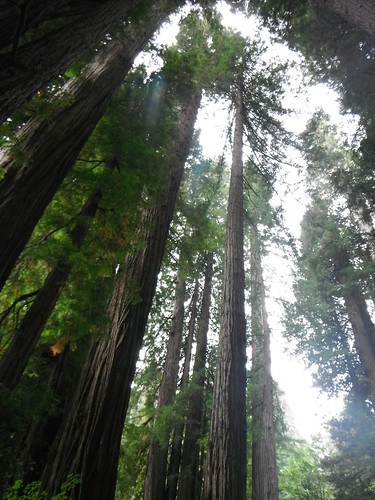
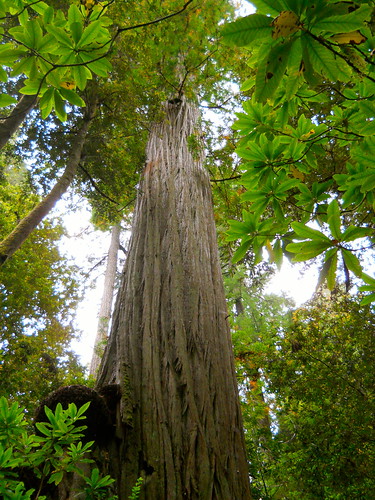
Redwoods National Park, talk about some impressive old growth forests!!

Saturday was filled with adventures! We started off the day with hiking and searching for the Grove of the Titans. While we found no Titans, we did have a lot of fun bushwhacking our way through the forest and seeing some impressive old growth forest. The redwoods are such an impressive sight, and if you’ve never seen them I would recommend making the trip; you would not regret it!
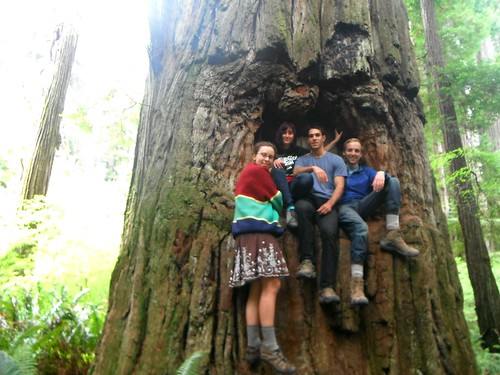
Relaxing up in the Redwoods with a few of the Sea Grant Summer Scholars!

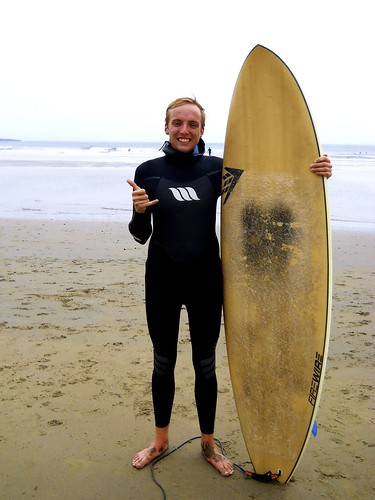
We also decided to rent surf boards for a couple of days and headed out to Crescent City, CA to catch some waves. I had never surfed a day in my life but I was stoked to give it a go. Lucky for me, one of the Sea Grant Scholars, Pat Cousineau, had spent a large portion of his summers teaching others how to surf and was kind enough to give me lessons! After just a few tries I stood up and rode into shore without falling; who would have thought a Midwesterner could be a natural! (Though I can’t take all the credit, I had great instructor!) We spent hours out on the water and I loved every single second of it.

Surfing was one of the most amazing experiences of my life. There is something so relaxing and calming about it, not to mention the thrill of riding the waves! It was definitely a de-stressor that I was in much need of. I’m heartbroken that surfing is not a hobby I can continue in Indiana but if I ever move out to the coast, you can bet I’ll be buying a board!

Catching some gnarly waves for the first time!

Just two weeks left here in Oregon and I’m sure the time will fly! I wish it’d stand still, though, because I do not want to leave! Until next week, cheers!

Week 8: More Field Work

This week was one of the busiest ones yet! It was basically a repeat of the field work we did in Willapa Bay, Washington, except it was here in Yaquina Bay. We put out cameras every day, in addition to fish traps and more tethered crabs. It was great to get so much fresh air, but I was definitely exhausted by the end!

Image

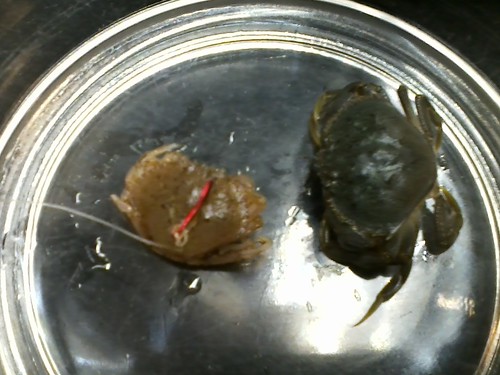
One of our tethered crabs molted its hook (empty molt on the left and actual crab on the right); the size difference after just one night is incredible!

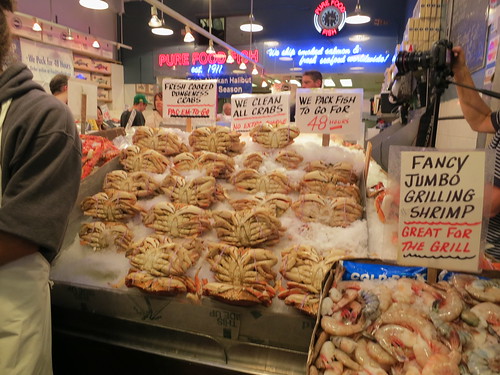
After all the hard work, I managed to get away to Seattle for the weekend, where I had never been before! My favorite part was seeing the Pike Place Market, where they were selling tons of fresh seafood.

IMG_0289

Adult Dungeness crab for sale; it is easy to forget how large they get when you’re working with ones that are only 2 cm wide!

I did some walking around the city too, and even made it to a Mariner’s game. The trip was short, but oh so sweet, and I can’t wait to go back. It’s good to know Seattle loves the ocean as much as I do!

IMG_0301

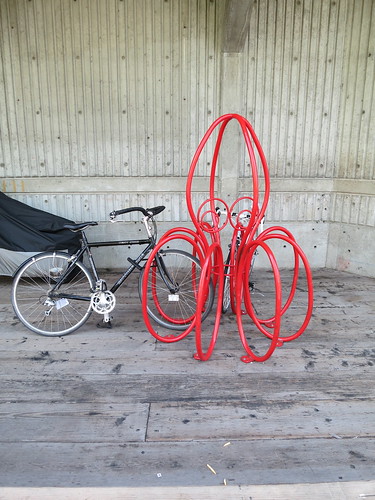
The coolest bike rack I have ever seen

IMG_0297

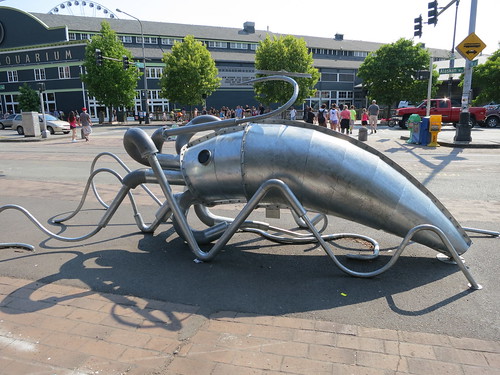
Cool sculpture on the waterfront; the aquarium is in the background

Sadly, it doesn’t look like it will be possible to get through all our video before this wonderful adventure comes to an end. However, I may be able to do some analysis on other data, to get more practice. Our final presentations are on Friday, so I have this week to prepare for that and get as much video analysis done as I can. I can’t wait to see what everyone else has been doing!

Week Seven

What an exciting week!
Starting bright and early Monday morning the first batch of returned angler surveys were on my desk, Hooray!  Granted as stack of 20 or so white envelops does not seem all that exciting, the information they contain is invaluable.  The surveyed anglers will help determine how we can save the more lives of protected rockfish. The experiences, opinions and suggestions of these anglers are important to our cause because they are stakeholders in the resource ODFW is trying to responsibly manage. Responsibly managing resources is a community affair which requires the participation of Oregon’s anglers.  Thank you to all of the respondents for doing your part!
The public comment meeting I attended this evening further emphasized this point.  A public comment meeting is an opportunity for stakeholders to meet with natural resource managers and provide their suggestions about regulation changes and receive updates about the goings with commission meetings etc.
Today’s meeting was presided over by the halibut and groundfish management time, with whom I’m associated.  Important news that was discussed included how to arrange the sport halibut season and the potential for China Rockfish to become an overfished species in the coming years.
For last three days have been busily entering survey data into the computer.  Because respondents answered a series of multiple choice and short response question, the data set which is created as a result is more complex than I am custom to.  I have transcribed all the short answer responses in to the computer and then coded the responses with a number that correlates to a summary of the response.  It is a time consuming task but I have really enjoyed looking over the responses.  Thus far I have about a 20% return rate of surveys and the requested return date is not until next Monday.  This is very encouraging since I have been anticipating a 25% return rate over all and it looks like this will be far exceeded.

Hello everyone! There was a question on my last post about how habitat type is discerned and incorporated into our hook and line sampling design. Habitat type is discerned using various underwater camera systems such as sleds, ROVs, and landers. The data received from these deployments are then used to generate habitat type which can subsequently be incorporated into an ArcGIS program. There are also other methods of distinguishing habitat type such as SONAR, LIDAR, and satellite imagery, but I do not know the extent to which these are used for our habitat maps.

Anyway, this past week I again found myself out at sea helping with the hook and line fishing surveys in the Cascade Head Marine Reserve, which is about an hour trip by boat from Depoe Bay. We fished for two consecutive days and caught a wide variety of rock fish and round fish species including: kelp greenling, black rockfish, blue rockfish, lingcod, yellow eye, yellowtail, canary, china, and quillback. The black rockfish and kelp greenling are euthanized and kept for age dating purposes, while the others are quickly released after capture. Fish that suffer from barotrauma are hooked to a descender device and are released at the depth at which they were caught so that their swim bladder can recompress. Some rock fish species are more susceptible to barotrauma than others; blue rock fish are notoriously prone, while others such as kelp greenling and lingcod do not require any assistant at descending to depth.  Although assisting in these hook and line surveys take up the majority of the week, I did find time to assist in another project: benthic extraction.

Benthic extraction is a study of the benthic invertebrate community. It is one way in which marine biodiversity is assessed and quantified. It involves SCUBA divers scraping invertebrates off quarter meter square rock structure and bagging the samples into mesh bags. The samples are then brought to a lab where they are sorted according to phyla and put into sample jars. The samples are then preserved with formalin and sent to an eco-analyst where they are then sorted into lower taxonomical ranks. Species diversity, abundance, and biomass are quantified which will serve as indicators of biodiversity. The goal of benthic extraction is to compare biodiversity between marine reserves and their associated comparison areas to observe how biodiversity and benthic community structure may change over time. This, along with hook and line surveys, are a couple ways to evaluate the effectiveness of Oregon Marine Reserves as a management tool.

Riding the Waves

Another week has come and gone. Things are beginning to wrap up for my internship and I am already dreading leaving the beauty of the Oregon Coast, but there is still work to be done! I am still working on my fieldwork and laboratory experiments and this week we will be going to our plots to photograph the sediment cross sections and see whether the oxidation line has become apparent in our natural observation plots and our plots where we controlled the amounts of algae.

DSCN1403

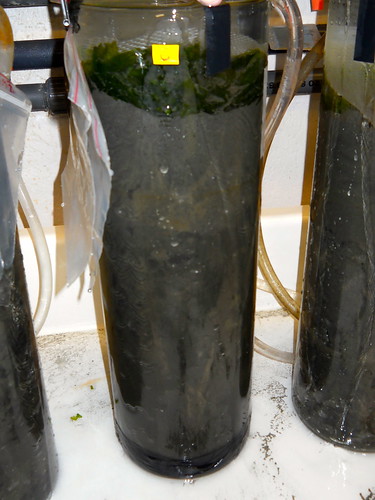
Our laboratory experiments are showing some interesting results. We believed that the tubes with high amounts of macro algae would show minimal oxidized sediment, like what happens naturally in the estuary. However, we have seen that the tubes with the high amounts of macro algae are showing the highest amount of oxidized sediment. One hypothesis is that the large amounts of algae are producing oxygen as a result of photosynthesis, which is adding oxygen to the sediment. We have now completely covered the tubes with aluminum foil and we hope that it will prevent any further photosynthesis and hopefully it will help the algae rot. When the algae rots, it begins to produce sulfides in the sediment and the amount of anoxic sediment increases greatly.

DSCN1360

This week we will be starting to use a tool called IRIS tubes. IRIS tubes are pieces of PVC pipe coated in ferrous oxide. When the ferrous oxide, which is normally orange, reacts with sulfides in the sediment, the tube turns black. This allows us to see how much sulfides are in the sediment and also where they are found. Sulfides are important because they signal anoxic sediment. We are deploying the tubes in our algae plots to see if the amount of algae can be related to the amount of sulfides and we also will be putting them into our containers in the laboratory.  Hopefully we will see some great results!

DSCN1336

I have also began to work on my final presentation and have really enjoyed putting together the story of my project. I have always enjoyed public speaking and I am greatly looking forward to teaching others about my work and estuary ecology. I also attended a presentation about how to put together an effective PowerPoint and I learned a lot of tips and tricks that I can’t wait to use when I present!

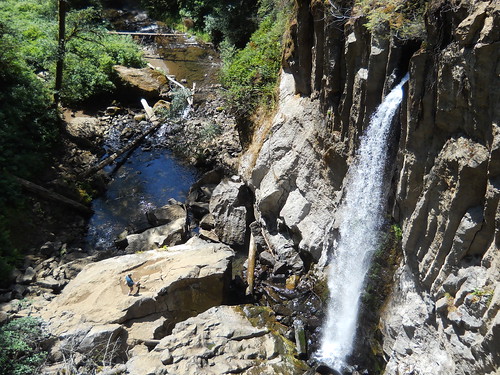
Aside from work, this past week has definitely been a great one. On Saturday, myself along with two other interns hiked Drift Creek Falls near Lincoln City.  It was beautiful to be walking through the forest and the waterfall at the end of the hike was incredible. That evening we made a delicious group dinner, and on Sunday I went surfing for the first time ever! I had no idea what to expect but I left the beach completely hooked.  I was able to stand up fully about 3 times, although I found myself falling over shortly there after! It was one of the most incredible feelings to be riding on the waves.  I was pretty surprised by how soon I was able to get up on my knees and I cannot wait to get back out there!

DSCN1483

This week and next will be dedicated to preparing my presentation and finishing up my field work. This coming weekend a group of interns from Hatfield will be taking a camping trip to Redwoods National Park in Northern California and I cannot wait to see them. Stay tuned!

To Road Trip or not to Road Trip: That is the question.

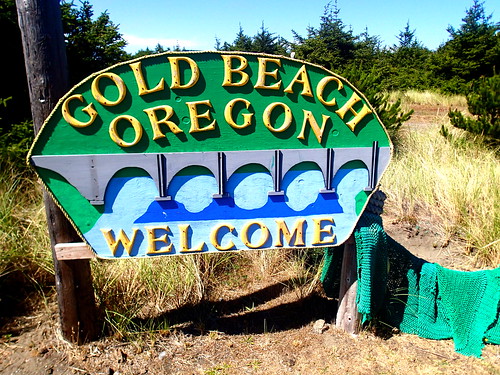
There are few things in this life more enjoyable than driving down Highway 101, taking in the stunning coastal views, and sipping on a delicious coffee!  Last week I had the chance to get out of the office for a few days to visit the towns of Port Orford, Gold Beach, and Brookings.  The purpose of this trip was to go over the asset list that I have amassed for each town, but more importantly to actually see all the attractions I’ve thus far only seen on a computer screen!  Coffee in hand I departed Bandon early Monday morning and headed South where I met with the following: Jodi Fritts (City Administrator) and Sandy Vieira (Executive Director of the Chamber of Commerce) of Gold Beach, Annette Klinefelter (assistant principal at Kalmiopsis Elementary School) of Brookings, Tyson Rasor (Coastal Tourism Liaison), and Jim and Karen Auburn (the Mayor and his wife) of Port Orford.

P7220068

Surprisingly the sentiments in each town towards coastal tourism were shockingly similar.  They all understood that changes would need to be made, and were more than willing to do what it takes to improve the South Coast!  But as eager as each city was, they were also cognizant of the possible push back from some community members towards an increase in tourism.  Since I’m here specifically to increase tourism, I was baffled as to why anyone wouldn’t be for it, especially if it meant their town would be more prosperous.  After discussing the problem at length I believe that I have a better understanding of where the locals are coming from.  One of their worries is that by better advertising the town’s “secret and local gems” (things such as the best swimming hole, or a really great campsite) the number of visitors will increase and they will lose ownership of their local treasure.  The second common concern I heard voiced was that people don’t want to add traditional tourist attractions that would change the character of their town (things such as a boardwalk with games and rides, or souvenir shops.)  Furthermore there are those who think their town is fine the way it is, and they don’t think tourism is useful.  The difficult question remains: how do you create more opportunities for tourism without changing the town?  Presently the main problem is that droves of people pass through these four towns on their way up or down the 101.  They will probably stop to get gas, use the restroom, buy a snack, and maybe even walk around for a while; but how do you get them to stay?  Like an onion this question has many layers and on a couple occasions has made my eyes water in my attempt to find an answer to this big picture problem!

P7270150

After determining that increasing ecotourism (something that the community members were interested in and something I feel is very tangible) would probably be the best way to increase coastal tourism, I was naturally faced with another slew of questions and drawbacks that were seriously messing up my plans!  Sadly that is the reality behind this whole project.  It is one thing to come up with ideas, research them, and find support, but it is another thing entirely to actually make it happen.  For example: I’ve heard that the coast of Oregon has some of the best kayaking around, however, in my research I found that there is only one place that will take you out on trips and nowhere on the South Coast can you rent a sea kayak!  Naturally my first thought was simply “Well, let’s put kayak rental stands out by the beach!”  Problem solved.  Case closed.  Sadly this was easier said than done as I realized that the reason why no one rents sea kayaks is that the insurance is too high and because of the coast’s characteristic howling winds, much too dangerous for many to take kayaks out on their own.  I ran into similar problems as I investigated similar ecotourism rental opportunities such as SCUBA, surfing, and snorkel gear rentals.  The end product of this has been that I simply have no idea what to do, and after being highly annoyed with this fact for a number of weeks, I’m becoming more accepting of it.

P7220096

The reality is that I am only on the South Coast for ten weeks, which is not nearly enough time to even scratch the surface of the tourism issue.  So in my remaining weeks here my projects and goals (or as I like to call them, recommendations to the future me) are thus: 1). Look into the pros and cons of ecotourism as well as new activities to promote, 2). Work to develop “Quest” projects in the area (free-choice learning adventures that use clues and hints to encourage participants to discover the natural, cultural, and historical treasures of each place and its community.), 3). Look into the development and implementation of marine and terrestrial education programs that increase the understanding of issues and resources that are pertinent to each community, and 4). Finish my ecological “summit to seastacks” summary for the area that will be covered by the upcoming scenic bike pathway in Port Orford.

P7270198

This past weekend I was visited by a couple of my friends from UC Santa Cruz!  With all the hiking, exploring, s’more eating, and wine tasting, it was truly a wonderful weekend on the South Coast!