I’m sitting at my desk in the office right now absorbing the fact that it’s already Week 7; one more blink and I’ll be sitting on the plane flying home before I know it. As my time as a Sea Grant Summer Scholar is slowly wrapping up, I’ve been getting waves of realization and urgency; I only have 3 weeks left in Oregon and an infinite amount of places I still want to see and explore in town! 10 weeks isn’t enough time when you’ve already gotten so attached to the people and experiences you’ve made in this awesome Newport life.
This past week was absolutely amazing—I went on a 3-day camping trip in Central Oregon with the other Scholars! By now you’ve probably already read the other Scholars’ blogs about Tacovore (the absolute best taco place in ~the WORLD~) and how we began AND concluded our weekend trip at the restaurant. (Yes, we went twice, and yes we each ordered the same thing each time, and yes we basically stripped the restaurant clean of their flan and vegan blueberry shortbread). It’s a jackpot of a restaurant and I can only hope that all future Scholars christen their camping trip with Tacovore and make it an annual tradition.
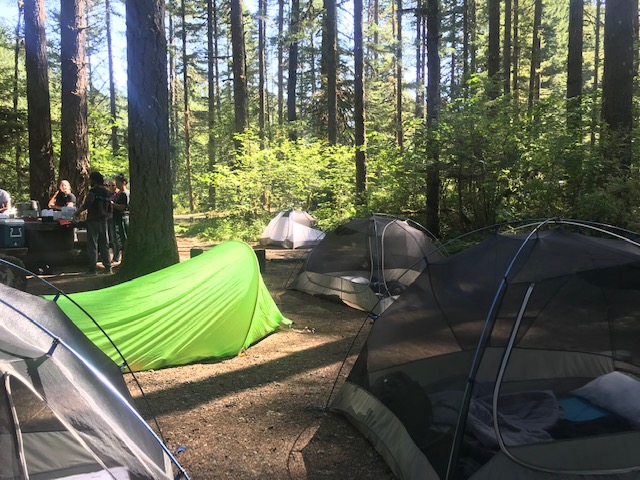
View of our campsite at Rujada Campgrounds! Hiked to a waterfall with Jenny and some of the other Scholars!
Before I move on to the work-related segment of this blog, I CANNOT forget to mention the single greatest dessert discovery that was made this past weekend. It was the love child of Honour’s package of Oreos and Hannah’s supply of Reese’s cups: a Hershey’s chocolate, Oreo, Reese’s Peanut Butter S’MOREEEE!!! I will leave the pic below and say no more.
The oozing Oreo cream says it all…
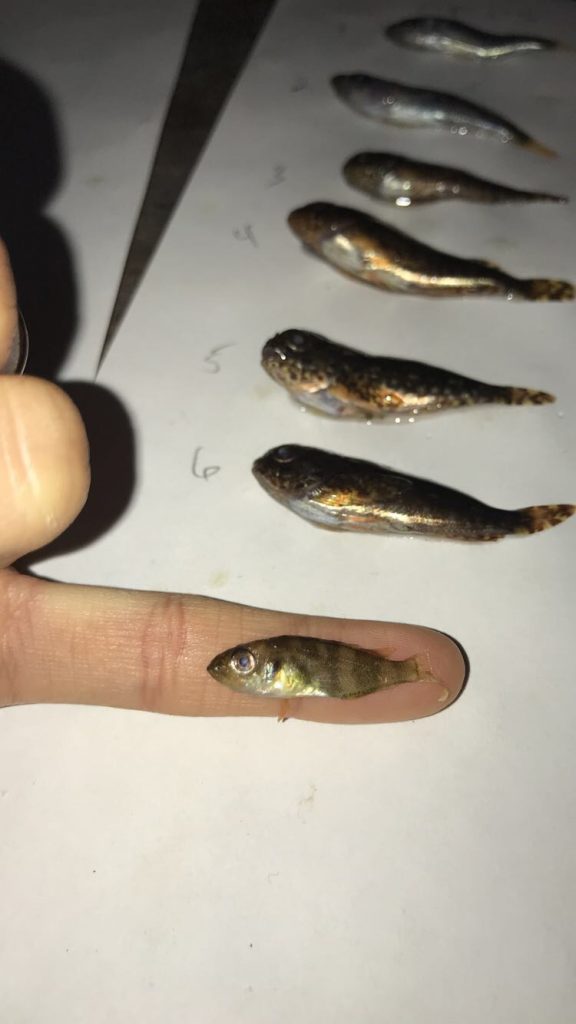
As if the weekend couldn’t have gotten any better, I came back to work and immediately hopped on the boat to SMURF! I absolutely love SMURF-ing and am convinced I could do it every day for the rest of my life and never get bored or tired of it. We also happened to see 10 different gray whales, and one of them breached and flopped their fluke 30 FEET away from one of our SMURF moorings while I was in the water! Super cool experience. For those who may have forgotten or haven’t have the chance to read my previous posts, a SMURF stands for the Standardized Monitoring Unit for the Recruitment of Fishes. In this case, we are specifically catching juvenile rockfish, and the data we collect helps create holistic fish stock projections for coastal waters inside and outside the Oregon Marine Reserves. Each snorkel SMURF-ing session is concluded by measuring the fish and categorizing them by species—there are some that are tinier than my pinky finger!!
Just the cutest darn thing you’ll ever see :’)
Once we finish categorizing and measuring the fish, they’re sent off to the lab where their otoliths (tiny ear bones) are harvested and studied under a microscope. Otoliths are neat in that they’re comprised of multiple banded growth rings (just like trees!), which carry a wealth of information on a fish’s life in terms of migration and dietary patterns. The otolith rings are counted to approximate the age of each fish, and the microchemistry of the rings are studied to gauge what food sources the fish have been eating and how much of it is eaten per day! It still blows my mind that I’m lucky enough to participate in these processes that supplement front-running marine research with the most amazing and knowledgeable people every day. Gotta pinch myself at times!
I’m getting ready for another round of low tide series, and that means…more Sea Star Surveys! I’ll be leading two more intertidal field days at the end of the week at both Otter Rock and Cascade Head. A special shout-out to Autumn, Ariana, and Suhn for being rock star volunteers at SSWD monitoring. They’ve been coming along each time I lead the surveys and are such an amazing help, so (if they’re reading this) THANK YOU x1000! :) Looking forward to their help in the field again and getting able to work in the tide pools! Till next time,
While the rest of Hatfield was still quiet and unstirring in the early morning hours, Ariana de Souza and I were making our way into the Environmental Protection Agency’s Office of Research and Development. We walked down the unusually empty hallway to get suited up. We quickly pulled on our waders and headed out onto the Yaquina bay mudflats with our supervisor, Jim Kaldy. The sun was just starting to say hello, yet the lights around the bay still twinkled against the cloudy sky.
Our goal that morning was to collect over two hundred Zostera marina plants before the tide covered them again. I had the best time crawling around in the mud, despite the early wake up time. There was something serene in the air that morning and the water was surprisingly warm.
It has been a few weeks since we collected the Zostera marina plants.They are now settled into their new homes in the lab. These plants are a part of an ongoing mesocosm experiment. As the weeks go by, we are monitoring the salinity, dissolved oxygen, pH, chlorophyll a and temperature of the water inside the various tanks.
Say tuned to hear about how the mesocosm experiment progresses!
***ALERT: Last week of data collection! If you have ever visited Cannon Beach, you are eligible to take the survey and enter to win a bunch of HRAP swag and Sleepy Monk coffee. Just click here to start! ***
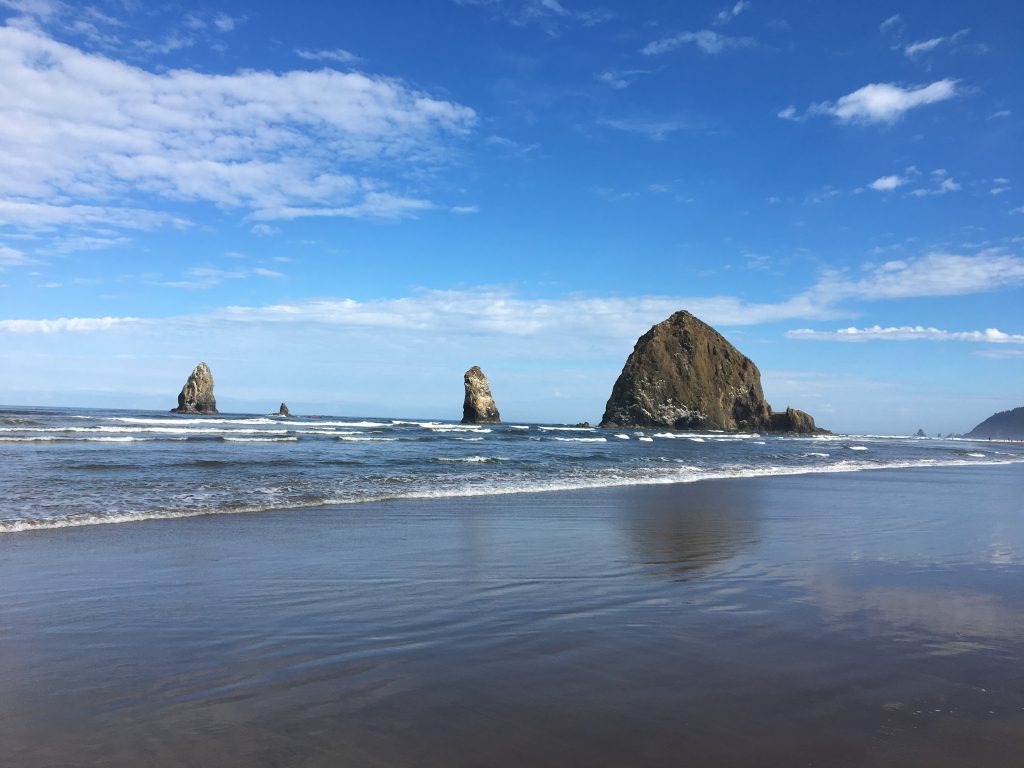
Haystack Rock and the Needles from the South.
During my few weeks of work with the Haystack Rock Awareness Program, I tried to walk to work as much as possible while staying just past Tolovana Park in Cannon Beach. I learned that the crusty, salted line of debris caused by the ebbing tide is called the wrack line; it is here that I have found amazing treasures and intriguing marine life. Identifying the organisms in the wrack line has helped me to become a better Environmental Interpreter as it has made me more knowledgeable of the marine life specific to this region. In most traditional Hawaiian practices the moon phase is very important to kilo, or observations, made in the natural environment. Thus, the following kilo include the Hawaiian names for the different faces of the moon.
ʻOle Pau, June 23, 2019
My first walk along the wrack line was an experiment to determine how long a commute would take on foot. As I stepped into the sand, the first observation made was the sound — the sand squeaks! Lifting my shoes out of the soft, powdery grains proved laborious, so I found a piece of drift wood to sit on and removed my footwear. Much better! Note taken: just like in Hawaiʻi, it is more efficient to walk barefoot in the sand. At first I was committed to being fully present and experiencing the beach through only organic eyes and not a screen…but this attempt failed when I saw the green, sludgy sea foam I had read about. Mai hopohopo mai — do not worry folks, it is not pollution!
Sea foam tinted green from diatoms!
Diatoms often cause the water to be a greenish color and give bubbles that develop on the shore a greenish tint. Moving on I found a strange arthropod that resembled a marine pill bug, which was being feasted on by other flea like creatures. This was my first run in with mole crabs and their babies — that bite! While attempting to film the frenzy I felt little pinches on my feet that felt like ant bites. Slightly shrieking and dancing away, I know now to move quickly when I see the hopping baby mole crabs so as to not give them time to munch on me. When I finally arrived at Haystack Rock, I found the first of many deceased birds that I would photograph. The contrast of the bustle of visitors at Haystack Rock fawning over the puffins and the sea stars with the floppy corpse of the murre fascinated me.
The lifeless body of a common murre in front of the icon Haystack Rock.
Kāloa Kū Kahi, June 24, 2019
When I stepped on to the beach in the morning, Haystack Rock could barely be seen in the distance through the mist. As I approached were the sea meets the shore, I noticed several progressions of wrack line. Dried lines of salt littered with bits of shell and detritus were evidence of the ebbing tide, which would continue to drop until 11:57 am that morning. I soon stumbled on to the shell of a key hole limpet and a sea gooseberry.
My first sea gooseberry!
Finding the keyhole limpet shell was particularly exciting because it reminded me so much of the opihi we have at home, except for the aperture at the apex of the shell’s point. When I got within the vicinity of Haystack Rock, I came across a pile of gull, the dry, fluffy feathers making it evident that the bird was attacked in air or on land and did not wash up with the tide. The common murre from yesterday was still there. Before leaving the wrack line, my eye spied bright blue debris — plastic! But alas when I picked it up I realized it was bits of egg shell — common murres can have blue eggs!
Not plastic — yay!
Conditions on the walk home were quite a contrast from that morning: blue bird skies, streaky cirrus and sand toasted by the sun. A sea nettle was the first of my discoveries in the wrack line, followed by a lady bug (?!?!), dead manʻs fingers — an algae, not actually, LOTS of dead sea birds and their parts, a tangle of bull kelp and finally some live gulls scavenging the rising tide.
A sea nettle, a lady bug, dead man’s fingers and bull kelp.
Kāloa Pau, June 26, 2019
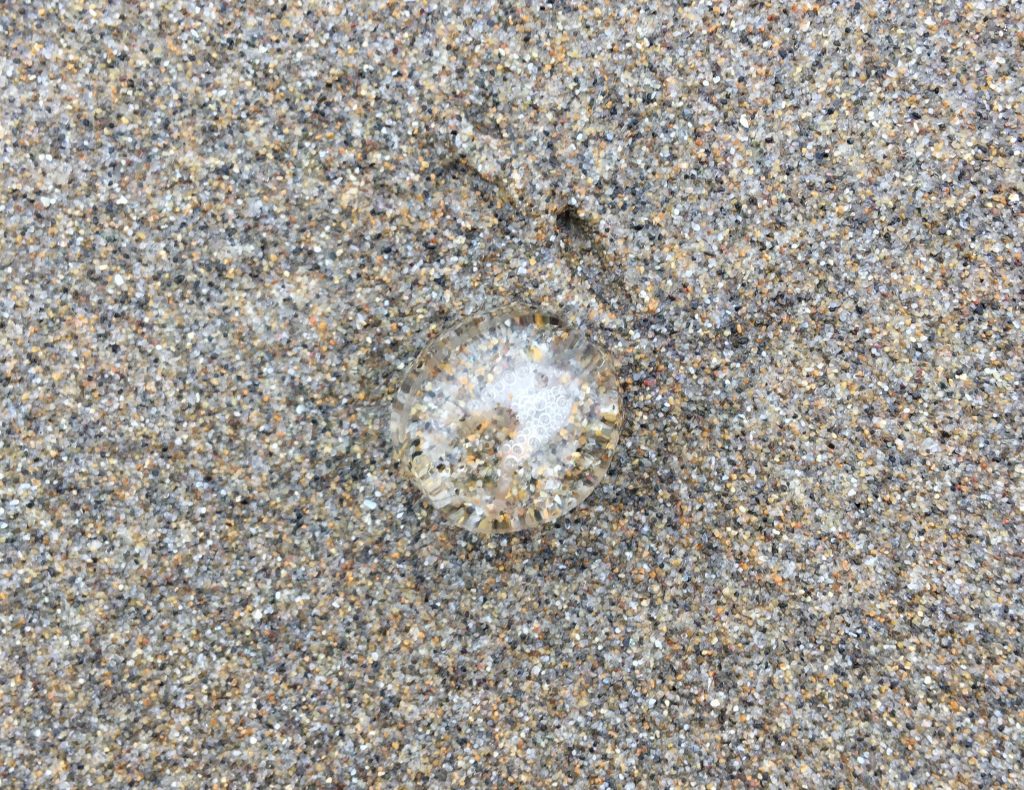
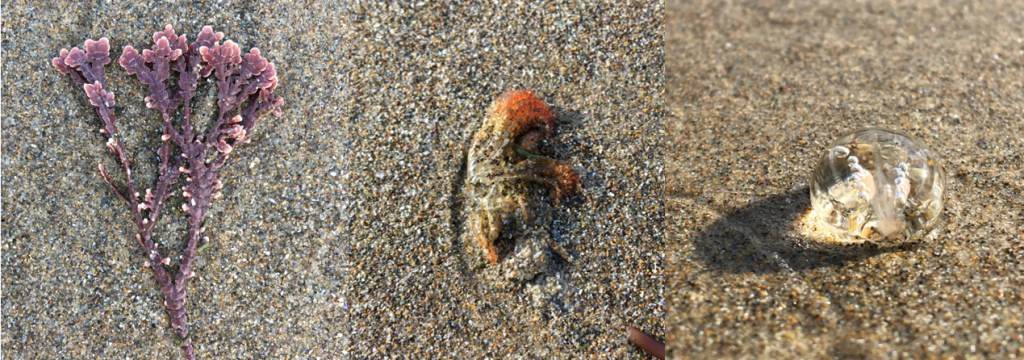
I stepped on the beach at 8:04 am to walk to work as the tide just turned from a high of 5.8 ft at 7:45 am. My first wrack line specimen for the day was a piece of coralline algae, of which I have only seen the crustose variety. The structure reminded me of the Halimeda that we have back home, a calcifying algae that contributes greatly to our calcareous sand beaches. Not far from the coralline algae was a clump of feathery cirri from a gooseneck barnacle. As I continued down the beach, bundles of cirri were a common find. I found a key hole limpet shell and a sea gooseberry again, and an intact moon jelly. I also found iridescent sea foam and tube worm casing. The highlight of this walk was definitely the flock of pelicans that were slowly making their way to the Needles. I was able to catch a video of one in flight as it searched for edibles in the water.
Coralline algae, gooseneck barnacle cirri, and another sea gooseberry.A beautiful moon jelly and some iridescent sea foam!
My first find on the walk home was a sand hopper, which cowered from the shadow of my phone as I tried to film it. Tube worm casing and crab molts littered the wrack line as the tide continued to rise from its bottom out at 1.7 ft at 1:40 pm. I also found an ostrich plume hydroid attached to some driftwood, a mole crab filled with bright orange eggs and what looked like akulikuli, or pickle weed. Before I made my way up through the dry sand to the beach access, I spied the biggest sea gooseberry I had found yet — it was the size of a quarter and I was lucky to snag a picture before the ocean reclaimed it.
An ostrich plume hydroid.A mother mole crab with eggs and cannibalistic babies!
Lono, June 28, 2019
The beach was crisp even though the sun was out when I got there. The tide was rising to 6.0 ft at 10:08 am from a low of 0.9 ft at 4:01 am. Last nightʻs rain made the wrack line difficult to differentiate from the rest of the sand, but I did find my third and biggest keyhole limpet shell. There are many limpets at Haystack Rock, but I have yet to see a live keyhole limpet — I have a feeling it does not do well in the intertidal zone because its aperture allows for the release of water, which so many intertidal organisms strive to maintain with their bodies as the tide recedes.
The bombucha keyhole limpet shell!
Another evidence of last night’s rain was runoff flowing from an outlet that usually does not make it to the sea. I often see children playing in the runoff at the Gower St. and the Tolovana Park outlets — not a good idea as this water usually has a high fecal bacteria count. Ick!
An olive snail shell in a patch of biogenous sand.
On my walk home, I found many shells. The olive snail shells were an awesome find — all empty and free of critters, of course. The smaller ones were dispersed in a patch of biogenous sand, which I was very excited to find. I also found a strand baby sea star. Not knowing what to do, I texted my mentor for help. For future reference: if you find a sea star stranded in the sand do NOT pick it up directly, either use something to shovel in up or pick up the sand around/underneath it. Then, if it is not already upside-down, turn it over: if is is hollow in the middle it is dead, but if it has tube all its tube feet it lives! Next, place it right side up on a rock nearby and hope it makes it. Or you can just leave it alone and let nature do its thing.
If you MUST pick up a sea star, pick up the surrounding sand with it!
My workload has definitely increased since before, and I’m really enjoying it! Autumn and I work on the mesocosms every day, checking the water quality of the eelgrass tanks and taking carbonate chemistry samples. We have also been given more responsibility in managing the Burke-o-lator, which is a carbonate chemistry instrument that quanitifes many different aspects of a water sample. The Burke-o-lator is named after Burke Hales at Oregon State University. It’s a state of the art instrument that, as of now, is only available for use in a few other laboratories. It was daunting to learn how to operate it at first, because each sample takes a while to run and you have to keep checking the internal wiring and making sure that nothing is wrong. When we started learning, our mentors were troubleshooting the instrument because one of the wires had sucked up water and the readings were all over the place, and so we were thoroughly warned about how to correctly operate it and to check for danger. We used to only run the Burke-o-lator when at least one of our mentors was present, but now Autumn and I trade off running it for the day and that way we can get a lot more done. I’m having a really great time learning about water chemistry!
Me working with the Burke-o-lator at the EPA
Last week we also had a picnic for the rest of the Oregon Sea
Grant Scholars and many past and present mentors were there. One of my mentors,
Jim Kaldy, came and was able to meet everyone! It was a lot of fun – the food
was so incredibly good. I had apple dumplings for the first time and I need to
find that recipe. If this blog gets out to the owner of said dumplings, please
know that they were divine and you are incredible, thank you very much. We also
met some adorable puppies and walked along Beverly Beach, which is gorgeous.
Then we had a great seminar on what Soft Power is and how we can use it in our daily lives. The day after that we went on a camping trip to Rujada Campground in Umpqua National Forest, which was so incredibly fun! Honour taught us all how to make s’mores with Oreos and Reese’s peanut butter cups inside (there is a specific method, it’s scientific and the product is delicious), Naomi taught us how to skip rocks, and I jumped off a rock into very cold water and had a splash fight with a small kid who was playing nearby. I may or may not have used my long hair to my advantage and shaken it in order to splash him. It was an incredible weekend of hiking, falling in lakes on accident, jumping in lakes on purpose, amazing food, and wonderful company. Jenny Engels came along with us, drove us everywhere, and was such fun company! She was the first one to jump off the rock into the lake! On the way to and from the campground, we stopped in Corvallis to go grocery shopping and visited Tacovore, a taco restaurant in Corvallis, Newport, and Eugene. I had made a sandwich for lunch going there because I’m cheap, but the people who did eat there wouldn’t stop talking about their fantastic tacos, so we went on the way back and I have to say the tacos I had there were some of the best I’ve ever had in my entire life.
Enjoying the beautiful waterfalls near Rujada Campground
All in all it has been a very busy couple of weeks, and I’ve
had a blast. I’m going to miss this place and these people so very much when I’m
gone. There’s something magical about spending a summer doing research in beautiful
Newport, Oregon. Everyone here is so funny, kind, and inspirational, and I’m
loving every second.
This past week has been very busy but very fun. I had a long week of field work but I saw and learned a lot. My research is going really well because I’ve managed to find 5 more parasites in my ghost shrimp samples. I was very happy to see that I was doing the digestion correctly and that all our hard work didn’t go to waste. Initially I was only able to see the parasite in the plastic cup that we did the digestion in but a lab member let me look at it under a microscope so that I could really see what it looked like. It looks like a little white worm that is constantly wiggling around.I can’t wait to do more field work and hopefully find more nematodes so that I can hopefully begin to figure out why they appear in these sites
We did take a break to have some fun during our trip and we stopped at the Tillamook creamery to get some fresh ice cream. I ended up getting a shake and I must say it was the best one I’ve ever had!
Today officially marks one month of being a Sea Grant Scholar. This week is also the half way point of our program—5 weeks down 5 more to go! Crazy how fast time is flying—I swear just yesterday I met all the Scholars at the Corvallis orientation with super aesthetic donuts and banana bread.
Since my last blog, the “Intertidal Survey” baton has been passed down to me; I’m officially in charge of leading Intertidal Sea Star Surveys on my own! I’ve been training for this the minute I stepped foot in the Marine Reserves office—it’s super exciting to finally take on this responsibility. As the designated Intertidal Survey Leader, I’ll be recruiting volunteers and overseeing sea star data collection at both Otter Rock and Cascade Head for the remainder of the Marine Reserves’ low tide series. We record data on sea star species abundance, size (measured from the tip of the sea star’s arm to the middle of the body), and health; there are specific health affliction codes assigned to the varying degrees of SSWD disease symptoms (lesions, deflation, twisted arms, lost arms, disintegration etc.), and it’s our job in the field to categorize both the healthy and diseased sea stars as accurately as we can! Yesterday was my first day conducting the surveys at Otter Rock and it was a ton of fun. Autumn (my roommate and fellow Scholar) came to volunteer, and a few of us got waist-deep in water to record data in a tide pool that was washed by the tide (I had never even flooded a boot before this, so it was pretty fun to get wet in the field!) Tomorrow I’m doing the same thing with a different group of volunteers (including Suhn, another Scholar!) at Cascade Head—personally my favorite Marine Reserve :)
Collecting data with volunteers along a Sea Star Intertidal Survey transect at Otter Rock.
I’m just now realizing I forgot to give an update on my intertidal graveyard shift! This “shift” wasn’t technically a “shift” because it didn’t involve the Marine Reserves team nor my Sea Grant job at all; I was helping a CSUN graduate student, Jenn Fields (also stationed at the Hatfield Center), collect data and run water samples at Otter Rock. Let me begin by saying I have mad respect for Jenn and her project team—they pulled two intertidal all-nighters back to back, each time working for 8+ hours. Though we ended up working around 9-10 hours, pulling the all-nighter with them the first night surprisingly went a lot quicker than I had envisioned, probably because we were constantly kept busy. Overall, I’m really glad I went out to experience the rocky intertidal from dusk to dawn—can definitely say it was a “once in a lifetime” experience.
Best part about working through the night is getting to see the early morning fog roll in! Otter Rock Marine Reserve, pictured at 5:20 AM.
I’m not going to conclude this blog without an apartment-baking update; to add to the running list of baked goods, we have: a Dutch baby (a fluffy skillet pancake—I had never heard of this before Autumn) and homemade granola. Though this doesn’t exactly fall under the category of “desserts”, I’ve also been making myself skillet-popped popcorn every night from organic kernels I got from Oceana, the natural food store in town. Still, though, the salty/buttery combo contributes to the amazing “you-can-tell-we-just-cooked-something” scent perpetually wafting in our apartment. Continuing on the topic of food, Autumn and I went to the dock last weekend to pick up fresh Red Snapper from a boat coming back from a morning fishing trip! We both seared it on a cast-iron skillet and basted it with butter and fresh rosemary (courtesy of Autumn’s rosemary shrub she bought from the store). I can honestly say that meal made my list of Top 3 favorite fish dishes I ever had—will definitely buy fresh seafood from the docks again. If I’m feeling a bit more adventurous next time, I’ll buy a live Dungeness crab and attempt to prepare it!
I’m really looking forward to this upcoming week; the four other Scholars I haven’t seen since orientation will be joining us “Hatfield-stationed Scholars” for a beach picnic, professional development day, and a weekend camping trip! Will keep you posted on this action-packed week in the blogs to come! :)
This summer I am stationed in Charleston doing fieldwork with SEACOR, a project in the Marine Resources division of the Oregon Department of Fish and Wildlife. SEACOR conducts bay clam population and estuarine habitat studies in all of the bays along the Oregon coast. The primary focus includes “documenting where recreationally important bay clams are found and the abundance, biomass, and preferred habitat type for each species” (source: SEACOR website, click to learn more). Clams which are recreationally harvested are the main targets but information on other shellfish in the estuary is also collected. The SEACOR project is a unique and important project, contributing to conservation of estuaries and clam populations.
In order to obtain the data used for recreational clamming maps, including calculating clam population and documenting clam distribution, it is necessary to conduct estuary habitat surveys. Summer time is the season for field work, which is where I come in.
Conducting clam surveys uses two main methods:
RAM- Rapid Assessment Method
DAM- Detailed Assessment Method.
RAM allows for more sites to be surveyed because it is a quicker process than DAM. First, a square 1 meter area is marked off, then the habitat is examined in and around the marked off area. Observations are recorded, including eelgrass and algae cover, substrate type, number and type of burrow holes, temperature, and depth of anoxic (low oxygen) layer. Once all of that information is recorded the area marked off is raked by hand and any cockle or littleneck clams are noted. Some sites will have extra samples collected and will be revisited for a more detailed assessment.
DAM is a more time consuming and in-depth assessment of randomly chosen RAM sites. This method involves megacoring which means going out on a boat, lowering a steel ring into the ground, and vacuuming out everything inside the ring about a meter down. Specimens are collected, sorted, measured, all data recorded, and the specimens returned.
One of the biggest differences between the two methods is RAM has to be performed when the tide is low and the flats are exposed. DAM, because it requires a water vacuum the sediment, has to occur when there is at least half a meter of water over the site. DAM requires a dry suit because maneuvering the pump requires standing in water and the Northwest Pacific Ocean is cold. RAM requires waders and boots because it can be extremely messy. The SEACOR team has been awesome and has made sure I get to fully participate in both types of data collection. My first week was gathering information via RAM and it was MUDDY! Never having been on a tide flat or walked through a shrimp bed, I quickly realized you have to embrace the mud and get comfortable with being muddy. Once that happens, it is actually quite fun to play in the mud (though trying to walk through can be exhausting).
Me raking for cockle clams inside the grid during the Rapid Assessment Method
And to illustrate how muddy it can get, here is a picture of me in the mud after I lost my hiking boot in the mud. Ignore the weird face- I was talking and didn’t realize anyone was taking my picture!
Lost my boot in the mud during RAM field work.
My first week consisted of three days of RAM work and I was exhausted. Little did I know the next week would be megacoring, which is a different type of exhausting. It involves about six hours on a boat with a team of three people. Two people are in the water, one person maneuvering the pump nozzle and another person maneuvering the pump while a third person is on the boat sorting the sample collection from the previous site. Below is a picture of me holding the pump nozzle and dredging the site.
On my way to becoming a megacoring pro!
During the megacoring weeks, it has been interesting sorting through the samples and finding the crabs, clams, and shrimp collected. Everyone on the team has been quick to share their knowledge identifying what is dredged up so the sorting and measuring process has been great for learning to identify different the different types of shellfish in the estuary.
Next week is yet another new kind of data collection involving images taken by drones to map eelgrass habitats. I am excited to get to spend a week in the Tillamook area (I have never been there) and see firsthand how the data is gathered. Be prepared to read all about it in the next post!
Posted on behalf of Hannah Sinclair, 2019 Summer Scholar
Being here at the South Slough Reserve has been an interesting and exciting time! During my first week here my mentors Jamie and Deborah send me off to trail the researchers that work on the science projects here at the South Slough. On my second day here, I went with researcher Shon Schooler to see the work that they’re doing with Green Crabs. Schooler and his team have been monitoring this species to check their population growth and how they are affecting habitats in Coos Bay area. European Green Crabs are invasive species that affect many ecological communities around the world and over the last few decades, and they have hit the west coast!
My next day I went with Jenni Schnitt to see their work on Seagrass Net biomonitoring! The reserve monitors seagrass to check the well-being and health of Seagrass Meadows as seagrass provides essential habitats for many invertebrates here.
Later, the following week I went with Ian Rodger to help and understand the remarkable work on eDNA here at the South Slough. As they’re using the information collected from eDNA to create a catalog of the species in the reserve as well as showing the tidal regime effects on eDNA sampling.
And lastly, I went with Alice Yeates to see their project on Eelgrass Monitoring as eelgrass has been decreasing in this area more and more, which has heavy impact on the ecosystem. Oregon State University, Oregon Department of Fish and wildlife, and the US environmental protection agency are working to create a map of the distribution of eelgrass throughout the Coos Bay estuary. Hopefully these new maps will show the progression of eelgrass coverage over the last couple of decades and what we need to do to protect it!
I am about halfway through my summer experience and so far I am loving Oregon’s southern coast!
The first week of my internship entailed a two-day tour of Oregon’s Marine Reserves. The first reserve I visited was the Redfish Rocks Marine Reserve in Port Orford. My supervisor and I then visited the Cape Perpetua Marine reserve near the town of Yachats. I learned the pronunciation of Yachats is Yaa-hots with a soft a sound, you may find this handy!
After visiting Cape Perpetua we continued northward to the other reserves. At each reserve we visited with community members who worked with the reserves. It was useful meeting in person with these individuals since establishing good contacts was one of the main components of this trip. While visiting the reserves, I took photos and videos that I am using in the courses. My favorite marine reserve is the northernmost reserve – Cape Falcon.
Here is a photo for reference:
A week later I found this photogenic guy at the same place:
Marine Reserve Modules:
Good progress has been made on the modules I am creating. Soon I am hoping to test the courses so that they can be evaluated by other interns or volunteers. I am expecting to spend lots of time editing and communicating with community partners until the finishing touches are done!
All of the courses make up the Oregon Marine Reserve Training Program. This program will allow people to earn a certification after they complete the program. For now, this certification process will target people working in the guide industry and people who work directly with the reserves.
I hope to exercise some of my creative abilities to create a logo for this program that could be used on stickers, pins, and other fun things that could help increase awareness for this program. I am excited to see how these coursesl turn out!
On Tuesday, June 18th the drive that I made from Corvallis to Cannon Beach was the farthest distance and longest time I have ever gone in a car by myself. If you are sitting in your car for hours back home on Oʻahu, it is not because of distance but because of traffic. The journey was exhilarating and a familiar playlist made the drive less scary. Any remaining anxiety was relinquished when I accepted that I would not be there in 3 hours due to traffic and areas where the speed limit was 35 mph. Though I passed many coffee shops and antique stores, I did not stop. The further I got, the more an overwhelming feeling of gratitude towards my Dad and Stepmom welled up in me, as I would not be experiencing such freedom without the car they lent me.
The view from the porch at my first residence in Astoria.
After arriving at Cannon Beach City Hall and getting set up in the office, Lisa took me down to the beach so I would know where to go the next morning for the beach shift. What surprised me was that I was not that cold. I have never been on the Oregon Coast before — that was the first time my feet touched sand in a week. The beach was so wide and the sand was so fine, I could immediately feel the difference between the quartz grains been my toes and the calcareous sand that I am used to. Though I wanted to stay and explore, my na’au (intestines, also gut, like gut-feeling) reminded me that I had not eaten in 5 hours and I would soon be dancing on the edge of hangry. Luckily my “work” day ended upon returning from the beach and I was free to go to the Farmer’s Market, which happens every Tuesday, to get some of the fish tacos I had already heard so much about before journeying on to Astoria where I would be staying for the rest of the week.
My first housemates…
As I continued north on the 101, the dependence of the area on visitors became apparent. Services and amenities that cater to tourists line the main highway and many signs announced camping sites. Astoria seems to capture many of the iconic features of the Pacific Northwest. Foggy, overcast and by the sea, it was difficult to not fall in love with the ambiance of the area. Over the weekend, I was able to attend the Scandanavian Midsummer Festival and experience some of the “local” culture. Tried pickled herring for the first and went back for a second helping. My stay in Astoria was short lived, however I plan on returning when I make the drive to Longview Washington to visit my paternal grandmother.
The five countries represented at the Scandinavian Midsummer Festival in Astoria.
My new lodging in Cannon Beach is incredibly close to work and Haystack Rock. I spied a beach access on my walk to Fresh Foods (to get what was probably the best strawberry rhubarb pie I have ever had — its the lard in the crust that really makes it!) and decided to check it out. From the beach access I could see Haystack Rock and thought “I can walk that far.” I was right — it only took 35 minutes and that was with stopping to take pictures of mole crab babies eating their parents and a decaying common murre. While I am staying so close to work, I will be walking to and from the office everyday for a morning and afternoon kilo (observation), respectively. These observations will provide material for my next blog, so stayed tuned to learn more about what washes ashore in the wrack line!