So much shrimp, I might as well be Forrest Gump

Hey y’all! It’s me, Grace, your resident shrimp scientist! I’m working with the USDA and OSU Fisheries and Wildlife to determine cryptoniscan lifespan and settlement and ground truthing the age/size relationship between Orthione and Upogebia.

I’ve been up to my elbows in shrimp the last two weeks! A lot of my time gets spent in the lab. I usually analyze the shrimp and input their data while my lab partner, Joshua, does the cryptoniscan experiments. Since June 25, I’ve analyzed over 200 mud shrimp! Only about 124 more shrimp from the May sample to go. We plan to go back out in late July to get another big sample. But hopefully not as big as the May sample…We usually work for a couple hours in the morning, have lunch together outside (weather permitting), and work for another couple hours in the afternoon. We have pretty similar tastes in music so we usually put on a fun playlist and sing to each other while we work or listen to cool ecology podcasts.

Large female Upogebia
A large female mud shrimp in my palm for size reference

On Wednesday night, we biked out to the fishing pier with Sarah Henkel and her grad and REU students to do plankton tows. We didn’t get back to the lab until about 1:15am! Thankfully we waited to comb through the samples for cryptoniscans until the next day. We’re planning to go out onto the mudflat behind HMSC on Friday morning around 5am with Brett Dumbauld and his crew to see how they do their annual sampling for USDA. We are also gearing up to go out with them next week to a couple different sites in Washington to look for remaining Upogebia populations. It’s going to be a great but hard working week next week!

Plankton tows on the fishing pier
Joshua and I doing plankton tows on the fishing pier next to Rogue (July 7, 2021)

We usually send our data to our supervisors/research team at the end of each work day and have meetings at least once a week. COVID-19 hasn’t affected us much. In the beginning we wore our masks in the lab, but with the most up-to-date info from OSU we are back to just about normal operating conditions. My favorite activity so far is field work! It feels good to be able to put in some physical activity while doing science. Being in the lab is fun too, mostly because of my great working relationship with Joshua, but it can drive you a little crazy looking at shrimp all day, every day. But it’s all definitely worth it to try and protect our ecosystems and estuaries.

The start of summer fieldwork

Summer is officially here, and it brought with it a scorching heat wave that has invoked record high temperatures throughout Oregon. Portland reached 116 degrees F this week, which is hotter than Dallas, New Orleans, or downtown Los Angeles have ever been according to NBC News. The Oregon coast, however, has not been experiencing this heat wave. The high each day in Newport has been a typical 63 degrees F, about 50 degrees cooler than the valley. These cooler coastal temperatures are perfect for field work, which is exactly what our summer interns are doing right now.

Earlier this month I spent a week in Newport getting to know our three summer interns. Two of them are Oregon Sea Grant Summer Scholars while one is a Doris Duke Conservation Scholar who has also been adopted by the Summer Scholars Program. You can read more about their personal experiences with fieldwork and living in Newport elsewhere in this blog forum.

It was wonderful to be working in person again rather than through choppy Zoom/Skype calls. The days flew by as we hastily prepared for summer field sampling including disseminating background information, creating codebooks, designing the sample plan, visiting sample sites, etc. It is such a privilege to work with college interns because they have a contagious enthusiasm and eagerness to learn and do the work.

It was also important to me to reconnect with the marine reserves which I am researching. Driving around to the different sampling sites with the interns allowed me to visit Cascade Head Marine Reserve, Otter Rock Marine Reserve, and Cape Perpetua Marine Reserve. The bright blue sky reflected off the ocean making it appear more blue than I remember it being. The birds were chirping, sea lions were barking, people were out surfing and walking their dogs on the beach. Sitting behind a computer looking at data all day can make you forget the bigger picture, but visiting the coast was the perfect way to remember.

Of course, I still found time to recreate in the evening, though the wind did nearly blow me away a couple times. I was lucky enough to be staying at a house just a couple blocks from the beach. The dog and I made it down to the beach every day, sometimes even twice.

Summer Scholar with OCOIN

This summer, I am interning with the Oregon Coastal and Ocean Information Network (OCOIN). OCION is a network that helps facilitate relationships between researchers, policymakers, and managers. I am proud to be a part of an organization that promotes the use of science in decision-making.

Joshua Fackrell : Remote working station

This summer with OCOIN, I will primarily focus on their outreach team, where I will be working to encourage participation with the network. To accomplish this, I will be helping to update OCOIN’s tools, the Coastal Research Explorer and the Oregon Explorer. In addition, I will be preparing newsletters and helping plan OCOIN’s Fall 2021 annual meeting. I will be working with another Sea Grant intern, Charlotte, who will be primarily working on the technical side of OCOIN. It has been great starting to collaborate with her and learning from one another. The OCOIN steering committee is made up of volunteers who work for various organizations throughout the state. So far, this has provided a fantastic opportunity to network with people and is providing so many new things to learn.

My work with OCOIN is perfectly situated with Sea Grant. By increasing collaboration between science and policy, coastal communities and ecosystems can receive the care they need. At the core of OCOIN is collaboration; I feel honored to be a part of their outreach team, helping to expand the users that participate with the network.

Starting the summer at OCOIN!

My transition from a year of online coursework at the University of Oregon to being a Summer Scholar with the Oregon Sea Grant has been seamless, as the process happened in my own room! This summer I am working as a remote intern with the Oregon Coastal and Ocean Information Network (OCOIN) as a member of the Technical Committee.

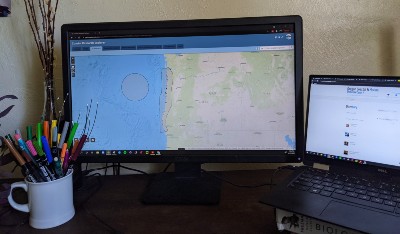
My workstation for the summer. On the larger screen is OCOIN’s Coastal Research Explorer tool, while the smaller screen displays OCOIN’s network directory.

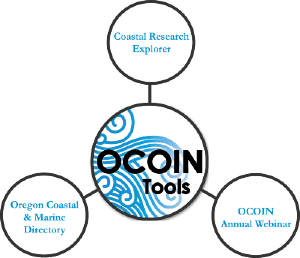
OCOIN as an organization is a professional network that aims to connect and facilitate collaboration between scientists, policy makers, and managers who are all involved in coastal and ocean affairs. This goal is accomplished through two tools, the Coastal Research Explorer and the Oregon Coastal & Marine Data Network Directory, as well as outreach efforts such as an annual webinar. The Coastal Research Explorer is a digital platform that allows the sharing of past, present, and future research taking place on the Oregon coast. Researchers and policy makers alike can use the maps and tables within this tool to view and explore research projects across multiple topics. Alternatively, the Network Directory facilitates contact sharing amongst the large OCOIN network.

The three main facets of the Oregon Coastal and Ocean Information Network.

As a member of OCOIN’s Technical Committee, I will be doing a lot of data management this summer: from updating research information in the Coastal Research Explorer and optimizing user capabilities, to updating the Network Directory. Over the first two weeks I met OCOIN’s many steering committee members, began the data updating process, and completed ArcGIS Online classes to prepare for working with the Coastal Research Explorer tool.

I am also excited to do outreach work with Joshua, my fellow Sea Grant Scholar working at OCOIN this summer. Together we will write two newsletters for OCOIN members and assist in the planning of the annual OCOIN webinar. Outreach is essential for sharing new and ongoing coastal research and maintaining the vast OCOIN network. 

The key intersection between the work I will be doing at OCOIN this summer and the Oregon Sea Grant’s mission is the promotion of discovery and understanding for Oregon coastal communities and ecosystems. The sharing of novel research and coordination between researchers is essential for creating new research projects and understanding research that is ongoing or already completed across Oregon.

100% shore it’ll be an exciting summer!

Coming into the second week of this internship has made me reflect on the previous week’s work. Although it has only been a week and a few days, it feels as if I’ve been here for months; in the best way of course. This summer I am working with the Haystack Rock Awareness program and I am working on a human dimensions study to further understand the knowledge gap between research communities and the public at large. This project could facilitate a productive two-way dialogue that could help bridge the gap between science and speculation. In order to do this, I will be curating a series of surveys that target research professionals,  the general public, and the staff at HRAP. Using my findings I will propose a plan that maximizes engagement and marine conservation prospects among the general public here at Cannon Beach. In addition to the surveys, I will be making the research from the community science projects, that HRAP is involved in, more accessible through a series of informational pieces. 

IMG_1449

My first week consisted of reading many research papers and beach days. While the bulk of my work has to be done in the office, there are a few days within the week that call for me to help HRAP with their interpreter beach program. This allows me to talk to people and collect points of focus for my research. On these days I can engage with the public and educate them on tide pool etiquette, marine life, and conservation. One of my favorite memories so far is from my talk with a little boy and his mom. They had been coming to the beach every day and had been interacting with the interpreters from HRAP every day. The little boy was so knowledgeable by day three and carried an incredible amount of curiosity and excitement despite being there many days prior. This interaction made me become more aware of the way that my summer program project could help with engagement and how everyone deserves to be curious and excited about marine life.

My project has a strong alignment with both Oregon Seagrant’s and Haystack Rock Awareness’s mission statement. Through my work, I hope to promote discovery via education and see this research increase marine and coastal curiosities that lead to overall ecosystem health. 

Summer Kickoff at Haystack Rock!

It is officially almost the end of my second week with Haystack Rock Awareness Program (HRAP) and I am starting to get a very good idea of their mission and how my project fits into that mission as well as Sea Grant’s vision. My primary project is creating a virtual education center. The education center will incorporate new research surrounding virtual field trips, 21st century curriculum, and NGSS science standards for a variety of age groups. This education center will help reach students all over the country that might not have access to field trips to intertidal zones. This project will accomplish a variety of goals, the main one being to modernize the current virtual field trip option, as well as just being able to reach a bigger group of people. 

Another part of my work here is to assist with their summer camps, in-person field trips, and  occasionally working as an interpreter on the beach. Last week I got to go on a two part field trip to the Ecola Creek Forest Reserve and Haystack Rock with a group of kids. Both of those trips gave me a close up look at what HRAP’s education looks like up close. Seeing the current educational programs gives me a much better idea of what the virtual program should look like as well as build my knowledge of conservation and native species in the area! Last week I saw clusters of squid eggs, a feeding starfish and tons of other cool things. 

IMG_3166
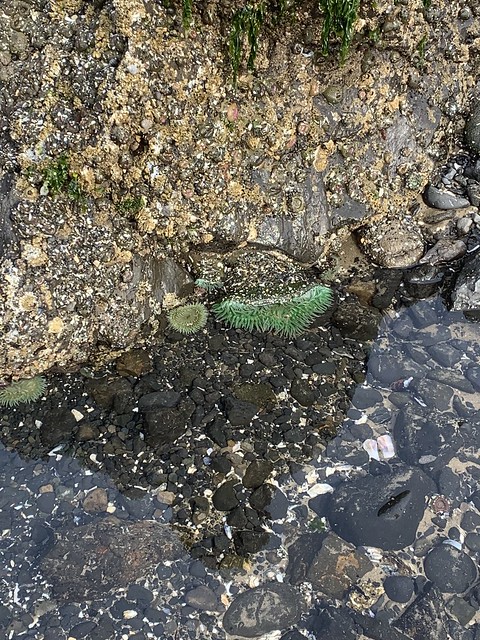
A cluster of squid eggs that were found washed up into a tide pool at Haystack Rock

My primary project is directly tied to HRAP’s mission, “to protect, through education, the intertidal and bird ecology of the Marine Garden and Oregon Islands National Wildlife Refuge at Haystack Rock.” By creating educational programs that are more accessible to a wider range of people, more people are inclined to be interested in marine conservation and be stewards to their environment. Additionally, by incorporating the ideas and theories of 21st century learning I am able to create a virtual program that is more engaging than the traditional video lecture approach. By creating a more engaging program that appeals to kids hopefully they will want to be more involved with conservation, and grow up to be more ecologically responsible. 

This also aids in Sea Grant’s mission to have thriving coastal communities, by serving as a catalyst that promotes discovery, understanding and resilience for Oregon coastal communities and ecosystems. My project aids in this goal by acting as an educational catalyst that promotes both discovery and understanding of a coastal ecosystem.

gIGrCfzA
Me at Haystack Rock!

Midwest-Mid=West

Hello everyone, 

My name is Lisette Perez and a super-senior at the University of Missouri-Columbia studying Natural Resources. Thanks to the Oregon Sea Grant Summer Scholars program, I will be working with the Oregon Department of Fish and Wildlife. Through their Marine Reserves Division, I will help analyze the socioeconomic impacts marine reserves have on businesses. Additionally, I will be surveying locals and non-locals to obtain their perceptions on the marine reserves. This internship has allowed me to learn about marine reserves, obtain the technical and analytical skills that I can use for future jobs.  With the work done by the scholars, we will be able to expand this project’s database and survey population.  Additionally, this project can promote education, outreach, and awareness on the marine reserves. This project is allowing is preparing us socially, academically, and professionally. It is providing us not only the opportunity to expand our professional sphere, but to gain the critical thinking, technical, and hands-on skills. 

I am very excited and honored to be a part of the prestigious program. Through this program I have been able to gain new friends, professional development opportunities, and the chance to be in a different state and region for the summer. I am originally from Chicago and being in Oregon is like being in a whole new world. This place is beautiful. I look forward to the rest of the summer and can’t wait to see what else is in store. 

The Start of a Summer Researching the Ocean from the Comfort of My Own Home

Hello!

My name is Yalin Li, I am a recent graduate from the University of Oregon and I am working with the Oregon Department of Fish and Wildlife (ODFW) this summer. The project I’m working on focused on researching ocean acidification and hypoxia (OAH) on our coastal species with a focus on the effects of hypoxia, and it affects our coastal communities. It’s nearing the end of week 2 of my time as a Summer Scholar, yet I have already learned and participated in so much in my short time working.

View of all my house plants keeping me company during my long hours at my desk

Oregon was one of the first places to be impacted by ocean acidification and OAH is unique in Oregon as it is driven by the natural process of upwelling that occurs along the Oregon coast. The OAH Council was created to guide Oregon on how to combat this issue of the rising intensity of ocean acidification and hypoxia as it threatens the security and resilience of Oregon’s fisheries, communities, and ecosystem. They created and released an OAH Action plan that acts as a roadmap to address and mitigate OAH with many of the actions being focused around public awareness. 

My main contribution to this project is the creation of an ocean hypoxia infographic to relaying the information from scientific studies to various audiences. I am currently in the process of conducting a comprehensive literature search and reviewing scientific papers to pull out relevant information to put on the infographic. This inforgraphic will show people how the species they care about are being impacted by OAH, and highlight where gaps in knowledge are, so we know what studies need to be conducted to fill in those gaps. In doing so, I will be supporting ODFW’s overall mission to “protect and enhance Oregon’s fish and wildlife and their habitats for use and enjoyment by present and future generations.” Alongside the infographic, I will be participating in various meetings with my mentor Liz Perotti, such as the Pacific Coast Collaborative and Tillamook Bay Clam Advisory Committee (TBCAC) meetings, and aiding in the creation of other pieces of outreach material. 

By participating in the OAH project, I am helping in spreading awareness of the impact of OAH condensing down the current pool of knowledge to make it accessible to managers, legislatures, and the public. This is right in line with the Oregon Sea Grant mission to promote discovery, understanding, and resilience for Oregon coastal communities and ecosystems to achieve their vision of thriving coastal communities and ecosystems here in Oregon. With more support and hands working on this topic, the quicker we can adapt and protect our oceans from OAH so that we and the future generations can continue to use and enjoy Oregon’s thriving coastal communities and ecosystems.

Subtidal collection of clams by the SEACOR Team at Tillamook Bay (source: Tillamook Bay Clam Advisory Committee)

While I might not be able to actively work at the coast this summer, I’m so excited to be part of such an amazing project and can’t wait to see it all come together! ~Yalin 🦑

SOS: Save Our (mud) Shrimps

Moving out of your parent’s house for the first time is not an easy thing to do. Especially if you move all the way across the country! But two weeks into my OSG Summer Scholars internship and I know I’m doing the right thing for myself. I’m excited to work live and in person with the animals and people that I’ve been working with for over a year. This summer I’m working on another piece of the 10+ year project trying to understand the relationship between a native burrowing mud shrimp, Upogebia pugettensis, and it’s invasive parasitic isopod, Orthione griffenis. Upogebia pugettensis populations up and down the west coast have drastically declined, with some local extinctions in California. Collapses in mud shrimp populations have been associated with infestations of Orthione and former pesticide use from oyster farmers.

Looking for juvenile mud shrimp in the lab (May 2021)

After taking a week to drive from North Georgia to the Oregon coast, I jumped right into my work duties. My lab partner, Joshua (an Oregon State REU intern), and I get the privilege of doing field and lab work this summer. Some of our field work includes trudging out onto the mudflats behind Hatfield Marine Science Center at low tides. On the mudflat, we take cores and sieve them down to collect the mud shrimp. We also get to bike out onto the fishing pier next to the Yaquina Bay Bridge after dark during high tides. On the pier, we are doing plankton tows, which are conical fine-mesh nets with a cod end that traps critters that are riding the incoming tides into the bay. Back in the lab, we sort and analyze the mud shrimp and the plankton tows. The mud shrimp are analyzed based on aspects like species, sex, carapace length, infested with Orthione, size of Orthione, and other important factors. The plankton tows get analyzed for juvenile mud shrimp (both Upogebia and Neotrypea) and Orthione cryptoniscans (one of the larval stages of Orthione).

Field sampling on the mudflat at low tide for Upogebia pugettensis (May 2021)

Through this project we are hoping to determine the life span and the settlement schedule of the cryptoniscans and to get large enough samples of mud shrimp to overcome sampling bias to ground truth the age/size relationship. Ultimately, accomplishing this project is putting another piece of the puzzle down into saving this mud shrimp from extinction. To do that, we need to know the relationship between the shrimp and the parasite better. That’s where my team and I come into play. With our work we can try and answer questions like: When do the shrimp become infested? Do the cryptoniscans settle on the shrimp or on other Orthione? Do cryptoniscans wait for a certain time to settle? What are they waiting for? Some kind of signal from the shrimp? Learning these answers will be one step closer to answering the big picture question “how can we turn this around or CAN we turn this around?”

Mud shrimp are native ecosystem engineers. They build permanent y-shaped burrows in the sediment that influence the estuarine benthic community by providing habitat and enhancing nutrient cycling. By saving these shrimp we are helping to advance OSG’s vision and mission to have thriving coastal communities & ecosystems. This research would also help to balance the forces of ecology and economy to inform oyster growers how to safely manage the burrowing mud shrimp populations without depleting them.

Getting Started

Hello!

My name is Jessica and I am majoring in marine biology at Oregon State University. This summer I will be working with the Human Dimensions Project within the Oregon Department of Fish and Wildlife. I will travel to Oregon’s marine reserves to survey visitors about their awareness and opinions of Oregon’s marine reserve system. I will also be going to tourist-oriented businesses in nearby towns to ask about their awareness of marine reserves as well as how they think the reserves have impacted their businesses. Later in the Summer I will enter the data collected into a database so that it can be analyzed and used in a report due to Oregon’s legislature in 2023.

When the marine reserve system started in Oregon, the legislation required a report be submitted ten years after implementation describing the affect marine reserves have had on coastal communities and ecosystems. Baseline data was collected for two years before any restrictions were put in place so that the state of the ecosystem and the opinions of local communities before the reserves were fully up and running would be known. The data collected this Summer will be compared to the baseline data, allowing the Oregon Department of Fish and Wildlife to determine the impact of marine reserves on local communities.  

One of the main goals of the Human Dimensions Project is to ensure conservation efforts are not negatively impacting coastal communities. Without community support ODFW would not be able to carry out its mission of, “protecting and enhancing Oregon’s fish and wildlife and their habitats for use and enjoyment by present and future generations.” The coastal community focus of the project also helps to further Oregon Sea Grant’s mission by supporting a management approach to marine resources that prioritizes thriving coastal communities as well as a healthy ecosystem.

The first day of surveying visitors to the Otter Rock Marine Reserve in Newport, Oregon.
Joe the sea Lion was not bad company between visitors to Cascade Head Marine Reserve.