Fishes, forests, and philosophers

There’s that old saying that has been attributed to Confucius which goes “Choose a job you love, and you will never have to work a day in your life.” I don’t like it. For one, it probably wasn’t even Confucius who said it. A quick google of reveals that “choosing a job” wasn’t really an option back in Confucius’s day. But Ancient Chinese economic systems are waaaaay off topic. My real issue is with the content of the quote, not the one who said it. Unless you never hold a job and literally never work a day in your life, you’re going to work. Work doesn’t have to be a bad thing, though. I was reading a book recently (I can’t remember which book right now and it’s killing me) that talked about how the western world has created a division between “work” and “life” where “work” is some awful obligation we slog through just so we can live “life” during our time off. It sounds like a real bummer, honestly. I’ve experienced that with jobs in the past, but this summer so far has been different.


To be clear, I have worked plenty of days this summer, and it’s felt like work. For example, last Thursday I woke up at 5:00 AM, ate a meager breakfast, and prepared to go on a cold, windy boat ride and jump into frigid waters. That felt like work. I’m not going to pretend I had a smile on my face the whole time, because that would be a complete lie. Still, I did it, and at 6:15 AM I went out for my first SMURFing survey of the summer. Verdict? Awesome and totally worth it. If you’ve been reading this blog faithfully you may remember what SMURFing is, but I’ll give a refresher anyways.


SMURF: Standard Monitoring Unit for the Recruitment of Fishes. A 3 foot tall by 1 foot diameter cylinder of folded up plastic fencing which we suspend just below the surface of the ocean to serve as a habitat for fishes. Juvenile rockfish often settle (recruit) in shallow, nearshore waters before moving lower in the water column as they get older and larger. Here at ODFW we’re interested in how the rockfish utilize the shallow waters in Oregon’s Marine Reserves, so we have SMURFs deployed in and around two of the reserves collecting fish. Long-term, this project will inform our understanding of what effect the Marine Reserves are having on Oregon’s marine ecosystems. Every other week during the summer we (or our collaborators) collect fish from the SMURFs, count them, and measure them. Collecting the SMURFs is done by a team of two snorkelers off of boat in the wee hours of the morning. It’s sort of controlled chaos, really. First, the captain pulls you up close to the marker buoy and shouts the signal for you to disembark. You and your buddy then leap into the ocean, holding onto your equipment the best you can. Will (PhD student working on rockfish, and my snorkel buddy) carried the net for collecting the SMURF, while I carried a replacement SMURF. We hightail it over to the mooring, bag the old SMURF, clip the new one on, signal for the boat to return, and hightail it back to the ladder to check your catch.

SMURFing is glamorous work

All this is done while competing with Oregon’s infamously inhospitable oceans. I was lucky in that my first SMURFing outing was on a very calm day. This meant swimming and staying warm was a lot easier, but by no means easy. For the eight SMURFs we had to collect that morning, Will made all eight trips into the ocean while MaddY (his REU student) each served as his buddy four times. When it was all said and done, we collected just 15 fish. This was a pretty small haul, but not uncharacteristic for this time in the summer. For more details about the science of SMURFing, check out some of the posts I’ve written at oregonmarinereserves.com.


To summarize SMURFing and juxtapose it with Confucius’ quote, yes it part of my job, yes I loved it, and yes it was absolutely work. I didn’t spend all last week working though. In fact, my parents came to visit and I had mini-vacation! My folks flew in all the way from good old Ohio on Tuesday under the guise of delivering my wetsuit and weight belt. It was a good excuse for them to come see what the Pacific Northwest has to offer. During the week I’d spend my days at work while they bounced around Oregon’s coast, then I’d meet up with them in the evening to do some touristy things.

My uber-adventurous parents exploring the intertidal in style

For them it was vacation, for me it was like a working staycation I suppose. Then on the weekend we road-tripped down to the redwoods! Unreal. Absolutely unreal. If you’ve been to the redwoods you can understand what it’s like. If you haven’t, I’m sorry, because words and pictures are incapable of capturing what it’s like to experience those trees.

One of my best photos, still doesn’t do it justice

It’s not just their size that overwhelms you, it’s how they’ve controlled these entire forest ecosystems for millions of years. Redwoods are stunningly resistant to fire, water, drought you name it. When one is damaged, it begins to grow a new clone right out of the burl at its base. Some animals live their entire lives up in the canopy of the redwoods, including salamanders of all creatures! All the sword ferns, small trees, and young redwoods that make up the understory battle for the patch of sunshine created whenever a titan falls, literally growing over each other as they lean towards the light. It’s an incredible place for a young scientist, or anyone else for that matter. It certainly was an incredible place to my parents. The three of us were constantly on the go from one trail to another and we covered many more miles than I expected to, stopping frequently to stare in awe.

C for Clemens Family!

“Stopping frequently in awe” was the theme for the whole road trip to and from Northern California as well. The Oregon coast is an absolute gem of a drive. What could have been a 5 hour drive, we spread out over a day so we could stop and experience as much as possible. My parents loved it, I loved it. I was more than happy to show them around my neck of the woods for the summer.


At one point when we were stopped for a break during a hike in the redwoods, my mom asked me what I was pondering as I sat in silence. My response was “work,” which came as a bit of a surprise to them. Fairly, they didn’t think I should be stressing about my job while sitting in such an amazing place. But I wasn’t stressing about it, in fact I was more looking forward to what I have to do this week. It isn’t going to be a uniquely exciting work week, no SMURFing, but it is work that I know is going towards something that I really care about, and that’s what makes it worth it. I care about marine conservation just as much in the office as outside of it, so “work” and “life” aren’t mutually exclusive. This probably isn’t how it will always be in my career, but at this point I’m comfortable defying Confucius (or whoever it was) and saying that I go to my job every day and work, and I love it. Perhaps it’s because I’m accepting that all the tasks and early mornings are worth it in the long run. You might even say I’ve started to see the forest through the trees.

Geez. A “Confucius” quote to open and a redwoods analogy to close? I’m sorry. I just couldn’t help myself.

This little intern went to the market

First off, let me say that farmer’s markets are one of my top three favorite things in life. I don’t know if it’s the good food, free samples, or variety of characters at the market, but the sun always seems to shine a little brighter at the farmer’s market, so it was about time that I gave the Newport one a whirl.

And I loved it. It was honestly bigger and better than I expected, with the highlights being: a lady selling grandma-sweaters with patches sewn on of cats, puffins, and the like, loads of sweet Oregon cherries, and a honey-vendor who not only sold honey but also some bomb honey mustard and honey barbeque sauce. He also educated me on something called Royal Jelly. It’s basically a paste made for the Queen Bee that he cited to have great health benefits and swore by it for helping him beat Stage 4 cancer! I love these kinds of interactions at farmer’s markets because you get to learn about and interact with people over your common love for food. Back in Los Angeles, there was a kombucha lady at the Brentwood farmer’s market who I would always look forward to seeing for her cheery attitude and funny stories.

I know farmer’s markets can get a bad reputation for being too expensive or bougie, but I find the value of these interactions and getting my food from local small-scale farms worth the price. Plus, the way I see it I would much rather spend my money on good food than new technological gadgets or the latest fashion trends.

Washed Up

I have spent an awful lot of time hunched over vats of acid washing bottles and syringes this week. Oddly, doing the dishes, whether with soap and water or 10% hydrochloric acid solution, is drudgery. The only excitement to be had was when my right glove began leaking. I expected the worst, but after rinsing with Milli-Q ultrapure water I was unharmed. I had the pleasure of throwing out the scary old gloves and donning a beautiful new pair that I can love and trust for the rest of the summer.

The experiment incubating pure water in plastic containers to look for an increase in the dissolved oxygen occurring as a result of leaching yielded interesting results. The 2 gallon ziplock bag showed quite a large increase in dissolved oxygen level in the ultrapure freshwater over several days. Unfortunately, the ziplock bag containing sterile seawater drained empty at some point during the incubation. The data on the logger from the drained bag showed a similar trend to the other bag, but the plot went wonky when the water started leaking. The five gallon carboys of pure water and sterile seawater showed much lower rates of leaching than the ziplock bags. Hmmm.

The glass BOD bottles are working out nicely. On Wednesday I went to Tillamook and collected water samples at low tide from several points in the bay that represent different mixing zones. I began incubating them on Thursday in BOD bottles. Temperature and light exposure have been difficult to control due to laboratory limitations, but wrapping the bottles in aluminum foil and storing them in a cooler in a dark room has helped keep them at a stable temperature and prevent light from triggering photosynthesis int he phytoplankton.

After 24 hours of incubation, we took oxygen readings and compared them to the oxygen levels in the water in the bay when the samples were taken. We noted significant decreases in oxygen, meaning the microbes were consuming oxygen at a rate that could be easily measured in a single day. This information answered key questions about the required size of bottle and length of incubation required to measure respiration rates in this environment. While biological oxygen demand has been measured in BOD bottles for many years and is a standard practice, measuring estuarine respiration rates in a complex system like Tillamook Bay is not the usual application. Knowing that we can use small samples of water and get results in a couple days is very helpful. If the oxygen decrease in the bottles levels off, it has been suggested that I add glucose to see if the microbes take off again and are carbon limited. Exciting!

Now I just need to prepare more BOD bottles. Back to the acid.

Week 4: Show me the cockles!

My favorite part about my placement for this internship thus far has been its erratic nature. I mean this in the best way possible! No two weeks are the same ; my schedule is always changing, and with it my tasks (partially due to splitting my time between 2 mentors). This week held in store some challenging statistics work and a new survey for cockle clams in the South Slough Estuary.

I will spare my readers from going too far into detail on the stats stuff, but basically I have been asked by Scott (the ODFW shellfish biologist and pink shrimp fishery expert) to assess the current rule for how pink shrimp takes are measured by authorities, and to see if we can come up with a better system that requires less work to get the same value. This can be done using a power analysis, which determines the sample size necessary for your experiment. Generally, the greater the sample size the more statistical power. However, we want to avoid huge sample sizes because that requires time and resources. And there lies my chore- to find a happy medium that gets the job done better than the current, arbitrary rule (found here #635-005-0645-  http://arcweb.sos.state.or.us/pages/rules/oars_600/oar_635/635_005.html ) .

For the cockle survey we set off as a crew of three (Joe, Liz [both ODFW employees], and myself), without the guidance of our trusted leader Scott, who was suffering from severe back pain. Though we were all first-timers to this particular survey, we had full confidence in our ability to run a smooth operation. The survey methods are fairly simple- 1. find your waypoint 2. lay down the 1 meter-by- meter quadrat and take note of the kind of substrate it is on 3. rake in one direction and pull out any cockle clams you unearth, then record that number 4. rake in the opposite direction and do the same. The reason for raking twice is to get a detection rate differential between the first and second swipe. It is almost always an 80% detection rate on the first swipe.

Raking for cockles

Cockles

Minus one navigational hiccup, day 1 of the survey went without a hitch. I got to practice more of my GPS skills as I led the team from waypoint to waypoint (which I had generated on our maps using a GIS program- nbd), and soon we had completed nearly all of our 60-point goal. We would have gotten all of them too, if it hadn’t been for those meddling tides! We brought our bag-o-clams back to the lab to be weighed and measured and entered into the data base with the previous years’ data. This survey has been done for almost a decade and the goal is to compare the densities at two sites- one that is open to commercial cockle fishing (they’re often used for bait), and one that falls within the South Slough National Estuarine Reserve that is only lightly recreationally clammed.

The next few days were the same, with the only differences being that we were rejoined by Scott and that we started at the heavily fished site and then moved up to the less exploited site. The south slough was a beautiful work space, we only had to deal with a few sticky spots on the flats (my waders have never been so clean at the end of the day), and we were surrounded by wildlife. Joe, being the typical birder, has an exceptional eye and ear for birds and their calls and never fails to point one out for me. We saw a couple juvenile bald eagles fly right in front of us, and drove past some fat sunbathing seals in the boat. The beauty combined with some great senses of humor made the work go fast, even if we had a lot more clams to carry. It was a fun time.

On a more personal note (since I’ve gotten a few friends and family to read these things), I wanted to share that my time in Oregon has inspired  the chef in me. My meals are still mediocre at best, but I really enjoy cooking for myself, especially after years of being stuck on a meal plan. I’ve found joy in planning my meals ahead and making a fine tuned list for the grocery store (which totally helps with budgeting). I’ve been incorporating so many veggies into classically easy college kid foods- like eggs and pasta- yummy and healthy. I’ve made several calls home to my mom along the way to ask some pretty basic food prep questions, and she’s been very helpful. It’s a process, but you gotta start somewhere. Pictured below is a meal I made a couple nights ago- garlic, onion, zucchini, and broccoli with parmesan and alfredo sauce over whole wheat shells.

Bon appétit

Cheers,

Katie

“So it goes.”

So it goes. Vonnegut’s wise words have followed me to the southern coast this weekend for my first work trip out in the field. For the past few days, Oregon State University graduate Katie and I have visited over one hundred houses in attempts to administer surveys. Our goal in this study is to assess quality of life, well-being, and attitudes of residents towards marine reserves on the Oregon Coast. The results of this study will then be provided to researchers, community leaders, and policy makers to inform decision-making.

Katie Williams (OSU) and Sarah Coffin (OSG) on the Coos Bay survey administration trip on July 15, 2017.

As we are still in the pilot study phase of our research, we anticipated a few hiccups as we continue to hone in to the balance between strong methodology and realistic limitations. As expected of any applied research study, many things have in fact gone awry. Nonetheless, I am grateful for the redeeming cup of coffee that sits in front of me as I write.

City map planning at So It Goes coffeehouse in Coos Bay, Oregon.

In my mind, a research project has many similarities to a relationship. It has its high and low points – all of which are testaments to the development of a rewarding finished product. Though low points are not typically glamorized, I find them just as constructive both for the growth of myself as a researcher as well as for my project. Introspection at this time is often a necessity. In attempts to juggle four projects, I’ve found myself mildly overwhelmed by this relationship. So it goes.

In addition to reflection specific to my daily work, this internship has provided me with a glance into future directions. With graduation from my undergraduate program nearing this fall, I am now faced with the question: “Do I want a Masters degree or a Ph.D.?” More importantly, “Am I ready for this?” I feel fortunate to be surrounded by advisors with both professional and academic degrees who have shared their experiences with me. Amongst all of their stories, I have noted a common theme of sacrifice.

An old friend once told me that, “you get out of it what you put in to it”. His words stay with me now as I mull through the decisions in front of me. Though my end results in research have always been exceedingly rewarding, I now strive to find a balance between my academic and personal goals. Perhaps my next step is to go abroad and travel. Perhaps it is to apply to schools. No matter my choice, I am thankful to be part of a program that challenges my perspective and encourages frequent spurts of growth. There is nowhere I would rather be than here. So it goes.

Kurt Vonnegut.


Week Four: Fish Seining Begins

The South Slough–and estuaries in general–are important spawning and nursery grounds for many marine fish species. However, the last time that there was a comprehensive assessment of the fish community in the South Slough was back in 1987. So approximately two years ago, the South Slough received funding to monitor the fish populations again. Once a week almost every month, a set of six sites are sampled at high and low tide. The information on the species and number of fish caught in each sample helps the reserve understand how fish communities in the slough are changing across seasons and years in different parts of the estuary. By combining this species abundance and richness data with water quality data, they can also assess how environmental conditions influence species presence, absence, and abundance. Overall, this project aims to characterize long-term trends in habitat use by fish, and it can additionally help evaluate the effectiveness of past restoration efforts.

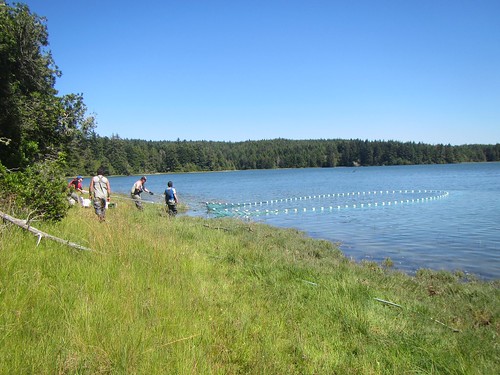
This fish monitoring project is the other main part of my internship with South Slough, in addition to the green crab work, and this week was the first fish sampling week scheduled since I started my internship. So starting this Monday, my time this week was almost entirely spent with fish work. The method used for the fish monitoring is called seining. Seining consists of a large net that hangs vertically in the water, with a float line on the top and a weighted line on the bottom. As the net is deployed along the shore, the weighted line drops the net to the bottom of the water and the float line keeps it buoyed on the water surface, creating a large barrier that scoops up all the fish in the seine net area.

To deploy the seine net, we first set a person on shore as the anchor, holding a rope at one end of the net. Then a person on the boat deploys the net from the bow, creating an arc near the shore.

IMG_0490

IMG_0491

IMG_0494

Two people then each hold one end of the net, and haul the net through the water to the shore.

IMG_0495

IMG_0497

IMG_0496

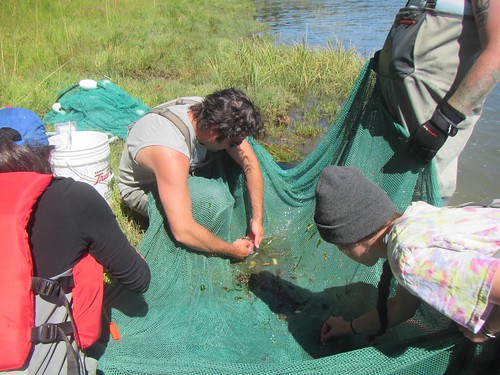
Once the net reaches the shore, everything in the net is funneled to the bag at the bottom of the net. All the fish and crabs in the net are then placed in buckets (with oxygenators).

IMG_0500 (1)

IMG_0503

IMG_0502

All of the fish and crabs caught are then identified, and their length and weight are measured.

IMG_0469 (1)

This week, we caught dozens of different kinds of fish and crabs–Chinook salmon juveniles (both wild and hatchery-released), different kinds of perch and sole, herring, anchovies, pipefish, and more.

IMG_0472

IMG_0475

It was exciting to learn new field techniques and to become better with fish identification as the week went on. The next week of fish seining will be sometime in August, and I’m excited to do it all again!

Finally Field Work! Willapa Edition

My research this summer with the US Department of Agriculture (USDA) is on the ecological role that oyster aquaculture plays in estuaries. It is commonly accepted that current industrialized agriculture has a huge impact on the environment, and we (a team of my mentor, a lab tech, a Master’s student, and myself) are specifically looking at how the fish and crustaceans utilize these aquaculture beds as habitat. Are they hiding in and around the oyster shells? Are they hunting? Just passing by to get to the more natural eelgrass beds? Or do they completely desert the area? Only data will tell.

Road tripping to Washington

Because our main study topic is aquaculture, and the Yaquina Bay where our Hatfield offices and my summer residences are located does not experience aquaculture, our field work involves taking trips of 3-6 days to other bays that do. This past Friday, while everyone was gearing up for the weekend, our little research team trucked up to Willapa, Washington for my first taste of estuarine field work.

Boating to site on a deceptively calm morning

So far, here’s what it tastes like: wind, salt, and great hotel coffee. The wind blasts in your face while on the boat, giving a nice dose of salty muddy estuary water with it, but to compensate the coffee provided at our hotel has been amazing (and I’m not even a big coffee drinker).

Our days have consisted of getting up at the crack of dawn and boating around the Willapa Bay to deploy and retrieve our many devices that will reveal the secrets of the “fishy” behavior going on below. Our technology ranges from camera rigs fastened with the highly regarded GoPro to sticks with squid piece super-glued to them, such is field work.

12-foot camera rigs at low tide (me for scale)

Same camera rigs at high tide


My favorite parts have been retrieving the minnow traps and counting and measuring the little critters we catch. So far, we have found: the feisty Dungeness crab, the “always looks kind of dead” shiner perch, the slimy gunnel, the abundant stickleback, the English sole that looks like Flats the Flounder from SpongeBob, and my favorite the staghorn sculpin (the namesake of my favorite IPA). The days are long and tiring, but to me zooming around on a boat and tromping through mud all day feels doesn’t really feel like work.

We will continue collecting data for the next few days (stay tuned for Field Work Part 2 next week), and upon return to Hatfield, I will finally have my own data to analyze! As a contribution to my mentor’s work on estuaries, my personal project for the summer will be to compare the collected video and predation data from this trip between two different types of oyster aquaculture (long-line vs. on-bottom).

For the past four years, I have been vegetarian to reduce my environmental impact. Being able to further learn about the impacts of agriculture and contribute to research that will help reduce those impacts has already been an amazing opportunity that I am excited to be a part of, and I look forward to what is still to come.

Week Three: exploring Oregon

In addition to the fun of catching green crabs over the past few weeks, I have also been able to explore some of the sites around Charleston and in central Oregon.

In just a 20 minute drive from the South Slough offices down Cape Arago Highway, there are a series of beautiful spots along the coast. One afternoon a couple weeks ago, Katie and I decided to just start driving and see what we could find.

A view of Sunset Beach (PC: Katie Gregory)

We first hit Bastendorff Beach, a long, sandy strip of beach that always has plenty of open space to have a bonfire or just sit and enjoy the view of the ocean. I’ve seen people surfing and paddleboarding, but I have only managed to get my toes in because the water is freezing so I’m not sure how the surfers manage.

We then got to Sunset Beach, but for some reason the park closes at 9 pm–before the sunset during the summer–so despite the name, I have yet to see the sunset at Sunset Beach. It’s still a gorgeous beach, with sandy shores surrounded by tall rocky cliffs. Simpson Reef is one of the best spots to view pinnipeds on the southern coast. The cliff overlooks large rocky islands right offshore where harbor seals, northern elephant seals, Steller sea lions, and California sea lions congregate. By the time we got there, the fog had started to roll in so we couldn’t see anything, but we could hear a lot of seals! Lastly, we got to Cape Arago State Park, the end of Cape Arago Highway, where we followed a few trails to spots where you could see the extensive rocky outcrops that line the coast. The trail down to the beach was closed due to seal pupping season, but hopefully we’ll be able to make it back later in the summer.

Last weekend, Katie and I decided to head the other direction and explore the sand dunes north of Charleston. We decided to hike the John Dellenback Trail, a 6-mile roundtrip trail that goes through a small forest, across a stretch of sand dunes, and then through a marshy forest to the ocean. Hiking across the dunes, where everywhere you look around you is sand except for a stretch of trees out in the distance, feels like you’re in the Sahara, not southern Oregon. But then you get to the swampy strip of forest, and the long expanse of ocean, and it feels like Oregon again.

More sand dunes, with some people included for scale. (PC: Katie Gregory)

Sand dunes at the John Dellenback Trail. (PC: Katie Gregory)


Last weekend, Katie and I decided to head the other direction and explore the sand dunes north of Charleston. We decided to hike the John Dellenback Trail, a 6-mile roundtrip trail that goes through a small forest, across a stretch of sand dunes, and then through a marshy forest to the ocean. Hiking across the dunes, where everywhere you look around you is sand except for a stretch of trees out in the distance, feels like you’re in the Sahara, not southern Oregon. But then you get to the swampy strip of forest, and the long expanse of ocean, and it feels like Oregon again.

For the 4th of July, I left the coast behind and visited family vacationing in Bend, located in central Oregon near the Willamette National Forest. The drive from Charleston to Bend was gorgeous, passing through endless forest and past large mountain lakes. We hiked Tumalo Falls, though we didn’t make it through the entire loop because my seven- and eight-year-old cousins were getting tired. We also floated in tubes down the Deschutes River, drank some beer from local breweries, and ate some amazing gelato. It was awesome to be able to see a completely different part of Oregon. It was sunny and hot (over 90 degrees, whoo!), and though I love the southern coast, it was nice to be able to wear shorts, have to put on sunscreen, and swim in the river without wearing waders.

Tubing down the Deschutes:

19657472_10213685601482372_499725847766661033_n

tubing

Tumalo Falls:

tomalo falls

19657164_10213689040888355_3135239411633128299_n

I’m looking forward to seeing more of the area (I’m hoping to make it to the northern part of the redwoods and to Crater Lake) over the rest of the summer.

(Also, thanks to Katie for letting me use all your pictures since I never take any!)

Coozy Bae

highlight of the week: meeting Frank

This week really flew by. I don’t know if it was because of July 4 or because I finally feel established here but it just seemed like everything was a blur. My weekdays have just morphed together to become some depressingly adult blend of waking up early, making myself breakfast and lunch, driving to work, working, working, working, driving home, then doing stuff of which has no real significance because I have to wake up at 7 again the next day (more like 7:20 because of all the ‘snoozes’). I say of no real significance not because it really has no significance but more so because I’m a night owl whose inspiration and work ethic are at its peak at 2am. So considering I am a very nap-loving human being who needs at least 6 hours of rest to not set up shop underneath his office desk like George Costanza, I must go to bed well before I can blossom into the sleep-deprived individual who I was born to be.


Despite this lack of energy and sense of accomplishment outside the workplace, within the workplace I am inspired! On Monday, we didn’t go into the office but got work done at the college’s library instead. There, Miles had Catie and I make a very detailed outline for this summer. The document is extremely thorough and literally covers every day of the internship along with what we plan on doing those days, meetings scheduled, and the amount of hours dedicated to each task. While it was pretty overwhelming to create such a future-oriented plan (I can barely even plan what I’ll be eating for dinner some days) it definitely made things clearer as to what I will be doing this summer and the skills that I’ll be taking away once I head back to San Diego. And I can happily say that I am excited! However, this excitement did not hit immediately but rather built up as the week progressed. Various meetings, daily duties, talks with Miles, and my own observations of the South Coast have not only opened my eyes to the various issues and things that are trying to be accomplished here, but it’s helped me understand where I may be able to fit into it all. I know I’m only an intern but there’s just so much potential for change and progress and it’s just really neat to be a part of it all.


I’ve been thinking of whether I would move here if I had a job lined up for me. I know it’s rash and maybe unrealistic to think I could get a job position out of this but I don’t think there’s anything wrong with fantasizing about the future. So with that being said, I’ve been fantasizing! I’ve just been imagining if I could see myself living in such a small place like this. I drive around the town, staring at the stores as they pass by just wondering “Would I be cool with this being my life?” I’m enjoying the work and I think there’s a lot of potential for growth, both in this position and the South Coast community in general, and that’s neat, but it seems scary to think I may one day uproot myself from California. But hey, I figure there’s no point in getting too invested in fantasies so I’m just gonna enjoy these next 7 weeks here and live as if I was living here.


In other news, on Friday, Catie and I went to the beach to take photos of people kayaking. We also got to kayak ourselves which was awesome. It was definitely a surreal experience to just paddle out and gradually hear the voices on the beach drown out. After that we enjoyed an incredible seafood barbecue, adorable dogs, good company, and country music. I went to the Oregon Country Fair in Eugene this weekend. My roommate Brendon and I drove up on Saturday and met up with some of his homies who joined our party. The fair was interesting to say the least. I have never seen so many painted boobs in my life, that’s for sure. That was my first real taste of Eugene and I can confirm, it’s a beautiful town. But as sweet as my weekend was, it was very relieving to finally see the Coos Bay bridge, it was a very home-y sight. 


The Smell of Ice Cream

Last week’s water incubation experiment was useful. The plot of the dissolved oxygen levels over the weekend showed clear declines in all of the samples, but there was some strange “noise” at around the same point in the plots of both of the ziplock bags. There was no way to determine an accurate respiration rate from the data. Additionally, the magnitude of change in the dissolved oxygen was much greater in the ziplock bags than in the carboys. My mentor, Cheryl Brown, found an interesting paper in which similar methods were employed to determine respiration rates, and the researchers found that enough oxygen would leach out of the plastic containers and into the water to confound their results. They carried on using plastic containers for incubations, but incubated additional “blank” containers containing ultra purified water to determine a rate for the oxygen leaching from the plastic so that they could correct for it.

I am currently running several incubations of ultrapure water in carboys and ziplock bags to see if leaching could be the source of the noise in our dissolved oxygen plots. We also went to Tillamook and collected more water samples that are now incubating in glass BOD bottles, glass bottles specifically designed for the purpose of measuring biological oxygen demand through incubation. The oxygen sensor we are using for the bottles is optical like the HOBO loggers, but much smaller and designed to fit into the mouth of the bottles. The sensor does not take a time series of readings, and will be used to take only initial and final readings of dissolved oxygen.

The main purpose of this week’s Tillamook trip was not to collect water for incubation experiments, but as a trial run of the bi-weekly water sampling plan of Tillamook Bay and the tributaries that will take place over the summer. Two teams with boats went out on Friday and collected water samples to measure the carbonate chemistry and nutrients of the bay and the tributaries. I rode along with the team sampling the tributaries. We did a little boating in the lower end of a couple rivers and went out only a short way into the bay before pulling out the boat and driving to all five of the rivers to gather water samples both above and below the agricultural zone. It was a long day, and aside from the pungent smell of dairy cows, or “the smell of ice cream”, I saw juvenile salmon leaping out of the water eating bugs in the morning, green herons and pairs of bald eagles, and even one large juvenile chinook in a pool up the Miami River. We will be doing these sampling trips every two weeks for the rest of the summer and I hope to observe and learn more about the ecology of the Tillamook region as I continue to learn about the science of water.

Collecting water with a Van Dorn sampler.


Nutrient sampling on the boat.


A beautiful morning on the Trask River.