Tag Archives: HST310

Oregon State College & its history with the Army Specialized Training Program, 1943-1946

During fall term 2023 Dr. Kara Ritzheimer’s History 310 (Historian’s Craft) students researched and wrote blog posts about OSU during WWII. The sources they consulted are listed at the end of each post. Students wrote on a variety of topics and we hope you appreciate their contributions as much as the staff at SCARC does!

Blog post written by Lily Ayola.

Students taking a Russian language class at OSC, taken some time in the 1940s. This language was added specifically for ASTP students by the Dean of Science Francois Gilfillan. Historical Images of Oregon State University, Oregon State University, “Russian language class,” Oregon Digital.

The document I have chosen outlines many facets of the Army Specialized Training program at Oregon State University during World War 2. This document was produced in 1943 and is in very good shape according to the digital version of this document. The part of the document that I am analyzing is the eligibility requirements for joining the army specialized training program (ASTP) at Oregon State College (OSC).[1] The document first explains that the program was created because the men that were being sent to the army lacked what the army was looking for in a leader. This document gave me some background on the ASTP as well as led me to many other documents. After this document, I was left wondering why Oregon State College was chosen by the ASTP.

At Oregon State College (now known as Oregon State University) there was a program called the Army Specialized Training Program which was implemented in 1943 and dismantled in 1946. This program was meant to create a new “breed” of solder, an educated man who was capable of leading his fellow men in war.[2] The main objective of my research was to find out why Oregon State College was chosen for this program.

This is an image of ASTP students in an electrical engineering class, and was taken in 1943. Historical Images of Oregon State University, Oregon State University, “Army Specialized Training Program (ASTP) students,” Oregon Digital.

What I have found using archival documents at OSC points to a couple of possible conclusions. Those conclusions being that the Army needed engineers, that OSC seemed willing to change the curriculum and rigor of their classes, while also adding completely new classes that would better serve the ASTP agenda. According to the “Biennial Report of Oregon State College” meeting notes I analyzed for the years 1943-1944, university administrators added more language courses and more nuances to said courses to service the ASTP students.[3] It’s also through the analysis of this meeting that we can see how willing OSC was to change or add courses. This was very favorable for the ASTP and probably was a main reason for why the ASTP decided to set up camp at OSC. This leads me to my first secondary source titled “Birth and Death of the Army Specialized Training Program” by Louis E. Keefer, where he discusses many topics, but most importantly he discussed the implementation of the quarter system, which was developed to help men returning from war learn more in a shorter period of time. I’m sure this revised schedule also helped men learn faster so they could leave for the army as well.[4]

This is an image of a swearing-in ceremony for new cadets in the ASTP. This image was taken some time around 1942, and appears in the 1943 OSC yearbook. OSU Special Collections & Archives Research Center, Oregon State University, “Swearing in new cadets during WWII,” Oregon Digital.

One of my main conclusions was that OSC had a lot of engineers already attending the school, so it was easy to implement the ASTP at OSC if there was an embedded baseline interest in the major the army wanted most, engineering. First, I analyzed the 1942-1943 registration statistics, which showed that in the spring term of the 1942-43 school year, engineering was the most popular major.[5] This sort of answers my question, that this is probably the leading factor in OSC being chosen to host the ASTP. OSC had a lot of people attending school already who were interested in continuing their education in engineering, which the ASTP stated was one of the majors they wanted more people to enroll in. The next thing to analyze is the enrollment numbers specifically for the ASTP. Something about this that I immediately found interesting was they only list the enrollment for students in the following majors: Basic Engineering, Advanced Engineering, ROTC seniors, and “area and language”.[6] This information suggests that even though the Army was looking for people in more areas than those listed, these were the only majors they really cared about. The next source I looked at seems to be a collection of letters requesting credits from the Mr. E.B. Lemon. From what I understand, these students either weren’t given the proper credits for classes they took at OSC, or they took similar classes in high school, so they wanted college credits for those courses.[7] All of these letters imply that young men at the time really wanted to meet the requirements to join the ASTP, which goes towards my question of why Oregon State was chosen, and maybe it was because there was so much interest. The next source I looked at was the Camp Adair Sentry newspapers to see if there was anything regarding the ASTP there and I found an article from 1944 talking about how ASTP registration was open again,[8] as it had been closed for some time. This is interesting, as I discovered the Army could only have 150,000 trainees at a time, and this lets me know it was a popular program to enter, and men seemed eager to join the ASTP.[9] One thing I found intriguing was that there was a course just called “military”. Although, later in the ASTP policies and procedures book it lists the fact that students could now choose to strike the military course from their schedules, meaning they wouldn’t have to take it anymore under ASTP guidelines.[10] My theory for why this happened was because it was taking up too much time, and schools needed these Army men to be learning faster.

Another point I have for why OSC was chosen for the ASTP is because of how eligible the men at OSC already were prior to the ASTP being implemented. According to the Army Specialized Training Program “essential facts” under the “eligibility” section of the booklet, the army created this program within colleges to encourage a flow of educated men from a college into the Army. Any man that had scored a 115 in the Army General Classification Test qualified for the ASTP, but they needed to meet some other education requirements. These requirements included: efficiency in a language or taking a class for one year that involves math, physics, or biology. These qualifications were raised based on how long they’ve been in college and how old they are. Men aged 22 or older needed “substantial background in one or more foreign languages” or their education had to include a year of math, physics, or biology. Men who had completed three years of college needed to major in either engineering, pre-medicine, or pre-dentistry.[11] According to my secondary source titled “ASTP” by John R. Craf, where he discusses the eligibility requirements for young men to join the ASTP, the eligibility requirements here are slightly different from the ones I found in the “essential facts” booklet, which were more specific.[12] It seems that the program simply evolved. We know that OSC joined the ASTP program in the spring of 1943, and this paper was written in November of 1943, so maybe the requirements changed before the program made it to OSC. Overall, the ASTP at OSC was an institution designed to bring as many educated men into the army as possible. It does seem like they were desperate for members but never short of willing young men who wanted nothing more than to fight for their country.

In conclusion, I can use these sources to infer that the ASTP chose OSC because it was a valuable place for them to hold their program. OSC had a high volume of engineering majors already at the school, and OSC was willing to shift curriculum to better accommodate the ASTP requirements. These factors made OSC a good place for the ASTP to set up their program to bring more educated men into the Army.


[1] US Army Services Army Specialized Training Program, Essential Facts About the Army Specialized Training Program (Army Specialized Training Division: Washington, D.C., 1943).

[2] US Army Services ASTP, Essential Facts, 1.

[3] “Biennial Report of Oregon State College 1943-1944,” Special Collections Archive and Research Center (hereafter SCARC), Registrar’s Office, RG 013- SG 12 Box 9 Folder 10.

[4] Louis E. Keefer, “Birth and Death of the Army Specialized Training Program,” Army History 33 (Winter 1995).

[5] “Registration Statistics 1942-’43,” SCARC, Registrar’s Office, RG 053-SG 1 Box 9.

[6] “ASTP Registration Statistics 1943-44 to 1945-46,” SCARC, Registrar’s Office, RG 053-SG 1 Box 23.

[7] Letter from Office of the Dean of the School of Engineering and Industrial Arts to Oregon State Registrar E.B. Lemon, October 18, 1941, SCARC, Registrar’s Office, RG 053-SG 1 Box 23, Special Military and Defense Courses World War II, item #2.

[8] “Limited ASTP Schools Again Open to All GIs Not Now in the Infantry,” Camp Adair Sentry, June 30, 1944: 2,  https://oregonnews.uoregon.edu/lccn/sn94052685/1944-06-30/ed-1/seq-2/#words=ASTP.

[9] US Army Services, Essential Facts About the Army Specialized Training Program, 3.

[10] “Biennial Report of Oregon State College 1943-1944,” SCARC, Registrar’s Office, RG 013- SG 12 Box 9 Folder 10.

[11] US Army Services, Essential Facts About the Army Specialized Training Program, 2-3.

[12] John R. Craf, “ASTP,” The Journal of Higher Education 14, no. 8 (1943): 399, https://doi.org/10.2307/1975350.

Oregon State’s Legacy: OSC’s World War II History Project and the Campus Experience

During fall term 2023 Dr. Kara Ritzheimer’s History 310 (Historian’s Craft) students researched and wrote blog posts about OSU during WWII. The sources they consulted are listed at the end of each post. Students wrote on a variety of topics and we hope you appreciate their contributions as much as the staff at SCARC does!

Blog post written by Hannah Beine.

The disruption caused by World War II transformed the experiences of colleges and universities across the United States. The onset of the war led to the departure of students and staff, changes in enrollment and courses, and new campus activities. As the college community dealt with the changes, there were efforts from OSC faculty-led committees and student-led organizations to collect details on Oregon State College’s participation in the war. College administrators embarked on documenting and collecting an array of projects and experiences within the Oregon State College community. They selected specific items for collection, including reports on faculty members and students who left for military service, as well as documenting the college’s changes in financial, academic, and social aspects. The endeavor aimed to gather various publications containing information about the college and individuals associated with the Beaver community.

While the primary goal was to chronicle OSC’s financial, organizational, and academic changes, the collection process also placed an emphasis on capturing the war’s human impact both overseas and on campus. Each piece of documentation provided insight into the experiences of the Beaver community during the war that could be added to the collective archive. The war changed the way of life for college communities across the United States and “never before had the nation been so united in its commitment to a cause, both in spirit and deed.” [1]The work and devotion put towards assembling war-time information highlighted the patriotism and pride within the Oregon State community, not only from employees but the students as well.

Oregon State College’s efforts to record its history during World War II all began with a conference that took place in October 1944. William L. Teutsch, the Assistant Director of Extension Services,  sent a memorandum to Dean William A. Schoenfeld, the Dean of Oregon State College, that outlined the plan of action for collecting information regarding the college during the war, known as the World War II History Project.[2] The conference took place on October 24, 1944 and was led by Dr. L. S. Cressman, the Director of the World War II History Project and Director of the Museum of Natural History at the University of Oregon. The memorandum provides a complete list of the members present at the meeting, including the Acting Dean of Agriculture, the Dean of Forestry, a representative of the Dean of the School of Home Economics, and the College Editor and Chairman of the Campus Committee. The inclusion of diverse departments appears to be an attempt to provide the project with multiple avenues to receive documents and information regarding the college’s participation in the ongoing war.

Exchanges between Assistant Director William L. Teutsch and Dean William A. Schoenfeld outlined the initial plan of action in regard to collecting information for the World War II History Project. This plan was agreed upon by the individuals present at the conference with Dr. L. S. Cressman, the Director of the project. Wm. L. Teutsch, “Memorandum of Conference with Dr. L.S. Cressman, Director of World War II History Project and Director of Museum of Natural History, University of Oregon,” October 25, 1944, SCARC History of World War II Project Records MSS OSCWW2  Box 1, Correspondence 1944-1946.

This document outlines the main points discussed and agreed upon at the conference, all of which provided a layout for the WWII History Project. These points included outlining and recording crucial war emergency activities such as records of OSC staff and students being released to serve in the military. It also provides examples of how to document these activities, emphasizing that the collection of records might span several years. The purpose of this project was to “make the experiences of war work a matter of record for use of the Executive Department in case similar occasion should arise in the future requiring executive action.”[3] This project recognized the importance of archiving information as a means to help guide future responses to similar situations.

There are multiple memorandums and related correspondence found within the archives, indicating that there was ample communication between individuals contributing to the World War II History Project. Often, there were requests for information or clarifying details between committee members and other individuals they were collecting information from. The well-preserved documentation implies that the committee members deemed the process of recording the activities of the Oregon State College community important and valuable.

Newspapers and publications like The Barometer, the Oregon State Yank, and other local newspapers provided the World War II History Project committee with a convenient means of collecting and requesting information. The collection and preservation of editions of the Oregon State Yank, a quarterly publication,  seemed to be an important piece of documentation.[4] This importance is underlined by the multitude of letters between L.S. Cressman, the Director of the World War II History Project, and Delmer Goode, the Editor of Publications at OSC, regarding the acquisition of the Oregon State Yank for the World War II History Project collection.[5]

This document is a letter between L.S. Cressman, the Director of the WWII History Project, and Delmer Goode, the Editor of Publications at Oregon State College. In the letter, Cressman is inquiring about the quarterly publication sent to men overseas called the Oregon State Yank. L.S. Cressman to Delmer M. Goode, November 16, 1944, SCARC, History of World War II Project Records MSS OSCWW2 Box 1, Correspondence 1944-1946.

This publication was focused on sharing real stories sent in from service members overseas, providing first-person accounts of experiences, and “an insider’s view of the war from the frontlines.”[6] The attempt at securing first-hand accounts from OSC service members extended beyond OSC campus publications. In 1945, Cressman made an appeal in the Herald and News, a newspaper from Klamath Falls, Oregon, inviting families across Oregon to share information about relatives serving in the war. Information could be sent in by family members or other individuals with connections to OSC with the hopes it provided helpful insight to the WWII History Project collection.

This column article, from the Oregon State Barometer published February 9, 1945, discusses the popular quarterly publication called the Oregon State Yank. The article references a serviceman who suggests an idea to have OSC rings made in order to identify fellow Oregon Staters overseas. “Our Voice in the World,” Oregon State Barometer, February 9, 1945, 2, https://oregondigital.org/concern/documents/8k71nk933.

The endeavor to collect information regarding Oregonians overseas through newspapers demonstrated the importance of fostering a sense of community and unity. The war not only united all Americans towards a common goal but also seemed to instill a strong sense of solidarity and patriotism within the Oregon State College community.[7] The 1945 column “Our Voice in the Wind” from The Barometer refers to a suggestion by a serviceman to create an OSC ring that students and alumni could wear while in the service.[8] The serviceman proposed this idea in order to make it easier to identify fellow OSC members serving throughout the world. This emphasized the importance of maintaining school pride, not only for those still on campus but also for those who were longing for community overseas.

The World War II History Project collected reports from many different available resources, some of which exemplified this sense of OSC unity through on-campus student war-related experiences. One of the most valuable student organizations for understanding the involvement of students in supporting and gathering information about OSC’s wartime participation was the OSC Student War Council, including both male and female students on campus. The Student War Council’s main objective was to organize and report on all activities at Oregon State College connected to the ongoing war.[9] At the end of each activity, the Council would create a complete report on the activity, documenting the experience, which could then be put into the WWII History Project collection. Not only were these activities and reports a means of collecting information, but they also were a showcase of patriotism and school spirit.

This is a page from The Beaver 1945, the college yearbook,describing the Student War Council at Oregon State College. This description of the War Council explains the origins, members, and responsibilities of the organization on campus. “War Council,” The Beaver 1945, SCARC, Oregon State University Yearbooks, 202, Oregon Digital, https://oregondigital.org/concern/documents/12579s71x.

A sense of collaboration between OSC and the other participating colleges in the World War II History Project is shown through the large amount of correspondence between them, as well as their willingness to participate in document collection. Colleges within California, Oregon, and Washington created the Federation of College War Councils which was a means of sharing information relating to war activities at colleges within these states.[10] These reports provided insight into the different activities that took place on various campuses by students who were not serving overseas. They provide a different perspective and insight into the civilian experience. These experiences, alongside those sent in and published in newspapers like the Oregon State Yank, offer a better understanding of the wartime experiences of students and faculty at Oregon State College.

The World War II History Project allowed members of Oregon State College, as well as the other participating colleges, to assemble the experiences of the Beaver community during the war into a consolidated archive. The collected documents highlight a more administrative look at the transformation of OSC during World War II while also showcasing the important work of OSC students in organizing and recording the campus experiences of community support for American troops fighting in the war. The Student War Council calls attention to the broader college and university experience during World War II. Oregon State College was not isolated in the participation of its students. The Federation of College War Councils confirms the focus on organizing and recording support from communities throughout the United States. The focus exhibited by individuals at Oregon State College to preserve the wartime experience underlines the importance of collecting documents. The World War II History Project has provided future generations with the opportunity to learn about the wartime experiences that helped shape the Beaver community.


[1] V. R. Cardozier, Colleges and Universities in World War II (Westport, CT: Praeger, 1993), 123.

[2] Wm. L. Teutsch, “Memorandum of Conference with Dr. L.S. Cressman, Director of World War II History Project and Director of Museum of Natural History, University of Oregon,” October 25, 1944, Special Collections and Archives Research Center (hereafter SCARC), Oregon State College History of World War II Project Records MSS OSCWW2, Box 1.

[3] “Memorandum of discussion between faculty members of Oregon State College,” October 24, 1944, SCARC, History of World War II Project Records MSS OSCWW2 Box 1, Correspondence 1944-1946, page 1.

[4] “Beginning with this issue,” Oregon State Yank no. 2 (May 1944): 1, https://oregondigital.org/concern/documents/fx719t22q.

[5] L.S. Cressman to Delmer M. Goode, November 16, 1944, SCARC, History of World War II Project Records MSS OSCWW2 Box 1, Correspondence 1944-1946.

[6] Mary Weaks-Baxter, C. Brunn, and C. Forslund, We are a college at war: women working for victory in World War II (Carbondale, IL:Southern Illinois University Press, 2010), 17.

[7]“Appeal Made for Documents Of Overseas Service Men,” Herald and News, September 30, 1944, 9, https://oregonnews.uoregon.edu/lccn/sn99063813/1944-09-30/ed-1/seq-9/.

[8]“Our Voice in the World,” Oregon State Barometer, February 9, 1945, 2, https://oregondigital.org/concern/documents/8k71nk933.

[9] “War Council,” The Beaver 1945, Oregon State University Yearbooks, 202,  Oregon Digital,, https://oregondigital.org/concern/documents/12579s71x.

[10]Cardozier, Colleges and Universities, 124.

Gordon Gilkey: The Monument Man at Oregon State College

During fall term 2023 Dr. Kara Ritzheimer’s History 310 (Historian’s Craft) students researched and wrote blog posts about OSU during WWII. The sources they consulted are listed at the end of each post. Students wrote on a variety of topics and we hope you appreciate their contributions as much as the staff at SCARC does!

This post was written by Eliza Eckman.

In Nazi Germany, art emerged as a treasure—stolen, created, and hidden. Gordon Gilkey led the charge to recover these artworks. His mission involved collecting and preserving war-related artifacts, confiscating works tied to Nazism, and facilitating artwork restitution. After WWII, in August 1947, he became Professor of Art and Chairman of the Art Department at Oregon State College (OSC), and the following year he earned recognition from the French Government. Gilkey’s service during the war as an academic turned serviceman was not an isolated case; numerous faculty members at OSC and across the nation, extending from librarians to camouflage course teachers, also served in the military and contributed to specialized war work.

Gilkey grew up on a ranch outside of Albany, Oregon and attended Albany College (now Lewis and Clark College) in Portland, Oregon starting in 1929 and completed his Master of Fine Arts at the University of Oregon in 1936. Gilkey married, and he and his wife, Vivian Malone, moved to New York City, where she pursued studies at the Juilliard School of Music. While in New York, he created a book of reproductions and originals that documented the 1939 New York World’s Fair. Gilkey later taught at Stevens College in Colombia, Missouri from fall 1939 until he joined the Army Air Forces in June 1942.[1]

In an October 1943 letter, Gilkey, serving as a supervisor of instruction for the Advanced Navigation School at the Central Flying Training Command (CFCT) in Ellington Field, Texas, expressed interest in joining the Commission for the Protection of Artistic and Historic Monuments in Europe. This commission, established a month earlier, sought soldiers with backgrounds in the arts to assist the US Army in safeguarding works of cultural value. Gilkey directed his letter to the chairman and founder, Supreme Court Justice Owen Roberts, and commission member Paul Sachs, a Professor of Fine Arts at Harvard. Gilkey outlined his civilian experience, including his education, art collection ownership, and teaching experience. He explained that, “As an officer in the Army Air Forces, the writer could be useful in aiding a determination of what to bomb and what to preserve. The writer is familiar with aerial photo interpretation and bombing procedures. Later, he could help reassemble Europe’s collections – especially graphic art collections.”[2] Sachs forwarded Gilkey’s letter to David Finley, director of the National Gallery of Art, and added that Gilkey was a potential Monuments Officer, along with other candidates with possibly superior qualifications.[3] Gilkey’s superiors at the CFTC denied his repeated requests to contribute to art preservation in combat zones, citing a lack of skilled personnel within the CFTC. To overcome this reluctance, Gilkey discovered a loophole: by undergoing combat intelligence training, he could be released from the role of supervisor of instructors, as the combat intelligence school held higher authority over the CFTC and faced its own shortage.[4] Upon completing his training in 1945, Gilkey contacted Boyd Shafer, one of the teachers he had overseen and who had become a speechwriter for Secretary of War Henry Stimson. Gilkey stated, “I’ve got to get to Europe. I want to be involved in resurrecting the art, working with art.” Shafer’s connection with Stimson facilitated Gilkey’s assignment, and Gilkey promptly took charge of the War Department’s Special Staff Art Projects.[5]

Gilkey had the responsibility of capturing this watercolor created by a German Combat War artist, with a stamp on it marking it as property of the U.S. War Department (Gordon Gilkey, German War Art, April 25, 1947, United States War Department, The Directives and Purpose, G.W.I.185.47, https://medium.com/@abeaujon/gordon-w-gilkeys-report-on-german-war-art-295e7dcb5360). Rudolf Hengstenberg, Boatload of Wounded Soldiers, painting, undated, The National Archives, G.W.1.2748.47, US Army Art Collection, NARA, https://nara.getarchive.net/media/artwork-boat-load-of-wounded-soldiers-artist-rudolph-hengstenberg-catalog-number-0c1c5a.

In his 1947 German War Art report, produced for the Army, Gilkey explained his work from the previous year, which involved collecting, processing, and preserving war-related artifacts, confiscating works of art dedicated to the promotion of Nazism, and returning paintings back to their owners. Gilkey detailed how larger paintings owned by Hitler were moved from Munich to salt bins at a refining plant in 1944 since they didn’t fit in the salt mines with other valuables. Some paintings were delayed due to a truck breakdown and traced to a dance room in St. Agatha, Austria.[6] Gilkey also outlined the direct restitution of paintings from Schloss Oberfrauenau, affirming that these artworks, acknowledged as rightfully owned by the artists who originally created them, should be returned.[7] As the operation concluded in summer 1946, Mrs. Gilkey informed her husband about a vacant position as the chairman of the art department at OSC, and despite a job offer from NBC in New York, he returned to Oregon in August 1947 to become a Professor of Art and Chairman of the Art Department.[8]

This letter from Gilkey provides guidance on the location of art collected by him and specifies the designated recipients for their return. “Paintings to be Restituted to Artists,” from Gordon Gilkey to Chief of the Monument program, Fine Arts and Archives Section,October 1, 1946, Records Concerning the Central Collecting Points, Restitution Claim Records, Austria Claims, 11.

Seven months after Gilkey began teaching at OSC, he received a letter notifying him that the French Government had awarded him the title of “Officer d’Academie” a distinction seldom granted to non-French individuals. Alfred Herman, Consul of France at the Agence Consulaire de France in Portland, Oregon, wrote the letter dated March 11, 1948. The one-page letter, typed on standard-size printer paper, is a copy. This distinction entailed an honorary degree from the French University and High Education System. The award also granted Gilkey the privilege of wearing the Palmes Academiques decoration in recognition of his devoted services to France. Herman offered to forward the diploma directly or arrange an official presentation, and he commended Gilkey for his help in the restitution of French Museum properties.[9] This communication provides insight into the recognition of the contributions of individuals associated with the college regarding World War II, highlighting how these contributions likely positively influenced the college’s reputation.

An artwork crafted by Ludwig Dettmann, a Nazi artist included in the “God-gifted list” (Gottbegnadeten-Liste), which is mentioned in the preceding letter, indicating that Dettmann’s artistic pieces are slated for return to his son. (Gilkey, German War Art, Staffel Der Bildenden Kuentsler, Propaganda Abteilung, Oberkomandowehrmacht.) Ludwig Dettmann, Battle Scene, painting, undated, Wikipedia Commons, https://commons.wikimedia.org/wiki/File:Dettmann-Battle.jpg.

Gilkey’s work coincided with a broader trend among OSC staff members in the humanities and the library who left for military service. In 1943, the Eugene Register-Guard published an articlethat listed the resignations of several personnel from OSC, including Priscilla Ferguson, a library cataloger, and Ruth Krueger, a circulation librarian.[10] OSC further documented the resignations and temporary leaves in a document titled “Record of Staff Members Released for War Activities.” For example, Kenneth Munford, an English Instructor, became Captain of the 2nd Mapping Squadron in Spokane, Washington.[11] In a letter dated November 1945, Wm. H. Carlson, Director of the Libraries, described the wartime work of his staffers for the benefit of Delmar Goode, the Editor of Publications at OSC. He explained that Grace Beecher, a reference assistant, had assumed the role of librarian at the Camp Adair Medical Unit.[12] Another November 1945 letter from the Dean of the Lower Division, Ellwood Smith, to Goode detailed the involvement of Lower Division faculty in the war effort, including those from the fields of Art, Economics, English, History, Psychology, Speech, and Journalism. Major H. R. Sinnard, Associate Professor from the Art department, chaired the Training Board for the camouflage course at Belvoir Engineering School. He used his artistic skills and expertise to design fake inflatable rubber tanks and artillery, as well as to create camouflage patterns.[13] This all demonstrates that wartime efforts encompass industries extending beyond the traditionally emphasized sectors.

Kenneth Munford, an English Instructor, became a Lt. Col. during the war and went back to teaching at OSC afterwards, serving as another example of OSC staff who contributed to the war effort. Record of Staff Members Released for War Activities, undated, SCARC, OSC History of World War II Project Records, Box 1, List of Staff Granted Leaves 1940-1946.

Faculty and librarians across the country made significant contributions to the wartime efforts. Led by Frederick Kilgour from the Harvard Widener Library, the Interdepartmental Committee for the Acquisition of Foreign Publications (IDC) primarily used faculty to facilitate the acquisition of print sources for intelligence purposes. Simultaneously, faculty assumed leadership roles in the Women’s Army Corps (WAC) Bands. While stationed in Stockholm, Adele Kibre, a Latin Instructor at the University of Chicago and an undercover agent, obtained publications through newspaper subscriptions and bookstores, microfilmed materials from Swedish institutions, and collaborated with the Norwegian underground to intercept mail from Berlin to Oslo.[14] Additional efforts from professors included female music teachers who became directors of the WAC Bands. Mary Waterman, who taught at the Crane Normal Institute of Music, enlisted in 1942, and attended Army Music School. She became a Warrant Officer and served as director of the 400th WAC Band. In 1943, Professor Leonora Brown of South Carolina State University enlisted. She assumed the role of director for the 404th WAC Band—an all-female African American Army band. Both leaders led their ensembles on a tour across the United States as part of national war bond drives and conducted martial performances on bases and in hospital wards.[15]

The intersections of the humanities and military service prompt reflection on the impact that university faculty, including Gilkey, had during World War II. Gilkey took his wartime experiences back to OSC, and in October 1947, OSC exhibited two sets of Nazi art collected by Gilkey: one that Hitler deemed ideologically acceptable and retrieved from hidden locations, and the other, acquired directly from artists disapproved by the regime.[16] This show, representative of Gilkey’s work, also symbolized the contributions of OSC’s faculty and the role of universities across the United States in wartime efforts.


[1] Gordon Gilkey, “Gordon Gilkey Oral History Interview,” June 27, 1980, Special Collections & Archives Research Center (hereafter SCARC), http://scarc.library.oregonstate.edu/omeka/items/show/34451.

[2] Gordon Gilkey to Owen Roberts, October 5, 1943, The National Archives, Records of the American Commission for the Protection and Salvage of Artistic and Historical Monuments in War Areas (The Roberts Commission), Staff Correspondence, Miscellaneous Correspondence-G, 8, Retrieved from Fold3: https://www.fold3.com/image/270025421?terms=gilkey,art,gordon.

[3] Paul Sachs to David Finley, January 24, 1944, The National Archives, The Roberts Commission,  Correspondence with Commission Members and Personnel, David Finley, 8, Retrieved from Fold3: https://www.fold3.com/image/270311993.  

[4] Gilkey, “Oral History Interview,” 1980.

[5] Gordon Gilkey, “Oral History Interview with Gordon W. Gilkey,” January 1, 1998, Oregon Historical Society, https://digitalcollections.ohs.org/oral-history-interview-with-gordon-w-gilkey-transcript.

[6] Gilkey, German War Art, Procurement.

[7] “Paintings to be Restituted to Artists,” from Gordon Gilkey to Chief of the Monument program, Fine Arts and Archives Section,October 1, 1946, The National Archives, Records Concerning the Central Collecting Points, Restitution Claim Records, Austria Claims, 11, Retrieved from Fold3: https://www.fold3.com/image/269943979?terms=gilkey,art,gordon.

[8] Gilkey, “Oral History Interview,” 1980.

[9] Alfred Herman to Gordon Gilkey, March 11, 1948, SCARC, News and Communication Services, Biological Files, RG 203, Folder 4.171-4.191.

[10] “State Board Boosts Salary of Educators,” Eugene Register-Guard, April 27, 1943, 2, https://books.google.com/books?id=E7BWAAAAIBAJ&printsec=frontcover&source=gbs_all_issues_r&cad=1#v=onepage&q&f=false.

[11] “Record of Staff Members Released for War Activities,” undated, SCARC, OSC History of World War II Project Records, Box 1, List of Staff Granted Leaves 1940-1946.

[12] Wm. H. Carlson to Delmar Goode, November 20, 1945, SCARC, OSC History of World War II Project Reports, Box 1, Correspondence Reports 1944-1947.

[13] Ellwood Smith to Delmar Goode, November 16, 1945, SCARC, OSC History of World War II Project Reports, Box 1, OSC Participation.

[14] Kathy Peiss, Information Hunters: When Librarians, Soldiers, and Spies Banded Together in World War II Europe (Oxford: Oxford University Press, 2019), 40-46.

[15] Jill Sullivan, “Women Music Teachers as Military Band Directors During World War II,” Sage Journals 39, no.1 (2017): 78-90, https://doi.org/10.1177/1536600616665625.

[16] “Contrasting Displays of Nazi Art Shown,” Eugene Register-Guard, October 15, 1947, 17, https://books.google.com/books?id=2o8RAAAAIBAJ&printsec=frontcover&source=gbs_ge_summary_r&cad=0#v=onepage&q&f=false.

Home Economics at Oregon State and WWII

During fall term 2023 Dr. Kara Ritzheimer’s History 310 (Historian’s Craft) students researched and wrote blog posts about OSU during WWII. The sources they consulted are listed at the end of each post. Students wrote on a variety of topics and we hope you appreciate their contributions as much as the staff at SCARC does!

This post was written by Madison Stoops.

The United States’ entrance into World War II halted life on campus for many students. Oregon State College, as it was known at the time, was no different. The institution that once focused solely on the education of its students, shifted gears, and began to focus on assisting in the war effort. No school on campus was left unchanged in this new pursuit, but in the halls of history, little attention has been paid to the contributions made by the School of Home Economics. The School of Home Economics of Oregon State College helped in the war effort through its involvement in various nutrition programs that addressed the nutritional needs of a public taxed by the stresses of war.

Initially established in 1889, the School of Home Economics predates the history of Oregon State University as we know it today.[1] Seemingly, the department did not grow large enough to be considered a school until the year 1908, where I found the first mention of the shift from department to school.[2] Although the School of Home Economics currently does not exist in any official regards and has not since 2002, when it “merged with the College of Health and Human Performance, thereby forming the College of Health and Human Sciences,” traces of its legacy can still be seen throughout the Corvallis campus.[3] Notably by Milam Hall, renamed in honor of Ava Milam, the Dean of the School of Home Economics, in 1976.[4]

Photograph of the Home Economics Building, taken in 1917. Historical Images of Oregon State University, Oregon State University. “Home Economics Building” Oregon Digital. Accessed 2023-12-10. https://oregondigital.org/concern/images/df70cz46b

The Biennial Report for the School of Home Economics from around mid-WWII initially sparked my interest in this research topic. It provides interesting details on how the ongoing war affected the School of Home Economics at Oregon State College. Ava Milam wrote in her 1942-43 and 1943-44 Biennial Report, “Despite the effect of the war on college attendance in general, the School of Home Economics has maintained its peace-time enrollment.”[5] The only data I can locate that mentions precise information regarding student enrollment in the School of Home Economics for one year, comes from 1940 and it cites there being 700 attendees.[6] This lack of change in attendance level made the school stand out in comparison to the other Schools at Oregon State College, and it is doubly impressive when one considers the number of women who were leaving education to pursue war jobs.[7] Even though the school was unaffected in terms of enrollment, the same could not be said for their access to materials. The program found difficultly in replacing essential items needed for Home Economics courses. Particularly for the “Clothing and Textiles department,” which had to change how their materials were utilized during this time.[8] This was just one of the many changes brought upon Home Economics by the war.

Photograph of Ava Milam, the Dean of the School of Home Economics. OSU Special Collections & Archives Research Center, Oregon State University. “Ava Milam Clark” Oregon Digital. Accessed 2023-12-10. https://oregondigital.org/concern/images/df70ck20x

Arguably Ava Milam brought the most changes to Home Economics at Oregon State College. Milam joined the college in 1911 initially to serve as the “head of the Department of Domestic Science.”[9] She later became the Dean of the School of Home Economics from 1917 to 1950.[10] During Milam’s time at Oregon State College, nutrition and Home Economics became linked, no doubt in large part because of her dual positions as both the Dean of the School of Home Economics and as chairperson of the Nutrition-for-Defense program.[11] This trend continued on, and under her leadership in the 1920’s and 1930s, the focus on nutrition within home economics was greatly expanded upon, with classes offered in “nutrition of the infant and child” of note.[12] Just about a little over half a year before the US entered WWII, Milam went to “the inaugural National Nutrition Conference.”[13] Milam’s early interest in furthering the spread of nutrition education certainly would come in handy when, during the war, she would go on to lead Oregon’s nutrition program.[14] This was an impressive show of leadership under such trying times.

Home Economics and Nutrition. OSU Special Collections & Archives Research Center, Oregon State University. “Nutrition demonstration for mothers and infants” Oregon Digital. Accessed 2023-12-10. https://oregondigital.org/concern/images/df70d2596

This link between home economics and nutrition was further strengthened during the outbreak of World War II when the Nutrition for Defense program entered the forefront. In Milam’s own words, the program “gave a refresher course for Red Cross nutrition teachers and participated in the work of a state nutrition committee for coordinating all nutrition projects in furthering war mobilization.”[15] Community outreach through instruction on proper eating habits also became a prime mode of supporting the war effort. In this spirit, OSC offered public classes related to nutrition.[16] A quick glance at the Oregon State College catalog from 1944-45 also demonstrates this dedication to the community with a course called “Community Problems in Nutrition.”[17] Additionally, with the scarcity of resources during the war, the nutrition courses offered at OSC began to focus on reducing waste.[18]

Though World War II put a pause on much of campus life, it did not slow down the School of Home Economics. Under Milam’s leadership the school thrived and went above and beyond in aiding in the war effort on the home front. Noticing the lack of proper nutrition education in the community during the war, the Home Economics faculty took charge and filled the gaps present in public knowledge. They achieved this through providing accessible public courses on nutrition and by training essential professionals. It cannot be understated how much of an impact OSC’s School of Home Economics had on the war effort.


[1] “Home Economics at Oregon State,” Oregon State University, History of Home Economics at Oregon State – Home Economics at Oregon State – LibGuides at Oregon State University

[2] “Home Economics at Oregon State.”

[3] “Home Economics at Oregon State.”

[4] Milam Hall – OSU Buildings Histories in the Special Collections and Archives Research Center – LibGuides at Oregon State University.

[5] Biennial Report School of Home Economics Biennium 1942-43 and 1943-44, Special Collections and Archives Research Center (hereafter SCARC) Box 9 Folder 9, p.1.

[6] “Home Economics at Oregon State.”

[7] Taylor Jaworski, “’You’re in the Army Now:’ The Impact of World War II on Women’s Education, Work, and Family,” The Journal of Economic History 74 no.4 (2014):175-176, https://www.jstor.org/stable/24550554.

[8] Biennial Report School of Home Economics Biennium 1942-43 and 1943-44, SCARC, Box 9 Folder 9, p.1.

[9] “Oregon State University College and Department Histories: Home Economics History” Oregon Digital, https://oregondigital.org/concern/documents/df71wk95q

[10] “Home Economics History.”

[11]  Oregon State University Yearbooks, Oregon State University. “The Beaver 1943” Oregon Digital. Accessed 2023-12-13, https://oregondigital.org/concern/documents/fx719t41x.

[12] Ava Milam, Sixty Years of Growth in Home Economics (Oregon State Board of Higher Education, 1950), 6-15.

[13] William G. Robbins, The People’s School: A History of Oregon State University (Corvallis: Oregon State Press, 2017), 162.

[14] Robbins, The People’s School, 161.

[15] Milam, Sixty Years of Growth in Home Economics, 7.

[16] “Nutrition Expert to Teach Subject,” Oregon State Barometer, March 31, 1942.

[17] Oregon State College, Oregon State System of Higher Education Catalogs 1944-45, 262-63.

[18] “Biennial Report of Oregon State College, 1941-1942” p.65, Oregon Digital, https://oregondigital.org/concern/documents/fx71d395d

Female Activism, Victory Campaigns, and OSC during the Second World War.

During spring term Dr. Kara Ritzheimer’s History 310 (Historian’s Craft) students researched and wrote blog posts about OSU during WWII. The sources they consulted are listed at the end of each post. Students wrote on a variety of topics and we hope you appreciate their contributions as much as the staff at SCARC does!

This post was written by Soraya Trujillo.

 When it comes to understanding the activism of students at OSC during WWII, scrapbooks are an exciting way to examine the events that took place. One example of this is the scrapbook of the Oregon State University chapter of Alpha Lambda Delta. The scrapbook itself is considerably large (around 2’x 1’) and has rounded edges. Several pages are falling out, as are some of the glued-in letters and photos, but nonetheless, it is chronologically organized and presented in a formal fashion. This scrapbook is an ideal example of the activism of female student-led organizations at OSU during WWII.

Formerly known as Oregon State College (OSC), there were many events that took place during the war years. For instance, during the school years of 1943-44 and 1944-45, the scrapbook highlights Victory Drives and harvest help that the chapter organized. Victory drives were fundraisers held by the nation as a whole, Oregonians, and college students at OSC to help with the war effort in the United States. These drives asked citizens to ration, collect, and recycle certain goods in order to supplement resources being allocated to the war effort. Using the Alpha Lambda Delta scrapbook, this post explores student activism during WWII, especially female-student activism, as well as the overall sense of community that emerged after Japan’s attack on Pearl Harbor in 1941.

When it comes to student participation in the war effort, the enrollment size of OSC during the war years is important to note. The decrease in enrollment at OSC during 1943-1944 shines a light on why student-led organizations, like the Alpha Lambda Delta chapter, were important on a local and national level in regards to supporting the domestic fight against the Axis powers. The war impacted the size and composition of student enrollment, especially male enrollment. Moreover, nationally, there was a 14 percent decrease in enrollment in colleges. In other words, OSC’s decrease in enrollment was normal.[i] However, there is a significant variation in the population of Alpha Lambda Delta members during this time.

This graph is important to note due to the abnormal increase in the population of Alpha Lambda Delta during the first part of the war years: 1939-1941.

The scrapbook includes an exciting graph titled, “Graph showing the fraction of Alpha Lambda Delta members that have graduated for the years 1933-1942.” The data shows a relatively constant increase in members during the years 1940 to 1942. By the 1941-1942 academic year, the organization had grown to 59 members.[ii] Why did the Alpha Lambda Delta chapter grow despite enrollment declines at OSC during the war years? One could infer that the increase is due to Alpha Lambda Delta being an exclusively female student organization. In March 1943, the Oregon State Barometer published an article titled, “OSC Enrollment Records Drop of 23 Percent: Women Almost Equal Men in Numbers Excluding Engineers,” which explains that overall registration had dropped from 3586 students to 2753 students, a 23 percent decline. This number did not include “army engineers on the campus” who were being educated to actively serve in the military through programs at OSC.[iii] Although there was a decrease in civilian male students due to war and military-related education, OSC experienced an overall increase in women’s enrollment. 

This shows Newspaper clippings of Victory Drives and harvestings that Alpha Lambda Delta took part in.

The local support that Alpha Lambda Delta mentions in their scrapbook leads to other avenues of interest. With the national war effort starting after Japan’s attack on Pearl Harbor, national-level drives that involved everyone in the US, such as the “National Victory Scrap Drive” of October 1st to November 15th in 1943, could have ignited the need to create local drives at OSC.[iv] Alpha Lambda Delta members responded by creating their own campaigns and aid for farmers. The scrapbook, for example, contains clippings of an article titled, “Alpha Lambda Delta Sponsors Farm work.”[v] Female student-led organizations at both OSC and the nearby University of Oregon participated in various Victory drives, such as the “Victory Book Drive” mentioned in the Oregon Daily Emerald  (the University of Oregon’s newspaper) in 1943, and helped local farmers with harvesting or tending to land.[vi] They too wanted to be a part of the overall national support.

This image shows Alpha Lambda Delta Sponsors working at farms to help the war effort in 1943.

Much of the student body at OSC during WWII supported the fight against the Axis powers, and female-led organizations led the charge when it came to supporting the local community. Female students helped local farmers in Corvallis and the greater Willamette Valley. A 1945 article in the Oregon State Barometer titled, “Coeds to help Harvest Beets: Alpha Lambda Delta Will Recruit Workers,” urged female students to volunteer to help local farmers. It was important, the article explained, that “each women’s living organization should be represented by at least three girls.”[vii] This article indicates that other female student organizations, in addition to the Alpha Lambda Delta chapter, were helping. More than ever, girls from each living organization at OSC needed to tend the land and harvest vegetables which would be shipped beyond the Pacific Northwest, due to the labor shortages in the war.[viii]

This image shows the support of Alpha Lambda Delta during the war. One can see the Patriotism and their need to support locally through the newspaper clippings as well as an American flag model/ figure.

Adding to the broader roles of females during the war, female faculty at OSC also helped in the fight against the Axis powers. According to historian Marty Branagan, “Women’s resistance ranged from actions adopted en masse as a gender to the work of women’s groups and individuals.”[ix] An example of this is the work of female administrators at OSC: Ava Milam, Lorna Jessup, and Maud Wilson during the war years. Ava Milam, the Dean of the School of Home Economics for more than 30 years, contributed to the nutritional program at OSC. Lorna Jessup, assistant to the Dean of Women, and her secretary created ration books for the student body. Maud Wilson, a female faculty member of the Agricultural College organized war guests into different homes around OSC.[x]  These are just some of the various ways in which the female student body and faculty members at OSC contributed to the wartime effort.

Universities across the country participated in philanthropic efforts as well, a reality that created a bond between institutions. Historian George Zook explains that this bond emerged after the US government asked higher education institutions to be more involved in the war effort. Zook explains that the National Committee on Education and Defense and the United States Office of Education, “undertook to sponsor what turned out to be the largest and most representative conference of university and college executives that had ever been assembled in this country, at Baltimore on January 3-4, 1942.”[xi] This large representation of university executives at the National Committee on Education and Defense shows that universities were actively participating and wanted to help the country in any way possible.

The poster campaigns that the US military developed were also a significant reason for the profound amount of support from the home front. Why and how did this support happen? Terrence Witkowski explains that the American government used poster campaigns that exaggerated the need for certain supplies to encourage both moderation and donations. Witkowski states, “Perhaps the single largest group of frugality-themed posters was sponsored by the U.S. Department of the Treasury and asked Americans to forgo their immediate consumption and instead buy war bonds and defense stamps.”[xii] War bond posters may explain why Victory Drives and harvestings were common at OSC during the war, especially for female students who could not actively serve in the war.

Both images found in the U.S. Government Printing Office highlight the emergence of consumer frugality in 1942, also found in Witkowski’s article.

Adding onto the war bond posters, the War Manpower Act and the War Manpower Commission both effectively created a bond between the military and universities and additionally addressed female citizens as well. William Robbins explains in The People’s School: A History of Oregon State University that the US government used the War Manpower Act to enlist the help of universities. Robbins states, “Gilfillan’s inquiry on behalf of his seven young staff members elicited a response when the War Manpower Commission reiterated that all young men with scientific training should register [to actively serve the country].”[xiii] The War Manpower Act, according to the American National Archives, was established to recruit, “labor for war and essential civilian industries” which implies that the government needed male students for the war. In addition to male students needed for the war, other students and civilians could still support the nation through different means.[xiv] Although men were wanted for actively serving, other women and men who did not serve actively and were students are also highlighted in the War Manpower Commission on August 19, 1942, which states, “the War Manpower Commission plans of guidance which will help the students where they can make the most effective contribution to the war effort, including essential supporting activities.”[xv] This highlights how universities nationally could potentially help with wartime efforts as seen by the national Victory Drives or, in the case of OSC, aid to local farmers.

Whether inspired by the poster campaign or the Manpower Act, female students at OSC participated in the war effort. Much like other colleges and institutions around the nation, OSC was no exception to the increasing effort to help the war front through local support. In this perspective, the examination of the Alpha Lambda Delta Scrapbook during the war years is a great example of how female activism in colleges was part of a larger home front effort. Through this lens, we begin to see examples of how students helped during the war despite the setbacks they faced.  For further research, finding student females and their narratives from this time period would broaden the understanding of their roles at OSC and overall define the roles of women during WWII.

Bibliography

Primary sources:

  1. “Colleges Cooperate in Victory Book Drive,” The Oregon Daily Emerald, January 30, 1943. https://oregonnews.uoregon.edu/lccn/2004260239/1943-01-30/ed-1/seq-6/#words=Colleges+Drive+Victory.
  2. Haskin, Frederic J., 1942. “Haskin’s Answers to Questions.” Evening Star, December 21. https://chroniclingamerica.loc.gov.
  3.  “OSC Enrollment Records Drop of 23 Percent: Women Almost Equal Men in Numbers Excluding Engineers,” Oregon State Barometer, March 24. https://oregondigital.org/concern/documents/8k71nj62w.
  4. Oregon State College Chapter of Alpha Lambda Delta Scrapbook, 1933-1952, Oregon State University Special Collections and Archives Research Center, Alpha Lambda Delta- Oregon State University Chapter Records, 1933-1999, Box 3, Folder 1.
  5. “Records of the War Manpower Commission [WMC],” United States National Archives, (record group 211): 1936-47, 211.1. https://www.archives.gov/research/guide-fed-records/groups/211.html
  6. “Throw Your Scrap Into the Fight,” The Marion Progress, October 8, 1943. https://chroniclingamerica.loc.gov/lccn/sn91068695/1943-10-07/ed-1/seq-6/.
  7. Zook, George F. “How the Colleges Went to War.” The Annals of the American Academy of Political and Social Science 231 (1944): 1–7. http://www.jstor.org/stable/1023159.

Secondary Sources:

Branagan, Marty. “Women and Nonviolent Resistance to WWII Nazism,” Social Alternatives, 41 No. 3, (2022), 68-75. https://web-s-ebscohost-com.oregonstate.idm.oclc.org/ehost/pdfviewer/pdfviewer?vid=0&sid=c9b57986-310f-42de-a096-ea551819454e%40redis

Robbins, William. The People’s School: A History of Oregon State University. (Corvallis, Oregon: Oregon State University Press, 2017).

Witkowski, Terrence. “World War II Poster Campaigns: Preaching Frugality to American Consumers,” Journal of Advertising, 32 No.1, (2003), 69-82. https://www.jstor.org/stable/4622151


[i]Frederic J Haskin, “Haskin’s Answers to Questions,” Evening Star, December 21, 1942: A-10, https://chroniclingamerica.loc.gov

[ii] Graph showing the percentage of Alpha Lambda Delta members who graduated between the years 1933-1942, Oregon State College Chapter of Alpha Lambda Delta Scrapbook, 1933-1952, Oregon State University Special Collections and Archives Research Center (hereafter SCARC) Alpha Lambda Delta- Oregon State University Chapter Records, 1933-1999 Box 3, Folder 1.

[iii] “OSC Enrollment Records Drop of 23 Percent: Women Almost Equal Men in Numbers Excluding Engineers,” Oregon State Barometer, March 24, 1943: 6,  https://oregondigital.org/concern/documents/8k71nj62w.

[iv] “Throw Your Scrap into the Fight,” The Marion Progress, Oct. 7, 1943, 6, https://chroniclingamerica.loc.gov/lccn/sn91068695/1943-10-07/ed-1/seq-6/.

[v] “Farmers aided by Oregon State Co-eds: Alpha Lambda Delta Sponsors Farm work,” Oregon State College Chapter of Alpha Lambda Delta Scrapbook, SCARC, Alpha Lambda Delta- Oregon State University Chapter Records, 1933-1999, Box 3, Folder 1.

[vi] “Colleges Cooperate in Victory Book Drive,” Jan. 30, 1943, https://oregonnews.uoregon.edu/lccn/2004260239/1943-01-30/ed-1/seq-6/#words=Colleges+Drive+Victory.

[vii]Oregon State College Chapter of Alpha Lambda Delta Scrapbook.

[viii] Oregon State College Chapter of Alpha Lambda Delta Scrapbook.

[ix] Marty Branagan, “Women and Nonviolent Resistance to WWII Nazism,” Social Alternatives, 41 no. 3, (2022): 71.

[x] William Robbins, The People’s School: A History of Oregon State University, (Corvallis, Oregon: OSU Press, 2017), 162.

[xi] George Zook, “How the Colleges Went to War,” The Annals of the American Academy of Political and Social Science 231 (1944): 3.

[xii] Terrence Witkowski, “World War II Poster Campaigns: Preaching Frugality to American Consumers,” Journal of Advertising, 32, no. 1, (2003): 77.

[xiii] William Robbins, The People’s School: A History of Oregon State University (Corvallis, Oregon: OSU Press, 2017), 152.

[xiv] “Records of the War Manpower Commission [WMC],” United States National Archives, Record group 211:1936-47, 211.1, https://www.archives.gov/research/guide-fed-records/groups/211.html.

[xv] Zook, “How the Colleges Went to War,” 4.

The Threat of a Second Death: Forgotten WWII Heroes at OSU.

During spring term Dr. Kara Ritzheimer’s History 310 (Historian’s Craft) students researched and wrote blog posts about OSU during WWII. The sources they consulted are listed at the end of each post. Students wrote on a variety of topics and we hope you appreciate their contributions as much as the staff at SCARC does!

This post was written by Keaton Kahn.

Many of the Americans who served and died in the conflict of World War II are being forgotten; this tragic occurrence is nearly as devastating as their initial deaths. In the months and years following WWII, the War Department worked to provide universities with more information about the students and faculty who had died in the war by sending information about their deaths to their universities. The Department also worked to answer any questions families may have had about their lost loved ones. While the hundreds of thousands of brave Americans who died in World War II are all deserving of our remembrance, I will be focusing on William H. Bartlett Jr. and his legacy as it connects to Oregon State University.

With the outbreak of WWII in 1939, many American college students viewed the United States’ entry into the war as an inevitable outcome. College students had to consider a possible draft and decide whether they would try to defer their enlistment until after completing their degree so that they could enter the service as officers, or try to find a way out of the conflict completely. Many students dutifully finished college and filled the military’s needs by fitting into specialized roles such as doctors or engineers while others decided to enlist before they completed their degree.

A good example of one student who was too eager to wait for graduation is our soldier of focus, William H. Bartlett. Bartlett decided to enlist after only being in school for one year as an engineering major.[i] Like many of his fellow soldiers, Bartlett Jr.’s family had a proud tradition of patriotism and service to the U.S. Armed Forces. Bartlett’s father was a colonel in the army and served during WWII. He received the Silver Star Award in 1945 for his heroic actions in Thuringia, Germany; Bartlett Sr. had exposed himself to small arms fire to set up a forward observation post.[ii] This forward post allowed him to direct artillery fire which resulted in the assault force taking the city of Suhl with minimal casualties, a feat that would not have been possible without Bartlett Sr.’s heroic actions.[iii] Perhaps the elder Bartlett was battling grief as he did these heroic feats; he had learned of his son’s death only a few months earlier.[iv]

Tradition and heritage led many students like Bartlett Jr. to proudly enlist, allowing themselves to be fuel for the fires of the war machine. Unfortunately, this military fervor resulted in many OSC being killed before they could return home either to finish their degrees or use their expertise for something other than fighting. Such was the fate of our soldier of focus: Bartlett Jr. died fighting in the Battle of the Bulge in 1945, just months before his father, perhaps in his son’s name, risked his own life to save the lives of his soldiers.[v]

According to records held by the Special Collections and Research Center (SCARC) at Oregon State University, on February 12th, 1946 Bartlett Jr.’s father wrote to the president of Oregon State College informing him of his son’s service, telling the president that in letters he had written to his father and family, Bartlett Jr. expressed a “great regard for the glorious history made by his 95th Division.”[vi] Bartlett’s Division was a part of the Third Army, which earned numerous awards during the war. While Bartlett Jr.’s unit was conducting a night march in the Ardennes Forest during the Battle of the Bulge, he was killed as the Third Army was trying to secretly maneuver to a more opportunistic position.[vii] Private Bartlett was awarded the Purple Heart for his sacrifices during his service and was buried in Holland, along with 17,000 other Americans who, as Colonel Bartlett explained to OSC President Strand, “gave their lives to ensure the Great American Victory of the Battle of the Bulge.”[viii]

 Colleges around the nation found their campuses drastically different than they had been in the past. With over ten million young men being sent to the war effort, females made up the majority of students on most campuses. The military had drafted a significant number of male students, and the only men remaining on campus tended to be those who obtained a deferment or were undergoing military training through the school. The lack of male students left a void in college attendance that was filled by those training for military service. Many colleges contributed to the war effort by allowing the military to conduct training on their campuses and holding events to help the war effort. Even before most men left campuses, many colleges incorporated mandatory exercise and drill training for men, as they were expected at some point to enter military service.[ix] College curriculums were streamlined, and free time, like summer break, became a thing of the past. Males in college were there only to learn their job and go serve the needs of the nation or the war effort.[x]

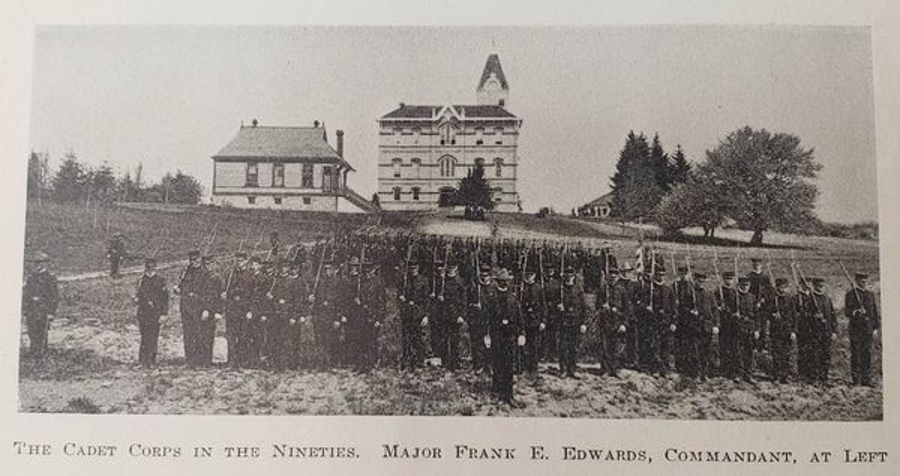
 Oregon State University has a long and proud history of military training and excellence. Since 1872, the U.S. Military has had a relationship with what was then called Corvallis College, and students have been involved with various practices and programs since its partnership, such as the ROTC program and numerous military tournaments and drilling competitions throughout the life of this partnership.[xi] During the Spanish War of 1898, the college trained many soldiers and officers to fight: the start of a proud tradition of students at what is now Oregon State University serving their country through military service.[xii] The college became so proficient at supplying trained individuals to the service that in 1917 the War Department acknowledged it as a “distinguished” institution.[xiii] From 1911 into at least the 1930s the military regularly held tournaments at Oregon State, giving students the opportunity to participate in events that showcased their military training and even win cash prizes.[xiv] This extreme dedication to supplying trained individuals to the military earned the college the nickname “The West Point of the West.”[xv] During WWII, the institution was instrumental in training cadets for military service. The institution hosted and trained 4812 cadets (Junior officers) who were on campus through the Army Specialization training program—more than any other non-military institution.[xvi] And many students such as William Bartlet Jr. voluntarily enlisted, along with students who enter the service today and are continuing this tradition of dedication and proud sacrifice.[xvii] The ROTC continues to recruit and send students into the military: well-trained and ready to represent the proud legacy of service at Oregon State University.

Third Detachment at “Retreat” outside Strand Hall, which would have been built just three years previous (May 9, 1916).[xviii]

This photo is from a pamphlet on military history at OSC, published by the Agricultural College on Dec 9, 1921.[xix] It displays the Corps of Cadets training at OSC. At that time, one of the uniforms they were wearing would have cost $16.[xx]

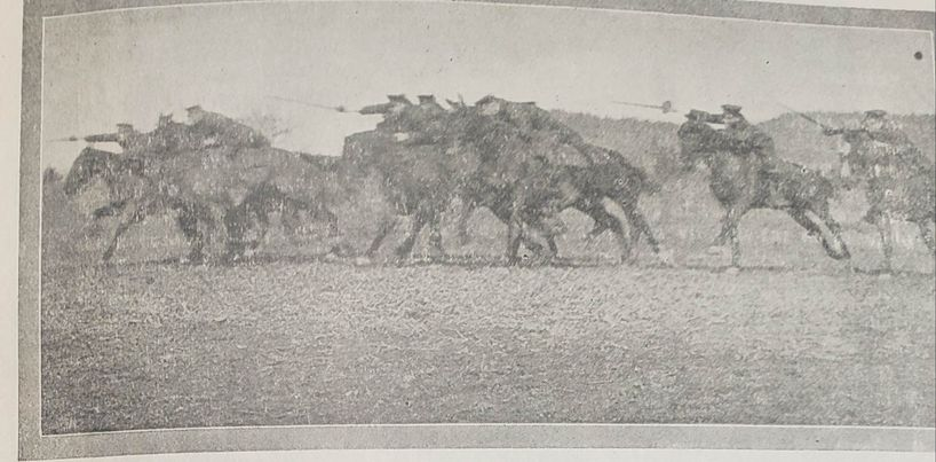
This photo is from a pamphlet (May 29, 1926) announcing an upcoming military tournament at OSC, shows a Pony Express Race, an event in which four teams of three from each cavalry unit compete. This event plays out a lot like a baton pass relay race, where they have a mailbag that they pass to the next person and so on; the first team to get the mailbag across the finish line wins.[xxi]

Above left: William H. Bartlett Jr. Above right: Colonel William H. Bartlett Sr.

Next Memorial Day, if you have no one else to remember, remember them: the brave Americans who died fighting in a distant land.


[i] “BARTLETT, William H Jr.,” Fields of Honor Database, accessed May 25, 2023. https://www.fieldsofhonor-database.com/index.php/en/american-war-cemetery-margraten-b/50175-bartlett-william-h-jr. Letter from Colonel William H. Bartlett to OSC president A.L. Strand, February 12, 1946, Special Collections and Archives Research Center (hereafter SCARC) Oregon State College History of World War II Project Records (MSS ODCWW2), Box 1, Folder titled “Completed war service record forms 1940-1946 Agee-Kirk.”

[ii] “William Bartlett – Recipient -.” Military Medals Database: Find Recipients of U.S. Honors, accessed May 25, 2023. https://valor.militarytimes.com/hero/86173.

[iii] LYONSJ9, “Uniform of Colonel William H. Bartlett,” U.S. Militaria Forum. last modified December 7, 2020, https://www.usmilitariaforum.com/forums/index.php?/topic/350806-uniform-of-colonel-william-h-bartlett/.; “William Bartlett”, Silver Star.

[iv] “William H J Bartlett Jr.” Honor States Website, accessed May 24, 2023, https://www.honorstates.org/profiles/103360/.

[v] “William Bartlett Jr..” (Honor States).

[vi] “Letter from Colonel H. Bartlett to A.L. Strand,” 1.

[vii] “Letter from Colonel H. Bartlett to A.L. Strand,” 1.

[viii] “Letter from Colonel H. Bartlett to A.L. Strand,” 2.

[ix] James Tobin. “The Campus at War.” University of Michigan Heritage Project, accessed June 7, 2023, https://heritage.umich.edu/stories/the-campus-at-war/.

[x] “College Life During World War II Based on Country’s Military Needs,” The Harvard Crimson, December 7, 1956, https://www.thecrimson.com/article/1956/12/7/college-life-during-world-war-ii/.

[xi] “History of the Military Department,” Oregon State Agricultural College Pamphlet, 7, stamped December 9, 1921, SCARC Memorabilia Collection, Box 106, Folder 17.

[xii] “History of the Military Department,” 9.

[xiii] “History of the Military Department,” 13.

[xiv] “Military Tournament of the Corps of Cadets O.A.C.,” 5, May 29, 1923, and “Military Tournament” January 21, 1911, SCARC: Memorabilia Collection, Box 106, Folder 17.

[xv] Department of Naval Science, accessed May 29, 2023, https://nrotc.oregonstate.edu/.

[xvi] Larry Landis, “Oregon State University,” The Oregon Encyclopedia, accessed June 1, 2023, https://www.oregonencyclopedia.org/articles/oregon_state_university.

[xvii] Luther Cressman, “War Service Record – World War II – Oregon State College,” February 12, 1946, SCARC, History of World War 2 project, (MSS ODCWW2). Box 1, folder 1.

[xviii] Pamphlet titled “Oregon Agricultural College, Education for Enlisted Men,” December 15, 1918, SCARC Memorabilia Collection, Box 106, folder 17.

[xix] “History of the Military Department,” 8.

[xx] “History of the Military Department,” 8.

[xxi] “Military Tournament of the Corps of Cadets O.A.C.,” 3. May 29, 1926. SCARC: Memorabilia Collection, Box 106, folder 17.

[xxii] “William Bartlett Jr.” (Honor States).

[xxiii] LYONSJ9, “Uniform of Colonel William H. Bartlett.”

How Victory Was Won at Oregon State College.

During spring term Dr. Kara Ritzheimer’s History 310 (Historian’s Craft) students researched and wrote blog posts about OSU during WWII. The sources they consulted are listed at the end of each post. Students wrote on a variety of topics and we hope you appreciate their contributions as much as the staff at SCARC does!

This post was written by Garrett Workinger.

Although battles and military victories may dominate histories of WWII, it was—at its core—a war of resources. As the United States scrambled to react to its involvement in the global crisis of WWII, many economic and cultural changes came about in the name of winning the war effort. The war effort on the domestic front created a national culture of conserving, creating, and rationing valuable resources such as food and raw materials. Communities, counties, cities, and universities across the nation became deeply involved in the domestic war front. Oregon State University (then Oregon State College) took quick action to help relieve the demand for resources that the nation felt. OSC and its extension program aided the war effort by promoting student and state involvement in Victory Gardens, food self-sufficiency, and raw material collection.

While looking through wartime documents preserved in Oregon State University’s Special Collections and Archives Center, I stumbled upon an Oregon State Extension Bulletin article located within a pamphlet subtitled “A Wartime Emergency Handbook for Community and Neighborhood Leaders.” Printed in 1943, the pamphlet was created to teach Oregon residents about how to handle food resources at home.  At the top of the front page it states, in large letters “Victory Begins at Home.”[i] OSU Extension Service created this document to inform the local community about what they should grow in their own gardens so that rations could be reserved for the war effort. The article emphasizes Oregonians’ need to be self-sufficient at home in order to save commercially packaged goods for the troops overseas. This publication informed readers about a variety of topics, including how much to ration and what food to grow or store. For example, the bulletin stated that a family of five needed to store 1200 pounds of vegetables and 25o pounds of fruit for the year 1943.  Other bulletins went into detail about how to grow a Victory Garden, or even how to can and preserve the produce that had been grown.

OSC Extension Bulletin 615 is 6 pages long; this is the first page. Federal Cooperative Extension Service, Oregon State College, 1943, “Victory Garden and Family Food Supply,” Corvallis, Or. Federal Cooperative Extension Service.

This OSC Extension Bulletin is part of a larger collection of bulletins that OSC Extension Services—still an important component of Oregon State University—has issued throughout its long existence. The OSC extension program was created in 1914 by the Smith-Lever Act which provided federal funding to land grant universities in order to further research in agriculture, home economics, and governmental policy.[ii] During WWII the OSC Extension Service printed these informational bulletins regularly. They contained information that the general public could use to expand their knowledge about agricultural topics and updated Oregonians about the country’s food and resource needs.

The Extension Service’s wartime bulletins provide a window into OSC’s involvement in the Victory Garden Program. The Victory Garden Program was a national movement created by the U.S. Department of Agriculture. Its goal was to increase the production of healthy food for the civilian population, as well as allow the troops to use the majority of commercially packaged food. Community gardens were often encouraged to people in cities who did not ample space to grow a productive garden. People in rural areas, or people who had farms, were urged to start their own Victory Garden on their own property. Victory Gardens could also take the form of a school garden.

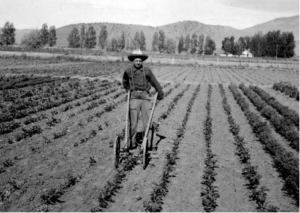
The Victory Garden program was popular all over Oregon. “Man working in a Victory Garden, Klamath County Oregon, 1942,” OSU Special Collections & Archives Research Center, https://oregondigital.org/concern/images/df70cz48w

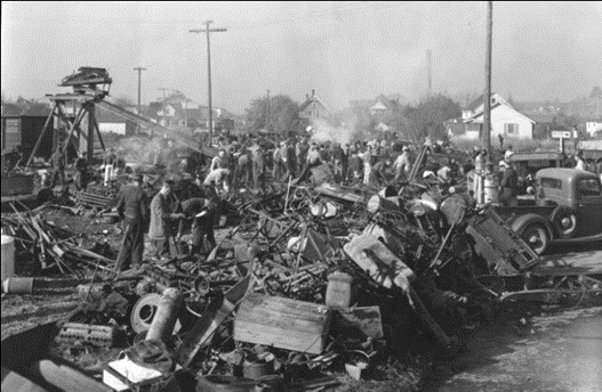
OSC used the Extension Program to encourage Oregonians living in cities and rural communities to plant their own Victory Gardens. The Victory Garden Program at Oregon State College was part of the larger victory movement at Oregon State that included a number of different Victory Programs. Oregon State was involved in 267 different wartime Victory Programs that were created to help the war effort. Aside from increased food production through the Victory Gardens, these programs focused on collecting raw materials needed for wartime production such as rubber and metal, increasing agricultural productivity, and researching the nutrition people needed.[iii] For example, the OSU Extension Service provided charts for families that laid out exactly the amount of food they would need in a year so families could preserve, can or freeze, the estimated amount they would use in a year.[iv]

The Victory Gardens and nutritional information were a significant part of Oregon State College’s agricultural Extension Service. The 1941-1942 Biennial Report of Oregon State College outlined five “broad fronts” that the OSC wartime extension programs were working on. The third “front” was the need to teach nutrition and home management to rural and farm homes.[v] The OSC Extension Service acted on this front by publishing curriculum such as a Food for Victory program for Marion County Schools. The curriculum’s objective was to provide children with an understanding of the contributions Oregon farmers were making toward the war through food production. The program provided teachers with songs, class activities, and stories they could use in the classroom.[vi] Curriculum and influence on rural homes apparently worked. By 1943, 90 percent of Oregon farms were cultivating Victory Gardens.[vii]

Victory Gardens were part of a national Victory Program movement. The National War Food Administration, along with the United States Department of Agriculture, initiated the Victory Garden Program. The Victory Gardens were a large part of the government’s WWII propaganda posters.[viii] These posters were distributed nationally with the hopes of bringing attention and support to different war efforts. Even the Science News-Letter, a national publication, provided readers with important Victory Garden information in 1943. The letter outlined the importance of joining a community Victory Garden, or if you had ample space, starting a Victory Garden at home. Also, the letter stated that gardens should allow plenty of space for the “most important soldiers in the Victory Vegetable army”—tomatoes.[ix]

Nationally, just as in Oregon, there was a sense of urgency in educating the youth about home gardening, self-sufficiency, and rationing. Schools from all over the nation participated in the Victory Garden Program by creating community gardens. For example, in early 1942, soon after America’s entry into war, teachers from Highland Park Schools in Michigan, aided by the Michigan Recreation Department, started a Victory Garden program for school students throughout the state. The program started because the teachers believed that home gardens were not enough to meet the needs of the war, and community gardens were needed in Highland Park. Over 100 students had an opportunity to work on their own gardens that were 4ft by 24 ft.[x] The production of food, and education of the youth in self-sufficiency skills, were a priority all over the U.S.

WWII Propaganda Poster. This is one of many nationally printed posters that were meant to influence the public to partake in the war effort. “Your victory garden counts more than ever!” United States War Food Administration, https://digital.library.illinois.edu/items/a9005460-0d92-0135-23f6-0050569601ca-8

While Extension Services played a lead role in championing Victory Gardens at OSC and throughout Oregon, faculty and students throughout the college contributed to these Victory Programs. Victory Programs were any program that was organized to aid in the collection of resources or materials for the war effort. The Oregon State Barometer encouraged female students to donate their rubber and metal beauty items because “any little thing you give will help to win the war.”[xi] The need for metal was so extensive during the war effort that shop owners closed down their businesses to help with a scrap metal drive. OSC class presidents requested all of the men’s living group presidents to bring five men each to the drive that occurred in October of 1942 in Corvallis. The students were challenged by Dave Buam, an organizer of the scrap drive, and chairman of the Oregon Defense Council, to try to load more scrap metal than the working-class men who were also helping with the scrap metal drive.[xii]

Students and staff took great pride in their contributions to these programs. For example, Dorothy Gerling noted in the 1943-1944 Coed Code how all activities on campus were “directed toward the Victory Program.”[xiii] The Coed Code was an annual OSC women’s publication. OSC faculty member Dean Salser likewise told the 1944 Beaver, the college yearbook, that he had no time for other hobbies because “teaching and his victory garden have occupied most of his time.”[xiv]

Scrap metal drives were a common way to get many people from the community involved in the war effort. “Scrap metal collection day in Corvallis, Oregon,” 1942. OSU Special Collections & Archives Research Center, https://oregondigital.org/concern/images/df70ct058

Oregon State College’s efforts on the home front during WWII were extensive and successful.  The Victory Gardens and other war effort programs that the OSC Extension Service organized helped create a culture of production, self-sufficiency, and with the local community. OSC was a small part of the national war effort movement, but its programs embodied the goals and culture of the domestic front that aided the Allies in winning the war. 


[i] “Victory Garden and Family Food Supply” in Oregon State College Extension Service Bulletin 551-650 (Corvallis: Oregon State Systems of Higher Education, 1943), Extension Bulletin 615.

[ii] Michele Scheib, “OSU Extension History,” OSU Extension Service, January 25, 2023, https://extension.oregonstate.edu/about/osu-extension-history

[iii] Oregon State College President’s Biennial Report, 1943-1944, pages 42-43, OSU Special Collections and Archives Research Center, https://oregondigital.org/concern/documents/fx71d3919  

[iv] Mabel C. Mack, “Planning Your Families Food Supply” in Oregon State College Extension Service Bulletin 551-650 (Corvallis: Oregon State Systems of Higher Education, 1944), Extension Bulletin 588.

[v] Biennial Report of Oregon State College, 1941-1942, page 98, OSU Special Collections and Archives Research Center, https://oregondigital.org/concern/documents/fx71d395d

[vi] OSC Extension Ag. Economics, April 1943, “Food for Victory: A unit of Work for the Schools of Marion County, Oregon,” OSU Special Collections and Archives Research Center, Extension Service Records 1903-2011, RG 111, SG 2, X, Projects, Extension Specialists.

[vii] Ibid.

[viii] Terrence H. Witkowski, “World War II Poster Campaigns: Preaching Frugality to American Consumers,” Journal of Advertising 32, no. 1 (2003): 76.

[ix] Frank, Throne, “Victory Gardens,” The Science News-Letter 43, no. 12 (1943): 186.

[x] M. A. Russell “Highland Park’s School Victory Gardens,” The American Biology Teacher 6, no. 8 (1944): 171–74.

[xi]  “Clean Your Drawers, Gals for Uncle Sam Takes All,” Oregon State Barometer, October 7, 1942: 3, OSU Special Collections and Archives Research Center, https://oregondigital.org/concern/documents/8k71nh47k

[xii] “Merchants Set to Aid Campus Scrap Drive,” Oregon State Barometer, October 20, 1942: page 1, OSU Special Collections and Archives Research Center, https://oregondigital.org/concern/documents/8k71nh87j

[xiii] Coed Code, 1943-1944, page 6, Historical Publications of Oregon State University, OSU Special Collections and Archives Research Center, https://oregondigital.org/concern/documents/fx71cm43k

[xiv] The Beaver Yearbook, 1944, page 92, OSU Special Collections and Archives Research Center,  https://oregondigital.org/concern/documents/zk51vh18n

What the students went through: Japanese-American Internment in WWII.

During spring term Dr. Kara Ritzheimer’s History 310 (Historian’s Craft) students researched and wrote blog posts about OSU during WWII. The sources they consulted are listed at the end of each post. Students wrote on a variety of topics and we hope you appreciate their contributions as much as the staff at SCARC does!

This post was written by Erin Phillips.

In the American narrative of World War Two, there are a few common story beats that persevere today. Japan and Germany dragged the United States into the war kicking and screaming. The United States assumed her position among the allies, harnessing her industrial might and manpower to defeat evil fascist regimes, liberate Europe and Asia, and secure democracy. According to this popular retelling, American citizens could be proud of this good and just war, fought for morally correct reasons.

While this narrative holds some truth, it does not tell the whole story. In their desire to defeat the Empire of Japan, American leaders sacrificed the values of freedom, liberty, and the pursuit of happiness for their citizens, especially American citizens of Japanese descent. The American government’s internment and illegal incarceration of Japanese-Americans impacted the lives of approximately 110,000 Japanese-Americans, including the students and alumni of Oregon State College (later Oregon State University). The specter of discrimination, racism, and doubts about their loyalty as United States citizens loomed large over the lives of these citizens. And their stories and experiences fill in the gaps of the typical American narrative, providing us a more comprehensive accounting of the US and Oregon State University during World War Two.

Firstly, it’s important to know who these citizens were. In 1941, Japanese-Americans were most commonly the children of immigrants or immigrants themselves. First-generation immigrants, those born in Japan, were referred to as Issei. The term Nisei applied to second-generation immigrants, those born in the United States to Issei parents. Nisei made up the majority of the Japanese-American population in 1941.[i] Japan’s attack on the US on December 7, 1941 raised questions about the loyalty of Issei and Nisei.

What does one do when their loyalty is in question? The document to the right is a letter that thirty-six Japanese-American students and alumni at Oregon State College sent to interim OSC President F. A. Gilfillan, on Thursday, December 11, 1941, four days after Japan’s December 7, 1941 attack on Pearl Harbor. Their signatures are visible below the body of the letter, a reminder that each one of these signatures belongs to a person—a student or alumni of Oregon State College. The Special Collections and Research Center (SCARC) has preserved this typed and signed letter within the records of the OSU’s President’s Office. Additionally, the Oregon Multicultural Archives (OMA) blog has provided a transcript of the letter and its signatories.[ii]

The letter explores the potential ramifications of Japan’s attack on the psyche and safety of Japanese-American students at OSC. The authors argued that Japanese-American students should not be treated differently because of Japan’s actions. They also stressed their “unswerving loyalty to our country, the United States of America, and to all her institutions.” The students and alumni explained how they have found peace of mind, friendships, and educational inspiration at Oregon State even as they stressed their readiness to prove their mettle as American citizens in the war.

Historian William Robbins observes that World War Two “rent asunder normal routines on the Oregon State College campus.”[iii] This reality was one Japanese-American students at Oregon State College found themselves in following Japan’s attack. During the 1941-42 academic year, 36 Japanese-American students and alumni called OSC their academic home. The office of the registrar has preserved the names and class standings of these thirty-six students through a list compiled for winter term of 1942.[iv]  While that number might seem small, more students with Japanese ancestry were enrolled at OSC at the time than at the University of Oregon and thus, OSC had the largest population of Japanese-American students in Oregon.

The outbreak of war between Japan, the country of their ancestors, and the United States, the country of their birth, deeply impacted these Japanese-American students. Political Science instructor and Associate Dean of Men Dan W. Poling recalled in later years that during a morning lecture he delivered on December 8, 1941, two Japanese-American students, “had their heads down and they never looked up. I know they were very distraught.”[v] A Tuesday, December 9, 1941, editorial in the Oregon State Barometer similarly contemplated these students’ experiences. Titled “The Unfortunate,” the author speculated about the impact these global events might have on Japanese-Americans, specifically, OSC students.[vi] The author argued that neither the university nor the student body should treat these Japanese-American students differently because of Japan’s actions. The author reminded readers that these students were American; the three-paragraph editorial referenced their American citizenship four separate times.

The writing of the loyalty letter to interim OSC President F.A. Gilfillan had a profound effect on OSC faculty and staff. They immediately realized how the war had shattered the normal lives of their Japanese-American students, and felt moved to console them and respond. Glenn A. Bakkum of the Department of Sociology sent a letter to interim OSC President Gilfillan on December 14, 1941, in response to the loyalty letter that Gilfillan received three days prior. Bakkum urged Gilfillan to respond to the individuals who had signed the loyalty letter and thereby alleviate and calm their fears.[vii]  Although it is unclear whether he was responding to Bakkum’s suggestion, Gilfillan did formulate a response. On December 18, 1941, his office sent a letter to each signatory.

In the letter, pictured above, Gilfillan empathized with Japanese-American students’ plight and contrasted it with the difficult situations Americans had faced before. Gilfillan noted that the college was honored by these students’ and alumni’s declaration of loyalty to the United States of America and Oregon State College.[viii]

These sentiments of loyalty, sympathy, and appreciation for the Japanese-American students at Oregon State College in the opening months of the war reflect a stark reality. While the outbreak of war indeed rent asunder the normalcy of life at OSC, the opinions and thoughts the student body and faculty expressed about the extreme hardship their Japanese-American peers faced demonstrates something remarkable. While Japanese-Americans across the nation encountered racism and harassment, the students and faculty at Oregon State viewed these students as friends and colleagues, not as enemies.

On February 19, 1942, President Roosevelt signed Executive Order 9066. This order authorized the secretary of war and military commanders “to prescribe military areas… from which any and all persons may be excluded.”[ix] While the order did not specifically name Japanese-Americans as the persons to be excluded, it was clear from the choice to not incarcerate Italian or German-Americans that this order would be exclusively targeting Japanese-Americans. The key proponents of this executive order and the mass incarceration were Western Defense Commander General John L. DeWitt and Assistant Secretary of War John J. McCloy. As a result, approximately 110,000 Japanese-Americans living on the west coast were eventually removed and placed in internment camps further east.[x] On March 2, 1942, DeWitt issued Public Proclamation No. 1, designating the west coast into military areas and excluding all persons of Japanese ancestry from these areas.[xi] The Western Defense Command (WDC) and the Wartime Civil Control Administration (WCCA) controlled and organized the implementation and evacuation of Japanese-Americans from designated military areas. By June 6, 1942, all Japanese-Americans had been forcibly removed from Military Area No. 1—which included Oregon, to assembly sites, such as the Portland Assembly Center.[xii]

Some university presidents pushed back against these orders and restrictions. For example, University of California President Robert Sproul spoke for many university presidents when he argued that these students should be allowed to continue their education despite the imminent internment order.[xiii] Interim OSC president Gilfillan similarly questioned the new restrictions, sending an inquiry to General DeWitt, on the subject of Japanese American students.[xiv] Gilfillan asked whether Japanese-American students would be allowed to study in the library past the 8:00pm curfew that the military had imposed on Japanese-American citizens, a request General DeWitt promptly denied.[xv]

The experiences of OSC students were similar to those of university students across the country, all of whom confronted wartime measures that restricted their freedom. Executive Order 9066 permitted the US government, the Western Defense Command, and the Wartime Civil Control Administration to remove “all citizens of Japanese ancestry from the Pacific Coastal Region.”[xvi] The Oregon State Barometer published an article on May 26, 1942 that explained that all Japanese-Americans would be evacuated. The article, titled “Japanese are ordered form 11 counties,” explored the effects of Civilian Exclusion Orders No. 87 and No.91. These required all citizens of Japanese-descent to report to civil control stations for eventual relocation.[xvii] The closest assembly center was the Portland Assembly center, located on the site of Pacific International Livestock Exposition Pavilion.[xviii] The lives of not just OSC’s student population, but also Japanese-Americans across the nation, changed irreversibly in the coming months.

Individual stories help us to better understand the impact these orders had on Japanese-American citizens. One young woman who signed the loyalty letter was recent OSC graduate Molly (Kageyama) Maeda—the only alumnus to do so. Molly (Mariko) Kageyama was born on November 23, 1919, in Dee, Oregon to Yasuta and Ichino Kageyama. She was the second child of the Kageyama family; she had two sisters and one brother.[xix] All pictures in the following section have been graciously provided by the Milton and Molly (Kageyama) Maeda Collection through Densho, a digital archive that records and preserves the stories of Japanese-Americans during WWII. Molly and her siblings were Nisei, meaning the second-generation Japanese-Americans born in the United States to Issei parents.

In 1937, Molly graduated from Hood River High School and began attending Oregon State College. One reason she chose OSC, she later explained, was because the university had given her a scholarship. Another reason was that her sister, who had also received a scholarship, was already enrolled there as a student.[xx] During a 2014 interview, Molly recounted in her own words, with a smile, that she “liked it (Oregon State) real well. I studied hard…”[xxi] During her college years, Molly made connections with the small community of Japanese-American students, connections that can be seen in the photo below.

“Group of three women” (ddr-densho-287-29), Densho, Milton and Molly (Kageyama) Maeda Collection, https://ddr.densho.org/ddr-densho-287-13/

Dated 1939, this photograph shows Molly, Lena, and presumably their fellow friend and student Emi, outside of what is now known as Furman Hall on the OSC campus.[xxii] Molly eventually met another Japanese-American student at OSC by the name of Milton Maeda. Molly and Milton were engaged by early 1942 and married later that year.

“Graduation Portrait of Molly Kageyama” (ddr-densho-287-27), Densho, Milton and Molly (Kageyama) Maeda Collection, https://ddr.densho.org/ddr-densho-287-27/

Molly graduated in June 1941 with Phi Kappa Phi honors. Following graduation, she later worked in the OSC registrar’s office. Japan’s attack on Pearl Harbor on December 7, 1941 cut short her employment.[xxiii] Molly left OSC a few months after the attack, during a moment of uncertainty for Japanese-Americans. She returned home to Hood River to be closer to her parents and siblings. Molly and her fiancé, Milton Maeda, traveled to the Portland Assembly Center on May 12, 1942, in accordance with the restrictions placed on Japanese-Americans by Western Defense Command. Milton and Molly married on May 19, 1942, at the Portland Assembly Center, the first such marriage performed inside a detention center for Japanese-Americans.[xxiv] Below is the wedding photo of Milton and Molly Maeda, taken on May 14th days before the proper wedding ceremony.[xxv]

In September 1942, officials within the Western Defense Command (WDC) and the Wartime Civil Control Administration (WCCA), transferred Milton and Molly Maeda from the Portland Assembly Center to the Minidoka Internment Camp in southern Idaho.[xxvi] Milton and Molly remained there for approximately 13 months before obtaining permission from the War Relocation Authority (WRA) to relocate to Milwaukee, WI.

It is hard to quantify how much Molly’s life changed during the first two years of the war, as did the lives of approximately 110,000 Japanese-American citizens. Molly’s life was uprooted by war and the internment of Japanese-Americans. Instead of having a wedding and honeymoon and continuing her employment at OSC, she was forced to relocate to an internment camp and endure numerous hardships. The wartime restrictions and disruptions that Japanese-Americans including Molly Maeda, went through, contrasts sharply with the lives they lived prior to WWII.

After eighty years, the experiences of Japanese-American citizens during World War Two are as relevant as ever in the American story. For many years, the general public neglected the experiences of these citizens, and in some cases outright denied their truths. Even when historians or the public examine the narrative of America’s role in World War Two, the experiences of Japanese-Americans are relegated to a footnote. It is easy to forget and distance ourselves from these events. However, we must strive to always remember that each one of the approximately 110,000 Japanese-Americans were as human as you and me. They were mothers, fathers, sons, daughters, students, and teachers. The people incarcerated in this racist effort were American citizens, as the decision to not incarcerate German or Italian-Americans implies prejudice rooted in racism guided American decision-makers.

The moment citizens feel the need to prove their innocence and loyalty–as these OSC students had–just in order to not be viewed as the enemy, we need to reflect on our own biases and how modern society perpetuates them. In a time when we are still dealing with the consequences of systematic and perpetual racism, the burden falls on us to reject racism and prejudice, and to never forget the victims of this injustice.


[i] Valerie Matsumoto, “Japanese American Women during World War II,” Frontiers: A Journal of Women Studies 8, no.1 (1984): 6, https://www.jstor.org/stable/3346082

[ii] Natalia Fernández, “OSU’s Japanese American Students during WWII,” Oregon Multicultural Archives and OSU Queer Archives (OMA & OSQA) Blog, January 30, 2013, https://blogs.oregonstate.edu/oregonmulticulturalarchives/2013/01/30/osu-jpnamer-ww2/.

[iii] William G. Robbins, The People’s School: A History of Oregon State University (Corvallis: Oregon State University Press, 2017), 145.

[iv] “List of Japanese Students – Winter Term 1942,” Oregon State College: Office of the Registrar, Winter 1942, https://oregondigital.org/concern/documents/df724m053#metadata

[v] Rebecca Landis, “Freedom Lost,” Oregon State University Alumni Magazine, (Corvallis: Oregon State University, October 1995), 15.https://oregondigital.org/concern/documents/fx71c133t

[vi] “The Unfortunate.” Oregon State Barometer, December 9, 1941: 2.

[vii] Glenn A. Bakkum, “Letter Regarding Registered Japanese American Students,” letter to F.A. Gilfillan, Oregon State University, December 14, 1941. https://oregondigital.org/concern/documents/df724m08x

[viii] F. A. Gilfillan, “Letter to the Japanese American Students,” in response to December 11, 1941 loyalty letter, Oregon State University, December 18, 1941. https://oregondigital.org/concern/documents/df724m08x

[ix] Brian Niiya, “Executive Order 9066” Densho Encyclopedia, accessed June 14, 2023. https://encyclopedia.densho.org/Executive_Order_9066/

[x] Niiya, “Executive Order 9066,” Densho Encyclopedia.

[xi] Brian Niiya “Civilian exclusion orders” Densho Encyclopedia, accessed June 14, 2023. https://encyclopedia.densho.org/Civilian_exclusion_orders

[xii] Niiya, “Civilian exclusion orders,” Densho Encyclopedia

[xiii] Robbins, The People’s School, 149.

[xiv] “Japanese Students,” Oregon State Barometer, April 4, 1942: 2, https://oregondigital.org/concern/documents/df724k71g

[xv] “Japanese Students.”

[xvi] Robbins, The People’s School, 148.

[xvii] “Japanese Are Ordered from 11 Counties,” Oregon State Barometer, May 26, 1942: 2, https://oregondigital.org/concern/documents/df724k72r

[xviii] Brian Niiya, “Portland (detention facility),” Densho Encyclopedia, accessed June 6, 2023. https://encyclopedia.densho.org/Portland%20(detention%20facility)

[xix] Molly was the second child in the family, with Mikie her older sister, with younger sister Lena (Rinako) and younger brother Bob (Yeichi).

Transcript of interview with Molly K. Maeda, interviewed by Tom Ikeda on April 17, 2014, segments 1 & 3, Densho, Milton and Molly (Kageyama) Maeda Collection, https://ddr.densho.org/media/ddr-densho-1000/ddr-densho-1000-420-transcript-46b2168a91.htm

[xx] Transcript of interview with Molly K. Maeda, segment 10, https://ddr.densho.org/media/ddr-densho-1000/ddr-densho-1000-420-transcript-46b2168a91.htm

[xxi] Transcript of interview with Molly K. Maeda, segment 11, https://ddr.densho.org/media/ddr-densho-1000/ddr-densho-1000-420-transcript-46b2168a91.htm

[xxii] “Group of three women” (ddr-densho-287-29), Densho, Milton and Molly (Kageyama) Maeda Collection, https://ddr.densho.org/ddr-densho-287-13/

[xxiii] Transcript of interview with Molly K. Maeda, segment 12, https://ddr.densho.org/media/ddr-densho-1000/ddr-densho-1000-420-transcript-46b2168a91.htm.

[xxiv] Transcript of interview with Molly K. Maeda, segment 17, https://ddr.densho.org/media/ddr-densho-1000/ddr-densho-1000-420-transcript-46b2168a91.htm.

[xxv] “Wedding portrait” (ddr-densho-287-6), Densho, Milton and Molly (Kageyama) Maeda Collection, https://ddr.densho.org/ddr-densho-287-6/

[xxvi] Transcript of interview with Molly K. Maeda, segment 18, https://ddr.densho.org/media/ddr-densho-1000/ddr-densho-1000-420-transcript-46b2168a91.htm

The Local and National Impact of Nutritional Health Programs at Oregon State College during World War II.

During spring term Dr. Kara Ritzheimer’s History 310 (Historian’s Craft) students researched and wrote blog posts about OSU during WWII. The sources they consulted are listed at the end of each post. Students wrote on a variety of topics and we hope you appreciate their contributions as much as the staff at SCARC does!

This post was written by Caitlin Patton.

In November 1942, the Oregon State Barometer published an article titled “Home Ec Schools Under Pressure,” which provides insight into the dietician and nutrition programs in Oregon State College’s (OSC) School of Home Economics.[i] Further research reveals that other departments beyond Home Economics developed programs to reach the broader Corvallis and Oregon communities. These programs reflect an increase in support from doctors and the general public for nutrition research and its practical applications during the beginning of World War II. The American government worked with universities across the country, including OSC, to develop and manage numerous programs to share information on and provide support for the nutrition of both civilians and soldiers.

“Home Ec Schools Under Pressure,” Oregon State Barometer, November 20, 1942, p 1.

This November 1942 article in the Oregon State Barometer, OSC’s student-run newspaper, reported the U.S. Army had requested “1200 additional trained dieticians” and that Dean Ava B. Milam, “who heads the [home economics] school on this campus and who is the chairman of the state committee on nutrition for defense,” shared this information at a recent Faculty Triad club luncheon. The article also described new collaborative programs between the military and the school to certify graduates as dieticians faster using apprenticeship programs. It also explained that Dean Milam hoped to apply the apprenticeship model to other subjects.[ii] This article shows how the army was attempting to recruit dieticians, but it does not explain if the army was asking for recruits directly from the home economics school at OSC or from colleges in general.[iii]  Additionally, some quotes from Dean Milam imply that the increased recruitment of dieticians was the result of a shift in public opinion towards concern about diet for civilian workers as well as soldiers.[iv] This article raises many questions about the forces and factors which influenced the development of the dietician program at Oregon State College.

Primary sources demonstrate the collaborative efforts of the dieticians and nutritionists within OSC’s Home Economics Department and the American government during World War II to improve the nutrition of both soldiers and civilians. Wartime articles sharing the experiences of recent OSC graduates showcased the work these dieticians were doing to help soldiers. For example, two articles from the Barometer, both printed in 1944, list several OSC graduates from the home economics department who were working as dieticians for the army.[v] Additionally, the Oregon State Yank, a magazine for OSC alumni serving in the armed forces, published articles that recounted the experiences of graduates serving as dieticians in various military theaters. One of these articles, titled “SHE-I Observations,” named various alumni working as dieticians at Fort Lewis and McChord Field, both in Washington. One OSC-trained dietician was even working with troops stationed in England.[vi] Another article titled “The Feminine Front” introduced readers to Roberta “Becky” Beer, a recent alum who had “answered the urgent call for dieticians.”[vii]

Home Economics also worked with government organizations to change the nutrition habits of civilians. In 1943, Dean Milam served as chairman of the Oregon Nutrition Committee for Defense. In this position, she took an active role in organizing numerous policies and programs meant to provide nutritional information and support to American families.[viii] As the Dean of the Home Economics School, Milam may have also been responsible for adding the class “Nutrition for National Defense” in the 1942-1943 class catalog.[ix] A survey of prior catalogs reveals this was a new class. Although details about course content are unavailable, it’s likely that Milam and others hoped that this new course would communicate useful information to women who might one day serve in the army or whose work might support their local communities.[x] Mabel C. Mack, an OSC graduate from the School of Home Economics also published several pamphlets with the Oregon State College Extension Service on food supply, nutrition, and management during wartime for families.[xi] Mack had completed a PhD at OSC in 1939 and may have served on Milam’s Oregon Nutrition Committee for Defense.[xii] These documents show how the women of the School of Home Economics contributed to the national conversation about the nutritional well-being of soldiers and civilian families.

The first page of Mabel C. Mack’s “Food to Keep You Fit,” adorned with patriotic decorations, provides information about the author and publisher. The second page of “Food to Keep You Fit” lists daily amounts for different food categories and pictures of those categories. The third page of “Food to Keep You Fit” provides readers with a recommended pattern of food categories for breakfast, dinner, and supper or lunch. The fourth and final page of “Food to Keep You Fit, lists weekly amounts of different food categories as well as an image of a red shield with the text “Defend Your Health With Protective Foods.” Available in Special Collections & Archives Research Center, hereafter referred to as SCARC, Oregon State University Libraries, Oregon State College Extension Service Bulletin (Corvallis: Oregon State System of Higher Education, 1941), Extension Bulletin 562.

OSC’s School of Agriculture and Extension Services also played a key role in wartime food and nutrition programs. Perhaps taking a page from the School of Home Economics, faculty authored pamphlets focused on food management during the war. For example, in 1943 A. G. B. Bouquet, Professor of Vegetable Crops, printed a pamphlet on growing a vegetable garden.[xiii] The next year, Thomas Onsdorff, an Associate Professor of Food Industries, and Lucy A. Case, a nutritionist from Extension Services, together published a guide on canning vegetables, fruits, meats, fish, and more. It also listed other resources published by OSC and the U.S. Department of Agriculture that families could easily request from their County Extension Office or OSC’s Home Economics Extension Service if they wanted more information.[xiv]

OSC and Extension Services also supported the Victory Garden Program. W. A. Schoenfeld, Dean and Director of Agriculture, presided over a conference, held in the Memorial Building on December 4th, 1942, for representatives of local branches of the Victory Garden Program in Oregon. Some of the featured guests included economists and horticulturists from Extension Services as well as state officials.[xv] And in an effort to share their expertise with the community, OSC faculty reached out to local schools. Professor Bouquet (noted above) developed a popular victory garden class for high school students.[xvi] The class included a lecture that guided students on which crops would be best to grow for canning and on how to maximize the amount of produce grown in their gardens.[xvii]

The various nutrition programs that OSC faculty developed and managed reflect a broader effort during WWII to improve nutrition for both soldiers and civilians. As the army began to draft soldiers, it also conducted surveys on the health of recruits and found that 25% of conscripts displayed symptoms of prior or recent malnutrition.[xviii] In 1940, President Roosevelt called for a National Nutrition Conference for Defense on the grounds that “Fighting men of our armed forces, workers in industry, the families of these workers, every man and woman in America, must have nourishing food. If people are undernourished they cannot be efficient in producing what we need in our unified drive for dynamic strength.”[xix] The first Nutrition Conference for Defense, held in 1941, stressed the importance of addressing national nutrition through programs across different levels of government, from the national down to the local.[xx] Although the Victory Garden Program was managed at the local level, it had a great national impact: families across the country locally grew 8 million total tons of food in a single year.[xxi] The national and state governments also developed programs such as free school lunches and food stamps to support struggling families.[xxii] The U.S. Congress passed the Tydings Amendment in 1942, which granted farm workers an exemption from the draft so that they could continue to produce necessary foods throughout the war.[xxiii] The U.S. Army, meanwhile, designed the dietician apprenticeship program mentioned in the 1942 Barometer article to secure nutrition support for both military and civilian hospitals.[xxiv] University students who completed an approved course could apply to serve as an apprentice at a military or civilian hospital for six months before serving another six months at another U.S. Army hospital. The army also developed another program to recruit dieticians from unrelated undergraduate programs.[xxv] These national nutrition programs benefited both civilians and the military greatly.

Student dieticians filling out forms for food requisition and special diets orders. Available in Journal of the Academy of Nutrition and Dietetics 114, no. 10 (September 22, 2014): 1648–62, https://doi.org/10.1016/j.jand.2014.08.001. Photo courtesy of The Alan Mason Chesney Medical Archives of The Johns Hopkins Medical Institutions.

The November 1942 Barometer article “Home Ec Schools Under Pressure” reveals the important role that Oregon State College faculty and alumni played in wartime efforts to promote nutrition across the United States and in the military. The graduates of the home economics school worked with soldiers as dieticians and shared resources with civilian families. The other departments of OSC also reached out to the Oregon community with guides and education programs. The nutrition programs of Oregon State College, from the dietician apprenticeship program to the Victory Gardens Program, contributed to the national efforts to improve the nutrition of Americans at home and soldiers abroad.


Notes:

[i] “Home Ec Schools Under Pressure,” Oregon State Barometer, November 20, 1942: 1.

[ii] “Home Ec Schools Under Pressure,” 1.

[iii] “Home Ec Schools Under Pressure,” 1.

[iv] “Home Ec Schools Under Pressure,” 1.

[v] “Armed Services Claim Co-eds,” Oregon State Barometer, May 19, 1944: 3, https://oregondigital.org/concern/documents/8k71nk56z; “YANKEE DOODLE DANDIES…,” Oregon State Barometer, March 7, 1944: 1, https://oregondigital.org/concern/documents/8k71nk402.

[vi] “SHE-I Observations,” Oregon State Yank, November 1944:14, https://oregondigital.org/concern/documents/fx719t25j.

[vii] Jayne Walters Latvala, “THE FEMININE FRONT,” Oregon State Yank, November 1944: 14, https://oregondigital.org/concern/documents/fx719t25j.

[viii] “Minutes of Meeting, Oregon Nutrition Committee for Defense,” June 25, 1943, https://sos.oregon.gov/archives/exhibits/ww2/Documents/services-nut3.pdf.

[ix] “Foods and Nutrition,” in Oregon State College CATALOG 1941-42 (Eugene: Oregon State Board of Higher Education, 1941), 342-345.

[x] “Foods and Nutrition,” in Oregon State College CATALOG 1942-43 (Eugene: Oregon State Board of Higher Education, 1942), 343.

[xi] Mabel C. Mack, “FOOD To Keep You Fit,” in Oregon State College Extension Service Bulletin 551-650 (Corvallis: Oregon State System of Higher Education, 1941), Extension Bulletin 562; Mabel C. Mack, “Use Milk, Eggs, and Milk Products,” in Oregon State College Extension Service Bulletin 551-650 (Corvallis: Oregon State System of Higher Education, 1941), Extension Bulletin 583; Mabel C. Mack, “Planning YOUR FAMILY”S FOOD SUPPLY,” in Oregon State College Extension Service Bulletin 551-650, (Corvallis: Oregon State System of Higher Education, 1942), Extension Bulletin 588; Mabel C. Mack, “Planning YOUR FAMILY”S FOOD SUPPLY,” in Oregon State College Extension Service Bulletin 551-650 (Corvallis: Oregon State System of Higher Education, 1943), Extension Bulletin 616.

[xii] Mabel Clair Townes Mack, “A Study of the Kitchen Sink Center In Relation to Home Management,” (PhD diss., Oregon State College, 1939), 1; “Minutes of Meeting,” 1.

[xiii] A. G. B. Bouquet, “Farm and Home VEGETABLE GARDEN,” in Oregon State College Extension Service Bulletin 551-650 (Corvallis: Oregon State System of Higher Education, 1943), Extension Bulletin 614.

[xiv] Lucy A. Case and Thomas Onsdorff, “Home Food Preservation by Canning * Salting,” in Oregon State College Extension Service Bulletin 551-650 (Corvallis: Oregon State System of Higher Education, 1944), Extension Bulletin 642.

[xv] “Victory Garden Heads To Convene at OSC,” Oregon State Barometer, November 25, 1942: 1, https://oregondigital.org/concern/documents/8k71nj11d.

[xvi] “Oregonian Features Bouquet in Editorials,” Oregon State Barometer, March 3, 1943: 1, https://oregondigital.org/concern/documents/8k71nj59k.

[xvii] “Victory Gardeners Hear Crop Lecture,” Oregon State Barometer, March 2, 1943: 2, https://oregondigital.org/concern/documents/8k71nj589.

[xviii] Karen Stein, “History Snapshot: Dietetics Student Experience in the 1940s,” Journal of the Academy of Nutrition and Dietetics 114, no. 10 (September 22, 2014): 1648–62, https://doi.org/10.1016/j.jand.2014.08.001, 1652.

[xix] “The National Nutrition Conference,” Public Health Reports (1896-1970) 56, no. 24 (1941): 1234, http://www.jstor.org/stable/4583763.

[xx] “The National Nutrition Conference,” 1248-1249.

[xxi] H. W. Hochbaum, “Victory Gardens in 1944: How Teachers May Help,” The American Biology Teacher 6, no. 5 (1944): 101–3. https://doi.org/10.2307/4437480, 101.

[xxii] “The National Nutrition Conference,” 1248-1249; “Minutes of Meeting,” 1.

[xxiii] Lizzie Collingham, The Taste of War (New York, NY: Penguin Group USA, 2012), 75–88, 78-79.

[xxiv] “Home Ec Schools Under Pressure,” 1.

[xxv] Stein, “History Snapshot: Dietetics,” 1650-1651.

Bibliography:

“Armed Services Claim Co-eds.” Oregon State Barometer, May 19, 1944: 3. https://oregondigital.org/concern/documents/8k71nk56z.

Bouquet A. G. B. “Farm and Home VEGETABLE GARDEN.” in Oregon State College Extension Service Bulletin 551-650, Extension Bulletin 614. Corvallis: Oregon State System of Higher Education, 1943.

Case, Lucy A. and Thomas Onsdorff. “Home Food Preservation by Canning * Salting.” in Oregon State College Extension Service Bulletin 551-650, Extension Bulletin 642. Corvallis: Oregon State System of Higher Education, 1944.

Collingham, Lizzie. The Taste of War, 75–88. New York, NY: Penguin Group USA, 2012.

“Foods and Nutrition.” In Oregon State College CATALOG 1941-42, 342-345. Eugene: Oregon State Board of Higher Education, 1941.

“Foods and Nutrition.” In Oregon State College CATALOG 1942-43, 343-345. Eugene: Oregon State Board of Higher Education, 1942.

Hochbaum, H. W., “Victory Gardens in 1944: How Teachers May Help.” The American Biology Teacher 6, no. 5 (1944): 101–3. https://doi.org/10.2307/4437480.

“Home Ec Schools Under Pressure.” Oregon State Barometer. November 20, 1942: 1.

Latvala, Jayne Walters. “THE FEMININE FRONT.” Oregon State Yank, November 1944: 14. https://oregondigital.org/concern/documents/fx719t25j.

Mack, Mabel C. “FOOD To Keep You Fit.” in Oregon State College Extension Service Bulletin 551-650, Extension Bulletin 562. Corvallis: Oregon State System of Higher Education, 1941.

Mack, Mabel C. “Use Milk, Eggs, and Milk Products.” in Oregon State College Extension Service Bulletin 551-650, Extension Bulletin 583. Corvallis: Oregon State System of Higher Education, 1941.

Mack, Mabel C. “Planning YOUR FAMILY’S FOOD SUPPLY.” in Oregon State College Extension Service Bulletin 551-650, Extension Bulletin 588. Corvallis: Oregon State System of Higher Education, 1942.

Mack, Mabel C. “Planning YOUR FAMILY’S FOOD SUPPLY.” in Oregon State College Extension Service Bulletin 551-650, Extension Bulletin 616. Corvallis: Oregon State System of Higher Education, 1943.

Mack, Mabel Clair Townes. “A Study of the Kitchen Sink Center In Relation to Home Management.” PhD diss., Oregon State College, 1939.

“Minutes of Meeting, Oregon Nutrition Committee for Defense.” June 25, 1943. https://sos.oregon.gov/archives/exhibits/ww2/Documents/services-nut3.pdf.

“Oregonian Features Bouquet in Editorials.” Oregon State Barometer, March 3, 1943, 1. https://oregondigital.org/concern/documents/8k71nj59k.

Peterson, Anne, “Dietitians Seek Military Status In Army Service.” The New York Times, October 13, 1940. https://timesmachine.nytimes.com/timesmachine/1940/10/13/94840663.html?pageNumber=60.

“SHE-I Observations.” Oregon State Yank, November 1944: 14. https://oregondigital.org/concern/documents/fx719t25j.

Stein, Karen.“History Snapshot: Dietetics Student Experience in the 1940s.” Journal of the Academy of Nutrition and Dietetics 114, no. 10 (September 22, 2014): 1648–62. https://doi.org/10.1016/j.jand.2014.08.001.

“The National Nutrition Conference.” Public Health Reports (1896-1970) 56, no. 24 (1941): 1233–55. http://www.jstor.org/stable/4583763.

“Victory Garden Heads To Convene at OSC.” Oregon State Barometer, November 25, 1942: 1. https://oregondigital.org/concern/documents/8k71nj11d.

“Victory Gardeners Hear Crop Lecture.” Oregon State Barometer, March 2, 1943: 2. https://oregondigital.org/concern/documents/8k71nj589.

“YANKEE DOODLE DANDIES…” Oregon State Barometer, March 7, 1944: 1. https://oregondigital.org/concern/documents/8k71nk402.

The Necessities of Wartime: The Development of Liberal Arts Curricula at Oregon State College in WWII.

During spring term Dr. Kara Ritzheimer’s History 310 (Historian’s Craft) students researched and wrote blog posts about OSU during WWII. The sources they consulted are listed at the end of each post. Students wrote on a variety of topics and we hope you appreciate their contributions as much as the staff at SCARC does!

This post was written by Andrew Hare.

Oregon State University (OSU) today looks much different than it once did. Whereas now the university has a broad curriculum that includes the sciences, the liberal arts, engineering, and agriculture, there was a time, not long ago, when OSU did not, and federally could not, offer liberal arts curricula beyond basic services. When the Morrill Acts of 1862 and 1890 designated Oregon State University to be one of seventy-six land-grant institutions, it did so with the intention of offering instruction in science, military tactics, agriculture, and engineering.[i] Additionally, in 1932 the State Board of Higher Education in Oregon determined that OSU, then known as Oregon State College (OSC), should focus predominantly on professional and technical curricula.[ii] This directive corresponded with the Oregon State System of Higher Education’s conviction that OSC not duplicate the liberal arts education offered at the University of Oregon.[iii]

The system of higher education in Oregon, alongside the rational of Oregon State College as a land-grant institution, is what prevailed until 1973 when the College of Liberal Arts officially began offering majors and degrees, ending the marginal status of liberal arts. Oregon State University did so despite more than 100 years of vocational and technical education. Such a shift in higher educational curriculum evokes the question: at what point did liberal arts curricula begin to become important and develop at Oregon State University?

One answer is found, in part, during World War II, a moment when liberal arts curricula increased to provide professional and technical students with supplementary coursework.[iv] A close study of wartime curricular changes at OSC reveals that increasing awareness of America’s international responsibilities and opportunities underscored the importance of the liberal arts. Oregon State College was not alone in this shift; many universities across the country found themselves implementing new liberal arts curricula likewise to prepare their students, illustrating a more dynamic concern for international preparation.[v]

This narrative centers on two key elements of archival documents: the yearly course catalogs the Registrar of Oregon State College published between the years 1941-1945 and the yearly curriculum coordination meetings that the university President, executive body, and Deans held during the years 1941-1945. The university publishes these course catalogs every year, and they provide information on numerous topics, including faculty numbers, course descriptions, and student enrollment (Figures 1 & 2).

Figure 1: Oregon State College General Catalog 1944-1945. Available at https://oregondigital.org/concern/documents/fx719v945.
Figure 2: Oregon State College General Catalog, 1944-1945. Available at https://oregondigital.org/concern/documents/fx719v945.

The curriculum coordination meetings, meanwhile, document various proposals to change curriculum—either by adding or removing courses (Figures 3 & 4 below). Once each Dean had proposed their changes, the President, executive body, and each Dean would vote on whether to advance that change. The story of the liberal arts at Oregon State College in WWII begins in the catalogs during the years of 1944 and 1945 with the addition of new language and cultural survey courses.[vi] Further examination of the curriculum coordination meeting reveals that OSC administrators believed that courses would support students pursuing professional and technical majors.

On December 29, 1942, during one of the administration curriculum coordination meetings, Oregon State College Dean Ulysses DuBach, speaking for the Lower Division & Service Departments (now College of Liberal Arts), proposed Russian language and Russian culture be added to the university’s course offerings to address the “present world conditions,” noting “Russia will be of increasing importance” (Figures 3 & 4).[vii]

Figure 3: Proposal for Russian culture survey & its reasoning by Dean DuBach. “New Courses,” 1942-1943, Curriculum Committees Minutes 1933-1965, SCARC, Microfilm RG 029, Reel-Folder 2.2.
Figure 4: Proposal for Russian language courses & its reasoning by Dean DuBach. “New Courses,” 1942-1943, Curriculum Committees Minutes 1933-1965, SCARC, Microfilm RG 029, Reel-Folder 2.2.

Only two years later in 1944, Oregon State College officially began offering Russian cultural studies and first/second-year Russian language courses.[viii] To instruct these new wartime courses, OSC hired four new faculty whose sole responsibility was to teach these new courses, a decision made partly to address the decrease in faculty as a result of the war.[ix] In another instance, Home Economics Dean Ava Milam relayed a story of a serviceman learning Chinese who had found work using his language skills, expressing the need for Mandarin language courses.[x] Dean Milam cited this example to champion the additional languages and expanded cultural studies at OSC.[xi] Administrators understood the necessity of liberal arts as a means of not only complimenting their students’ scientific and professional education but also preparing them to work within an increasingly globalizing world.

These instances of language and cultural studies at OSC during World War II highlight a much deeper conversation OSC administrators had throughout the war. Concerned with how to ensure that the college’s liberal arts curriculum did not overlap with the University of Oregon, but wanting to continue its development, President Strand debated with colleagues about the benefit of introducing a liberal arts associate degree, asking “would it be a good thing for Oregon State College?”[xii] Only months before, on November 4, 1943, each Dean in their respective college unanimously agreed that language arts remained a critical necessity for the future of their students’ success in technical and professional fields.[xiii] Two years later in 1945, President Strand addressed the College in his biennial report stating and reiterated the necessity of liberal arts education and the development of its presence at Oregon State College for its students.[xiv]

Across the United States, higher education universities and colleges followed a similar path of utilizing liberal arts curricula to prepare their students for an increasingly globalized world economy.[xv] As John W. Studebaker, U.S. Commissioner of Education, noted on February 13, 1942: “Isolation is gone for good in the United States.”[xvi] Studebaker made these comments not about the war effort, but about curriculum, predicting that the war would encourage more instruction on “world geography, economics, and foreign languages.”[xvii] Many universities added cultural surveys and courses about international organizations, foreign languages, foreign literature, and geographical analysis.[xviii] Additionally, institutions began offering courses in Japanese, Russian, and Mandarin, reflecting the increased presence of each nation-state participating in the war at the time.[xix]

Overall, the changes made to Oregon State College’s liberal arts curricula throughout World War II coincided with a national imperative to provide students with opportunities to succeed in a post-isolationist United States, now amidst an international community. Yet, Oregon State College remained unique in that it made such changes while attempting to fit within the designation of its Morrill Act and Oregon State Board of Higher Education vocational and professional education outlines.

The development of the liberal arts curriculum at Oregon State College throughout World War II and beyond illustrates a much broader connection the higher education institutions have with the events and necessities of the world. The introduction of Russian as a language course is only part of a much larger expectation that universities had during and after the war to address the beginning of a much more global world. Although administrators at Oregon State College attempted to not duplicate courses offered at the University of Oregon, they recognized and addressed the necessity for students to have an expanded curriculum available to them, one that would enable them to advance their goals and responsibilities after graduation. Since then, the importance of both a scientific and liberal arts education has been a foundational asset to higher education institutions. It is interesting to wonder how the curriculum of today will change to be the curriculum of tomorrow.


[i] William Robbins, The People’s School (Corvallis: Oregon State University Press, 2017), 1.

[ii] Robbins, The People’s School, 6.

[iii] Biennial Report of Oregon State College 1945–1946, 4-5, SCARC, Oregon State University, Corvallis, Oregon, RG 013, box 11, sub. 12.

[iv] “A Plan for Wartime,” April 26, 1942, item 60A-60F, Administrative Council Minutes 1941-1942 to 1945-1946, SCARC, Oregon State University, Corvallis, Oregon, RG 032, Box-Folder 2.4.

[v] Caroline J. Conner and Chara H. Bohan, “The Second World War’s impact on the progressive educational movement: Assessing its role,” Journal of Social Studies Research 38, no. 2 (2014): 7, https://doi.org/10.1016/j.jssr.2013.10.003.

[vi] Oregon State College Catalog, 1943-1944, 105, 107, SCARC, Oregon State University, Corvallis, Oregon. Also available at https://oregondigital.org/concern/documents/fx719v945; Oregon State College Catalog, 1944-1945, 105, 107, SCARC, Oregon State University, Corvallis, Oregon. Also available at https://oregondigital.org/concern/documents/fx719v945.

[vii] “New Courses (Continued),” 1942-1943, item 1, Curriculum Committees Minutes 1933-1965, SCARC, Oregon State University, Corvallis, Oregon, Microfilm RG 029, Reel-Folder 2.2.

[viii] Oregon State College Catalog, 1944-1945, 34, 43, 48, SCARC, Oregon State University, Corvallis, Oregon. Also available at https://oregondigital.org/concern/documents/fx719v945.

[ix] “Minutes of the Administrative Council Meeting,” December 15, 1943, item 56 and “Minutes of the Administrative Council Meeting,” December 15, 1941, item 9. Both available in Administrative Council Minutes 1941-1942 to 1945-1946, SCARC, Oregon State University, Corvallis, Oregon, RG 032.

[x] “Minutes of the Administrative Council,” November 4, 1943, 53, Administrative Council Minutes 1941-1942 to 1945-1946, SCARC, Oregon State University, Corvallis, Oregon, RG 032, Box-Folder 2.4.

[xi] Ibid.

[xii] “Minutes of the Administrative Council” February 2, 1944, 121, Administrative Council Minutes 1944-1945, SCARC, Oregon State University, Corvallis, Oregon, RG 032, Box-Folder 2.3.

[xiii] “Minutes of the Administrative Council,” November 4, 1943, 53, Administrative Council Minutes 1941-1942 to 1945-1946, SCARC, Oregon State University, Corvallis, Oregon, RG 032, Box-Folder 2.4.

[xiv] Biennial Report of Oregon State College 1945–1946, 1-2, SCARC, Oregon State University, Corvallis, Oregon, RG 013, box 11, sub. 12.

[xv] Virgus Ray Cardozier, Colleges and Universities in World War II (Westport: Praeger Press, 1997), 118-121.

[xvi] Macarena Solis, “Higher Education Adapts to the War,” World War 2.0, published February 13, 1942, https://blogs.shu.edu/ww2-0/1942/02/13/higher-education-takes-a-turn-in-result-of-war/.

[xvii] Ibid.

[xviii] “Changing Courses: Classes and Curriculum During WWII,” CUNY Academic Commons Archives, Brooklyn College, https://countdown2030.commons.gc.cuny.edu/the-1940s/changing-course-classes-and-curriculum-during-wwii/.

[xix] Sarah Madsen, “The Impact of World War II on Baylor University’s Course and Program Offerings,” Baylor University, May 13, 1942, University Press Release; “Departments Announce New Courses,” Baylor University, February 25, 1947, The Baylor Lariat, 1https://digitalcollections-baylor.quartexcollections.com/Documents/Detail/the-baylor-lariat-waco-texas-vol.-48-no.-39-tuesday-february-25-1947/94438; “Ohio Includes Chinese in New War Curricula.” New York Times, Feb 1, 1942, https://www.nytimes.com/1942/02/01/archives/ohio-includes-chinese-in-new-war-curricula-more-than-60-courses.html.