Fred Kiser

Still reeling over those delightful Crater Lake images in Flickr Commons? Want to know more about the man who took them? It’s another great story and another great find — from the comfort of our own offices… And the pages in Oregon Photographers: Biographical History and Directory.

It turns out that many (maybe all) of these images were taken by a Portland-based photographer who was “one of the best known commercial view photographers in the era between the turn of the century and the first world war.” No, he’s not one of the Giffords, but a man named Frederick H. Kiser.

Fred Kiser

Kiser partnered with his brother, Oscar, to set up the Kiser Scenic Photo Studio in Warrendale (1903) and Portland (1905), and they produced both images and murals. They grew up on Columbia Beach, on the Columbia River opposite Beacon Rock — a place, of course, known for its beauty and undoubtedly its inspiration! Their parents owned the Columbia Beach Hotel and Nursery. Unfortunately, Oscar died in a boating accident soon after the business was established.He is buried in Lone Fir cemetery in Portland.

Curious about those “murals”? Apparently, murals by Kiser (not sure which one) were installed at Multnomah Falls Lodge, Crater Lake Lodge, and the chateau at Oregon Caves. The Oregon Photographers book states that “it is certain that the Kiser Brothers were technically able to produce murals no later than 1905.”

Curious about Fred? He was a longtime member of the Mazamas, a mountain climbing club that is based in the Portland area. He was a frequent contributor of photographs to their publications. In 1915, he sold the business so he could devote his time to photographing the new Columbia River Highway and in 1922 he opened a motion picture studio! Fun fact: Gifford was also based in the Columbia River Gorge area for a time, with studios in the Dalles.

Curious about even more great connections to other Flickr Collections? Stay tuned for tomorrow’s post…

Fun Photo Find!

OAC School of Pharmacy display
Check out this great image of the OAC School of Pharmacy display at the Yukon-Pacific Exposition, which was held in Seattle, Washington in 1909. In this picture you can see OAC faculty (from left) Charles Arthur Cole (Horticulture), Edward Ralph Lake (Botany and Forestry), Farley Doty McLouth (Art), and John A. Bexell (Dean of Commerce).

While this one is quite cool, it was not quite an award winner …


The Grand Prize was awarded for display and demonstration of trap nest and poultry houses.

Not Your Grandmother’s Quilts

As part of “Quilt County,” a series of quilt exhibits in Corvallis and Philomath, and organized by the Mary’s River Quilt Guild, the OSU Women’s Center invited women quilters affiliated with Oregon State to display their work in the Women’s Center gallery. Titled “Not Your Grandmother’s Quilts,” this show honors the beauty of traditional women’s craft work and the artistry of modern art quilts. “Not Your Grandmother’s Quilts” can be viewed at the Women’s Center Monday-Friday 9 a.m.-5 p.m. through mid October.

Want to see more historic quilts? The Benton County Historical “Cockrell Quilts showcase a spectrum of historical quilting styles and techniques, and were dated by the donor to represent the era from the Revolutionary to the Civil War. Susan Cockrell’s goal was for them to be seen and enjoyed. Susan Cockrell gave most of the historic quilt collection to the Horner Museum in the mid-1950s, followed by two more in 1971, in memory of her mother Elizabeth Saville Lewis, a quilt enthusiast and avid collector.

The Story of Dr. Joseph S. Butts

Dr. Joseph S. Butts
One of the wonderful things about being an archivist is finding a story that grips you and all of a sudden you are enmeshed in a stranger’s life — Friday morning it happened.

We have lots of collections here … And in a push to get collection guides online we want to have at least a collection level description available for everything we have. Not surprisingly, since my favorite thing is to research and write, I have plunged into writing biographical or historical notes!

First up, Othneil Robert Chambers: psychology prof, head of the department, includes LPs for a KOAC lecture series entitled “Is my child growing up?” from the 1930s and 40s. Dr. Chambers was an interesting guy and his collection also includes items on home care pulled together by his wife. Check, history done!

The next was a smallish collection, a little more than one file box, for a professor and former chair of the Agricultural Chemistry department, Joseph Shirley Butts. We didn’t know much, and the items we have looked to be his research notebooks and a bound volume of reprints and manuscript drafts. I headed to the microform machine with his microfiched personnel file, curious about its size but ready to skim through in 15 minutes to find the demographic basics and be done. Wrong.

What I wound up with, at 5:30 on Friday, was 3 pages detailing the fascinating life of this fascinating man! I’ll spare you all the sum total, but see if this catches you like it caught me … So have a seat and get ready to read!

Joseph Butts was known for his work as a teacher and administrator, soldier, scientist, and scholar. At the time of his death, he was known as one of OSU’s most widely-traveled staff members, having served as a consultant in almost every section of the world. He was an international authority in biochemistry, agricultural chemistry, and the peaceful uses of atomic energy.

He was born in Indiana in 1903, then strayed far from home for college, getting his BS in 1926 (Agricultural Chemistry) from the University of Florida in Gainesville. He obtained his MS in 1929 from Fordham University in New York City and his PhD from USC, under the advisement of Harry J. Deuel, Jr.

  • Fun fact: while a student at Fordham, Butts traveled to the University of Leipzig, in Germany as an exchange student for the fall of 1938. That same year, he was also a “visiting worker” at the Cardiff City Mental Hospital in Wales, England.

Butts came to Oregon in 1939 to take a position as a professor of biochemistry after completing a PhD in biochemistry (1933) at the University of Southern California. Serving as the head of the Agricultural Chemistry Department from 1946 to 1961, he increased the number of full-time staff nearly five-fold, brought in outside contracts from the Atomic Energy Commission and the Surgeon General’s Office, and enthusiastically supported the expansion of the Physics Chemistry building.

Rumor is that Butts was one of the first civilians to leave OSU when the U.S. entered WWII. After a stint in D.C., he seized the opportunity travel to England with the Eight Air Force as a Nutrition Officer.

  • Fun fact: his first attempt to get to England was interrupted by a Nazi torpedo!

After the war, he stayed in Active Reserve and was honorably retired in 1960 after nearly thirty years service. He was one of only a few Colonels in the Medical Service Corps.

  • Following his return to campus after the war, he was selected by the State of Oregon to go to Oak Ridge to become acquainted with the “Manhattan Project.”

In 1952, Butts did a two-year assignment in Europe with the AEC’s National Biology and Medicine Lab. Immediately following that he was picked to be the U.S. representative at a six-week atomic energy exhibit in Germany for the State Department: the focus was on peace-time atomic energy utilization. 1957 found him in Western Europe on a special assignment working on the International Atoms for Peace Program. Following this assignment, he worked with the office of European Economic Cooperation on the Peaceful Use of Atomic Energy, a job that led him through 19 European countries to establish research programs.

However, Dr. Butts’ work was not confined to the field of atomic energy. His services as a consultant on a national and international level were varied, including positions with the Food and Agriculture Organization of the United Nations (FAO), UNICEF, the Atomic Energy Commission, the Interdepartmental Committee on Nutrition for National Defense, and the Surgeon General. His work on nutrition surveys took him to Iran, Iraq, Turkey, and Pakistan. After spending an hour reading through all his leave requests, I wondered how he functioned as the head of a department — and then there was another! This one was for a project in India working with the school milk program for children; the assignment was sponsored by the FAO to establish an accelerated program in foods and nutrition.

As I scrolled to the next microformed document, feeling a bit bad for the OSU staff in the Ag Chem department, I was hit with the program for his memorial service: Joseph Butts died in New Delhi after contracting a fatal case of amoebic dysentery.

In quotes after his death, Butts was often referred to as an unselfish congenial person, dedicated to increasing the understanding of science and developing higher standards of living throughout the world. But it was this quote, from President A.L. Strand in an April 18, 1961 that sums up Butts’ amazing contribution to the world.

“Dr. Butts’ competence, notably in the fields of human nutrition and the peaceful uses of atomic energy, made him much in demand as a consultant. During the last ten years he must have spent fully half the time abroad on such official duties.

The ancient pestilences of Asia — cholera, typhoid, plague, and dysentery are an ever-present hazard in most countries of that part of the world. Dr. Butts was well aware of this calculated risk. He was willing to take it. Versed as one may be in how to avoid infection, there are times when known precautions are impossible. It was doubtless such a situation along with the delay in obtaining proper medical attention that led to death.

It would not be his wish to be singled out for matchless praise. He accomplished much. He worked diligently to improve the health and welfare of a great many people. And he died in the line of duty. The university honors his name.”

And now, nearly 50 years later, take few minutes on this sunny Monday morning to do the same … And then, think about all the work that is being done today on our campus — making history and stories for some archivist to find in the not too distant future!

The Legend of Llao Rock…

Another great one from the Visual Instruction Department instructor booklets!

According to the legend of the Klamath and Modoc Indians the mystic land of Gaywas was the home of the great god Llao. His throne in the infinite depths of the blue green waters was surrounded by his warriors, giant crawfish able to lift great claws out of the water and seize too venturesome enemies on the cliff tops.

War broke out with Skell, the god of the neighboring Klamath Marshes. Skell was captured and his heart used for a ball by Llao’s monsters. But an eagle, one of Skell’s servant, captured it in its flight, and a deer, another of Skell’s servants, escaped with it; and Skell’s body grew again around his living heart. Once more he was powerful, and once more he waged war against the God of the Lake.

Then Llao was captured; but he was not so fortunate. Upon the highest cliff his body was torn into fragments and cast into the lake, eaten by his own monsters under the belief that it was Skell’s body. But when Llao’s head was thrown in, the monsters recognized it and would not eat it.

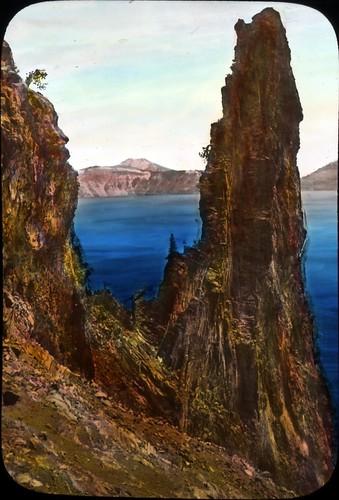
Llao’s head will lies in the lake, and white men call it Wizard Island. And the cliff where Llao was torn to pieces if named Llao Rock.

The Story of Mount Mazama

Who can resist this one? Straight from the pages of the Visual Instruction Department lecture booklets comes the Story of Mount Mazama! Sit back and enjoy this short tale…

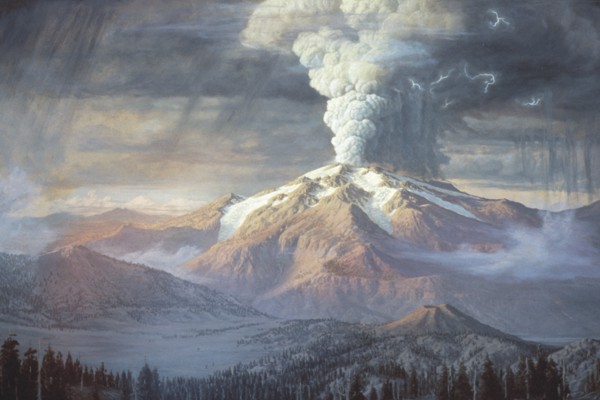
Listen to the startling story in which geology gives us a picture of creation days in this mysterious region – the story of Mt. Mazama.Once a great mountain reared a smoking peak many thousands of feet above the present peaceful level of Crater Lake. Away to the northward stood other volcanoes – Baker, Rainier, Adams, St. Helens, Hood, Jefferson, and noble Mt. Multnomah which towered above the present region of the Three Sisters, while to the southward were Shasta and Lassen, all of which helped build the Cascade Mountains. Most of these old volcanoes stand today quiet and cold in their shining armor of snow and ice – but Multnomah and Mazama are missing.

Evidently there came a day when Mt. Mazama poured forth vast quantities of lava, creating a great cavern beneath, and then collapsed and sank within the grave it had made for itself. This drawing shows the bare outline of Mt. Mazama as it must have towered in its greatest days.

Want to know more? Check out the Wikipedia article and USGS page entitled “Mount Mazama and Crater Lake: Growth and Destruction of a Cascade Volcano“.

More trips! Join us and take a tour of Crater Lake…

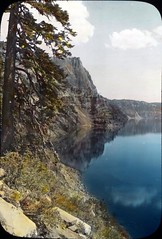
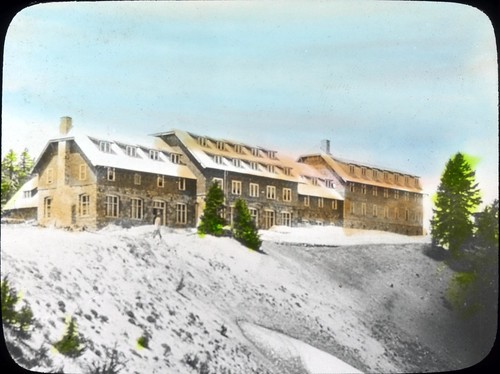
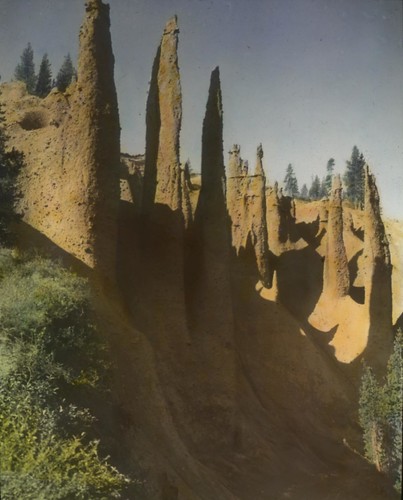
Who can resist the brilliance of Crater Lake? Wizard Island, Mt. Mazama, Phantom Ship, the Pallisades, a really cool lodge – it’s another great hand-colored set from the Visual Instruction Department Lantern Slide Collection!

Again, we’re lucky to have such great slide descriptions from the booklets – they must be quoted, so please check the descriptions under each for more details! Who can resist these directions?

“Crater Lake National Park may be reached from Medford, Oregon, on the Southern Pacific Railway, and on the Pacific Highway about 36 miles from the southern boundary of Oregon, or from Kirk, on the new Southern Pacific line between Eugene and Klamath Falls and near The Dalles – [aka] ‘California Highway.’

Motorists southbound from Portland may choose to traverse the Pacific Highway through Oregon City, Salem, and Albany, or go by the West Side Highway through Newberg, McMinnville, Corvallis, and Junction City where this road merges with the Pacific Highway [which] leads through Eugene, Roseberg, Grants Pass, and Medford. From Medford, the distance to Crater Lake is about 80 miles.”

And look what you can find on Google books? This 1916 text on the Crater Lake set from “Pictured knowledge: visual instruction practically applied for the home and school” by Calvin Noyes Kendall and Eleanor Atkinson.

Where is Crater Lake and why is it such a marvel? To quote the National Park Service site:

“Crater Lake has inspired people for hundreds of years. No place else on earth combines a deep, pure lake, so blue in color; sheer surrounding cliffs, almost two thousand feet high; two picturesque islands; and a violent volcanic past. It is a place of immeasurable beauty, and an outstanding outdoor laboratory and classroom.”

And, as usual, Wikipedia gives us some great information and even better links to follow to find out more.

And yes, we have more shots of Crater Lake in the Archives! Check out the inventories for The Herman T. Bohlman, The Ralph I. Gifford, and The John Garman photographic collections.

150,000 views!

For those of you keeping track, we hit 150,000 views in our Flickr Commons account this weekend! So I send out a hearty thanks to all our loyal viewers and all our new friends — we wouldn’t be here without you.

And remember, we launch new sets every first and third Wednesday and you can set up an RSS feed so you don’t miss a single thing.

What’s coming? This week we’re heading to Crater Lake, care of the Visual Instruction Department Lantern slide collection. Here’s a sneak peek for those of you who can’t wait.

After that, we’re staying with this collection, but shifting to another great series of images from Oregon Industry, circa 1905, 1925, and 1940.