

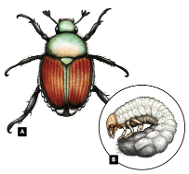
The Japanese beetle Popillia japonica (Newman) is a scarab beetle (Coleoptera: Scarabaeidae) from Japan that has become an invasive pest in the US where it was first introduced in 1916. This insect, although very beautiful, is a major threat to Oregon specialty crop industries (Fig. 1). The larvae (grubs) feed on roots of grasses, but they can inhabit most soils, and adult beetles are voracious consumers of plant canopies. They feed on more than 300 plants including hazelnuts. An Oregon Department of Agriculture (ODA) economic risk analysis , which omitted hazelnuts, estimated that the damage to Oregon specialty crops could be $35 million per year. The actual impacts could be much higher including hazelnuts and accounting for inflation.
Situation
Japanese beetle is now established across the eastern US, Midwest, and is increasing in western states. In Oregon, a population detected in 2016 initiated an eradication effort by the Oregon Department of Agriculture that began in 2017 and lasted until 2025. These efforts successfully reduced the populations of the beetle in Washington County, but fell just shy of complete eradication. Unfortunately, the Oregon legislature declined to fund the program for 2026, and this may leave Oregon’s specialty crop industries more vulnerable than ever to this pest. Without the eradication campaign, Japanese beetle will likely spread and establish in commercial agriculture. Unfortunately, the Willamette Valley is a highly suitable environment for this pest.
Impacts
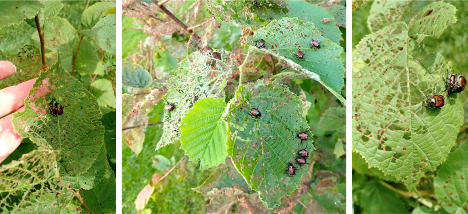
For a preview of what the impacts may be for the hazelnut industry, we can look to two places in the world where there are hazelnuts grown and the Japanese beetle is established. In Europe, Japanese beetle is established in the Piedmont region of Italy, which is famous for hazelnut production. And in the midwestern US, native and hybrid hazelnuts are affected. The main impact of Japanese beetle in hazelnut orchards will be severe defoliation of the tree canopy (Fig. 2). While this is not a direct effect on yield, the loss of leaves will be a setback for tree health and could push stressed trees over the edge. Young, establishing trees may be particularly affected. There are several insecticides currently registered in hazelnuts that can be used against this pest. Unfortunately, these tend to be broad spectrum products with potential to disrupt biological control. Management of key pests such as filbertworm and BMSB should help manage Japanese beetle. We will need some research to determine how best to integrate this pest into our overall integrated pest management strategy, and to develop sustainable approaches and new registrations.
Resources
National Invasive Species Information Center: https://www.invasivespeciesinfo.gov/terrestrial/invertebrates/japanese-beetle
Oregon Department of Agriculture Japanese Beetle Project: https://www.oregon.gov/oda/ippm/survey-treatment/Pages/japanese-beetle.aspx
