By Ali Van Otterloo
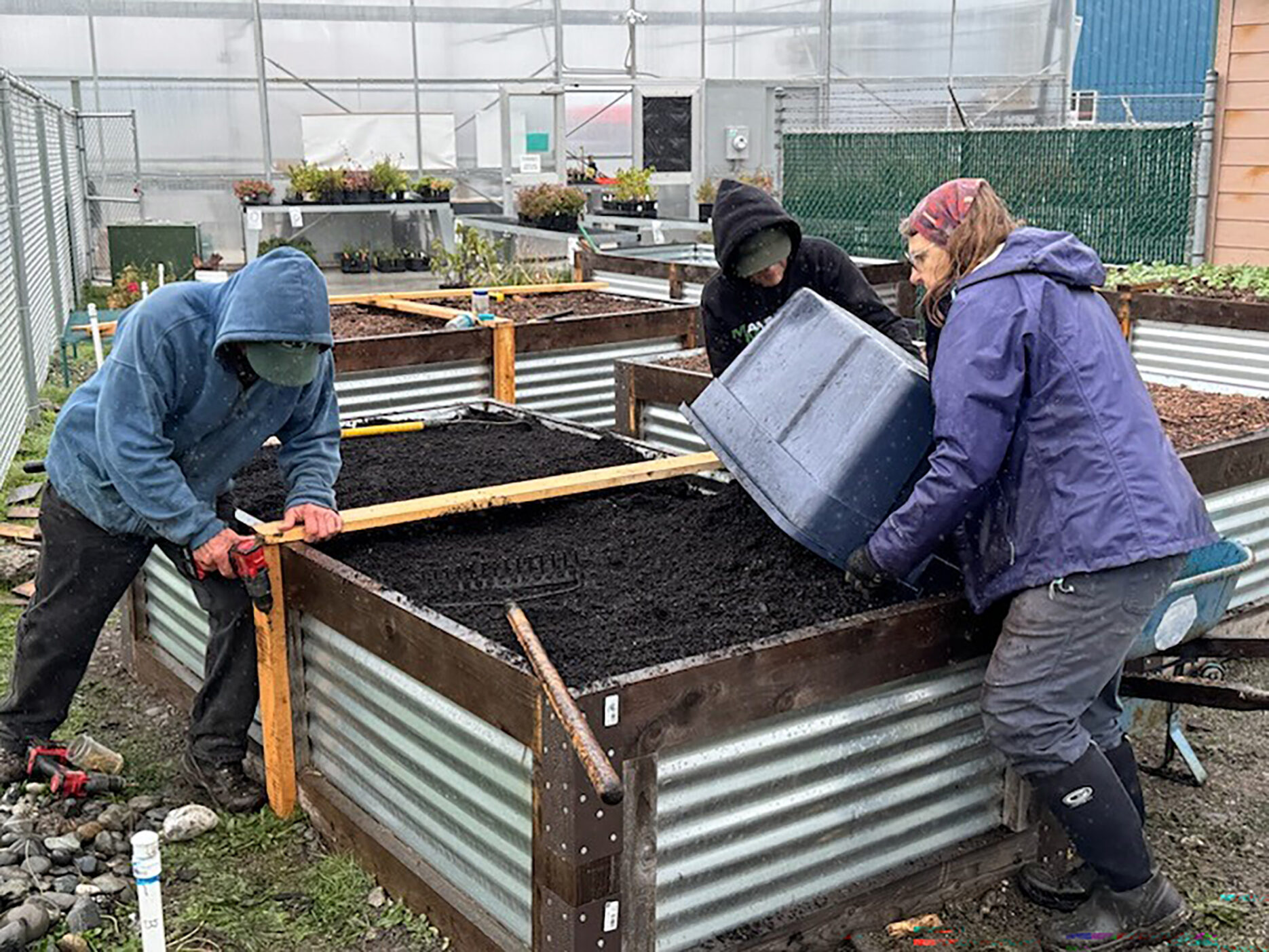
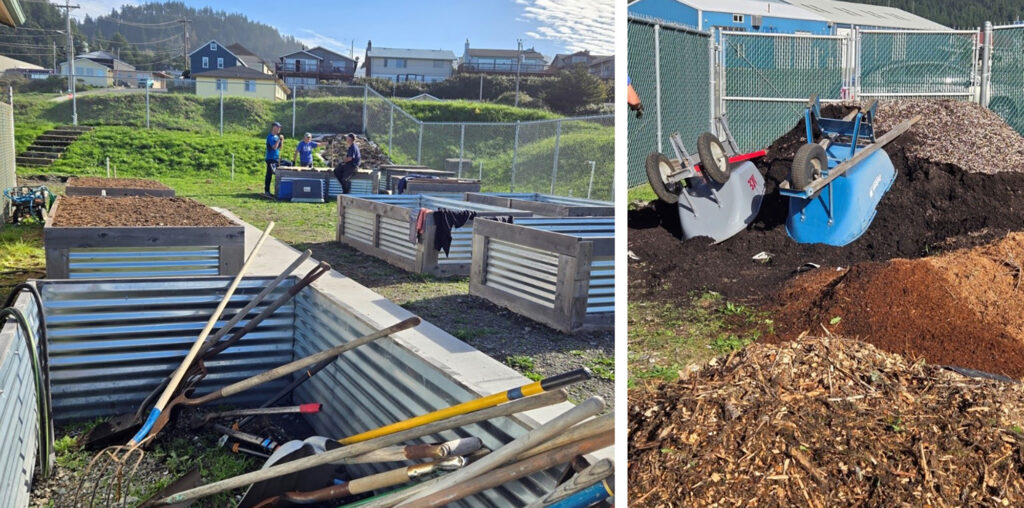
When the City of Gold Beach donated raised beds for the New Greenhouse (CEGG) Demonstration Garden we quickly realized that it would be very expensive to fill them only with garden soil. They were large (4’ deep x 8’ long x 3’ tall) but suited our needs for accessibility. So, we decided to fill them using a recently popular method that has been used for centuries to create raised beds: Hügelkultur. A hügelkultur bed is a sloped and/or raised planting bed filled with topsoil, wood, and organic materials.
Types of Hügelkultur Beds
Although we are building hügelkultur beds in enclosed structures, they do not have to be. Originally these beds were more in the form of a berm where either a trench was dug to accommodate the first layer of rotting logs or constructed at ground level. The advantage to berm construction is that it provides 3 microclimates for plant growth: the sunny side, the shady side, and the top. A typical hügelkultur bed has multiple layers of materials: large logs, branches, small twigs, grass clippings, manure, and topsoil. It can be of any practical size and should be in a sunny location.
Hügelkultur utilizes a lasagna gardening or sheet composting process, meaning one layer of material is stacked on top of another, alternating carbon and nitrogen sources of organic material that will decompose with time.
Basic Material List
- Tree logs, branches, and leaves. Hardwoods are the best, including alder, aspen, birch, cottonwood, maple, oak, poplar, and willow. Avoid using the following:
- tree species that may have allopathic qualities (Allopathic trees are known for their ability to release chemicals that inhibit the growth of other plants. These trees can significantly impact the growth and health of nearby plants) (e.g. black walnut, eucalyptus)
- trees that resist decay (e.g. cedars)
- cut green trees that sprout easily (e.g. willows)
- wood with antifungal and antimicrobial properties (e.g. railroad ties and painted lumber).
- Manure, kitchen waste, and grass clippings can be used for composting. These are nitrogen-rich materials, which help to maintain a proper carbon-to-nitrogen ratio in the decomposing process.
- Topsoil and mulch to cover the planting surface at the top of the mound 1 to 2 inches deep. If the hügelkultur is built slightly into the ground, the excavated topsoil can be used.
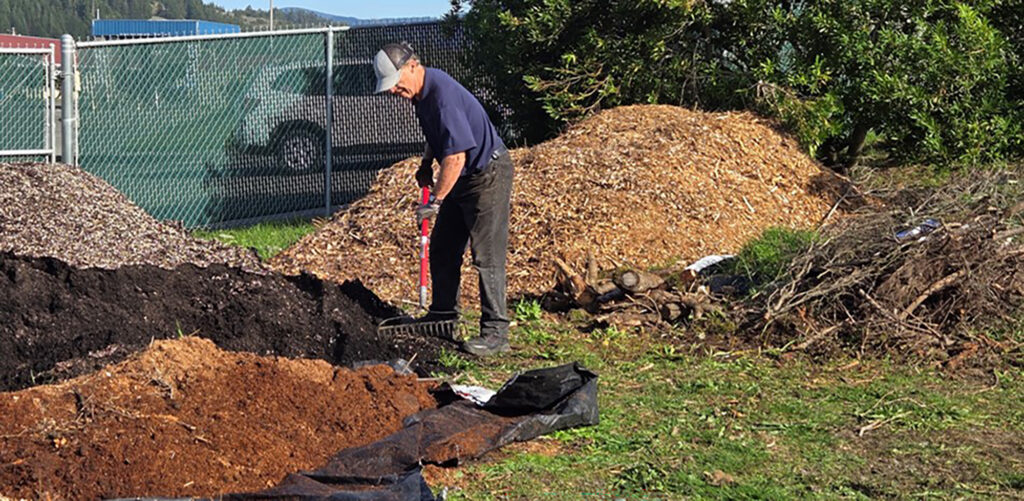
For our beds we used three layers of rotting logs and wood chips, topped with a manure wood chip mix, then a layer of garden soil, and mulch on the very top. We also firmly compacted all layers to minimize air gaps and settling. We then planted Fava Beans as a cover crop to fix atmospheric nitrogen. We chose to use materials that varied in size and decomposition rate, to create a more diverse environment that would house a diversity of microbes, insects, and other organisms. A biologically diverse soil community is more resistant to environmental disturbance and will in turn support a diverse and healthy plant population.
Hügelkultur has several advantages:
- Less expensive to fill with materials that we can obtain for free (rotting logs, wood chips, manure)
- Sequesters carbon
- Introduces mycelium and microbes to the soil.
- Conserves water; our watering use should be reduced.
- Fertilization needs are reduced
- Low maintenance, although weeding is still needed
Problems that can occur:
- Building the bed (berm style) too tall and expecting the plants at the top to benefit immediately. The logs have not had a chance to rot and the plants still need water.
- Air gaps in your bed. Wood rots better when touching soil and roots perform better in soil.
- Air gaps also lead to more settling of the bed where you then need to add soil or material to the top to maintain the height.
- Use of inappropriate wood. As mentioned above allopathic, rot resistant, green, or treated wood needs to be avoided.
- Addition of diseased soil. We live in a SOD (Sudden Oak Death) quarantine zone so we need to be aware not to spread SOD using diseased material.
- Compaction of layers inhibiting water penetration. Use of sawdust or leaves as a layer should be avoided unless they are mixed with larger wood chips as they will compact and form an impenetrable layer.
Resources
- https://extension.okstate.edu/fact-sheets/print-publications/hla/sustainable-landscapes-creating-a-hugelkultur-for-gardening-with-stormwater-management-benefits-hla-6501.pdf
- https://wpcdn.web.wsu.edu/wp-ecommerce/uploads/sites/2/product-3750-sku-FS283E.pdf
- https://www.douglascountymg.org/ask-a-master-gardener-hugelkultur/
- https://permies.com/t/hugelkultur-variation
- https://www.reddit.com/r/Permaculture/comments/kd8oab/common_hugelkultur_errors_and_how_to_fix_them/
- https://www.growingwithnature.org/hugelkultur-beds/
- https://www.vegega.com/blogs/our-garden-bed/how-to-build-a-hugelkultur-raised-bed
Photo credit: Sarah Mocas & Lori Phelan