Money is always a topic of contention. There’s never enough of it to go around and it’s almost always a hassle to think about. When we go on vacation, we try to escape the stresses of money and it usually falls to the wayside. However, the same could not be said for the locals in Costa Rica. As mentioned in the introductory and welcome page of this blog, Costa Rica is the most visited Central American country. The nation sees a lot of revenue from tourism as whole, which makes you think that everybody sees part of the wealth and it’s distributed evenly. Unfortunately, as you’ll see in this blog post, that is not the case.
Distribution of Wealth
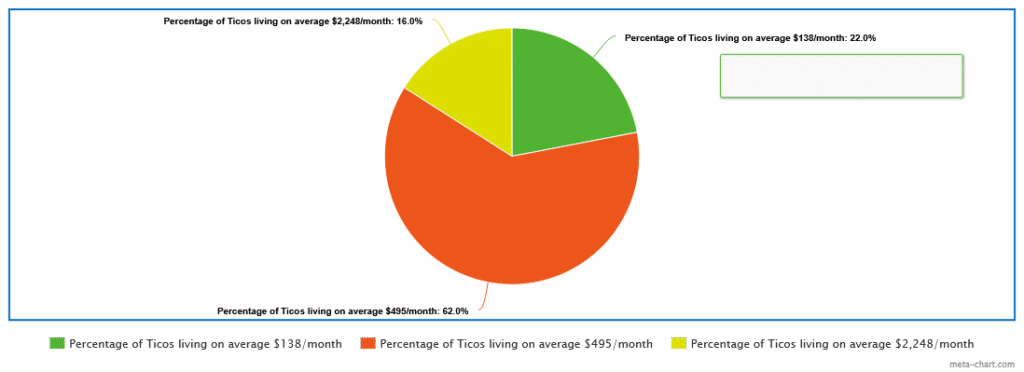
Lets try to make sense of this pie chart together, shall we? For context, a Tico(masculine) or Tica(feminine) is a way that locals refer to each other as Costa Ricans, so I will be referring to the population as Ticos here on out. Each of these figures was taken from Aliesha Baldé on Medium, but she took those figures from survey data in The National Institute of Statistics and Censuses(INEC). Since I don’t speak Spanish, I took the figures from her article.
The first slice of this graph, the green, is the percentage of the lower class which lives on average $138/month USD. What this graph doesn’t include is that 5.9% of Ticos live under The World Bank’s poverty line, which is $3/day USD, or around ~$90/month USD. That’s a heart breaking amount. Furthermore, that 5.9% lives in extreme poverty. This figure was found by Joseph Webb of The Borgen Project, an NGO working to combat poverty. What’s frustrating is that tourism can help alleviate poverty in certain conditions and circumstances. This is not one of those circumstances.
The next slice of this graph, the orange, focuses on the ‘middle class’ which lives on average $495/month USD. I put middle class in quotes because despite the fact that it’s around 3.5 times the lower class, it’s still a very low figure. I compared this figure to various expat(immigrant) sites to see what the comfortable price of living might be for a single person and it fluctuated between $1000/month USD and $1500/month USD in a city. I am not exactly sure how reputable these sites are individually, but considering that many websites were throwing these figures around, I think that estimation is valid. So taking these numbers into consideration, I speculate that Ticos are being pushed out of major cities(or if they are, they are cohabitating or have roommates) and can scarcely afford luxuries or utilities. This of course also applies to the green slice as well but exacerbated to the extreme.
Last, but certainly not least, we come to the yellow slice. This is where the wealth inequality really shows up. These folks live on average $2,248/month USD and are clearly the upper class of Costa Rica. That’s 16.28 times the lower class make on average in a month and 4.54 times the middle class. It’s not rocket science to figure out that it’s a ludicrous amount of wealth inequality.
Unequal Distribution of Benefits
This wealth inequality also demonstrates that there is an unequal distribution of benefits when it comes to the revenue generated by tourism. The touristy areas: beach towns and cities where locals were already living in and could afford to keep living in, I argue receive the most benefits as those are the upper-class and expensive areas. Since they receive the most amount of tourists, the government can keep funneling money into those locations and neglect more rural and inland areas where plenty of Ticos live.
But Why?
That’s the kicker, isn’t it? Why on earth are these issues occurring in the first place? Costa Rica receives plenty of visitors. I have pinpointed two main reasons. One of them is more innocent than the other. The first of which is that the Colón is becoming stronger. The Colón is the currency of Costa Rica and it has been slowly becoming stronger and stronger compared to the dollar. One Colón now is 0.0021 USD. That doesn’t sound like a lot. But comparing it to July 2022, we can see that it was 0.0014 USD, a 150% increase over four years. That is a significant increase. A 150% increase is even enough to slow down the amount of tourists that can come to visit. According to Ticotimes.net, an English language newspaper in Costa Rica, 2025 ended with a 1% increase in tourism in Costa Rica. While this sounds good, the standard global tourism rate grew by 5% in that year. Costa Rica started to slip it’s competitive edge to other countries like Columbia, the Dominican Republic, and Mexico. The Tico Times cited other issues like infrastructures, rising insecurities, and “the rapid spread of informal accommodations and travel agencies” Furthermore, this slipping has been happening for a bit. In Q3 of 2025, 22,000 jobs were also lost(Ticotimes.net), largely for the same reasons. This was because of many of the same reasons, including rising crime which deterred tourists on top of the exchange rate.
The other major reason why there is a downtick in tourist arrivals is ironically, that the government is focusing on making tourists happy rather than their own citizens. This seems counter-intuitive at first. If the government is focusing on tourists, why haven’t there been more tourists? Well, as mentioned in the previous paragraph a lot of the issues that have been neglected for the general population would honestly bring more tourists in than whatever they’re currently focusing on. I will present possible solutions for this in the solutions section of this blog.
Shouldn’t Poverty Alleviate Tourism?
In theory, yes! But it can only alleviate poverty if it is built from the ground up to do so. If it is just an afterthought then it won’t work. Tourism can contribute to poverty reduction IF it does some or all of the following: it can create employment and income for local households, provides decent work(not just jobs), builds up local capabilities and assets such as skills and savings and business opportunities, strengthens local supply chains, supports social services through coordinated long-term investment, respects land rights and benefit-sharing, and enhances resilience to economic and climate-related shocks.
According to Regina Scheyvens and Emma Hughes and their paper Can Tourism help to “end all poverty in all its forms everywhere”? The challenge of tourism addressing SDG1 a lot of times tourism often falls short because of structural inequality, profit imperatives, poor labour conditions, exclusion of the poorest, and limited government capacity and regulatory will. A lot of these are already happening to Costa Rica.
Sources: https://borgenproject.org/wealth-inequality-in-costa-rica/, https://medium.com/@ayeebalde/4-reasons-why-costa-rica-is-so-expensive-2cfda1bc15fb, https://ticotimes.net/2026/01/17/costa-ricas-tourism-is-losing-ground-to-mexico-guatemala-and-others, https://ticotimes.net/2025/11/22/costa-rica-tourism-crisis-as-22000-jobs-are-lost-in-downturn, https://www.tandfonline.com/doi/full/10.1080/09669582.2018.1551404