Oregon Aquaculture Highlights

Hello! I am a new fellow so I’ll start by introducing myself and my background. My name is Amy Ehrhart and I am the Aquaculture Fellow for Oregon Sea Grant. I started this position in November 2020 part-time while I finished my PhD in Environmental Science and Management at Portland State University. I was about two weeks away from my defense when the position began which made for a whirlwind of a month. But somehow I was able to defend, edit and submit everything on time. It feels surreal to be done with graduate school and starting a fellowship, especially during a pandemic. 

So how did I get into aquaculture? My dissertation research focused on pharmaceutical contaminants in coastal ecosystems. Two of my research chapters addressed effects and accumulation of these compounds in Pacific oysters, which are commercially grown in Oregon and Washington. To conduct field experiments, I used off-bottom rack-and-bag culture methods (see picture below) to grow oysters in areas near and far from contaminant sources. While aquaculture was not the main focus of my research, I gained a good understanding of oyster biology/ecology, different growing methods, areas where culture is taking place, and some industry priorities. Since starting the fellowship I have learned A LOT more about aquaculture in Oregon and the West coast and I am enjoying the deep dive into this topic.  
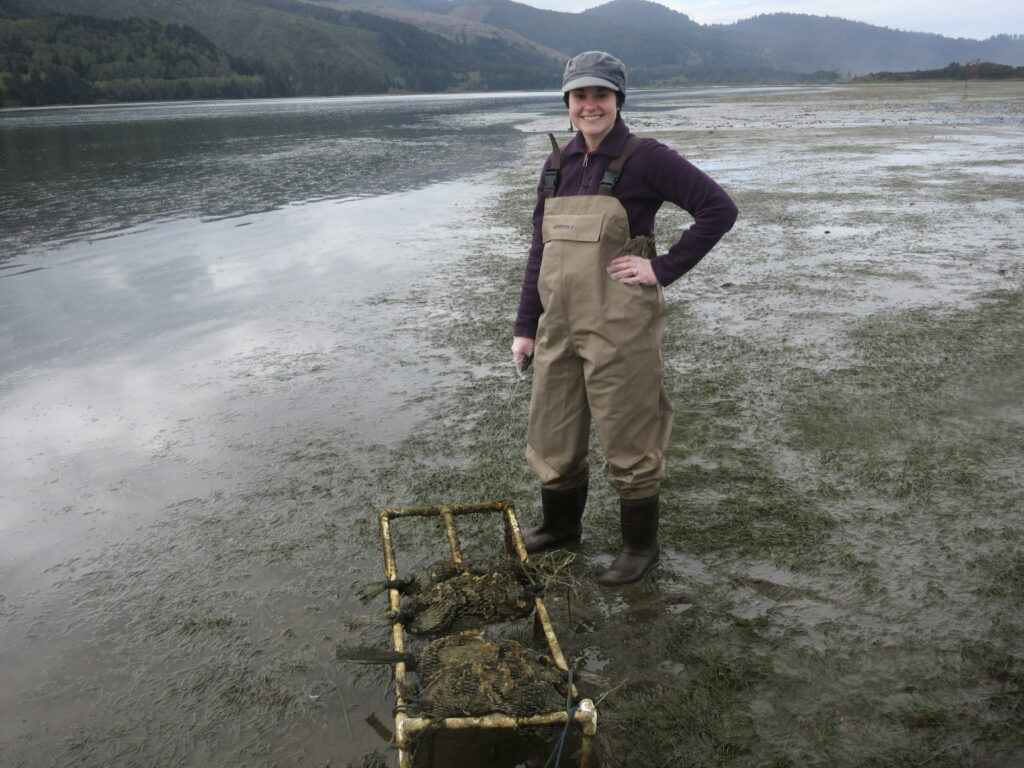
Pacific oysters being grown in mesh bags attached to a PVC rack in Netarts Bay, Oregon (April 2017).

So far in my fellowship I have focused on three main projects: conducting a landscape analysis, planning a needs assessment, and participating in a regional seaweed aquaculture collaborative. I also provided updated content for the Oregon Sea Grant aquaculture website to highlight these current endeavors. There hasn’t been a large focus on aquaculture at Oregon Sea Grant for a few years so there was a need to identify who the major players are in the industry. I was tasked with completing a “landscape analysis” or more simply put, a spreadsheet of people, groups, and agencies involved with marine aquaculture in Oregon. I spent a good portion of my time compiling this information, and I continue adding to it as my work continues. 

My second project involved planning a needs assessment for growers, prospective growers, agencies, and researchers working on aquaculture topics. Globally, about 50% of seafood comes from aquaculture (NOAA Fisheries), and a lot of this is imported to the U.S. from other countries. There is federal support for coastal states to increase domestic aquaculture production, but they face several challenges and barriers. Oregon aquaculture production is fairly low compared to other states, and there is a potential opportunity for expansion, which could provide significant economic benefits for the state. But we don’t know if there is interest in expansion in marine aquaculture or what the current challenges are for growers. The goal of the needs assessment is to identify needs and barriers surrounding aquaculture expansion and use this information to inform outreach and engagement strategies. I am currently finalizing an online survey that will be distributed as soon as it gets human subjects research approval. 

My third project has been participating in a collaborative group that represents California, Washington, Oregon, and Alaska with a focus on seaweed aquaculture. Seaweed is a relatively new product, and one that I knew very little about coming into this group. I have been working hard to catch up so I can contribute meaningful recommendations. Our goal is to plan a regional symposium on seaweed farming that will be beneficial to growers and other industry members in all west coast states. This is incredibly challenging as all of the states have highly variable regulatory requirements, environmental constraints, and current seaweed operations. In Oregon, seaweed aquaculture is in the very early stages and constitutes 2-3 growers that cultivate Pacific dulse seaweed in land-based tanks. This is very different from a state like Alaska, that produces large amounts of kelp in the offshore environment. Identifying topics and strategies that apply to all states at a regional level has been an interesting challenge, and I look forward to strategizing and learning more. 

These first three months of my fellowship have flown by and I am really enjoying the work! It was difficult to start a job with a heavy focus on stakeholder engagement during a pandemic that restricts in-person interactions, but I am feeling much more optimistic about the future as vaccines are being administered and COVID-19 cases are starting to drop.

Thanks for reading and stay safe out there!

Beginning your research project during a global pandemic

In the Haze

Graduate school can be hard and a dredge. You get lost in the details, in YOUR project, in the details of your project and you lose perspective. When I decided to come back to school for my graduate degree, I decided that I would lay down some boundaries that might help me keep better perspective. Work whilst at work, play and rest at home. Obviously there would be some exceptions (research is not a 40 hour a week job, between teaching classes, taking classes, applying for funding and grants, conducting your research, and professional service inevitably there is always some working during your planned free time), but I found that sticking to this plan to be very helpful. Working from my office gave me a chance to engage in work actively and intentionally, reinforcing a need to use my time wisely and efficiently. This also meant that I was able to disengage and recharge when I went home.

Then, COVID-19 made its internationally debut. EVERYONE has been impacted by COVID, I am no exception. Overall, I feel very lucky and privileged to have faired as well as I have. Yes, my field work has been continually delayed, but I have a paying job, food in my belly, and a roof over my head, and a loved one (and furry one) to keep me company at home. It is hard not to be grateful when I know that I am much better off than many. That is the large-scale perspective.

When I analyze how my professional life has been affected by COVID-19 things start to get fuzzy. For the safety of myself and my family, I work from home. I have a quiet place to work and have no real obligations or worries that hinder my ability to work from home (like children or loved ones that need my care). Yet, I know that my ability to stay focused and motivated has decreased. My ability to draw the lines between work hours and personal hours has blurred, my efficiency has gone down, and as a result my morale has greatly suffered. Being a graduate student can be hard… I have so many privileges including setting my own schedule and having ultimate flexibility and culpability with nearly every choice that effects my professional life. But it can be difficult to keep perspective when you have ONE over-arching goal over the course of several years to accomplish – your research project, your thesis, your publication(s). It is hard to see the progress you have made, to see the steps forward, and the steps you have already taken behind you.

In my experience, field work keeps you connected to your study subject. Working in the field rejuvenates your excitement, inspires new ideas, and thus keeps you motivated throughout the rest of the year. Like many, my field work has been delayed due to COVID-19 (hopefully, I will be collecting data this fall). However, the combination of working from home on a research project with no definite end date, and without any field work or significant excuse to leave the safety of my home, has left me feeling a bit lost and dejected.

Do the next right thing…

Alas, time continues to pass and the reality of an impending defense date looms somewhere in the future. Currently, it seems difficult to see the light at the end of the tunnel. It almost feels as though I have stalled out before my project even started, yet I remind myself of the long-term goal. The goal is to conduct a research project from start to finish, complete a thesis, publish, and obtain my master’s degree in fisheries science and hopefully along the way I will take a step towards doing some good in the world of marine science.

For now, I will keep in mind advice that I once received from a wise source, Disney’s animated film Frozen 2, “All one can do is the next right thing”. At this point in time that means continuing to engage in my quantitative ecology class where I am learning about how to better conduct data analysis; continue to make appointments with mentors and collaborators who can help inspire ideas and motivate me during this strange time; and lastly, to refine my methodology as much as possible before data collection begins this fall. One day at a time, one step at a time, just doing the next right thing.

State Agency Role in Natural Resource Management

One of things that has surprised me the most, is the difficulty State agencies have in weighing all of the interests involved in authorizing activities off the coast. For my project particularly, there are several State agencies who have authority and expertise over key State resources that may be affected by an authorization of an activity. From working in the non-profit world, I was unaware of how many stakeholders are considered throughout the administrative process.

Marine Spatial Planning, is an interesting field, with several intersections of studies involved. From economics to marine sediment management, natural resource agencies are tasked with weighing each and every use and resource to determine whether certain projects can move forward. While this sounds pretty straight-forward, I have learned that this can become pretty tricky, very quickly.

Like many other coastal states, the Oregon Coastal Management Program (OCMP) follows the networked approach, which allows several agencies to have jurisdiction over marine resources located in State waters. This model allows for each agency to “flex” their expertise while also contributing to strategizing the State plan for coastal management. The Dept. of Land Conservation and Development (DLCD) is tasked with ensuring that these needs are met throughout the State, which includes ensuring coastal management is integrated into several other agency work plans. For example, the Oregon Dept. of Fish and Wildlife (ODFW) is tasked with managing the biological resources of the State, including resources found within Oregon’s territorial sea. The OCMP relies heavily on ODFW’s expertise in planning for activities in the territorial sea, and leverages their ability to analyze the effects of certain activities to those resources. In addition to speaking with experts in the agency, OCMP often communicates with the local communities to ensure that their concerns are heard, and responded to (in real time).

Some of the time, these concerns can be at odds with each other, and DLCD is tasked with making the ultimate decision, as to whether certain projects can move forward with the State’s approval.* This dichotomy has been pretty interesting to watch. Over time, I have realized that each of the agency employees have different ways of engaging with these audiences to ensure their voices are heard. For example, one of my mentors has a regular marine policy phone call with ODFW to hear any of these concerns informally. This ensures that the networked partner agency is apprised of potential agency actions, and has the time and space to respond in an unfiltered manner. Hearing these concerns, and coordinating with ODFW has developed into years of a healthy working relationship.

I think learning how to strike this balance has been a great lesson for me, and I hope to implement it as I continue to work in the marine natural resource management world!

*Under the Coastal Zone Management Act, States have the ability to review certain federal permits known to have reasonable foreseeable effects to State resources for compliance with State enforceable policies. While federal government, ultimately has discretion, the State plays a large role in ensuring these concerns are appropriately mitigated by the person pursuing the activity.