How to Make A Difference: Reflections on a Year on Capitol Hill by Eva Lipiec

Posted on behalf of Eva Lipiec, a 2016 Knauss Fellow who served her legislative fellowship in the U.S. House Committee on Natural Resources, Democratic Staff.

Every day, we are bombarded by stories of partisanship and gridlock in Congress, between branches, and increasingly between our very own neighbors. To break through these barriers, especially after our most recent election, it is important to become more involved in the issues we hold dear and understand how the decisions of our elected officials impact those issues.

Personally, as a scientist and voter, it can get depressing – how are we ever going to deal with global problems like climate change and the resulting regional hostility around the world if our elected officials can’t even talk about it in a constructive way?

During my time as a John A. Knauss Sea Grant Fellow on “the Hill”, I’ve had the opportunity to inform Members of Congress on topics impacting our oceans, wildlife, and open spaces (see more about my work here). I’ve also gotten a peek into how change really happens in our nation. My host office has been a wonderful place to spend a year as a fly on the wall; these musings are purely my own and do not reflect the views of my host office. Below I share a few insights I’ve gathered from my year as a Fellow:

  1. Elected officials are human – No matter what side of the aisle, each person elected to office is a human, warts and all. They may be very well versed in specific topics and have values of their own – but it’s your job to inform them of topics and values that are important to YOU.
  2. Local elections really matter! – From the hallowed halls of the Capitol to meetings in local community centers, the people that end up as your officials (whether you voted or not) are your voice! If you want to guarantee they hear you and represent you, you have to vote!
  3. Your job is not done once you vote – When we elect an official, they are assuming the role of our voice and are paid by our tax dollars. If something is happening, or not, the best way to voice your support or discontent is to contact them. Every office tracks its constituents in a physical database – and these concerns are depended upon to make real changes. Think your community needs something? Tell your representative, and then tell your friends to do the same. Think you senator should support an initiative? They want to hear from you! Every day, congressional staff meets with groups from all over their district, state, and the nation. These groups represent some, but not all, of your views. Call or email – if the official wants to keep representing you, you will get a response!
  4. Have a topic that’s really important to you? – Local businesses? Community poverty? Elementary schools nearby? International conflicts? There are groups most likely in motion already thinking of those issues, so get involved with them! They will be your best source for information and can help lead the charge to inform and push our representatives in the right direction.

Oftentimes it’s easy to dismiss the discussions, or lack thereof, in the Capitol and our capitals. However, our democracy only works when each and every person utilizes their rights and holds their officials accountable. In the craziness of our lives, democracy can be as easy as picking up the phone.
Perspectives on Transitioning from Research to Resource Management

Howdy, everyone!

My name is Daniel Sund, and this is my first ever blog post! I could not be more proud to be doing it for Oregon Sea Grant, an institution so very close to my heart, as a 2016-2017 Natural Resource Policy Fellow!

Seven years ago – when I officially transferred the focus of my academic studies to marine science – I passed along a nascent resume to my favorite oceanography professor in the hopes of gaining some hands-on experience. Low and behold two weeks later, after an out of the blue phone call from his colleague and then an interview I didn’t know I was walking into, I started work as a research assistant conducting a literature review on environmental hypoxia and its impacts on fish.

Since that first experience, which lasted nearly two years, Sea Grant and I have continued to have a long and fruitful relationship. I have had the distinct pleasure of mentoring other students developing their professional experiences in the Sea Grant Summer Scholars program, serving as a part of the interview committee placing students with mentors for the same program, interviewing for a few of Sea Grant’s fellowships myself, and, coming full circle, becoming a full-fledged Sea Grant Scholar.

Before accepting the Natural Resource Policy Fellowship, I spent that last four years as a field ecologist. I have spent endless days on the small bays in the Pacific Northwest looking at burrowing shrimp, juvenile crab, and intertidal habitats and endless nights watching video, making maps, and analyzing data to try to understand the role commercial oyster and clam aquaculture plays in the ever intricate and dynamic ecology of our estuaries. It surprises many people who know me that I have turned in my field gear and floppy old fishing hat for a position where I am at my desk 100% of my workday. My “fieldwork” now consists of organizing workshops, gathering sets of experts in a room to pick their brains, and rending even more time commitments from their busy schedules to inform resource management. All I have to say is that I am extremely happy with the transition.

As a fellow, I have stepped in as the only support staff in the Oregon Department of Fish and Wildlife and am the only person within all of the state’s executive agencies entirely focused on Ocean Acidification (OA) and, on occasion, Hypoxia (OAH). For those of you who don’t know, OA refers to the process by which carbon dioxide (CO2) is removed from the atmosphere by our oceans, where it chemically transitions to carbonic acid (H2CO3), a weak acid, resulting in seawater with lowered pH (acidified) as our oceans remove more and more CO2 in response to increased atmospheric concentrations. Hypoxia (H) refers to an environmental condition of low oxygen dissolved within the water leading to decreased productivity and stress on organisms that respire on one end to massive fish die offs on the other. This focus of my position on OAH means that I am a single issue type of guy granted the unique ability to entirely immerse myself in the realms of science and policy to better understand and inform resource management as they relate to OAH along the Continental West Coast.

Day to day, my work duties include drafting emails, editing documents, reading literature, and compiling information. However, at a broader level, I have been an integral part of launching an international collaborative focused on combating OAH impacts across much of the globe (OA Alliance). I have also participated in high-level discussions between state, federal, and international governments. Additionally, I have organized regional-level efforts to understand how state governments are monitoring OAH on behalf of the public as well as started the process of identifying the monitoring improvements necessary to insure resource managers are able to respond threats to our coastal resources and the communities that rely upon them. While it may seem like a lot to have been part of in only two months, this list is far from exhaustive.

Being engaged in work that has tangible products with societal benefit is a very different experience from the academic research I have been a part of up until this point. After working as a technician and research assistant, I often felt that the information and insights we were generating were lost to the annals of a journal or our own filing cabinet. In comparison, this fellowship has placed me “where the rubber meets the road” with regards to being able to use research to create tools used both by natural resource managers and stakeholders. It seems to me that the efforts I am currently part of make a more immediate and meaningful impact than anything I have previously worked on. I look forward to continuing my work here and seeing where it takes me.

Application season for the Summer Scholars Program!

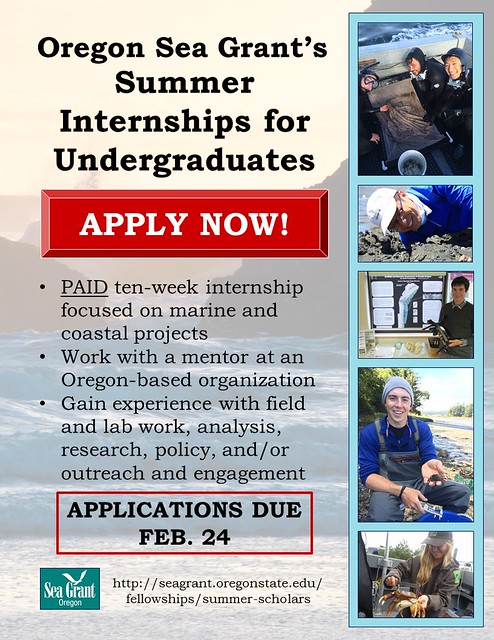
With the close of 2016 the Research and Scholars Team at Oregon Sea Grant are now beginning to ramp up for the 2017 Summer Scholars Program. Host applications are due this week and student applications are due next month on February 24th. Spring is always a busy time of year for the Scholars program as we review applications, interview candidates, and place successful applicants with host organizations. In 2016 we received nearly 150 applications, and with our increase in advertising to reach a broader audience, I suspect we will reach at least 200 applications this year. The caliber of applicants is always extremely high, and narrowing the applicants down to just ten Scholars is always extremely difficult and takes plenty of time and a team of diligent people.

Summer Scholars are outstanding undergraduate students or recent graduates from around the nation who come to Oregon to work under a mentor on a marine-related project. Scholars work on everything from analyzing fecal indicator bacteria in the Tillamook estuary to evaluating the impacts of lost crabbing gear to creating identification videos for tidepools. Ten students were placed last year in various positions and all blogged weekly throughout the summer. To find out more about the 2016 scholars experience and projects just scroll through this blog and you will encounter plenty of posts!

If you know of any students (or if you yourself are this student!) that would be interested in a paid summer internship on a coastal or marine project, please visit the Oregon Sea Grant Summer Scholars website.

Summer Scholars 2017 RFA Poster