Another week of great variety in Charleston.

Last week once again saw me participating in a variety of activities for ODFW. On Monday and Tuesday, we finished the summer sampling session for bay crabs in Charleston marina. We measures, weighed, and tagged 325 (±) Red Rock crabs (Cancer productus) and 350 (±) Dungeness crabs (Cancer magister) in a week’s time (no tagging for these). The next sampling will occur in October, well after I’m back at OSU. I detailed the methodology of the study in my last couple of posts. Here I’ll briefly mention the purpose: Red Rock crabs are native to Oregon and, although they do not provide as much meat as Dungeness crabs, they are still sought after for the table. Red Rock crabs seem to be a sustainable resource—there are no size or sex regulations governing their taking—however little research has been conducted into their life histories. The study I’ve participated in, being conducted by Sylvia Yamada of OSU, is to assess various aspects of the life histories of Red Rock crabs in the Coos Bay area: how fast they grow, how old they get, how often they molt, and their movements between sites. We took measurements for the Dungeness crabs as part of an ongoing monitoring effort by my mentor, Scott.

Wednesday was, of course, Independence Day, and OIMB sponsored a nice BBQ for all the students and interns at Sunset Bay State Park. It was a good chance to get to know the staff of OIMB and talk to some of the students about their studies. However, the highlight of the BBQ was definitely culinary: grilled oysters on the half-shell. Yum!

Thursday and Friday were occupied by shore seining for salmonids in the morning and practice sessions with GIS, ‘R’ statistical software, and Microsoft Access in the afternoons. So far the computer activities have represented the greatest challenges for me during this internship. Up until now I’ve had zero experience with any of the afore mentioned programs, and I do not find them “user-friendly” in the slightest. Scott has been very helpful in writing some skeleton instructions and providing some basic activities to help me learn, but it’s still ultimately up to me to figure it all out. My learning has been through a combination of Scott’s guidance, online tutorials, and my own exploration/experimentation with the programs. This style of learning sometimes gets frustrating, because I tend to think in linear terms and prefer to have one source of info from which to work. I also admittedly find fieldwork much more attractive and exciting than sitting in the lab in front of a computer screen. However I have had some success in learning the programs, and I know it’s good to get outside of my comfort zone and experience a new style of learning. I also realize that skills in GIS and database management are essential to being competitive in the field of Fish & Wildlife science, so I’ve committed myself to spending a block of time each day to increase my proficiency.

For the upcoming week, I look forward to beginning my heart cockle study in earnest. So far, Scott and I have conducted a sort of exploratory study where we went out and investigated some sites in the south slough of Coos Bay and took some GPS coordinates. We also measured and weighed some cockles taken by a recreational harvester. These were basically introductory sessions to give me an overview of the fieldwork and protocols. This week, however, we’ll begin in-depth sampling of heart cockles and constructing the database. Stay tuned! More details to come!

Week 2: The Experiment Begins

The Mesocosm or "Tank 1"

Monday arrived this past week, and with it came the dawn of the project I will be working on this summer. I collected 35 liters of water  from 4 sites throughout Yaquina Bay. One of the sites, “OSU Dock” as the EPA calls it, is right outside the Hatfield Marine Science Center Visitor’s Center. The other sites are further up river around the city of Toledo, with one site being labeled as “Toledo” and the other sites “Cannon Quarry” and “Elk City.” So why on earth am I collecting 35 liters of water and lugging it back to the EPA labs? Excellent question. Let me explain.

The purpose of collecting these 140 liters of water combined is to examine the nutrient limitations of phytoplankton throughout the estuary. After these samples were collected, we divided them up into 48 two liter bottles. We measured the initial nutrient concentrations as well as the chlorophyll a concentrations, and then proceeded to “spike” them. Along with a control of plain water, these spikes consisted of treatments in which a Nitrogen spike, or “N”, was added as well as Phosphorous, or “P” spike. To further confirm whether a given spike had an effect an “N+P” spike was also a treatment. The result is 3 replicates of each treatment for each site, or 3 x 4 x 4, totaling 48 bottles. Complicated, I know, and they proved to be a little difficult to manage as the experiment progressed.

Once these bottles were spiked according to the given treatment, they were randomly placed in a mesocosm or in this case two tanks with pumped sea water and UV lights. These tanks produce the environmental conditions found throughout the estuary, so they are quite useful in conducting experiments. They were placed in these tanks starting Monday night, and there they remained till Friday morning. Every day, I measured the temperature of the water in the tanks, and the photosynthetically active radiation (PAR). More interestingly though, I also measured the relative fluorescence of each bottle, to get a sense of whether any given spike was having an effect. The result? The OSU Dock, or the site closest to the ocean, had a significant response for the “+N” and “N+P” treatments, suggesting that there wasn’t very strong upwelling prior to the sampling resulting in Nitrogen limitation. This may change as the summer progresses. The results further up river suggested “P” limitation, as the Toledo and Cannon Quarry sites showed significant results for the “+P” and “N+P” treatments. Elk City showed a significant response for the “+P” treatments, but mixed results for the “N+P” treatments. We believe that if given more time, the “N+P” treatments might further reflect the results from other sites. We will replicate this experiment several more times of the course of the summer so we will see how the results change as summer progresses. Regardless, from this week of the experiment it is evident that further up river phytoplankton appears to be limited by phosphorous concentrations. Keeping with my themes of leaving you hanging, I’ll get more into what this means next week! But I will say that I really enjoyed this week. Performing science at a high level, with the means and ability to conduct an experiment in a week is amazing, and I consider myself to be very, very lucky. Furthermore, it is a terrific feeling to know that the science you are doing is extremely pertinent to the state and the country in which I have largely spent my entire life. Alright, before I get too sentimental, I will say goodbye and remind you to look for next week’s post to learn more about what the results of my summer experiment mean for Oregon’s estuaries!

Wave energy in Oregon

This week was another that flew right by. I’m researching story pitches for a coastal magazine to help raise awareness about marine issues and the work OSG is doing. One pitch that came in late in the game was by far the most challenging, and the most interesting one out of the bunch because I didn’t know anything about the subject. Wave energy. What is it? How does it work? And why in the world is there so much hubbub surrounding it in Oregon? Well, after almost a full days research and very informative conversations with Mark Farley and Kaety Hildenbrand of the HMSC, I can answer all of those questions (mostly).

Wave energy is a very promising resource that if done right, may solve a lot of Oregon’s energy needs. But apparently there is a lot more that goes into harnessing wave energy than just floating a buoy around in the ocean. Wave energy requires a lot of space, whether it’s in a vertical or a horizontal sense. In addition to the mechanism that absorbs and collects the energy, a whole network of cables, mooring, pipes, and a bunch of other stuff is needed to keep the equipment from floating away or banging into each other, and to ensure that the energy that is collected makes it to land. Aside from the benefits of a renewable energy source, there are a lot of environmental factors that come into play when exploring wave energy farms. The cables and moorings are obtrusive and may block migratory paths or feeding grounds for marine animals and the electrical current can attract animals (like crab) to the cables. And on top of that, the rigid tethers and anchors could potentially make an entire soft-bottom substrate ecosystem disappear because they will attract hard-bottom animals like shellfish. They will in turn attract predators, and so on, potentially displacing entire populations. It’s a topic that could easily keep one researcher busy for months.

After delving into the subject, I have begun to fully appreciate the full scale of the Coastal Marine Spatial Planning OSG is involved in. The planning is a collaboration of land and water management and community stakeholders and the work falls under the premise of determining who and what will be the most or least affected by wave energy. In part, it’s the complexity of the situation that makes it so important that people are educated about the potential benefits and harmful “side effects” of wave energy. The resource planning spans the arenas of engineering, marine science, economics, philosophy, and sociology. Pretty fascinating stuff.

Gaining New Strength Out On the Estuary

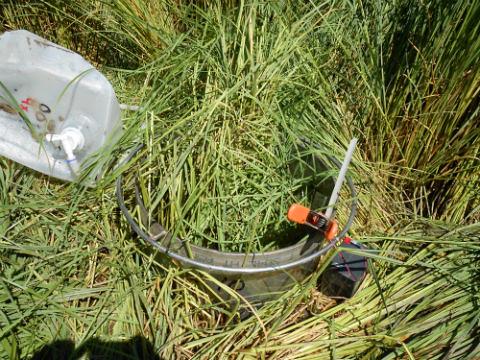
The lab group and I have accomplished a great number of things this past week on the nutrient uptake research project here at the EPA. We traveled to the Salmon River and the Tillamook Bay estuaries where we carried out our experiments. At each study location we set up six chambers like the one shown below: two in the channel, two in the low marsh habitat, and two in the high marsh. The chamber is about two feet high so, as you might imagine, this chamber has been pushed into the ground. And that, my friend, has been the challenge of the week! We must use every bit of weight (human bodies and 2 sixty pound weights) plus muscle power to get these things in the ground. Each estuary and habitat is different so we never know what difficulty will await us. I’m always up for a physical challenge, though, being a runner!

expsetup

To give you an idea of the experiment, we fill the chamber with artificial seawater made up in the lab (a rather tedious process) that contains various concentrations of nutrients. Then, over a one hour time period we take water samples every twenty minutes that will be analyzed later to determine how much nutrients have been taken up. We measure a bunch of other things like temperature, salinity, water depth, and plant biomass. All of this data will be looked at later and we hope by the end of the summer to tell a story about how nutrient uptake in Oregon coast estuaries works.

My fellow intern and I have also designed our own experiments to carry out and did our first experiment on Friday in the marsh here in Yaquina Bay, behind the Oregon Coast Aquarium. She is looking at how the ratio of nitrogen to phosphorous affects uptake and I am going to see if temperature of the water plays a role. This involves carrying 14L of water in a large cooler of ice to the study location…another physical challenge!

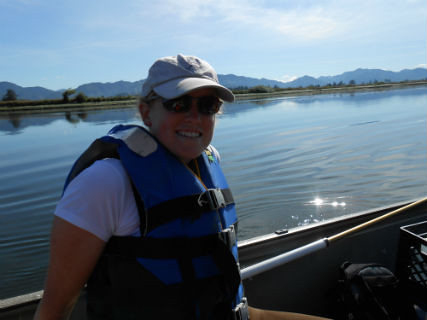
Overall, I like this sort of research. I am enjoying being outside and getting to see great stretches of the Oregon coast and its various estuaries. The people in my field group are also great fun to work with. Below is a picture of me on the Tillamook River, headed to the marsh.

onboat

Some aspects of the fieldwork get stressful as you have to remember to do every tiny task or it will make the data worthless. With so much effort put into packing for fieldwork, getting to the field site (driving, hovercraft, and boat) and setting up the experiment (pounding the chamber in), one small mistake would make all that work pointless. For instance, on Monday, just after some of us had gotten to lab at 6AM to prepare and we were about to pull away at 8AM, my mentor, who is the primary investigator and calls all the shots on this project, found out that the water hadn’t been stored in the cooler overnight. He initially told us to scrap the whole field day, and I almost cried! However, someone had the brilliant idea to let the cubitainers of water incubate in the river before the experiment, which worked to keep the temperature down and all our work that morning did not go to waste.

Next week we work on our experiments two of the days and then travel to other estuaries the other two days. The 4th of July, our day off, my roommates and I plan to explore the tide pools since there is supposed to be record low tides that day.

Crab Butter

The beginning of anything new and exciting always seems to end up in a blur and last week at the Visitor Center was no exception.  What has struck me most since starting my internship is how much work goes on behind the scenes to make the doors open every day at 10am.  When I show up around 9:30 to turn on all the lights, the ball has already been rolling for a few hours for the aquarists.  Their job is to make sure all the tanks in the Visitor Center as well as in back are working properly.  Recently they have had issues with herring dying over night for some unknown reason.  I was able to work an aquarist and fish out the dead herring from an 8ft tank just before visitors started arriving.  It doesn’t sound like much but when you couple that with leaking shrimp displays, overflowing touch tanks, and whatever else the morning brings, it can be quite the adventure.  Troubleshooting these issues everyday really keeps the doors open to the public.

Last week was also a lot of firsts for me and the most interesting was definitely the estuary tour.  We (the VC interns) give estuary tours at 11am every day to whoever wants to go.  My first tour had an elderly husband and wife as well as a mother with her two kids.  It was pretty fun trying to juggle the interests of the kids and adults.  I ended up using the “slurp gun” to dig out some shrimp from the estuary to keep the kids fascinated and then explained more about how HMSC functions to the adults.  Overall it went really well and I think everyone had a pretty good time.

Lastly, the most interesting thing I found out this week wasn’t at the Visitor Center but actually up at Kelly’s Brighton Marina near Manzanita.  After catching and boiling a crab, I had the privilege of eating the heart of the crab as well as the crab butter.  The butter was comprised of all the liquified crab fat.  When the crab is done boiling, you flip is over, open the carapace, and voila you have crab butter.  It goes on anything!


Nick Pitz Week 2 blog

Monday was my first “day off” from the HMCS visitor center. During this time I busied myself with researching my project (looking up information on tsunamis, the Cascadia subduction zone, and tsunami proof buildings) and practicing the Ocean Quest presentation. This was also the first day all week that I finally got to sleep in.

Tuesday was the last official day of training. The interns attended two special lectures about waves and wave energy. We also attended a brown bag lunch with all of the REU students and learned a bit more about the sea turtle that washed ashore in Newport. Tuesday was the first day that we actually helped to close up the visitor center at 5 PM. Nearly all of the centers light switches are cleverly hidden from view (an therefore impossible to find at a glance).

Wednesday was my first official day at the visitor center. I showed up for at around 9:15AM to start turning things on. I quickly found myself  helping Mark Farley fill up the new tsunami tank. We also noticed that we seem to be having some mortalities with some of the herring in an exhibit, we still have no idea why this is happening. We also got a few more behind the scenes information learning about when and what the different animals get fed during the week.

On Thursday I gave my second estuary walk tour. Once again I found myself with only two people attending. I did my best. We made an interesting find in the mud flats when I uncovered a polychaete worm with the “slurp stick”. After the tour I returned to man the front desk at the visitor center. We helped to get the visitor center in order for the 1:00 octopus feeding which usually brings in more people. After the feeding we decided that it would be a fun idea to measure out the dimensions of the Japanese dock that had washed ashore on Agate beach. This would be helpful for giving visitors a better idea of the size of the dock.

On Friday we helped Mark Farley with the wave machine again. Our job was to “calculate” the ideal parameters that would give us the biggest waves without splashing and shorting out the machinery. We did this for most of the day, at one point I was using a small umbrella in order to protect our computer from splashes generated by the wave maker. After finishing the calculations we proceeded to knock down a small lego building with a “tsunami”. Later I helped Mark move one of the other wave tanks out to his truck so that he could take it for repairs.

On Saturday we got an unexpected surprise. Apparently Senator Ron Wyden was given a closed lecture in the Library about Tsunami debris. For the first 2 hours of the day we were helping to direct people to the library for the lecture. This turned out to be very time consuming. We also had another octopus feeding that day. I was charged with getting a photo of the octopus in the event that he attempted to squeeze through the small hole (which he didn’t). We also continued to have problems with moralities. This time we noticed several of the herring behaving strangely (swimming near the surface as though they could not control their buoyancy properly).  I suggested to McKenzie that we might try setting up a video camera over the night to observe what is actually going on with the fish. She thought that it was a good idea and is considering it. After closing up the visitor center I ran over to the Oregon Coast Aquarium to ask how the sea turtle was doing (as visitors keep asking). Apparently the turtle is doing better and they plan to eventually release it down in Monterrey Bay.

Will my voice ever be the same?

It’s only the second week and I’m already learning and being tested on so much information about not only the Oregon Coast, but also biology itself.  While mainly working the front desk this week at the Hatfield Marine Science visitor’s center, I talked to visitor’s constantly.  I welcome them, ask where they’re from, give them a 30 second tour of the visitor’s center, ask for a donation and then send them on they’re merry way.  I also work at the tide pool touch tank where I teach people to touch gently and actually what’s in the touch tank to begin with.  Lastly, my main job is to lead the estuary walk and give insight into what an estuary is and what happens there.  Does my job end there? NO! Lies completely!!! I get to do so much more!!! Not only do I get to work with marine education, I also get to work with the aquarists.  Already since I have been here I have done water quality tests on the “west wing” water, fixed problems with tanks in the visitor’s center and got to “de-leech” rock fish! Oh yeah! I have been walking around, helping visitor’s and learning more and more about Oregon from everyone around me.

I definitely had to face a few challenges this week, but they were mainly because of my left knee. Earlier in the summer I had torn part of my ACL, LCL, Meniscus and brusied the knee bone.  This left me needing an ACL derotation brace and I had to get it here. Too bad the nearest orthopedic and prosthesis place that takes my health insurance is in Corvallis! Thus, figuring out my work schedule to take days off and finding a way to get to corvallis was an interesting task all on its own.  Yet, it was all worth it because now I can move around with ease and feel much safer all around.

One of the main things that was completely new was touching our giant pacific octopus Squirt! It was awesome!!! He even almost came out of the tank, but we got him.  I got to interact with him and help him move through the circular hole that is placed between the front of the tank and the back of the tank.  It was amazing to see this creature move and interact with visitor’s all while learning about him and his tendencies. Yet, definitely one of the most amazing things that has happened to me so far is how welcomed I feel.  The volunteer’s, aquarists and my supervisors have all made me feel like I am one of the family and that I am completely worthy of working at the Hatfield Marine Science Center.  Next week that main things to face will be fixing exhibits, dealing with large groups coming to the visitor’s center all at once and becoming even more acquainted with the science behind the center.  Bring it on!

Crabs, clams, and shrimp (Oh my!)

The title pretty much explains the theme of the past week.

Most of my time was spent collecting, measuring, weighing, and tagging Dungeness and Red Rock crabs for an abundance/life history study. I worked with my mentor, Scott, and Sylvia, a researcher from OSU. We started Monday afternoon by deploying about a dozen crab traps throughout Charleston marina. Tuesday morning, the survey began. Aside from an occasional kelp crab, the traps contained only Dungeness and Red Rock crabs. We started by measuring and weighing the Dungeness crabs. We measured carapice width and then took their weight in grams. This information was later uploaded to a database so Scott could make continuing estimates of the size distribution and biomass of the crabs in the Charleston area. The Red Rock crabs were measured and weighed in the same manner as the Dungeness crabs but were then tagged as part of a mark-recapture study being conducted by Sylvia. As I recall, the tags were called “flow tags” and were attached to the crabs using a plastic “gun,” which had a needle that was inserted into the crab’s carapice at the molting seam. When the trigger was pulled, the tag was attached and hung off the crabs by a small plastic thread. Unfortunately I couldn’t get a photo, because the work was fairly wet, and we wanted to keep the pace up. I’ll try to upload a photo of the tagging this week. The tagging is believed to have no effect on the crabs’ mortality, because the needle is inserted into a hollow area of the carapice, but I think it would make for a cool study to confirm this. The tagging procedure was performed every day of the week, and we’ll be doing it again this Monday and Tuesday. We tagged over 200 rock crabs and measured/weighed over 500 crabs total. And to think I only got pinched once! This procedure provided an introduction to crab sampling and also got me started on my first in-depth work with databases.

At various times over the week I also measured and weighed pink shrimp as part of an abundance/size study. This work was conducted in the lab. Shrimp boat captains graciously provide us samples of their catch, which we measure and weigh to determine the most common size present. Measurements were taken using electronic calipers that were plugged into a laptop so the data were injected directly into a spreadsheet for later analysis.

Finally, this past Saturday was the Clamboree festival in nearby Empire, OR. Clamboree is a culinary festival celebrating……clams (and other shellfish as well). I helped staff the ODFW booth with Stacey and Cami from ODFW, Newport. We had much literature to pass out regarding shellfish identification and good crabbing/clamming locations around Coos Bay. We also had live specimens of gaper, butter, littleneck, cockle, and softshell clams, as well as a live Dungeness crab. These proved popular with everybody; especially the kids. I learned how to properly clean clams and some popular ways of preparing them for the table–chowders, fritters, steamers. Visitors to the booth readily shared tips and tricks for cooking clams. The only downer of the day was the weather: it was cool and rainy, and it definitely had a negative effect on festival attendance. We kept busy at our booth, though, and had a steady flow of visitors throughout the day.

Oh yeah, one last thing. Backtrack to Monday. The week actually started off with a staff meeting, via conference call, between various ODFW biologists and managers. I sat in on the meeting with Scott and Steve Rumrill, leader of the ODFW Shellfish Program. At one point during the meeting people took turns discussing what they had done/accomplished the previous week and what their plans were for the upcoming week. It was at this point that Scott had to excuse himself to take a call in his office. No big deal right? Well, turns out the Charleston office (where I’m interning) was first up. Steve talked some about what he was doing and then says something like “And now Eric will discuss what he and Scott have been working on.” Yikes! You mean I actually have to speak? Despite being caught off-guard, I think I did pretty well. I reported on our exploratory cockle study, beach seining, and GIS work and then spoke about the upcoming crab sampling. Steve was very reassuring and gave me the thumbs up when I finished. A bit nerve-wracking at first, but I actually felt pretty good when it was over.

I’ll leave you with some photos of crabs and clams and will try to upload some detailed photos of the tagging this week. I bid you peace.


At the ODFW booth. Clamboree! Empire, OR.

Our live specimens at Clamboree 2012.

Measuring a Dungeness crab.