Sea Grant Blog, Earthdate 0812.2012

Another week of my summer Sea Grant experience has passed; I’ve reached the point where the conclusion of my internship with ODFW is in sight. I have mixed feelings of melancholy and excitement regarding this. On one hand, this has been an extraordinary experience that I’ll miss. Living on the Oregon coast, especially in a semi-isolated town like Charleston, has been like living in a different world. It’s difficult to describe, but there’s definitely an underlying subculture here that’s unlike any other I’ve previously experienced. The connection to the ocean and the importance of its resources permeates everything here. It’s one of several things I’ll miss. On the other hand, though, I look forward to sleeping in my own bed again and cooking my own meals (though the food here in the OIMB dining hall has been stellar). I look forward to the warmth and sunshine of Corvallis (it struggles to reach 65 here and is often foggy/overcast) and to being on campus at OSU once again. I know I will emerge from this experience as a changed person, and I wonder what it will feel like in a month when I look back on it all.

Speaking of looking back, I spent more time last week in front of the computer running stats, generating maps, and starting on my final presentation. The statistics are yielding some interesting differences in cockles between the two survey sites. This is encouraging, because one site is within a reserve where the taking of clams is prohibited, and another site is outside the reserve where clams are harvested at least semi-regularly, so we would expect to see some differences in the data. We’re going to have a closer look at the characteristics of the data (normality and equal variance) to determine if parametric stat tests will be reliable. So far we’ve been using non-parametrics, based mainly on suggestions made by the stats software. However, parametric tests can be more powerful when all the underlying assumptions are met, and we don’t want to rely completely on the software to guide our decisions. Furthermore, some of the non-parametric test results seem to contradict each other, and we’re not sure why. It would take too much writing for me to explain it here, but suffice to say the results, despite being interesting and encouraging, have still prompted us to examine the data a bit more and assess our stat methods.

Data analysis has been one of the biggest challenges for me in the past weeks, especially when it comes to analyzing graphs. I’ll take a look at a graph and am able to interpret what it’s saying, but applying the interpretation to the bigger picture with respect to cockle population dynamics and providing answers to questions about “why this” and “how come that” is more challenging. I think it probably has something to do with my lack of in-depth knowledge about the biology of shellfish and the fishery industry that harvests them. I’ve thus been digging into past research in an attempt to gain deeper understanding of cockle population dynamics.

Last Thursday I stopped by the office of Jamie Doyle who is the Sea Grant outreach representative at OIMB. We had a nice conversation about what I’ve been doing over the summer, my interests, and future plans. We talked some about Oregon Sea Grant and the role she plays and future opportunities. It was good to have the chat.

I’ll be helping out with some red sea urchin surveys this week, which I think may involve going out on a fishing vessel. It may be dependent on the weather. We’ve been getting a lot of fog lately, and visibility has been zero. Thus for safety reasons we may not be going out. Hopefully the weather will cooperate. It would be nice to get out into the field one last time before my internship concludes. We’ll see. I will be spending additional time this week dialing in the stats for the cockle surveys and working on my final presentation.

Keep your eyes open, I may have more photos to share as well.
Week 8: Guns and Roses Reunion Tour

This week I worked an extra day in exchange for me starting my long weekend a day early. Earlier in the week we received a piece of the bumper off of the Japanese dock. People have been very curious about the artifact and we have even installed a little sign on the fragment to help people identify it. It would also seem hat we will also be receiving a larger section of the dock at a later date. The dock is currently being broken up somewhere inland.

Aurora our octopus has been much more active this week. She has also continued to remain on the viewable side of the tank when she is sleeping. The new cool looking Octocam Cards are also proving to be very popular and we routinely have to refill the empty stack on the front desk. Another interesting event occurred this week as well. While we were refilling the Tsunami tank we accidentally lost control of the hose for a few seconds causing it to spray all over the place. We got some water on one of the computers as well but the device turned out to be alright. The Tsunami tank is still a work and progress but we have been opening it up to the public on Tuesdays with very positive results. On Friday Bill Hanshumaker had me help repaint the Yellow submarine out in front of the visitor center. It only took 2 hours and the submarine now looks really good (almost like new). All of us desperately tried to resist the urge to start humming the Beatles song while we were working.

Saturday was marked by another incident involving people with firearms. It has been decided that we should make a sign to discourage this from happening again. Additionally we have been having more trouble with leaks that seem to be spring up in multiple exhibits.

This upcoming week will be short (only 2 days) for me. I will be heading home for a 5 day break accumulated from all of my days off over the summer. I cannot believe that it is Mid August. Where has the time gone?

Salmon River Detective work

This week I continued to do pressure counts and surveys at Cascade Head. This week I found the surveys to be challenging not because people weren’t willing to participate, but rather because they were very cautious about their answers. As I described earlier, I am finding that I survey a lot more local people in the Cascade Head area and naturally they seem to be more concerned about the Marine Reserve. People are asking me more and more questions before they give me their answers, which can be difficult because I don’t want to give away information that might influence their answers but at the same time I still want them to make a well-informed decision. The most common questions I receive are  about the size of the reserve and what activities will be allowed. However, I am starting to get questions about the impacts it will have on fishermen and the local economy. It’s good that people are thinking about these issues and that is exactly what the ODFW is trying to figure out right now, but at the same time I can’t give people a straight answer to these questions at the moment.

As I mentioned in my previous post, part of my job at Cascade Head is to look for boats that might be going over the bar from the salmon river into the ocean. After 10 stops of monitoring the ocean area past the salmon river with no sightings, I spotted a small motorboat in the ocean inside the reserve from a top a hill on Wednesday. I was hoping to find the boater when I went back to do my pressure counts at Knight Park later in the day. In order to do this, I asked all the fishermen in the parking lot at Knight park if they had gone into the ocean that day, and they looked at me funny. I got a lot of, “Are you kidding me, going over the bar in this tiny boat, do you think I am crazy?” I was feeling like I was the crazy one for asking and went to go check for boats in the ocean one last time. On my way back a man asked me what I was doing, and when I responded that I was looking for boats he told me that he had just seen a boater go over the bar and into the estuary, and he had just disappeared around the corner. I lept into my car and drove as fast as I could down the gravel road to chase down the boater. When I arrived back at Knight park there was a man pulling his boat out and he confirmed that he had indeed been fishing in the ocean, with a boat about the same size as the other fishermen who were laughing at me for the idea (This made me feel less crazy) . For some reason I think I was too out of breath to give the man a survey, but I did get all his information, so the ODFW can contact him and find out more about his fishing practices. Success!

Workshop Article

Hi All,

If you are interested, a journalist at the workshop just posted this article about the workshop (he might have done a slightly better job explaining it than I did) Take a look!

http://psuvanguard.com/news/japanese-tsunami-debris-prompts-discussion-at-psu/


In other news, after the workshop I have continued to be busy busy as two of my co-workers teach me the fiscal ropes of travel reimbursement and accounting. Not sure this is my favorite part of the summer, but it is new, interesting and useful for sure. So far I have learned that there are a lot of different people in a lot of different places that have to be in the loop when trying to reimburse people for their workshop travel expenses. Also, I have learned much about being diligent in my communications; the travel reimbursement process requires several different forms to be filled out, and because I was not painstakingly thorough in my directions, we received many forms back that were incomplete, filled out incorrectly, the wrong combination of forms, or were missing forms.  I also needed to be very clear where I wanted documents to go, instead of saying “please send all documents back to me” at some point in the email I needed to be clear concise and evident: “ALL forms must be either faxed (fax number here) or emailed directly to me.” Because otherwise, forms were faxed to the main billing and finance office for OSU which makes it increasingly difficult to track and follow-up with people about their reimbursement. My organizational skills are also being put to the test as I must track how has responded with what, what I still need from them, who to follow up with, what forms have been sent to central payables, who still needs an index number, etc. I’m sure you are all riveted, and would love to hear more, but I’ll leave it at that for now.

Conquering the Mudflat

YB-1208-06-scn-06

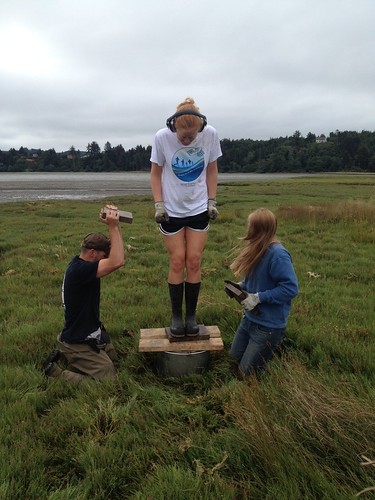
Pounding in cores at Aquarium Marsh today

My work here in the marshes of Oregon has been challenging in ways I would not have imagined when I applied for the position. Not only have I dealt with the rigors of science in the field, but I have learned a number of survival skills. The picture above shows me using my weight to help with the pounding of the cores. Even though this job does not require physical strength, it does require bravery. (Though I don’t look very brave in this picture!) There is something unnerving about two 40 lbs. weights getting slammed three inches from your feet while two plywood boards holding you up gradually slip apart and the platform beneath you drops an inch each jolt. I have never felt an earthquake before, so perhaps this experience will prepare me a bit.

I have been informed that in the event of an earthquake within twenty miles offshore, the ground at Hatfield Marine Science Center will liquefy and we’ll have a heck of a time getting to high ground before the tsunami hits. My training in the mudflats of Yaquina Bay has given me some preparation for this. Friday we went up river from HMSC to a piece of marsh that had a great stretch of mud we had to cross to get to it. The plan was to take us three interns and the rest of the gear across the mudflat on the hovercraft from the boat. Once we were all piled in, we realized the hovercraft would not move. So Dave, our ever so kind driver, told Taylor and I to get out. Immediately upon stepping out, the mud swallowed Taylor’s leg. I helped pull her out, then walked a few steps away and I started sinking too. It’s a scary feeling being trapped like that. But you have to be patient. If you get too anxious and pull out too fast you can tear your leg muscles and ligaments. Jody, our dedicated lab tech, helped me out then gave me some quick advice for how to walk on mud. Lightly. Just glide across. Walk on the balls of your feet. Don’t stay in one place too long. So I could either stay and wait for the hovercraft to get me and sink possibly further, or charge across the mudflat with my own two feet. I decided the second option. So I made a run for it, sinking in four inches each step, feeling near doing a face plant multiple times. Once across, I was out of breath and exhilarated, having conquered a fear I had all summer!

I have also learned a few other potentially useful non-science skills. I know how to tie a boat to a dock, how to attach the boat to the trailer, and how to operate a jack to most efficiently pull cores out of the ground. It is nice learning to be more handy.

Today we did our last day at Aquarium Marsh, which is sad. I am busy now trying to collect the data into a spreadsheet for my individual project studying the effects of water temperature on nutrient uptake, and finding a way to analyze it and present it. While doing this, we are still continuing the overall project as we travel to Alsea Bay tomorrow and Winant in the Yaquina Thurs and Fri.

This weekend was a great one as my family visited from Seattle and Chicago. We rented a cottage near the beach south of Lincoln City and I got to visit and explore the coast with them. I took my grandpa on an estuary walk given by a fellow scholar, Brian. My grandpa was very adamant about learning everything he could about estuaries as he is a scientist as well, though estuaries are out of his area of expertise. Also, I loved watching my baby nephew toddle along at the beaches we visited. He is great at walking in sand and will one day be a fantastic mudflat walker I’m sure.

Week 7: Phytoplankton galore!

Each week it get’s harder and harder to piece together the whirlwind that was my life in the past seven days, but here I am again to give it another shot. From what I recall, I seem to remember spending a significant amount of time with 2 liter bottles. Yes, that sounds about right. Which estuary were these bottles from though? Yaquina? Nehalem? Alsea? Umpqua? Siuslaw? A combination of the above? And what kinds of responses did they show again?

Digging deeper, I can confirm with 99.99% confidence that we conducted a phytoplankton limitation experiment with water collected from the Siuslaw estuary. While, I haven’t extracted and analyzed the chlorophyll from these samples yet, the in-vivo results seem to suggest that this particular estuary was both nitrogen and phosphorus limited in different locations. Given that the alder cover in this particular estuary was about 7.4%, compared to the largely “P” limited Yaquina which has 13.4% alder cover, this is an interesting result. Remember, alders are tremendous nitrogen fixers, and are huge source of the nitrogen that eventually ends up in these bodies of water. Looking forward to this week, we have samples from both the Nehalem system up north, and the Alsea system in Waldport. These systems have 5.15% and 7.9% alder cover respectively, so I would expect to see similar results, if not outright “N” limitation.

Alright, now to take a little step back from the data. This week will be week eight, and after this week we will have conducted a staggering six phytoplankton limitation experiments from the estuaries I listed above. Those two weeks we missed were my first week on the job, and the Fourth of July week. Other than that, I have helped conduct an experiment each week I have been here. It has been a tremendous experience, and I can’t even fathom how much I have grown as an aspiring scientist. I have also grown more and more intrigued by the field of Marine Pollution and Water Quality. It is an area of marine science which I am going to spend a considerable time investigating once I finish up this internship, and begin to contemplate graduate school programs. Alright, that’ll do it for this week. Until next time!

New survey site, habitat data, and muddy mishap

 Last week we journeyed once again into the South Slough of Coos Bay for another Cockle sampling. This time we went to Valino Island, which represents a more heterogeneous habitat than our previous survey at Indian Point. That is, the substrate at Valino Island ranges from a softer, muddier consistency to a firmer, sandier consistency whereas Indian Point is more consistently sandy. Much of Valino Island is muddy, so the raking and walking were a bit more arduous. There was also considerably more eel grass at Valino, so we wanted to take some extra care to minimize our impact on it. Nonetheless, we managed to rake up around 120 cockles, which I measured, weighed, and put into the database. The cockles seem to be less abundant in the muddy areas with eel grass and more abundant in sandier areas closer to water sources like channels and pools. We’ve thus decided to expand the study to include habitat as a factor for cockle distribution. Since we didn’t take habitat info down in our initial surveys, we took some extra time and revisited each quadrat at each site and recorded various habitat aspects: substrate type (sand, mud, smud [sand+mud]), presence/absence of eel grass, presence/absence of gaper clams. (note: for a more detailed description of our field methods, see blog entry for 7-23-2012). In my last blog entry I mentioned starting in on some stat analyses. Due to last week’s fieldwork, we weren’t able to start much in-depth interpretation, but we did decide to collect some extra cockles at each field site to boost our sample size. We randomly selected approx 20 quadrats at each site and raked up about 70 extra cockles per site. This should help beef up our data for further analyses. So far it looks like nonparametric hypothesis tests are the way to go, because our sample sizes aren’t large enough to assume a normal distribution. Something I’ve learned through these initial stat analyses is that our sample sizes need to be very large in order for standard parametric tests (T-test, ANOVA, etc) to be valid. This morning we journeyed back to Valino Island to collect habitat data and more cockles. My confidence for walking on soft mud has increased—to a fault: at one point I let my guard down, my foot got stuck, and I fell right on my backside in the mud. Luckily my chest waders saved me from total disaster. Nothing hurt but my pride, and I may have an interesting photo to share. The rest of the week I’ll be generating pivot tables, which are very helpful/powerful when looking at data (more about those later when I learn more) and doing some more in-depth stat analyses with the new habitat info.

Preparing for the end

Well it has definitely been an interesting time here at Hatfield.  We have had some bright sunny and very warm days and then it changes completely to a fog bank that makes me unable to see even the bridge that crosses over the Yaquina Bay.  This past week I did get 2 days off like regular and during that time I slept, watched olympics, did laundry and planned out more of my vacation.  At work, I got to meet some more amazing volunteers and visitors that made my time here much more fun.  I got to do some awesome aquarist work where I got to inject lemon juice (acidic) into aplasia which is a coral invasive.  Doing that, taught me a lot about how to keep a tropical fish aquarium clean and healthy.  I also was able to siphon the tank by myself, which meant I got to change the tropical water and decide how to treat it correctly.  I was also able to see Auroras beak! It was a spectacular thing to see and I may never see an octopus beak again, but now not only do I have memories of it, I also have pictorial evidence as a reminder of my sensational summer here at Hatfield.

My wave tank though is at a standstill right now.  Both my mentors and I are now at the next stage of progress that will require a lot more than just signs and sand.  We need to start making real stainless steel tables and other items that are more than I can do myself.  Which means mainly that time is now an even larger factor, but I’m hoping for all the best.  I still get to see all the different things kids imaginations make with my freshwater wave erosion tank and that still poses some fun challenges for my job.  Ocean quest keeps getting better and better as I get more and more comfortable with it.  I also get to hear more stories about the Mt. St. Helen’s eruption in 1980 which gives me more facts to talk about as the presentations keep going.  People told me how they had to wrap their air filters in toilet paper every few miles to make sure they didn’t breathe in ash as they drove to work each day.  Some said they still has ash from 1980 in the woods of their backyard. It’s crazy learning all about the different experiences people have had with volcanos and earthquakes especially when they’ve had experiences all through their lives.  Then, estuary walks are always amazing because no matter how many people you have or the age differences between the people I still always have an amazing time and I learn more and more after each estuary tour.   Also, each estuary tour is different since the tide is different from being a low tide or a high tide, and of course the people change each day.

The main things I have to look forward to are a five day weekend which involves me going to Vancouver, Canada for 3 days and then meeting up with my other housemates (kate, maryna and hillary) in Seattle for a few days.  I get to take the amtrak train on the west coast for the first time.  Everyone keeps saying I’ll see some beautiful views along the way, so I only have high hopes for the trip :)  I also can’t wait to see if more progress can be made on my wave tank while I’m gone and then when I get back.  Mainly because once I get back I only have 11 days before our final presentation to get everything together.  Wish me luck and a great vacation time!