Coos Bay Adventures

It has been a busy second-to-last week on the nutrient uptake project. The first two days were spent finishing up our five replicates at Winant, a special little salt marsh that is near and dear to the hearts of many at the EPA. Wednesday was spent in the lab doing more data entry and looking at the cross-estuary results to see how they could be incorporated into my project on the effect of temperature on nutrient uptake. We also prepared for our two day trip to Coos Bay, which included scrounging up as many coolers as we possibly could to house all our precious nutrient spiked salt water for the overnight journey.
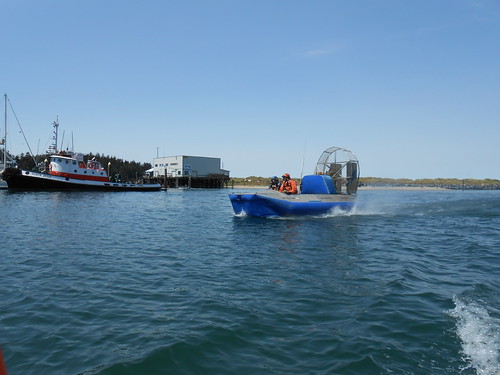
hovercraft

Hovercraft in Coos Bay

Thursday we began our trip to Coos Bay. Looking at Eric’s photos is seems like we got lucky in terms of getting a cloudless, fogless day. Above is a picture of the hovercraft at its peak of performance, hovering through the bay. Another researcher at the Oregon Institute of Marine Biology wanted a ride so she got one. Below is the site we studied the first day. A fellow intern is seen walking through the mud. I lost both boots in this mud and had to pull them out with my hands. I think I need to work on tying them better. This site was more pristine than other sites and relatively devoid of human presence, which was ideal for our experiments and for our own pleasure. It was peaceful.
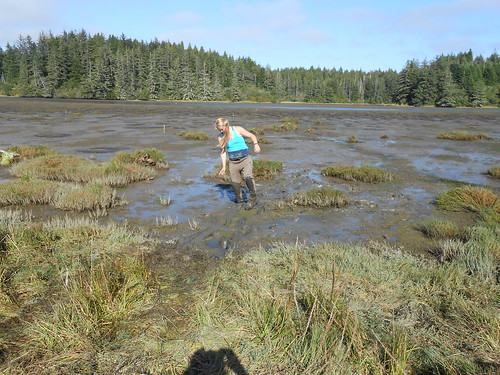
Coose Bay site 1

Taylor mud walking at first site

That night we went to the best and possibly only Thai restaurant in Coos Bay and then went to our yurt to sleep. I had always wanted to sleep in a yurt so I was excited, but after a nearly twelve hour work day I was too tired to marvel long at its yurtliness. The next morning we awoke early to get to our second site shown below. This site had its issues as dogs roamed free to poop and pee anywhere they pleased as it was near a trailer park, quite the contrast to our site from yesterday. My mentor had originally wanted to go to a slightly different location, but No Trespassing signs blocked our entry and he did not want us ending up on a WANTED poster. Our next attempted solution was to cross a section of the mudflat to get to some salt marsh islands. We brought some equipment out there, but quickly realized we would be screwed for getting out when the tide came in. We quickly returned to the mainland and sure enough, in the middle of the experiment the tide came, which would have made the passage quite difficult.
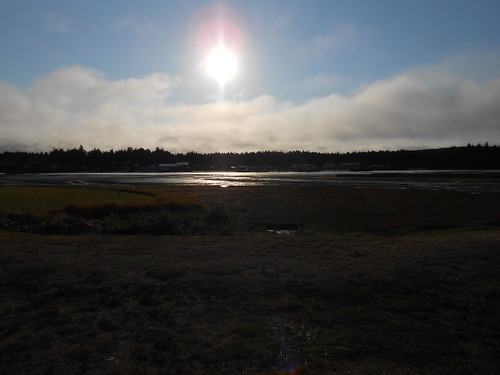
Coos Bay site 2

Coos Bay second site

In the end, we set up our experiment in the marsh where the dogs roamed. I am not sure about the quality of that data. After these experiments we quickly returned to Newport so my mentor could meet with some visiting EPA people from Washington D.C. It is important to show them that research is active and thriving (which it is!) so they know their funding is going to a worthy cause.

It is hard to believe that my internship is almost over here in Oregon. It has been a great summer with a lot of experience gained and a lot of memories created. I just need to finish it up by giving my presentations, writing my paper, and finishing the last bit of fieldwork on Monday. I am sad the summer of fieldwork is over, but it has inspired me for graduate school and beyond.

This weekend has been a lazy weekend of hanging around in Newport, which is fine for me because I finally–after nine weeks of deliberation–bought a ukelele! According to Google it is the easiest instrument to learn, so I am optimistic of my ability to make some good sound come out of it. I also hope to surf today. We will see how that goes.

Foggy Adventures in Tillamook

This week marked the end of my time in Tillamook helping with the subtidal survey. Just like many of the other projects I have helped with, just because I am leaving doesn’t mean the sampling is done and the team will have to round up some volunteers to fill my place for the rest of the sampling days. Nobody seems too excited about that, to say the least.

This week in Tillamook turned out very different than my previous visits, mostly due to some thick fog causing problems. We quickly found out that fog, main channel sites, divers, and safety don’t mix. Nobody was hurt, or even close to getting injured, but we were kept on our toes by constantly peering through the mist trying to make out were other boats where in relation to our divers.

The week started out really great. On Monday it was “warm” and the sites were short and sandy. We ended up getting a whopping 16 done by about noon so once the wind picked up we called it a day and headed in. It was strange to be done sampling and measuring at 3pm because normally we have been out working until 4-5pm. After we all had a little time to ourselves, my coworkers and I went to a nearby blueberry u-pick and got a ton of super delicious berries. Standing out in the sun among the rows of berries was very relaxing but made me miss my garden back at school. I only got 1/4 of a flat because I was unsure I could eat all the berries before I need to leave in a week. I’d never had fresh blueberries before and I was very surprised at how different they are from store-bought blueberries (something I have never been a huge fan of). After picking blueberries, everyone (including the divers!) went out to dinner to celebrate my coworker Natalies birthday. It was fun to chat with everyone outside of work and we finally got to know the divers a little better.

The rest of the week was a little crazier. The fog rolled in right about the time we started sampling which made the whole situation a tad stressful. We were in the middle of the main channel that runs from Garibaldi harbor to the ocean and our samples were taking longer than the day before. After we got a few “yahoos” speed by us in the fog (a little too close for comfort) we decided to stick to the edges of the channel while the fog was around. It helped a little, but some people still were going around really fast and didn’t really know where they were going.  The current and wind picked up a lot around 12pm again so we had to call the day early. The last site we did was so difficult because of the current that the divers had to stop halfway through to change tanks. By the time they got back it was obvious that we were not anchored and had dragged the dredge and sample ring around in the water so we couldn’t continue on that site. We only got 10 samples that day, which is much less than the 13-15 we have been getting in Tillamook.

Wednesday was another foggy day but we were prepared with lights and airhorns from the beginning  and stayed on the edges of the channel. There were still yahoos running around and making us pay close attention to our surroundings. After we set a few points on the chase boat we got a call from the dredge boat that someone had stolen our gas can overnight. but because they had already left the docks they would rather get started on the points with the gas they still had in the motor. So the chase boat went back to the docks and began our search for a gas can. We checked the marina store: nope; we checked the closest gas station: nope; the only other gas station: yep, but only a 2 gallon can. We got that because it was better than nothing then headed to the last place in Garibaldi, the single grocery store. They also had a 2-gallon can but it was more expensive so we kept the one we had. We then returned to the marina to get marine grade gas (can’t have ethanol) and headed back out. The rest of the day went much like tuesday: lots of fog, high currents, and a quick wind pickup. We finally called it a day when the divers were obviously having a tough time keeping the dredge in one spot due to the current. One of our safety protocols is that the divers can at any time decide to stop based on the conditions in the water. While they didn’t directly tell us the current was too strong, it was apparent they were having a lot of trouble so we called it for their sake even though it was only 11am.

Thursday and Friday I had off (yay 4 day weekend!) so I went to Cape Perpetua and hiked around. Unfortunately the fog obscured my view but it was a nice walk nonetheless. I also made a blackberry pie for some interns that left this weekend. I have also been spending a lot of time working on my presentation because this coming week I have 2 more days of fieldwork before I get some time in the office to work on it with Tony. Hopefully I’ll get enough done before then that those 2 days won’t be too hectic.

Fotos of fog.

A few photos of last week here in Charleston/Coos Bay.


Fog off of Cape Arrago. It's been like this most of the week.

Another fog shot. You can't see them, but there are pinnipeds all over the rocks making quite a racket!

Foggy daze in Charleston, OR

Change is in the air here at OIMB. Most of the students have finished their classes and are now packing up for their moves back to Eugene or whichever part of the country they came from. A handful that are taking an intro stats class remain, but campus has quieted down significantly. Despite not being in class with them, I got to know most of them pretty well, and it’s been a pleasure spending the summer with a great bunch of up-and-coming marine scientists.

Due to fog and unfriendly seas, the urchin surveys didn’t happen last week. It was also a short week due to a mandatory furlough day for ODFW on Friday. Much of my time was thus spent assembling my Power Point presentation and measuring a few samples of pink shrimp that came in. The toughest part of my presentation is definitely the results section. I feel like I pretty much have the interpretation down, but the organization as far as slide order and how to tie it all together for effective communication is a bit tricky. Scott has, of course, been great with helping me to fine-tune it and in providing constructive criticism, but it’s ultimately up to me to finalize it and present it effectively. Oddly enough, the final “thank you” slide is also posing a bit of a challenge. The list of people to include is quite long, and as I whittle it down to be more manageable I feel a tinge of guilt as I remove names and relegate them to the “thanks to everybody else” category. These things must sometime happen. Other than that, I’m very happy with the way my presentation has come together. I look forward to the symposium this Friday with a little nervousness but mostly optimism and high hopes.

My last week here in Charleston may or may not involve sea urchin surveys. As with the previous week, it’s all weather dependent. So far the forecast is for more fog, so I’m not getting my hopes up. It would be so nice to finish up with some fieldwork, though. The last two weeks have largely been spent in the lab or in front of the computer, which I’ve learned is not my favorite place to be despite the satisfaction of seeing the results of my project and gaining much-needed software skills. There’s been talk among the remaining students here of having a bonfire on the beach tonight, so maybe I’ll do some sort of ritual to stave off the fog and reel in some sun.

I bid you peace.

Beginning the End

This last week it really hit me how my time is coming to a close at Sea Grant. In all the bustle following the workshop I almost forgot that I have my own little project that I have to create! I won’t say too much, but scattered between my work with Roseanne and Melissa on travel reimbursement and budget maintenance, I have been trying to pull together my thoughts about the workshop and also drawing from post-workshop documents in order to synthesize my own ideas and conclusions about the event planning process and what it meant for my own learning experience and also for the broader context of a regional response plan for JTMD-biofouling issues. In addition, I have also been working to pull documents together for a report to give to Stephen and eventually, back to the National Sea Grant office. This involves some amount of communication with people on the east coast, but it seems like nothing compared to what I have done to put together the workshop.

An interesting development since the workshop seems to be the way it has spurned action on more than the intended front. Even at the workshop it was evident that while a major reason for the workshop was to get feedback and discussion going on a few issues that key parties wanted input on, it also allowed state representatives to see what other states and agencies were doing, and able to compare actions and generate ideas. I think many took valuable lessons and ideas back to their states, especially since not all states have had to deal with ‘major’ tsunami marine debris issues like Washington, and especially Oregon has. Some of the ways this has kick-started action is visible in the Sea Grant office. Since the workshop, Stephen and the other West-Coast Sea Grant Directors had a conference call to discuss the role of the West Coast Sea Grant programs on marine debris and invasive species and the potential for another, smaller workshop that would involve 4 or 5 at the most representatives from each West Coast state. From preliminary discussion it seems a major goal would be to build off the discussion held at the workshop, with focused representation from each state. There is still much to clarify and narrow within this proposed scope, but it is a good start!


Week 8: Experiment…Finished!

After eight practically non stop grueling weeks of collecting and analyzing, the phytoplankton limitation experiment has largely been completed. Wow. I can’t believe I am saying that myself. We have completed the in vivo portions of phytoplankton limitation experiments from Yaquina, Siuslaw, Umpqua, Nehalem, and Alsea. And we did Yaquina three times. Just saying.

The most recently completed experiment from both Alsea and Nehalem responded well. Alsea showed “N” limitation which I believe I predicted last week, and Nehalem showed a combination of “N” and “P” limitation which I believe I also predicted last week. Not to toot my own horn or anything.

Just because we finished the in vivo doesn’t mean there isn’t work to do though. I have some chlorophyll samples to extract from Alsea and Nehalem, some acid washing to do to get the bottles all neatly put away for another day, some data to analyze, and a presentation to create that will knock the socks off of everyone at the symposium.

And because the symposium is rapidly approaching, I won’t say too much more about how my eight weeks of data is looking. Wouldn’t want to ruin the surprise! Alright, until next time!

Filming faux pas

Last week proved to be one that posed its own unique set of challenges, primarily with technology. As I’ve been going through the interview processes for the media clips, I’ve be touching base with Stevon Roberts, who resides in the fourth floor editing bay in Kerr. He has been more than gracious to show me the ins and outs of Final Cut Pro X, the digital editing software. It only varies a little from the program we use at school and so far, seems to be pretty intuitive.

On the other hand, the cameras, microphones, and such, have not. Each camera that I have (attempted) to work with has been different, and each has its own little quirks. For an interview with one of the grad students last week I reserved an interview room in the library that comes with its own camera. After getting lights that work (no windows in the room and on of the lights was burned out), finding out that the camera (which is mounted on the wall) cannot be adjusted, and getting a memory card (which was supposed to already be in the camera), we were able to begin the interview. It wasn’t until I was trying to download the videos that I found out that the Canon handicam I was filming with records in an .mts format, which Final Cut doesn’t recognize. This presented its own set of issues. Finally, after multiple trips to the library, and one very gracious person at the media help desk, I was able to at least get the video onto the desktop in the editing bay. More research and a brief conversation with Stevon, and I was able to get the video into Final Cut.

From this day (yes, all of this took a whole day), I learned that you can never be prepared for everything when working in the field. After making sure my Final Cut folders were ready for the media and calling ahead to make sure the room was set up for the interview, there were still a host of things that went wrong. But, despite all the frustration, I’m glad to say I’ve learned of some more items to add to the preparation list when getting ready for an interview.

Results are in!

Things are winding down on the nutrient uptake project. We finished the last replicate day of experiments for my temperature experiment on Monday. I have looked at the data now, but I don’t want to discuss it here as I still have to do some further thinking on it. I will say, though, that there are two bars on the graphs I have created that made me jump out of my desk chair with excitement. I stayed after all my coworkers had already left creating this graph and thus had no one to share this excitement with until the next morning. It was agonizing.

Putting this excitement aside, the mood in the lab this week has become more somber for me. I am realizing that this summer is drawing to a close and the great times I’ve had at the EPA are as well. I’ve enjoyed getting to know the people in the field group and the lab, sitting outside under the Oregon sun in sometimes boiling waders, tromping through mud, gaining strength by lugging stainless steel cores across varying terrain, pouring liters and liters of salt water while belting out Hakuna Matata, jumping in and out of boats and getting splattered with mud by the hovercraft. It has challenged me in many ways and helped me to realize that I truly love field work.

There are now two weeks left to get a ton of things done. I need to prepare my presentation, which I am giving to the EPA and to the Oregon Sea Grant. I also need to discuss with my mentor what sort of write-up he wants on my project. There is also a portfolio that I am doing for the Sea Grant. It should be a busy two weeks. We have collected a lot of data this summer from many different estuaries. I am curious to see what sort of “story can be told,” to use the words of my mentor.

At the end of this week we have our last field hurrah down in Coos Bay. It will be an overnight trip and I think we are camping out somewhere. I need to get rest for this week as this weekend has been tiring. My roommates and I went up to Seattle and then down through Portland and Tillamook doing various touristy things, with a stop at Powell’s Books! I can never get enough of bookstores.

Muddy Dredging and Presentation Prep

This week was much the same as last week: lots of intertidal dredging. On Monday and Tuesday I wasn’t on the boat but I went to measure the samples when the boat team returned to the office. On Wednesday and Thursday I was out on the boat nearly all day. Its really tough to stay in a dry suit that on because after about 5 hours you start getting sweaty and the inside of the suit (which is made to not allow the transfer of moisture) gets really sticky and uncomfortable.

Last week we did dredging on Bridge flat, which is all sand. This week we dredged at Sally’s Bend, which is a huge mud flat, and boy did it make a difference. In case you weren’t aware, mud is much stickier than sand. And this made it much more difficult to get our samples. It generally took 25-35 minutes for each site on Sally’s Bend compared to 10-20 minutes for sites on Bridge Flat. It also took much longer to sort the mud out of the samples and we had to rinse the bag in the water every few minutes. Luckily it was pretty warm out on the days I was out sampling so sitting in the cold water that long wasn’t terrible.

On Friday we finished measuring clams and then prepped gear for our next (and my last) excursion to Tillamook. We will be there until Wednesday night, and beyond that I’m not sure what the week will bring. Hopefully some time off to relax!

This week I also met with Robert Allen, the Director of Student Development for the College of Earth, Ocean, and Atmospheric Sciences at OSU. We chatted about what direction I have been moving with my degree and what my plans are for the next year and beyond. It was really great to hear I have been doing well and that I don’t need to rush off to graduate school if I am not ready. He also recommended taking some time off (if I want to) and do something really awesome. He mentioned Peace Corps and Teach for America, among other options. I feel much better now about how I am going to spend my final year of school preparing for the future.

This weekend I made a quick run up to Seattle with Kate, Hilary, and Diana. Kate and I left on Friday after work and met Hilary and Diana up there. We went to the Aquarium, Pike Place, and rode the ferry. We also briefly stopped in Portland on our way back. I wish I had more time to explore these places!

I’ve also been working hard trying to get my presentation into shape. Its rather frightening that I have a mere 2 weeks left before I have to make the trek home to California and prepare for my last fall quarter. And because I know that I’ll be doing lots of fieldwork in the meantime, I wanted to get started as soon as possible. Here’s a sneak preview of one of my slides as it is now. Hopefully next week I will have pictures of dredging and my last days in Tillamook.

Yesterday was the most chaotic day at the VC while I’ve been interning here.  Chaotic days are definitely more fun than a non-chaotic day.  Here’s how it goes.  First off, no coffee.  This is nearly always a good start to a chaotic day.  Coffee is definitely a must each morning and as it was the weekend there was no coffee in the dining area yesterday.  This is something I expect on the weekends but the rest of the day was very very unique.  Both my supervisors, Becca and McKenzie, were absent yesterday.  It’s the first time both of them have been gone at the same time and this is problematic because they are the first line of defense when something goes awry.  So when things went bad, as they did, there weren’t really many people to go to.

In the morning Athena was heading up an invertebrates class for high school students and she was the only one around so she was stressed out.  Athena out.  Just a few minutes later another huge unannounced group of university students came in to have a vet lecture with Dr. Tim and Kristen.  Dr. Tim and Kristen out.  Next another unannounced group of vice presidents and administors from China came expecting a tour from Shawn Rowe.  “Okay lets get Shawne.”  No Shawn for 15 but he eventually showed.  Phew hopefully nothing else too crazy happens. Nope next there’s a leaky shrimp tank that is spilling water all over the floor.  Becca and McKenzie are gone, Kristen is in a class, so we got Tim to help us mop up.  Next the last unannounced group shows up.  This was a group of OSU students taking a Physical Oceanography course.  Apparently they were expecting a tour of the facilities but nobody had any idea what they were talking about.  So I ended up canceling the estuary tour at 11 and brought the group all over Hatfield and talked about research, student involvement, and then the estuary.

To make things more chaotic the only certified octopus feeder at Hatfield yesterday was Athena and she was doing her inverts class.  The show must go on so she came out and rocked the octopus feeding.  Our only volunteer in the morning disappeared for awhile and then two guys with firearms on their sides came in to end the day.  Kind of stressful but definitely kept me on my toes.  The day went by more quickly than any other of the summer.