Legislative Update from Oregon Sea Grant’s Legislative Fellow

To date, it has been an incredible experience serving as the Oregon Sea Grant Legislative Fellow, working for the Oregon Legislative Assembly’s Coastal Caucus, and being a part of the 2013 legislative session.

Last week (that of April 15th) marked two important benchmarks for this legislative session: the halfway point of the session and a deadline for bills to pass out of committee in their originating chamber. A symbolic marker, the halfway point denotes the mid-point between the beginning of this legislative session and the constitutional sine die date of June 30, 2013. It is at this time that many legislators take stock of what work they have accomplished — and what legislative goals they yet have to achieve. As of today, 2,631 measures have been introduced, 357 passed by the House, 266 passed by the Senate, and 47 signed into law by the Governor.

Last week’s calendar included a second important procedural marker: the date by which bills must be passed favorably from committee in their originating chamber. In the Oregon Legislative Assembly, much of the work is completed in committee. Once introduced, bills move next to the chamber floor for a first reading, and from there are assigned to a committee by either the Senate President or the Speaker of the House. Senate bills are referred to one of ten Senate committees and House bills are referred to one of sixteen House committees. In lieu of chamber-specific committees, a bill may instead be referred to once of six joint committees.

It is in these committees where much of the work happens in the Legislative Assembly — and where the fate of most Oregon legislative measures is decided. A committee may essentially “kill” a bill by simply failing to take any action on it. Further, a committee may conduct a public hearing on a bill (to gather public input and feedback), but may then decline to hold a work session, meaning they will not vote on the bill; this is another action that will “kill” a bill. To continue on in the legislative process, a bill must receive a majority of committee member votes — allowing the measure to pass from the committee and back to the chamber floor for a vote by the Senate or House body.

Last Thursday, April 18th, marked the deadline by which bills must have been voted out of their originating chamber’s committee*— House bills from House committees and Senate bills from Senate committees. This deadline serves, to some degree, as a procedural sifting mechanism. What does not move from committee by this date does not move forward and is essentially a “dead” bill.

Two small factoids provide some context to the importance of this deadline: prior to the April 18th deadline I tracked close to 300 bills (293 to be precise) for the Coastal Caucus; today, my list contains 123 bills — an almost 60% reduction. While this represents a mere snippet of the thousands of bills being considered by the Legislative Assembly, it illustrates the functional value of the deadline, which serves to considerably shrink the universe of bills that the Legislative Assembly must now consider and assess. Of course, this is most important as the days of the 2013 legislative session begin to grow shorter.

Several important bills impacting the ocean and marine resources made it out of committee by this deadline— among others, Senate Bills 580, 605, 606, and 737; and House Bills 2694, 3451, and 3476. I will discuss those in more detail in a later post, but you can search for the bills here to keep an eye on their progress: https://olis.leg.state.or.us/liz/2013R1

The next major deadline on the horizon is June 1st, the last day for policy committees to move measures that originated in the opposite chamber out of committee.

*Three types of committees are exempt from this requirement: the Joint Committee on Ways and Means; the House or Senate Committees on Rules; or the House or Senate Committee on Revenue.
Things Learned Lately

This is something I have never wanted to admit, especially as a young marine scientist. It is something that I did not think was true. It is something that I never thought could happen to a person who has grown up riding roller coasters.

I get sea sick.

I discovered this last friday when we went out on the boat in my deep sea and subtidal ecology class. Instead of staying in the bay, we found ourselves passing through the mouth the jetty into the ocean. We were going out to deploy a go pro camera sled to look at the sand dollar beds right offshore, hoping to discover something about their distribution after discussing a study on sand dollar bed ecology earlier in class.

I was excited to finally go out in the open ocean! Even though I grew up in the San Francisco bay area, my time spent on boats has been very minimal and mainly limited to paddle boats in the lake or kayaks during summer camp.

As we made our way out of the bay, a few of us sat up front on the bow, enjoying the sunny day as the sea breeze whipped past.

Upon arrival at the sand dollar beds, my friend looked over and warned, “This is when it’ll hit.” Little did I know what was coming next.

We deployed the sled for 4 minutes, hauled it back up, and looked at the video with excitement. Of course, the go pro moved on its way down, so we did not see any sand dollar beds.

Round 2.

When we started lowering it down again, I realized I did not feel good… At all. Trying to hold a conversation was about as difficult as an o. chem exam. I quickly shed all my layers and moved up to the bow. The entire rest of the trip I spent curled in a little ball, anxiously awaiting our return trip back home. Let’s just say when we got back, chili hot dogs for lunch did not sound a bit appetizing.

Thankfully, I learned a few more pleasant things this past week:

1. Teaching is really fun! We had the opportunity to take a visiting class of freshmen and sophomore biology majors to the mudflats and tide pools sunday morning. Even though I’ve only been taking invertebrate zoology for 2 weeks, I had fun sharing what I did know about the worms we dug up in the mud flats and all the amazing creatures we found tide pooling. My favorite moment was when one girl asked about “floating jelly balls” she saw at the dock the previous day. I was excited to tell her all about ctenophores, which we just learned about in class.

2. There is nothing like a long run with friends on the rim of sea cliffs to start a Saturday after a full, hardworking week.

3. Making tissue sections is a pretty relaxing way to spend a couple hours after studying all morning, especially when listening to my favorite podcast. I’ll write more about this project next :).

4. Worms are wondrous! We learned all about Platyhelminthes (flat worms) and Nemerteans (ribbon worms) in class today. I particularly like the flat worms; their little tentacles and eye spots are cute. We also placed Nereis (a polychaete) in a tub full of Paranemertes. In the mudflats, when Paranemertes  comes across a mucous trail of Nereis, the chase is on! OnceParanemertes catches up, it attacks with its proboscis injecting paralytic toxins into the polychaete. It was amazing seeing these tiny nemerteans attack this giant polychaete with their proboscises.

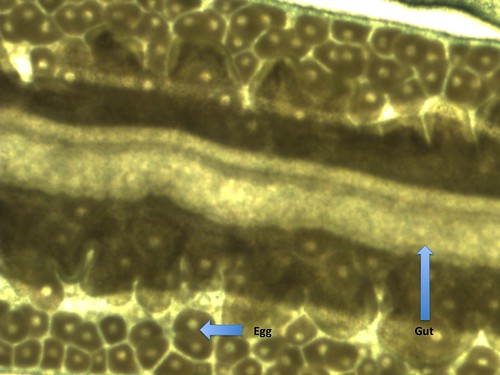
I’ll end with a wondorous picture of Emplectonema gracile, a beautiful green Nemertean. I put it under a compound microscope to be able to draw its internal structures (gut, brain, gonads, etc…). I saw all these giant cells next to the gut thinking they were normal cells (what constitutes a “normal cell” I’m not really sure…), but when I asked my professor he was surprised to see so many eggs!
Emplectonema gracile
The adventure of work and learning continues!

And one day, sea sickness will be conquered.

Back in the Bay

It’s hard to believe Winter quarter is over, and I am back at OIMB after an eventful, yet relaxing spring break in California’s Bay Area. I enjoyed spending time with my parents, my best friend from back home, visiting my sister and her husband in their new house in Southern California, rock climbing with my older brother, and going to San Francisco with a few of my friends from Oregon. Now it’s back to work!

Returning to OIMB on Sunday and seeing friends from fall quarter as well as meeting new friends was great. We even got Easter baskets with our dinner! :)

This quarter I am taking Invertebrate Zoology and Deep Sea Ecology as well as a class in preparation for a 2 week trip to Panama in the summer (I’ve never been out of the country before!). I’ll also be working on my honors thesis. This will be a busy quarter, but I am looking forward to the work and learning.

IMG_0492

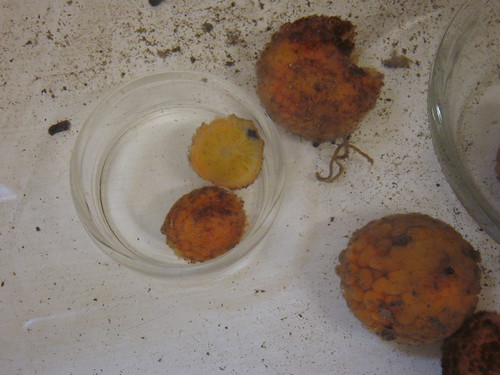
Tethya california. A cross section looks like an orange, with spicules radiating from the center.

Tuesday was our first class of inverts, and we learned all about sponges. I’ve seen sponges before. I’ve touched sponges before. I thought I knew a bit about sponges. I also thought they were not very exciting…but I was wrong! Sponges are pretty cool little creatures, especially considering their sessile life. Essentially, two cell types are responsible for the circulation of water, capturing and digestion of food, excrement of waste/foreign particles, and capturing or dispersal of sperm/egg. It’s crazy that four processes that require four different organ systems in humans can be carried out by two cell types in a sponge!

In the lab, we looked at sponges under microscopes, which we then had to draw in our lab books. Some people’s drawings are amazing! (and I’m not talking about my own…) Besides going out to the tide pool to look for sponges, my favorite part was looking at the spicules that form the skeleton of the sponge, especially the spicules of Leucilla nuttingi

Thursday in inverts was part 1 of Cnidaria: Anthozoa. After lecture we walked down to the docks to look for sea anemones as well as collect jellies for later on. We found so many cool organisms! There were a lot of lion’s man jellies (Cyanea capillita), which are rare to see in the boat basin, the shaggy rug nudibranch (Aeolidia papillosa), ctenophores, and of course sea anemones! While we were out, it was pouring rain with strong winds, making it for a wet, but fun adventure. To top it off, we came back to grilled cheese and tomato soup for lunch! I also learned that sea anemones are much easier to draw than sponges.

The adventure of going out in stormy weather continued on friday in Deep Sea Ecology. After lunch, we went out in the bay for some otter trawls to study species richness. This was only my 4th time out on a boat and my first time doing this type of trawl, so it was really fun, even in sideways rain, choppy water, and crazy wind. We found a lot of cool organisms in the trawl, and since we just learned about sea anenomes the day before, we were able to identify Metridium senile to species! A tiny Pycnopodia (~4 cm in diameter) came up in one of the trawls. It was really cute, but right after we threw it back in the water, a gull came and ate it. That was a sad moment for all of us in our cruise.

Apparently we can’t get enough of the rain because we went out tide pooling on Saturday, in our free time, in a down pour… If the rain keeps going as hard as it has this week, I will definitely get my money’s worth out of my rain pants. I sure hope that the sun pokes out sometime this week to say hello.

Cyprids, Nauplii, and Copepods…Oh My!

These past couple weeks have been busy in Eugene due to outings with my outdoor leadership class, vertical rescue class, an overnight backpacking trip on the coast, and a term paper for my animal behavior class. The quarter is slowly winding down, as I was reminded last week when I signed up for spring classes at OIMB! I am very excited to take invertebrate zoology (I hear we get to do many dissections!) and deep sea ecology. I can’t wait to be back in less than a month!

At OIMB, classes are small and meet once or twice a week for the entire day. This allows plenty of time for hands on learning and actually doing science rather than simply reading and talking about it like most undergrad classes, which is why OIMB is such a great experience.

Research

Ready to collect some data in the wee hours of the morning

My weeks during fall quarter started with Biological Oceanography on Mondays. Before this class, I was never particularly interested in the physical aspects of the ocean, but I soon discovered the fascinating relationship between the physical condition of the ocean and how it affects the biology. We learned all about the seasonal cycles of phytoplankton and zooplankton, currents, the thermocline, warm core rings, upwelling, the coriolus effect, and so much more.

During one of our classes we were supposed to go out on the boat to collect plankton samples, but the ocean was too choppy. I was disappointed we were unable to go on the ocean because I have only been out on a boat in the ocean once before. Instead, my classmates and I performed a 24-hour plankton survey off the Charleston Harbor docks.

The goal was to note the variation in abundance of different plankton during various physical conditions (tide, time of day, vertical distribution). We were split into groups of two to cover a six hour shift from 10 AM on Saturday to 10 AM the following Sunday. We sampled every two hours by lowering a CTD through the column and collecting phytoplankton and zooplankton samples from the surface and at depth.I felt like a real scientist while lowering the CTD and dragging a plankton net through the water. Chris, my partner, and I collected samples on Sunday morning from 2 AM to 10 AM. Despite the fact that it was early and cold, it was exciting to collect our own data.  The sunrise was also very rewarding!

We spent all of lab analyzing our samples, which mainly involved counting plankton. This may not sound exciting, but it was so much fun! The first couple days were more difficult, as we were learning what all the different plankton looked like, but soon it was easy to tell them apart. The phytoplankton we counted were Coscinodiscus, diatmos, Navicula, Pseudonitzchia, Tintinids, and Distephanus. The zooplankton we counted were harpacticoid copepods, calonoid copepods, copepod nauplii, barnacle nauplii, barnacle cyprids, bivalves, polychaetes, zoea, and gastropods. My professor and TA’s enthusiasm quickly rubbed off on me as I realized how intricate, beautiful, and exciting plankton are. I always appreciated how excited my TA was when she saw a cyprid. I was always excited when I saw one cyprid in the midst of an overwhelming number of copepods. I have a fond liking for cyprids now and I think they are pretty cute :).

IMG_8876_1

The sun is about to come up!

In total we had 52 samples to count between 8 people. It took most of the quarter to count all the samples and once we finished, it was time to research what the abundance of plankton meant. At first I was overwhelmed by all the data we had, but my professor suggested to focus on relationships that I found interesting. I decided to focus on the influence of the tides and time of day on the abundance of zooplankton, specifically cyprids, barnacle nauplii, harpacticoid and calanoid copepods, gastropods, and polychaetes.

I found that the vertical distribution of zooplankton in the water column determines whether or not they enter, leave, or stay in the estuary. For example, harpacticoid copepods live in the brackish waters of estuaries, and during ebb tides, these copepods were more abundant at depth, possibly to avoid drifting out to the ocean with the tide.

Due to my fondness for cyprids, I was particularly interested in learning more about them as well as their earlier stage, the nauplius. Barnacle nauplii are late stage planktonic larvae while cyrpids are the non-feeding stage of a barnacle that is ready to settle in the estuary. Both nauplii and cyprids came in with the flood tide, but only nauplii left with the ebb tide, suggesting that the cyprids settled into the estuary to grow into adult barnacles.

This project was a lot of work, but it was also a lot of fun. I enjoyed collecting my own data and learning how to analyze the overwhelming amount. I was able to better understand all the relationships between the zooplankton and the water conditions because I collected this data rather than solely finding the information in a textbook our journal article. Learning from experience is the best (and most enjoyable) way to learn!

1st Quarter Report

So much has happened here during my first quarter at OEM! And there is so much exciting stuff coming up!  It’s going to be hard to fit everything into one blog.

The Western States Seismic Policy Council (WSSPC) Board of Directors recently announced the winners of the 2013 Awards in Excellence. The Overall Award in Excellence in the category of Mitigation Efforts went to the Oregon Emergency Management for the Oregon Seismic Rehabilitation Grant Program (SRGP).For more information, check out: http://www.wsspc.org/news/news_files/eNews_Winter13.pdf. 

“Oregon Emergency Management is honored that it has been selected to receive the WSSPC 2013 Overall Award in Excellence for the Oregon Seismic Rehabilitation Grant Program,” said OEM Director Martin Plotner. “The program helps protect the residents of the state by providing funding to rehabilitate schools and emergency facilities.”

For those interested in seeing some of the amazing work that has resulted from the Oregon SRGP, come meet us at Central Elementary School in Albany on April 24 at 9 am.  Central Elementary is one of the schools that received seismic retrofits through SRGP funding.  We will be holding an assembly there to talk about the progress of the SRGP, its impacts on Central Elementary, and its impacts on the entire State of Oregon.  There will also be a tour of the school in order to highlight the specific types of retrofits that can receive SRGP funding.   This is a great opportunity to learn more about the SRGP, to learn more about the importance of seismic safety, and to see exactly what a seismically-sound public elementary school looks like.  We will be joined by a number of State Officials and Legislators, as well as UO & OSU professors and seismic safety experts. Come join us!

The Governor’s Japan Tsunami Marine Debris (JTMD) Coordination Group held its quarterly meeting this past month.  A number of programs have been established to help mitigate the impacts of the spreading marine debris resulting from the March 2011 Japan tsunami.  This past month the Japan Environmental Action Network (JEAN), a nongovernmental organization, coordinated a visit to Oregon. Through this visit, JEAN and other participating Japanese organizations were able to share information about their disaster recovery efforts with U.S. audiences and do research on the tsunami debris showing up on North American shores. Oregon First Lady Cylvia Hayes welcomed the Japanese group and said their visit is important to her and to the people of Oregon. Hayes is founder and CEO of 3EStrategies, an environmental consulting firm. In the role of First Lady, she and “life partner” Governor John Kitzhaber have done several trade missions to Japan. Hayes does beach cleanups, convenes and speaks to groups about tsunami debris, and has filmed a public service announcement on the issue (seen here: http://www.youtube.com/watch?v=DtMkGz2qwE4).  For more information, read this article (http://ens-newswire.com/2013/02/18/oregon-welcomes-japanese-tsunami-debris-activists/) or check out the OEM website (http://www.oregon.gov/OMD/OEM/Pages/plans_train/tsunamis.aspx).

OEM has also scheduled the 2013 Tsunami Road Show at locations on the Oregon Coast.  The presentations will take place in Oregon coastal counties March 11-23. Residents will learn how to prepare for a tsunami should it strike the coast. Topics covered will include how to build an emergency kit, create an emergency plan, and prepare your family for a disaster.

“This will allow people to learn how to write their own survival story,” said Althea Rizzo, Ph.D., Oregon Emergency Management geologic hazards program coordinator, who is scheduled to present at the events.  For specific dates, times, and locations, check out: http://www.tillamookheadlightherald.com/news/article_86a9032a-81fb-11e2-b8c5-0019bb2963f4.html or http://www.oregon.gov/OMD/OEM/Pages/2013-Tsunami-Road-Show.aspx

There is so much more awesome stuff going on here at OEM! However, if you want to learn more about it, you are going to have to read my next blog.  Check out the 2013 Tsunami Road Show this month, come out to Central Elementary School in Albany on April 24th, and make sure to keep reading my blog for alerts and updates.

Hello!

Hi everyone!

My name is Christy Stumbo and I am a junior undergraduate marine biology major at the University of Oregon who has a slight obsession with sharks and giant squid. I am from the San Francisco Bay Area, but have fallen in love with the great state to the north. Growing up, my family  frequently went to Monterey to explore the tide pools and visit the aquarium. I believe these trips (and watching countless Jacques Cousteau documentaries on PBS) is where my fascination with the ocean began, and by 5th grade, I knew I wanted to be a marine biologist.
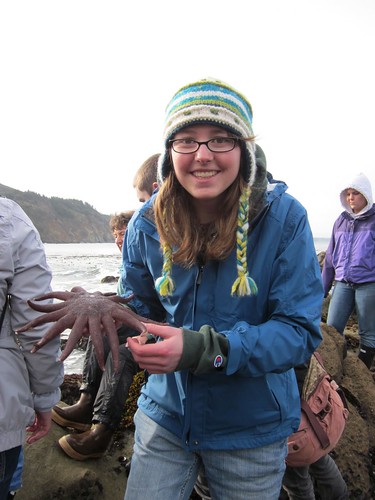
seastar

I specifically chose to attend the University of Oregon because of the marine biology program at the Oregon Institute of Marine Biology (OIMB), and I spent my first term there in the fall of 2012. It was a great experience! I was a bit nervous at first because I did not know anyone. I was even scared that what I dreamed of doing my entire life might not be something I actually enjoyed, but I had nothing to fear. I enjoyed all my classes, the field and lab experience, and making new friends who share the same excitement for the ocean. During fall quarter, I took Biological Oceanography, Molecular Biology for Marine Sciences, and Marine Environmental Issues. Although my classes were so diverse, there was a lot of overlap between all three.

I am  currently  in Eugene taking classes on the main campus, but I am anxiously awaiting my return to OIMB for the spring and summer. I am looking forward to being back, learning more about the ocean, working on my project, and surrounding myself with all things related to marine biology. Until then, I will share about my classes and experience during fall term as well as anything marine related that happens in Eugene.


NOAA Coastal Fellowship Progress Report July- December 2012

Greetings from the Washington State Department of Ecology! I’m now wrapping up the 6 month mark of my 2 year NOAA Coastal Management Fellowship.

First off, I should probably describe what my project is about: creating guidance to promote “Green Shorelines”. Green Shorelines is an initiative very popular in Puget Sound these days. Due to concerns of shoreline habitat degradation, water quality, public access, and other Puget Sound health issues, Green Shorelines, otherwise known as Alternative Shoreline Armoring, Living Shorelines, or Soft Shorelines, is being promoted along Puget Sound’s marine and freshwater shores. My project is focusing on the shoreline armoring aspect; more specifically, how to implement the removal of bulkheads and seawalls and replace them with either completely natural or those with “soft” and environmentally friendly stabilization techniques.

It has been a whirlwind experience for me and these next few paragraphs describe some of the things I have accomplished during my first 6 months as a fellow:

The first month of the fellowship was spent getting to know the office and familiarizing myself with previous Green Shoreline projects. I then created a plan to network with individuals involved with Green Shorelines projects and gather background information on the needs and barriers to Green Shorelines implementation. For the next three months, I conducted a needs assessment by interviewing experienced individuals from state and local government, shoreline consultants, NOAA, and Washington Sea Grant and discussed with them the issue of Green Shorelines. During this time, I read literature related to Green Shorelines including Puget Sound marine and nearshore literature, Washington Administrative Code related to shoreline armoring, and shoreline stabilization techniques. I have also participated in site visits with Ecology employees, viewed green shoreline sites, and attended public workshops and conferences.

During the last couple of months of 2012, I identified the goals and major long-term outcomes of my project and developed a draft work plan. I then attended a Coastal Training Program class on Project Design and Evaluation and used the skills I learned further refine my project by identifying short- and mid-term outcomes, outputs, and activities suitable for my two year fellowship. I have been in contact with other organizations and individuals involved with Green Shorelines, including the Marine and Nearshore National Estuary Program grant administrators, Puget Sound Partnership, Green Shores for Homes, and others on how to best collaborate our project products in order to further advance green shorelines implementation. I have given project presentations to Ecology and local shoreline planners to facilitate discussion and feedback on my project development. The project products identified so far include a Green Shorelines Stabilization Concept and Management Principles definition geared toward assisting shoreline planners in understanding Green Shorelines stabilization, assistance in promoting Green Shorelines through incentives, and training of local shoreline planners on Green Shorelines. I am currently working on a fellowship project summary to share with interested stakeholders.

It is definitely a steep learning curve, but the frequent shoreline site visits, ferry boat rides on Puget Sound, and the motivated people I meet every day give me the energy to tackle this issue. I anticipate the future months of my fellowship to continue to propel me forward in my mission toward Green Shorelines.

Until then…

Kelsey

My First Month at OEM

Hello World!

     My name is Geoff Ostrove and I am Oregon Sea Grant’s newest Natural Resources Policy Fellow.  I am a graduate student at the University of Oregon, pursuing a PhD in Media Studies from the School of Journalism & Communication as well as a Master’s of Community & Regional Planning from the Department of Planning, Public Policy, and Management.  For this next year, I have been given the amazing opportunity to work with the Oregon Office of Emergency Management (OEM) on a couple of really important projects.  

      The first one is called the Seismic Rehabilitation Grant Program (SRGP).  Over the last 10 years, the Oregon Legislature has recognized seismic safety as a critical element of Oregon’s disaster resiliency plan.  The SRGP is a State of Oregon competitive grant program that provides funding for the seismic rehabilitation of critical public buildings, particularly public schools and emergency services facilities.  Public K‐12 school districts, community colleges, education service districts, and universities are eligible for the grant program. For emergency services facilities, the emphasis is on first responder buildings, which includes hospital buildings with acute inpatient care facilities, fire stations, police stations, sheriff’s offices, and 9‐1‐1 centers.  The purpose of this grant is to help fund seismic retrofits to critical public buildings that are in serious need of improvements.  This grant is not intended to fund the construction of new buildings.  Buildings located in a tsunami inundation zone are ineligible for this grant.

     Which leads me to the second project that I am working on here at OEM: the Governor’s Japan Tsunami Marine Debris (JTMD) Task Force.  On March 11, 2011, Japan was hit with a magnitude 9.0 earthquake.  The subsequent tsunami impacted cities throughout the eastern part of the country, creating approximately 25 million tons of debris.  5 million tons of that debris is believed to have been pushed offshore, with about 3.5 million tons sinking and about 1.5 million tons floating and dispersing throughout the Pacific Ocean.   Here in Oregon, we are seeing the impacts of that tsunami earlier than most of the rest of the world.  On June 6, 2012, a dock from a Japanese harbor landed on Agate Beach.  We are beginning to see more and more of this type of activity occur up and down the west cost of North America.  The goal of the Governor’s  JTMD Task Force is to create inter-agency coordination throughout Oregon, the United States, and with Japan in order to mitigate against the potential negative impacts of the JTMD that has been dispersed throughout the Pacific Ocean and is now reaching our coast.    

      I am excited for the opportunity to work on both of these projects.  The coordinator for the SRGP is Kiri Carini, and the project is supervised by Paulina Layton, Director of OEM’s Mitigation and Recovery Division.  John Lewis, OEM’s Director of Plans and Training, is coordinating the JTMD effort.   I will also be working closely with Kim Lippert, OEM’s Public Information Officer.   

   I expect my experience here at OEM to be extremely educational and applicable to my future career goals.  I want to thank Stephen Brandt,  Sarah Kolesar,  Eric Dickey, and everyone else at Oregon Sea Grant for this amazing opportunity.  For updates on the SRGP and the Governor’s JTMD Task Force, look for my next blog.

Vessels, Pumps and VIs – Oh My!

Since my last post I have completely re-designed my chemostat system. Take a look at my last blog post to see a picture of the previous system (aka Cv1.0). Although good in theory (autoclavable culture vessel, large culture volume, inexpensive to implement), many problems came out in the test culture phase.

To begin with, although the culture vessel itself was indeed autoclavable, the bulkhead fittings that connected tubing to the vessel were not. The silicone sealant used to close off gaps was also not autoclavable.

Additionally, the peristaltic pumps for this system quickly became very unreliable and refused to stay synchronized. Since the principle of a chemostat system is dependent on constant, synchronized influx and efflux of media, lack of synchronization in the input/output pumps leads to serious problems such as excessive dilution of the culture or (far worse) draining the culture vessel dry.

The culture vessel for Cv1.0 was also far too large. Topping out at 4 liters, it required an enormous amount of media to keep the culture at steady state.

Because of these problems I have decided to adopt a new system design (Cv2.0). Instead of the previous two pump chemostat system (one input pump and one output pump), the new system is an overflow chemostat. This simply means that the culture vessel has an open port in the side of the flask that drains excess media when the media level rises to the overflow level. This has the great benefit of requiring only one media pump (the input pump) since the overflow port drains media at the same rate that it is being pumped into the system. This new culture vessel is also much smaller (2L media capacity), so media demands should be less. Upgrading to a better quality peristaltic pump seems to have solved the flow inconsistency problems experienced in the previous system.

I have also begun the process of writing a LabVIEW VI (virtual instrument) to control the gas manifold (see picture) in response to culture pH. Slowly but surely, progress is being made.

Gas manifold with solenoid valves and non-compressible gas lines

In between working over my chemostat I have been writing my thesis proposal. It looks like I’ll be defending my proposal sometime in March or April, so I’ve also been working on some preliminary data to relate Alexandrium cellular health to pH. Hopefully I’ll be including this in my next post.

Happy 2013! :)