
The Feng Tian Chinese American Postcard Set, 1908-1920, 2026 is a new collection in the Oregon Multicultural Archives (OMA). It is a more unique collection, in that the primary materials consist of only five postcards. The rest of this small collection contains a research report and citation materials.
The postcards arrived to SCARC with very little backstory. They were known to be from Seaside, Oregon in the early 1900s, given the year and location postmarked on one of the cards. The seller also relayed that the addressee on the postcard matched the name of a Chinese-American individual living in Oregon at the time. The postcards depict several different people in what appears to be Victorian-era clothing, posting with various beach-themed props:
While the individuals pictured are not identified, surrounding context implies that they are Feung Chin (Feng Tian )and her family and/or friends. The postcards were taken circa 1920, except for one of the postcards, which was taken in 1908 and sent later with the rest of the postcards. The writing contains messages of well-wishes between the writer, Fueng Chin (Feng Tian) and the addressee, Harry Ding. Two of the postcards have writing on the back, the other three are blank on the back.
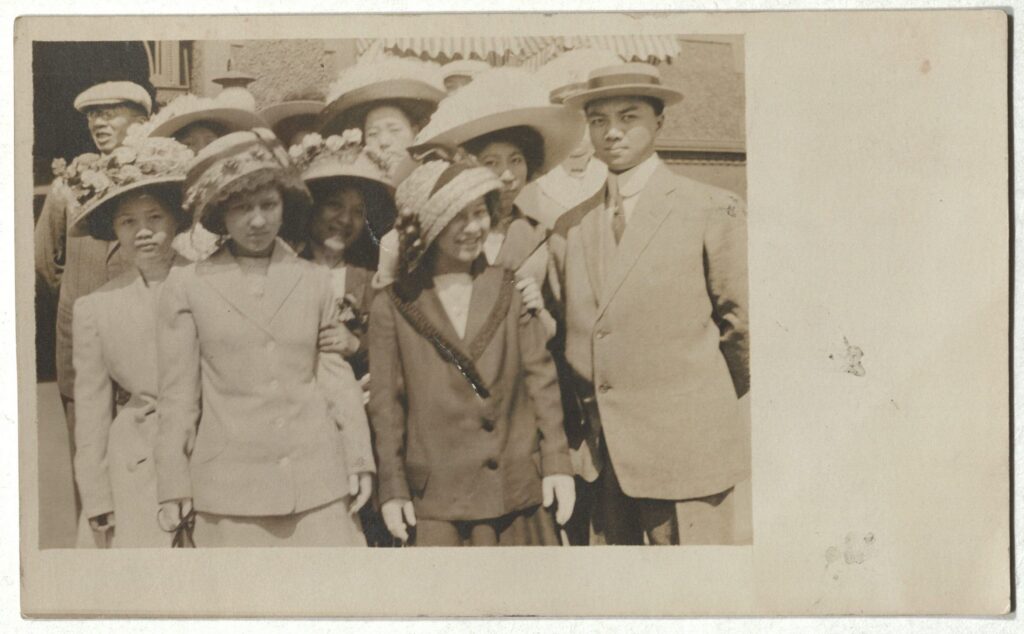
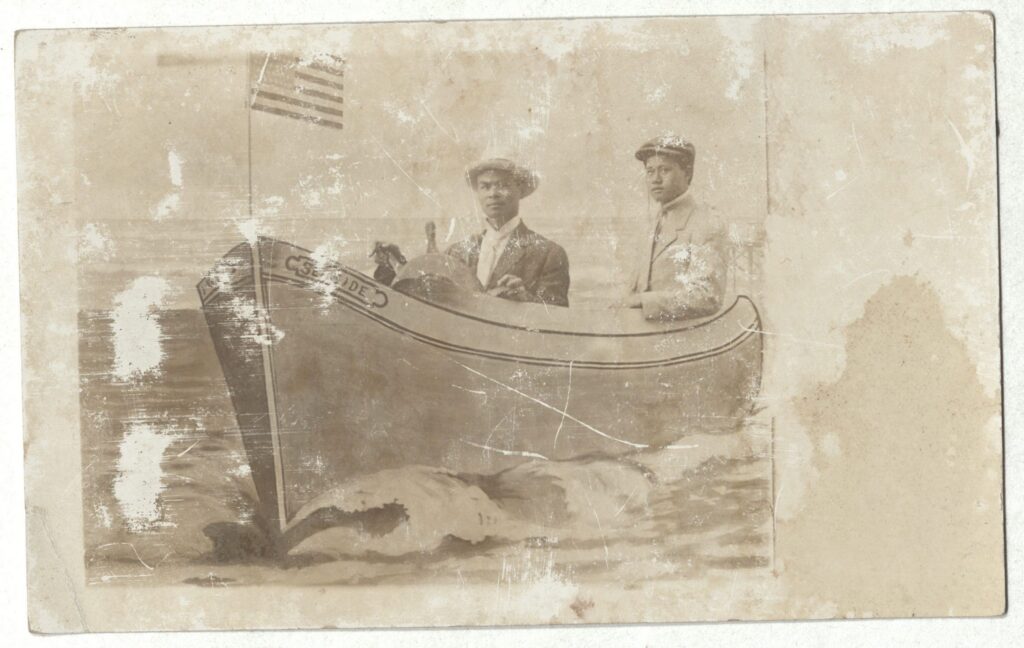
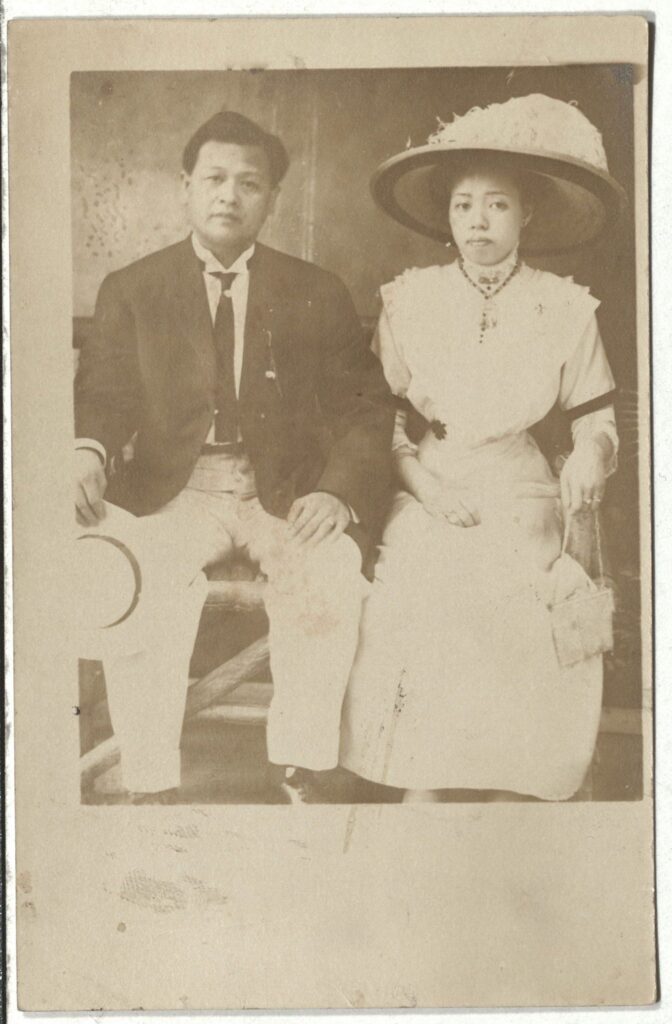
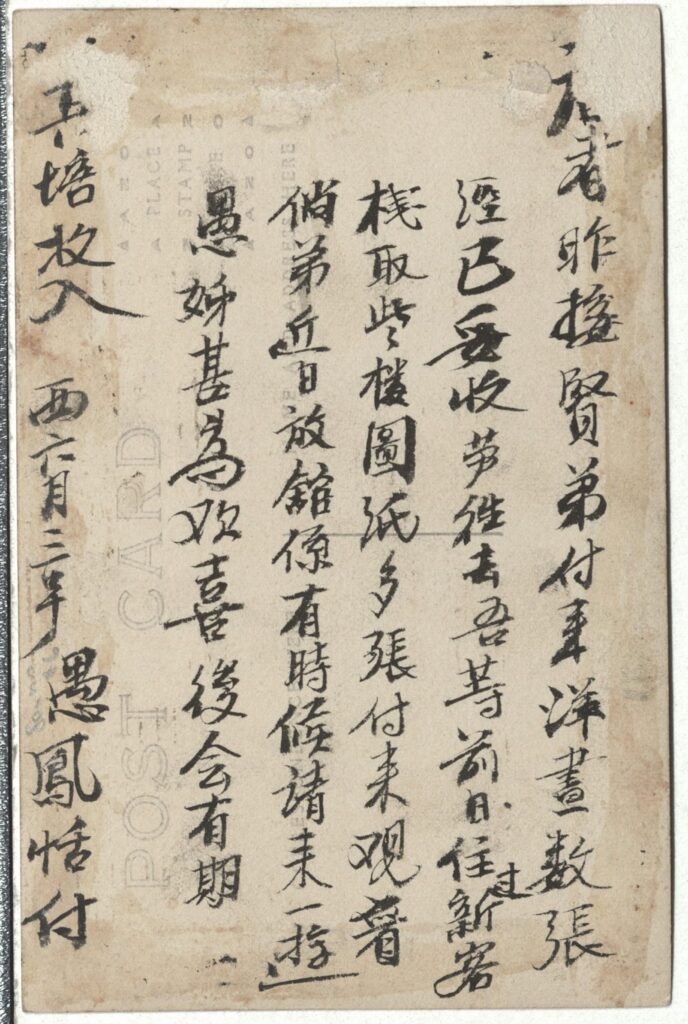
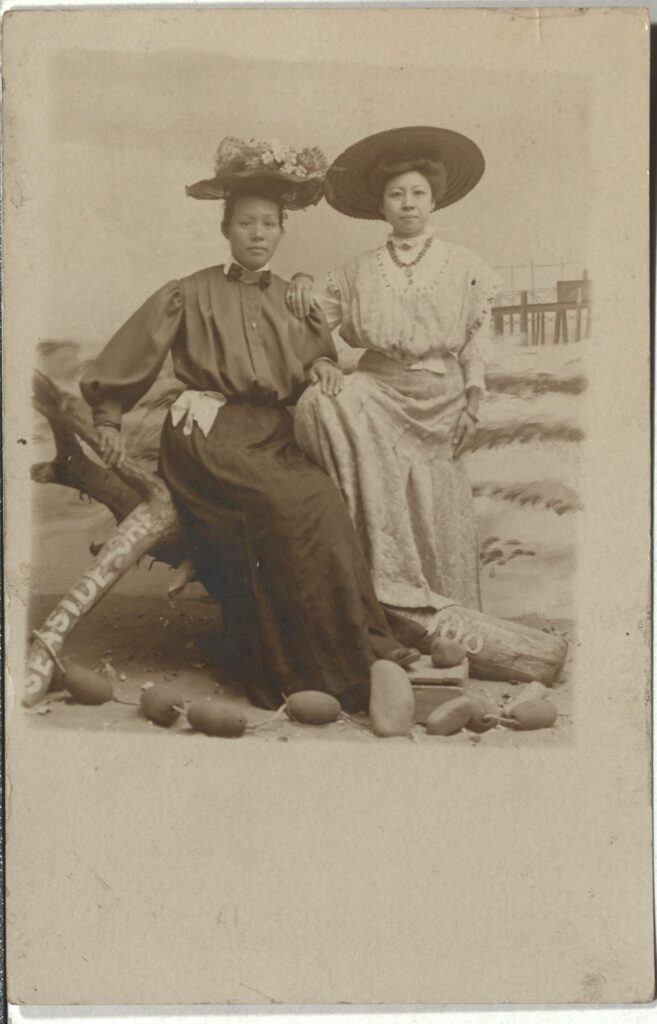
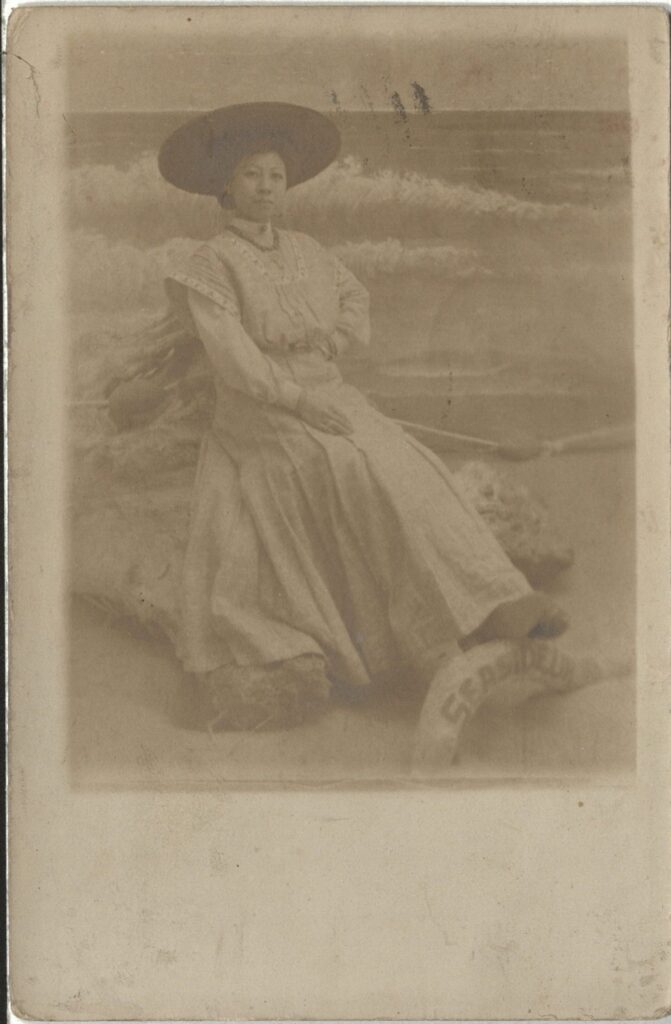
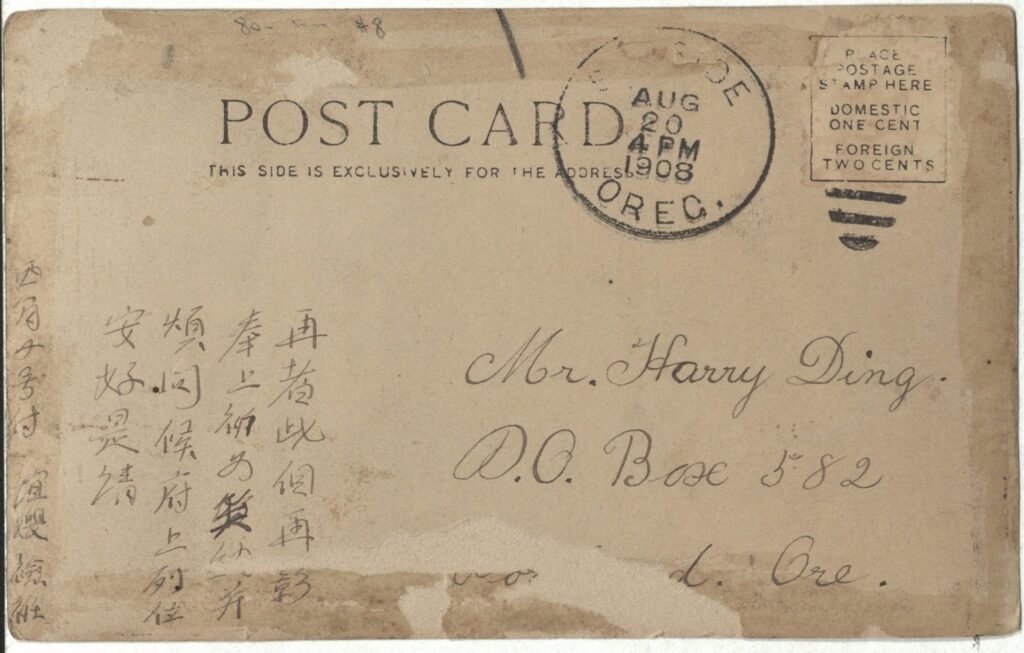
The photos, along with the writing, introduced many questions: Who are the subjects pictured? Who wrote the postcards and who were they sent to? What is the relationship there? Why is this collection relevant to OMA, and how do we convey that importance to a researcher who is viewing this collection?
To begin the research process, I started with attempting to translate the writing on the postcards. After a great deal of struggle, I decided to phone-a-friend for help. I contacted Tamithy Su, and asked if she could use her expertise to translate the writing. While waiting for her to work her magic, I performed a search on Ancestry.com for the addressee, Harry Ding. The search produced several census records for Harry Ding, including a 1920 record where he lived in Clatsop County, which includes Seaside, Oregon. The record listed him as a laborer in a cannery, an occupation that was common at the time, especially so for Chinese-American immigrants. Next, I found an article on Newspapers.com that mentioned Harry Ding. The article wasn’t discussing him, but his wife. She was named as ‘Mrs. Harry Ding’ in an article reporting on the robbery of the Ding family home (her full name is Helen Lai Ding).
Through other census records, I was then able to find Harry’s parents and siblings. The 1910 census lists the entire family as living under one roof. At this point, I had a nice picture of a wealthy Chinese family living in Portland, Oregon. However, there was still no clear connection between the postcard author and Harry Ding. Under the recommendation of my supervisor, I searched online for photography studios in the area at the time. Finding very little, I submitted a research request to the Seaside Museum and Historical Society and waited to hear back.
Then, Tamithy, my translator friend, sent me the full translation of the postcards, complete with notes on the tone of formality and the author’s full Chinese name. How fantastic! I was able to use the author’s name, Feng Tian, to trace her and her husband’s anglicized names to their records. Feng Tian is how we would anglicize her name today, which is the most current and accurate English form, but her records show her as Fuong or Fueng Chin. Previously, this collection was known as the Harry Ding Chinese-American Postcard Collection because we only had Harry Ding’s name to work with, but after learning the author’s name, we decided it would be more fitting to name the collection after its author rather than its recipient.
With the members of each family present in their respective census records, I was able to draw out a family tree. Here is an early draft of the tree:
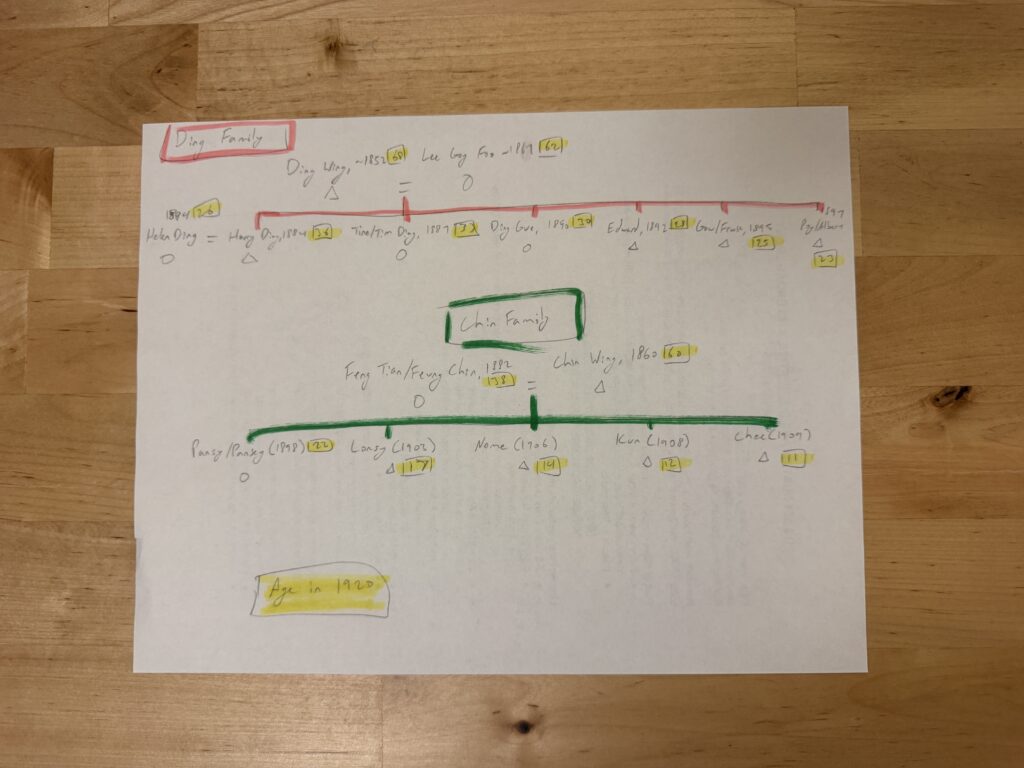
Though the dates on this draft aren’t entirely accurate, you can see that Feng Tian and Harry Ding are very close in age. This would explain how they might be close enough to correspond so familiarly, but still did not explain how they knew each other to begin with. After searching through Newspapers.com for much time, I stumbled upon an article in which Harry Ding was accused of being complicit in a gang murder. The article, from 1918, was published only two years before he shows up on the Seaside census. Was he running from retaliation? Hiding out from his fellow gang members? Did his father, also a gang member, send him away to keep him safe? We have no concrete evidence on what happened, but we do know that this relocation is why we find Harry Ding in Clatsop County in 1920, where he received the postcards.
At this point, I heard back from the Seaside Museum and Historical Society. They cited William Montag as the photographer of the postcards. He was the only photographer in Seaside and Astoria with a professional studio, and the digital preservation of his work that are available online show the same props and backdrops that are pictured in the postcards. As it turns out, Montag was very prominent in the area, and there are many historical resources dedicated to his life and work.
With that loose end tied up, I turned back to filling out the details of everyone’s lives. But still there was the looming question of the connection between Feng Tian and Harry Ding. Though Harry and Feng were only a few years apart in age, her husband was the same age as Harry’s father, and her children were close in age to Harry’s own siblings. By Chinese customs, this would technically make her a part of Harry’s father’s generation, which added an extra layer of separation to parse through.
After a few fruitless internet searches, a website called the Chinese in Northwest America Research Committee (CINARC) surfaced. It is a website showcasing the work of the CINARC committee, including a page on business history in and around Portland. On this page, both Feng Tian’s husband and Harry Ding’s father were listed, both involved in the labor supply business. There was the breakthrough! Feng Tian’s husband operated one of the biggest companies, and Harry Ding’s father was one of the oldest. It was clear they were closely associated in their shared work. Harry and Feng Tian were practically cousins through business. With this new information, I was then able to connect the paths of their lives, which are listed in detail in the research report.
The remainder of the research process was spent tying up loose ends. By the end of it, I had a very satisfying frame of their lives, and even an ending to a few of them. Working on this collection was a very exciting process. The items here serve as a great example of how history can be represented through physical presence of objects, and how important it is to preserve and share their stories.
~ Sabrina She, SCARC OSQA/OMA Student Archivist