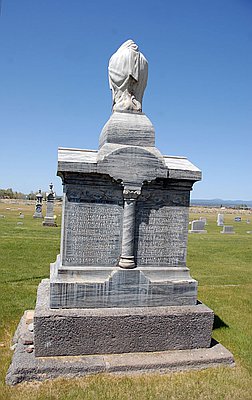
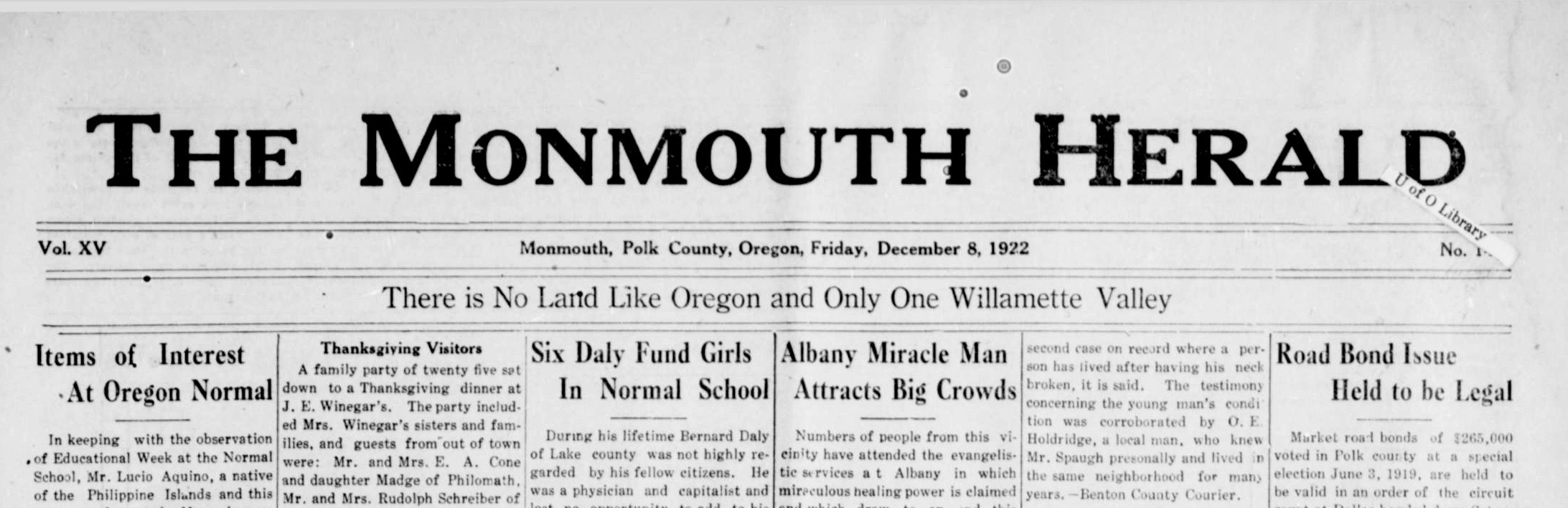
On this day, January 5th, Bernard Daly died on a train bound for San Francisco where he hoped to be treated by medical specialists. Daly never made it to San Francisco; he died enroute, near Livermore, California at 5:30 A.M. on Monday, January 5th (yes, it was a Monday then too). On the following Sunday, a crowd of about 700, almost everyone who lived in or near Lakeview attended his memorial service.

Over the years, there had been much speculation about what Daly would do with his wealth. Everyone knew that he was wealthy, but the amount of his estate was a mystery. Since he never married and had no direct heirs, people wondered where the money would go. A couple of days after Christmas on December 27, 1919, just ten days before his death, Daly signed his will. In five typewritten pages, the carefully crafted will contained ten bequests and six instructions. 

The first of the bequests were as might be expected: $1,000 to his brother and to five nephews and nieces; $5,000 to Pearl Hall (the love of his life) and a continuing $2,000 each year for the remainder of her life. Next was a bequest of $1,200 each year to the Lakeview Hospital for ten years, and a bequest to the Bank of Lakeview of the land on which it was located.

Following these bequests were instructions that revealed the heart of the will. All of Daly’s property was to be sold and converted into cash, invested in municipal bonds, and combined with Daly’s other investments and placed in a fund to be known as the Bernard Daly Educational Fund, the annual income from which would be used for college scholarships for Lake County youth.

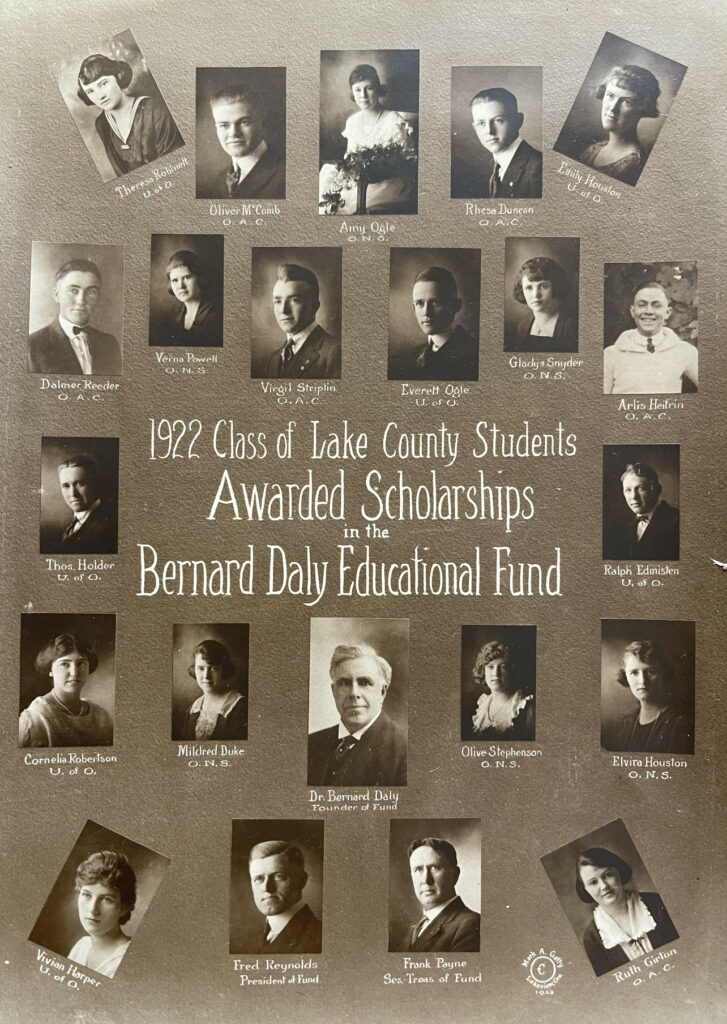
I struggle to explain just how remarkable this was. At a time when almost no one went to college, Daly’s extraordinary act of generosity would make it possible for most Lake County high school graduates to go to college. There was no scholarship like that in Oregon or perhaps the entire country. To get a sense of just how extraordinary it was, the 1922-23 University of Oregon catalog identified only two scholarship funds available to students. One was the new Daly Fund that would provide full funding each year for four years to at least 15 students from Lake County. The other was a scholarship that covered room and board for one student for one year.

Daly’s scholarship fund was unprecedented, and the impact has been huge, changing the trajectory of people’s lives (and their families) for more than a century. During this year we can honor Daly’s memory and extend his generosity even further by sharing his story with a wider audience with a feature-length documentary about Daly and his scholarship. We have initial funding for the project but still have a way to go. Here’s how you can help.
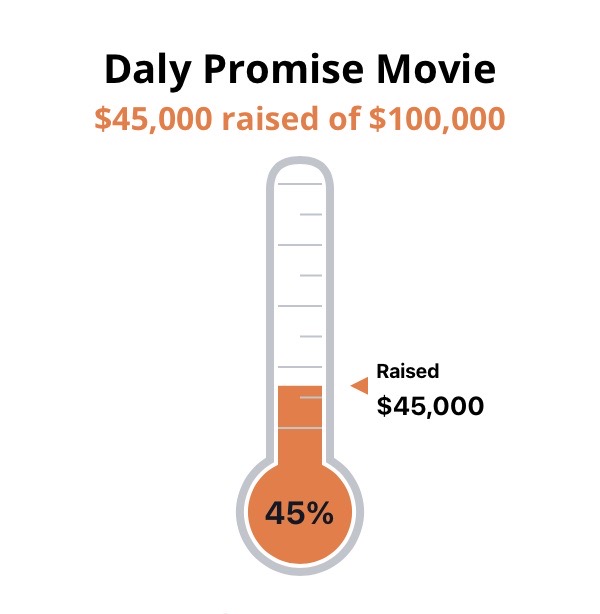
  • Make a donation through our GoFundMe web site.
  • Donate by sending a check made out to: Daly Fund Movie LLC. The check should be mailed to Kathy Boespflug, 10416 W. Rockwood, Boise, ID 83704.
  • Consider being an investor in the film (minimum $10K). If the film is profitable, investors will receive their initial investment plus a 20% premium and share of profits in proportion to their investment. (Please contact me (sam.stern@oregonstate.edu) if you are interested in becoming an investor in the project.)

Note: If the film is profitable, 10% of the profits will be given to the Daly Scholarship Fund.
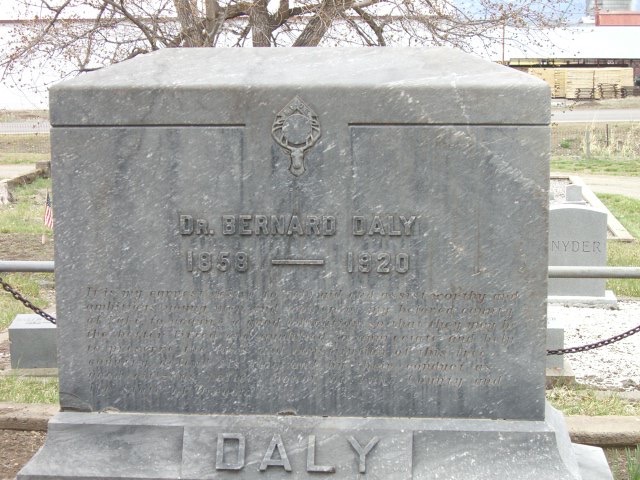
This month is the 100th anniversary of the Daly scholarship. It was a hundred years ago in June of 1922, when the Daly Fund trustees met in Lakeview to select the first scholarship recipients. It was a big deal then and it still is.

It’s hard to overstate the uniqueness of the Daly scholarship. Daly’s vision that not less than fifteen students would have all their expenses provided for four years of college was unusual. There was no scholarship like that in Oregon or perhaps the entire country.

Continue reading

This year is the 100-year anniversary of the first awarding of the Bernard Daly scholarship. I learned about the scholarship in the early 1980s from my OSU colleague Dan Dunham, who grew up in Lakeview and received the scholarship in 1954. The story of Bernard Daly and his scholarship stuck with me and many years later at an OSU alumni gathering I attended while serving as dean of OSU’s College of Education, I met Sue (Ogle) Densmore. When Sue mentioned that she was from Lakeview, I asked about the scholarship and learned that Sue and both of her sisters had been recipients, and so were their parents, Jim and Dorothy Ogle. At the time, I was planning to step down as dean and return to a faculty position before retiring, and I was looking for a research project I could start and possibly work on in retirement. When Sue suggested I go to the annual breakfast her parents hosted at their ranch on Labor Day weekend, I jumped at the opportunity.

Continue reading

For the first time in a couple of years, our family will come together this next week to celebrate the holidays. We do so with a renewed sense of the preciousness of time together, and also the nearness of tragedy. It’s especially jarring when tragedy occurs in the midst of celebration as it did on Christmas Eve in 1894 when a terrible fire occurred in the community hall on the second floor of the Chrisman general store in Silver Lake. Though it is the deadliest fire to have occurred in Oregon history, until this month it has not been included in the Oregon Encyclopedia, an authoritative and free resource on all things Oregon.

Several years ago, I added an entry on Bernard Daly, and now one on the Silver Lake Fire. Take a look at the entries and while you’re there, check out some of the other entries related to Lake County – Abert Rim, Lakeview, Reub Long, and Paisley Caves. I’m hoping others will be added in the years to come.

My best wishes to all for happy holidays and the new year, the 100-year anniversary of the first awarding of the Bernard Daly scholarship.

Note: Many thanks to Larry Landis, former OSU director of Special Collections and Archives who first encouraged me to write an entry on Bernard Daly for the Oregon Encyclopedia.

Bernard Daly’s will is best remembered for the bequest that created the Daly scholarship. Although not as large, there were other bequests, including one that provided an annuity of $1,200 each year for ten years for the …“… expenses of sick, maimed, or injured patients, residents of Lake County, Oregon, who may be brought to its hospital, and who are unable to bear such expenses; it being my will and desire that they receive the same careful nursing, medical and surgical attention, and the full benefits of such hospital, as other patients in so far as this bequest may allow.”

About the time the support provided by Daly’s bequest ended, the Daly scholarship began to have even greater impact on the Lakeview hospital. Daly scholarship recipients, Connie and Joycelin Robertson, and their younger brother, Louis, all became doctors and returned to Lakeview to practice at the hospital. Over the years, many other Daly recipients have returned to work at the hospital, including Abby (Tracy) Finetti, a 2000 Lakeview High graduate and Daly recipient who began working as an emergency nurse at the Lake District Hospital in 2007.

Continue reading

I’ve been researching the life of Bernard Daly and the impact of the scholarship he created a century ago. It’s an incredible story and Daly was an impressive man. By almost all accounts, Bernard Daly was remarkably successful, prosperous, and generous. I say almost all accounts because Daly did have his critics. I shouldn’t be surprised as Daly was in the public eye for almost all of his adult life, and his wealth and his frugal nature attracted much attention. In the spirit of full disclosure, I thought I’d devote this post to his critics.

Continue reading

As the election draws closer, I find myself immersed in the politics of the past when Daly was elected state representative, state senator and then a candidate for the U.S. Congress. Daly’s election to the Oregon Legislature in 1892 representing Lake, Crook (including what are now Deshutes and Jefferson counties), and Klamath counties is an indication of how well known he had become since arriving in Oregon just five years earlier. Daly, a lifelong Democrat, won the election with what was described as a “most flattering majority.” Another sign of Daly’s growing political stature was his appointment to the Oregon Agricultural College (now OSU) Board of Regents in 1893. He was appointed by Governor Pennoyer, one of two Populist governors in U.S. history.

Continue reading
Old Lake County Courthouse

While in Lakeview last month I went to the Lake County Courthouse to look through the county records from the early 1900s when Bernard Daly was county judge. There’s a lot to look at. It was time when counties had considerable power, Oregon’s state government was still relatively new and weak, roads and communication were poor, and Lake County was far from Salem.

In those days, the county judge, Bernard Daly, acted like a governor and the commissioners like a legislature for a county that was larger than several states. Among other things, the judge and commissioners established tax rates; built and maintained roads and bridges, appointed county officials, managed elections, and even granted U.S. citizenship.

Continue reading
The Oregon Encyclopedia

Bernard Daly was missing… but now he can be found in the Oregon Encyclopedia, an authoritative and free resource on all things Oregon. Some time ago, my friend, OSU Archivist Larry Landis, suggested that I write an entry on Bernard Daly. Larry knew that I had been researching Daly and noticed that there wasn’t an entry for him. Seemed like quite an omission given the remarkable breadth of the encyclopedia and the extent of Daly’s impact. 

Continue reading