The “Fortune 100 Best Companies to Work For” list highlights great places to work, assessed across a range of questions. I wondered how the insights from employee reflections intersected with the arguments from our course text. First, Break all the Rules presents twelve questions that reliably measure employees’ satisfaction and are linked with better business outcomes. The authors group these questions into four “camps” for a metaphorical mountain climb representing the employee’s journey:
- Base Camp: What do I do here?
- Camp 1: How am I doing?
- Camp 2: Do I matter?
- Camp 3: Am I learning and growing? Are all of us?
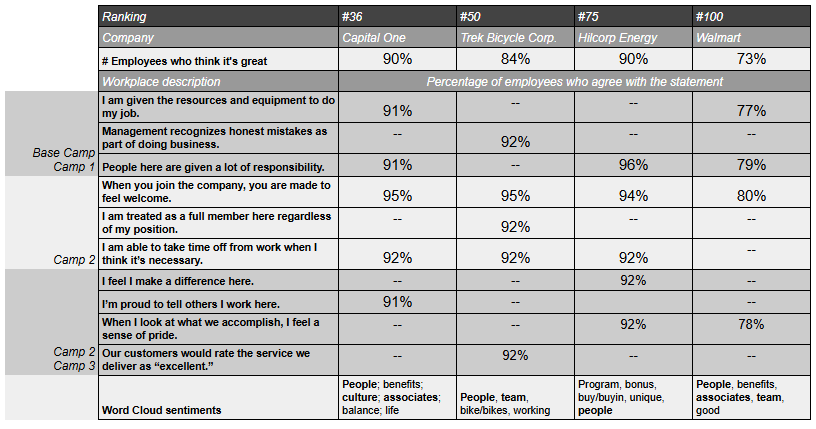
As you can see in the table below, the themes I drew from employee sentiments at Capital One, Trek, Hilcorp, and Walmart align with these “camps,” supporting two arguments made by Marcus and Buckingham: first, that across companies and industries, what drives employee engagement and productivity is consistent; and second, that the insights may be unexpected (Marcus and Buckingham, 22-24). You see far more insight about company culture and people than pay and benefits in the Fortune 100 list.
I have been a people manager for six years. What’s most stressful is supporting people through challenges like low performance, friction with peers, or personal issues. My job is to set clear expectations and “ensure each individual can do their best work”…which is about 70 jobs in one. But in my experience, a strong company and leadership culture is the backbone of good management.
This is why Human Resources Management matters; it’s the discipline of efficiently using human capital to achieve a company’s goals and developing the systems to enable that to happen. On the front lines of HRM, individual managers are managing individual team members. The absence of structure not only leaves them to figure things out on their own, it promotes inconsistency across the organization. HRM introduces that consistency by providing insights about what matters most to engaged, productive employees and providing standards, support systems, and training to help managers create that environment on a day to day basis.
Works Cited
“Fortune 100 Best Companies to Work For® 2025 – Default List.” Great Place to Work®, 2025, www.greatplacetowork.com/best-workplaces/100-best/2025. Accessed 3 Apr. 2026.
Great Place To Work. “Capital One.” Great Place to Work®, 2026, www.greatplacetowork.com/certified-company/1000049. Accessed 3 Apr. 2026.
—. “Hilcorp Energy Company.” Great Place to Work®, 2026, www.greatplacetowork.com/certified-company/1001155. Accessed 4 Apr. 2026.
—. “Walmart Inc.” Great Place to Work®, 2026, www.greatplacetowork.com/certified-company/1120506. Accessed 4 Apr. 2026.
Harter, Jim, and Marcus Buckingham. First, Break All the Rules : What the World’s Greatest Managers Do Differently. New York, Ny., Gallup Press, 2016, ebookcentral.proquest.com/lib/osu/detail.action?docID=1584214. Accessed 3 Apr. 2026.

One reply on “Managing in a “great place to work””
Hi, this is a comment.
To get started with moderating, editing, and deleting comments, please visit the Comments screen in the dashboard.
Commenter avatars come from Gravatar.