Categories
Uncategorized

Money Talks.

There are many factors that go into finding the right job. Many questions come to mind when considering which job opportunities seem to be worth the energy and effort of filling out a job application. Considering the location, career field, and organizational structure of the job are important, however the most important consideration is usually compensation.

When I first entered the job market, minimum wage was the expectation. I never expected any more or any less, it’s just what you were paid as a college grocery clerk. As I continued gaining experience and acquiring new skills, my expectations regarding compensation began to grow. I began to value my experience more and looked for jobs that also valued my experience. All in all, compensation has always been and remains a crucial aspect of job hunting.


After (my first) 4 years of college, I decided that I wasn’t actually sure what I wanted to be, so I dropped out and went to clown school. Just kidding. I didn’t go to clown school, but I did begin taking classes at a health institute for medical massage therapy where I became a certified massage therapist after 9 months of courses and training.

As soon as I landed my first job as a massage therapist in a chiropractic office, I was astounded at my new income. Even though the rate I was getting paid was quite low for an average therapist income, it was still well above any wage I had made before. This job became a shining beacon of what I was going to be able to accomplish with my new set of skills.


Compensation was a huge motivator for me to not only go to massage school and become a licensed practitioner, but also for me to stay in the career field. The security and the feeling of adequacy from the dramatic increase in income drove my desire to continue working as a therapist for 6 years.

I believe that compensation plays a huge role in everyone’s lives. It’s how we evaluate our work, our skills, and our experience in our relevant job markets, and it is also the bloodline to living a (hopefully) comfortable life. Almost all of our needs can be provided for through money, so it’s no wonder why it is such an important aspect when considering a job or career.

Categories
Uncategorized

The Best (and Worst) Training I’ve Ever Had.

Over the years, I have experienced varying levels of training and subsequent varying results based on the depth and type of training used. When I think back on a memorable training experience, I have to say that The Best Training goes to… The Melt! A relatively quaint fast-casual grilled cheese, mac and cheese, and burger restaurant located in Denver, Colorado.

As a new hire from outside the company stepping into my first management position as a shift lead, I was impressed with the Manager and Employee Training manual that was given to me on the first day. It outlined a weekly planner that guided me through the training workbook, complete with check-ins and direct one-on-ones with the General Manager. It felt like I was completing a school workbook with exercises, questions to ponder, and tasks to complete, making it a fun and educational experience. The use of the manual/workbook coupled with hands-on training gave me the tools and the knowledge I needed to feel confident running my own shifts, even though I still made plenty of mistakes.

The reason I feel like this experience was especially effective is because it helped me not only understand what the standards and expectations were of the job via the handbook, but I also developed a mentor-like relationship with the GM (Lecture Notes – Development). Her hands-on and one-on-one time approach made me feel safe and comfortable to ask for help when I needed it. Overall, I had greater satisfaction, motivation and commitment towards that job because the company saw how important it was to give employees the information and the tools they need to succeed.


On the other hand, I have certainly been let down by companies, big and small, regarding training or lack thereof. When I was contemplating which, if any, was the worst training I’ve ever had and I really couldn’t pin down one experience in particular that was memorable. In general however, I would say that The Worst Training goes to…. the jobs that didn’t provide any training at all!

When being onboarded into an organization, there is some level of expectation that you will be taught or at least told what a role entails and the job tasks required. However, some organizations (maybe un-organizations) offer very little to no training or onboarding, which can be a frustrating experience as a young adult with a tendency toward people-pleasing. All I wanted was for someone to tell me what they needed from me. In my experience, these types of “training” situations made me feel as if I were thrown to the wolves, left to figure it out on my own.

What makes this type of training style ineffective is that it does the exact opposite of what The Melt experience did. I had very little job satisfaction since I didn’t know what job I was supposed to be doing, motivation went out the window with job satisfaction, and job commitment did not last long, sometimes only a day. Beyond that, I was not invested in the company because I was not socialized into the working environment.

Hiring the right person with the right talents is important but training and onboarding is the only way to set your new hires up for success.


SOURCES

Lecture Notes – Development

Categories
Uncategorized

Implicit Bias in Recruiting & Selection

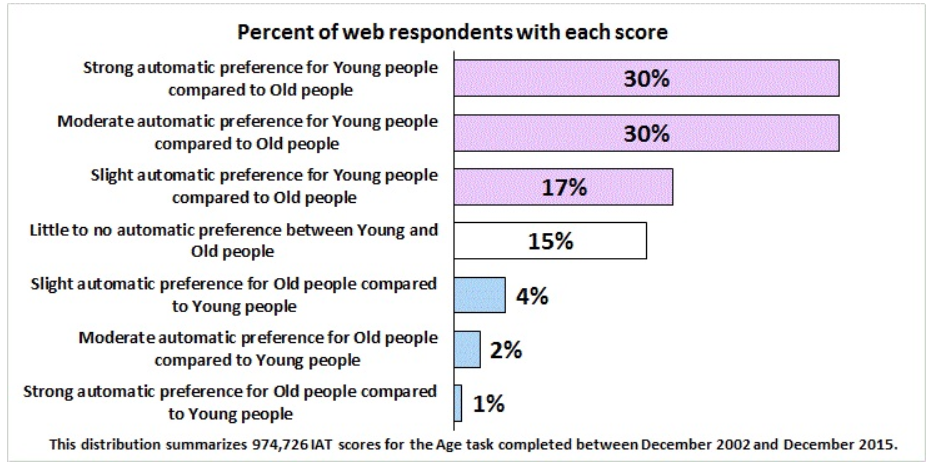
Below are the results of the average Age Discrimination test. What can be seen is that more people have a general preference towards young people compared to old people. My results showed that I land within the 15% of people that show little to no automatic preference between young and old people.

While this is good results for a one-time test, the reality is that we contain biases towards younger and older people when we are out in public. Even if these biases are seemingly “good”, like giving preferences to younger or elderly individuals, they can still translate to implicit biases that can affect another person’s opportunities.

According to the results above, the majority of individuals express an implicit bias either towards younger or older people. What this can mean in a recruitment and selection process is that these biases can carry through into the interview and beyond without hiring managers knowing if they are not aware of their personal biases. This changes the reliability and validity of the selection process if these biases are not accounted for and mitigated.

One way to mitigate bias is to create a standardized set of questions pertaining to the job itself. This avoids the possibility of a hiring manager asking unintentionally easier or harder questions to those they may have underlying biases towards. Another way to mitigate bias during the hiring and selection process is to have multiple interviews with potential candidates using a scoring method. This allows multiple people to score a candidate, eliminating single biases from individual managers if they are present.

Breaking implicit biases is like breaking a bad habit, according to Be Better Blog (2024). The first step in addressing personal biases is to bring awareness of the biases to the surface. It’s noted that it takes time to change biases, however the keys to change are commitment, motivation, and persistence.

SOURCES

Chang, Clara. “Understanding Implicit Bias-and How to Work through It.” Better Homes and Gardens Real Estate Be Better Blog, December 30, 2024. https://bhgrecareer.com/bebetterblog/implicit-bias/.

Categories
Uncategorized

Effective interviews: Making the selection

When reflecting on my past experience with job interviews, I can recall the ones that went really well, effectively getting me the job, as well as the ones that went comically wrong, leaving a lasting memory of what not to do. Aside from my own inexperience as a young interviewee, I could still tell the difference between interviews that felt connected, open, airy, and light, allowing me to answer questions with confidence and ease and the interviews that felt disconnected, stodgy, and tense, leaving me scrambling for words.

Not only were there differences in how the interviews made me feel, but they were also different in how they were conducted. Over the years, I have experienced various interview methods: unstructured interviews, behavioral interviews, situational judgement interviews, knowledge tests, and cognitive ability tests. Each have their strengths and weaknesses in how they are able to truly assess a candidate’s predicted performance.


EFFECTIVENESS

When I think about the different interview methods, the most effective were the methods that focused on reliability – the consistency of a performance measure, validity – the extent to which a performance measure assesses all relevant aspects of job performance, and utility – the extent to which a selection method is worth the time and money.

The most successful interviews were the structured ones where the interviewer asked questions that were directly related to the job and job performance. Those who asked questions regarding situational judgement gave me a chance to choose between many options to a situation, allowing me to explain the rationale behind my decision making.


MY ADVICE

If I could give advice to the interviewers of the past, I would tell them that if they want to find the best fit for their open positions, they should choose a selection method that correlates with the job performance they are looking for in the position. Figure out which outcomes are integral to the position and then hire based on how well candidates’ talents will contribute to the job outcomes.


SOURCES

Lecture Notes – Selection

Lecture Notes – Recruiting

Categories
Uncategorized

Job Descriptions: How to hire the right people


The basic job description is a written statement of the overall tasks, duties, and responsibilities of a job and is the foundation of nearly every HR function, as stated in Job Worth Doing: Update Descriptions and the lecture notes. A well-designed job description is the linchpin for recruitment, training, performance evaluations & goals, compensation, and workforce planning.

That being said, without succinct and current job descriptions, “you aren’t operating your business as efficiently as possible.” Because of this, it is important for HR management to keep job descriptions up-to-date using job analyses to determine the tasks, duties, and responsibilities associated with the job; an essential HR function.

Keeping job descriptions current isn’t just about redefining a role. It’s also about understanding how and why job functions are changing, and anticipating any possible job description updates to reflect those changes.

Jill Bidwell, Sauer-Danfoss
Job Worth Doing: Update Descriptions

Overcoming the Challenges

Keeping job descriptions up-to-date

Although most HR managers would agree that keeping job descriptions current is important to an organization, it seems that very few managers have a regular policy for updating them, according to Job Worth Doing. In fact, updating job descriptions end up being the “last thing on the list to tackle.”

To combat this challenge, it is recommended to make amendments to job descriptions regularly, but at least once a year. “If you pull out a job description every time you work on performance reviews, compensation planning, succession planning, training and development needs, you are a lot more likely to maintain it.”

Team involvement

Creating and maintaining job descriptions can be complicated as there are many moving parts in most jobs with various points of communication. In order to make sure job descriptions are accurate, involving employees, managers, and HR may give the best scope of the job and tasks performed.

Employees have the best idea of the inner workings of the job and can attest to the duties that they perform daily. Managers can verify that the responsibilities reported by the employee are aligned with the job title. They can also use a template to keep job descriptions up-to-date as part of the performance management process. HR should review these templates and job descriptions, coaching and facilitating management, to ensure that they fit into the larger organization as well as their legal obligations.

Having a bad job description is worse than having none at all.

Tracy McCarthy, SilkRoad – Job Worth Doing: Update Descriptions

Mitigating risks

Without appropriate job descriptions, companies may find themselves at the wrong end of an employment claim or other legal matter. More than ever, it is critical for job descriptions to be “crystal clear” in terms of essential tasks, especially ones that are considered a performance measure. With clear and accurate job descriptions, employees know what is being asked of them and it keeps any potential legal implications for the company at bay.


At the end of the day, job descriptions aren’t meant to sit on a shelf, they should evolve alongside the work itself. When employers keep them clear, current, and utilize real input, everything from hiring to performance runs more smoothly and with fewer risks. Ultimately, getting the right people in the door starts with clearly defining what the job actually is.


SOURCES

-Tyler, K. (2013). Job Worth Doing: Update Descriptions.

-Lecture Materials, Week 4, Spring, 2025


Categories
Uncategorized

Week 1 Blog Post

Fortune: 100 Best Places to Work

So, what makes a work place great, anyway?

According to greatplacetowork.com, qualitative studies researched statements such as, “When you join the company, you are made to feel welcome,” “I am proud to tell others I work here,” and “I am given the resources and equipment to do my job.” These statements and others, regarding an employee’s experience with their work environment, were then rated and compiled to produce the “Best Places to Work, 2025.”

According to First Break All the Rules (2014), these statements are congruent with the “measuring stick”, a series of 12 questions that Buckingham and Coffman say test the strength of an organization. Based on the positive responses from the employees of these companies, we can assume that HR and management are answering these questions seriously to improve the experiences within their individual organizational cultures.

Comparing #1 Hilton, #15 Delta, #43 Zillow, and #100 Walmart, employees at these Fortune 100 Best Places to Work say that their company is a “great place to work”, more so than the average employee experience. With Hilton topping out at a 95% positive employee experience and Walmart coming in at 73%, these companies score much higher than the 53% national average.


Looking ahead: What kind of manager do I want to be?

In general, I want to be the type of manager that helps employees learn, change, and grow in whatever direction they want to. I want to be the type of manager that is always willing to listen to feedback and challenges and help my team collaborate on solutions. I also want to be the manager that wants to connect with my team, both up and down the chain, to maintain relationships and perspective.

The conversation between Gallup and ‘Michael’ in First Break All the Rules resonated with me deeply regarding the type of manager I would like to be. It was refreshing to hear an experienced manager say that it is perfectly ok to treat each employee you work with differently than the next. It speaks to a willingness to not only meet an individual where they are at in their employment journey, but to also speak their language and learn what makes that person tick. Personalizing human resources management is a more connected approach that I believe leads to higher job satisfaction and commitment.


Management: What are the Challenges?

While there are many challenges that come up for managers, I think one of the most obvious challenges is attempting (and failing) to please everyone. Even in the most thoughtful decision making, there is likely going to be someone that disagrees with your decisions and may be upset as a result. In cases like these, I think being empathetic can go a long way in allowing an employee to feel seen and heard while still being firm in the decisions being made.

Another challenge that I could see come up for managers is having to be the middle man between the top of the firm (the macro decision-makers) and the bottom of the firm (the workers and laborers). I can imagine it can be quite frustrating to always be relaying information and putting things in action coming from the top-down, especially related to scheduling, staffing, and organizational changes like restructuring or layoffs.

Above all, the biggest challenge managers face is earning the trust of their team. Effective managers have the unique role of building and maintaining relationships with the employees they work closely with. A great way to earn trust with a team is to give trust, allowing employees to have a certain level of autonomy. In First Break All the Rules, ‘Michael’ states, “…pick the right people. If you do, it makes everything else so much easier. And once you’ve picked them, trust them.”

While human resources management certainly has it’s challenges, managers who are willing to accept these challenges will grow into even better leaders than they were before.


SOURCES

https://www.greatplacetowork.com/best-workplaces/100-best/2025, (2025)

Buckingham, Marcus, and Curt W Coffman. First, Break All the Rules : What the World’s Greatest Managers Do Differently, Gallup Press, 2014. ProQuest Ebook Central, https://ebookcentral.proquest.com/lib/osu/detail.action?docID=1584214.

Chouinard, Yvon. Let My People Go Surfing : The Education of a Reluctant Businessman : Including 10 More Years of Business Unusual. Second edition., Penguin Books, 2017, https://search.ebscohost.com/login.aspx?direct=true&scope=site&db=nlebk&db=nlabk&AN=1149012.