
The OSU Carbon Reduction Grant Program, funded by OSU Facilities Planning and Management and administered by Carbon Commitment Committee (C3) and the Sustainability Office, is intended for practical, measurable projects that reduce greenhouse gas emissions across OSU operations and activities. For fiscal year 2026 (FY26), nine awards were granted, ranging from $988 to $10,472, with approximately 45% of funding going to projects substantially led by OSU students!
Grant recipients provide progress updates and estimated impacts on OSU’s carbon emissions as the projects move forward. Read below for an update on one of the projects currently underway!
Project title: Reducing Energy Losses by Locating and Eliminating Nitrogen Gas Leaks at ATAMI
Project team: Advanced Technology and Manufacturing Institute (ATAMI)
Amount awarded: $10,472
Project summary: ATAMI, an 80,000 sq. ft. facility that is part of OSU’s Division of Research and Innovation, provides infrastructure, support, and resources to startup companies, students, and researchers. One such resource is high-purity nitrogen gas (N2) used in research and design processes primarily for the semiconductor, flow chemistry and materials manufacturing industries.
Although N2 itself is not a greenhouse gas, producing and transporting liquid N2 is highly energy-intensive. Liquid N2 is produced by cryogenic distillation of air that takes a substantial amount of electrical power to compress, cool, and liquefy the air before separation of N2 from other gases.
After analyzing nitrogen use data, ATAMI suspected leaks in their N2 piping system. They observed continuous use which correlated neither with operations nor with slower periods such as weekends and holidays. They estimated 50 -75% of N2 gas consumption was unaccounted! Using OSU’s Carbon Reduction Grant funding, ATAMI hired Charter Mechanical to employ a combination of techniques, including “pressure” and “snoop” tests to locate leaks. The biggest challenge was accessing pipes often located up high or hidden above ceilings, requiring lifts and harnesses for access.
Over 50 leaks were identified and repaired! Initial pressure tests showed some areas were losing up to 30 psi/hour. After repairs, the lines held pressure. Additionally, during this project, ATAMI engaged with researchers to foster behavioral changes with respect to N2 consumption, an inert “invisible” and often perceived “free” resource.
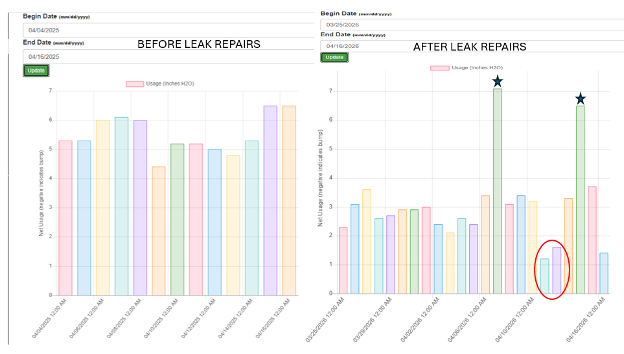
Since project completion, the N2 consumption rate for one full 3000-gallon tank has been monitored. Overall, there was ~ 30% reduction despite two notable days of peak demand. The average daily baseline use was cut in half, and weekend low demand was observable. One tank, which usually lasts ~2 weeks, lasted more than 3 weeks.
If these trends continue, savings will equate to approximately 24,000 kWh or 7.5 tons of CO2 equivalent per year. This would not only save the facility approximately $20,000/year but is equivalent to greenhouse gases emitted by driving 1.5 gasoline-powered passenger vehicles for a year or equivalent to carbon sequestered by 120 tree seedlings grown for 10 years.
One challenge was that during initial pressure testing, a large section of pipe lost significant pressure, indicating multiple leaks; unfortunately, inaccessible piping prevented repairs within this project’s timeframe and financial scope. If this is addressed in a second phase, ATAMI hopes to double the energy savings already achieved.
CATEGORIES: Uncategorized