By Sarah Mocas
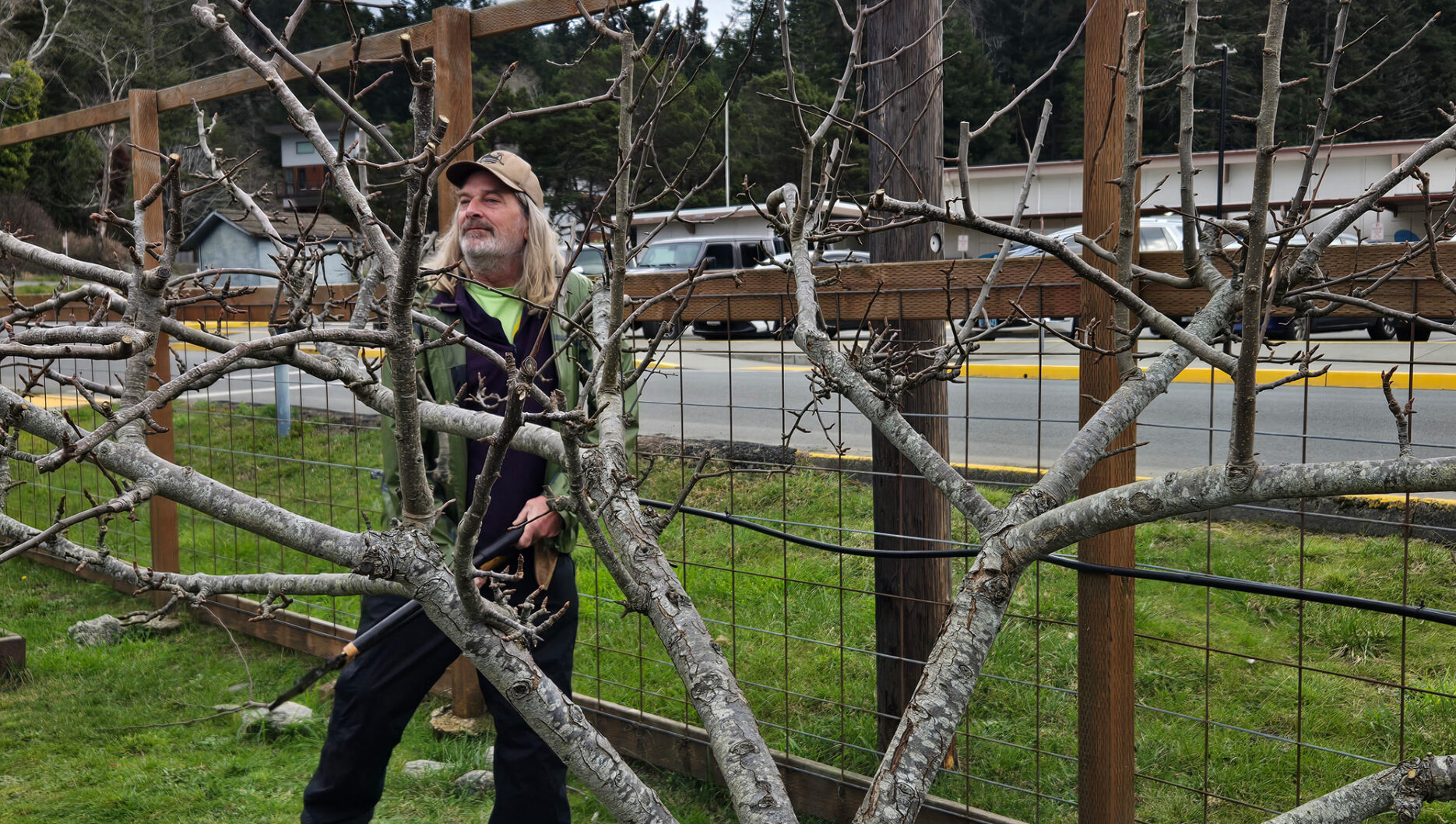
Saturday morning, February 7th, MG volunteers and trainees turned out for a hands-on tree pruning workshop at Riley Creek School Garden (Gold Beach, OR). The workshop was led by MG Lori Phelan and local arborist Tim Scullen.
I recently began taking care of a few fruit trees, and consider myself a novice apple tree pruner – I’ve yet to clearly understand how to prune to develop fruit! Based on Tim’s instruction, I’ll start with a few of the apple tree pruning basics that he covered.
- Remove damaged or diseased wood to maintain plant health.
- Control tree height so the fruit is within reach.
- Open the canopy to improve airflow, light to lower branches, and reduce disease risks.
- Promote new spur growth – apples grow on spurs.
- Encourage new limb growth, which may be used to bear fruit in 2 years.
- Develop strong limb structure for better fruit production and overall health.
Based on my general pruning experience, I usually start a pruning project by considering the first 3 items listed above. This will remove some of the larger branches, especially if a tree is older and has not been pruned regularly.
Removing dead wood and broken branches is a good starting point since dead wood is fairly easy to recognize – it will be the brittle, dry branches that snap rather than bend. Also, once cut they will not appear green inside. At this time, we can also remove crossing or inward-growing branches to open out the structure of the tree. Most water sprouts can also be removed especially if they will shade the fruit on lower branches.
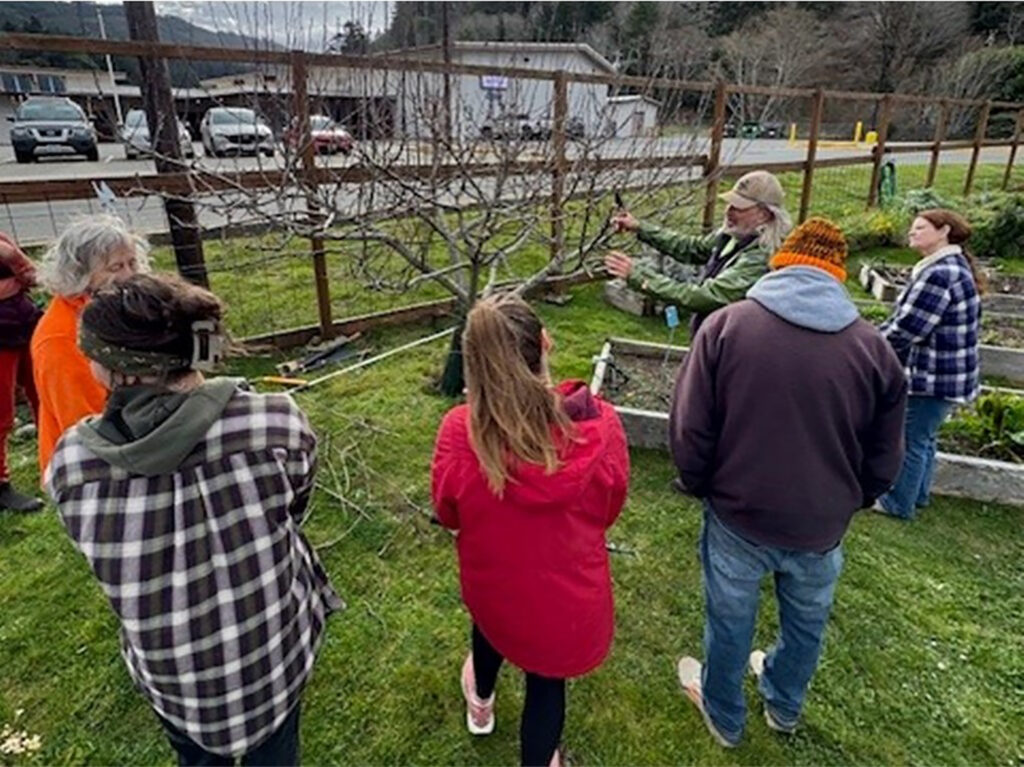
Recognizing diseased wood can require more experience. During the workshop, Tim removed a branch with a canker. After cutting the limb off up from the canker, he continued to remove more of the branch until the internal wood did not show a reddish-brown streak. A deeper dive into apple tree bark diseases can be found using the Pacific Northwest Plant Disease Management Handbook at https://pnwhandbooks.org/. Last, it’s important to sanitize pruners especially after working on diseased wood. It’s also important to dispose of diseased wood separate from wood that can be composted.
Given the confidence to prune the central structure first, results in less time pruning, but the decisions on removing larger branches takes practice. The overall goals of having the fruit within easy reach, and increasing the amount of sunlight that reaches the lower branches, will make pruning decisions easier. Tim’s choice to favor a medium, lateral branch over a stronger or weaker branch took some getting used to, but he was considering long term structure. He explained that by cutting limbs at the top of the tree, even a leader, to a lateral branch, would reduce the height of a tree and strengthen the lateral branch. These choices develop strong limb structure over time.
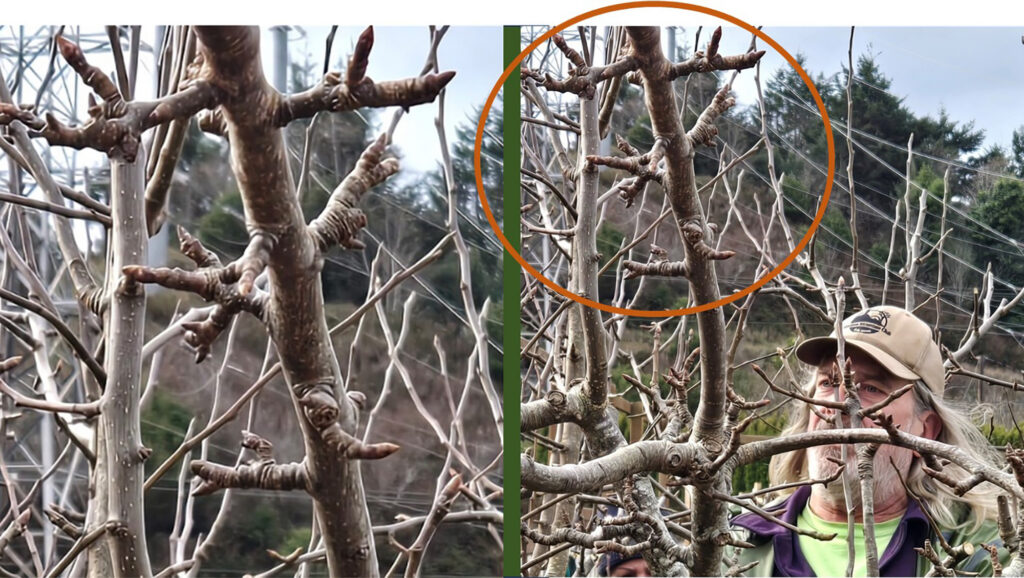
Items 4 (promote new spur growth), and 5 (encourage new limb growth for fruit in two years) both promote apple production, and are trickier for me to see. The spurs, pictured, contain the blossoms, and so eventually apples. Spurs develop on wood 2 years old or older. Some tips are:
- To promote spur growth, shorten the current year’s side shoots (laterals) back to 3-4 buds (about 4 inches from their connection to a branch). This encourages them to become new spurs.
- To shorten a long branch, cut back the branch (the tip of a branch) by about one-quarter of its growth to an outward-facing bud. An outward-facing bud, directed away from neighboring branches, encourages a direction for new growth. Do this to maintain shape and promote lower branch strength.
From looking at the resources below, it’s apparent that there are multiple, correct ways to prune, depending on the age of the tree and the desired goal. The workshop was fun but only convinced me that lots of practice is needed to really understand apple trees!
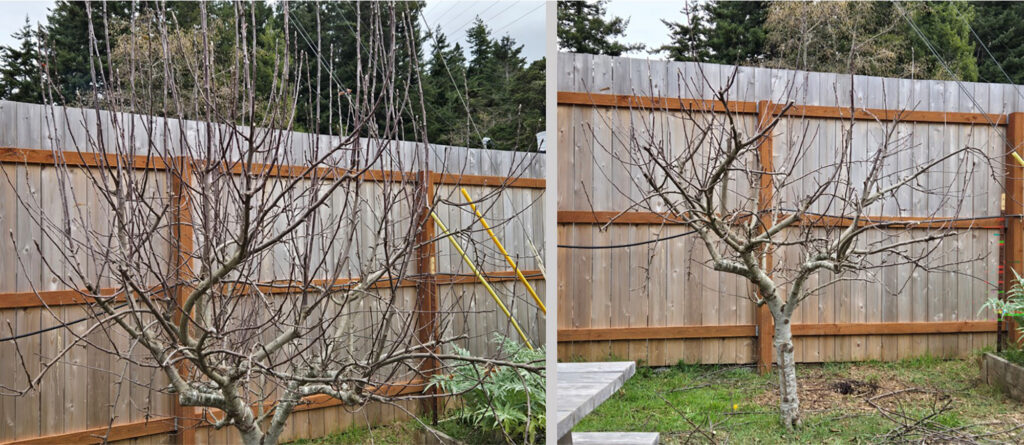
The apple trees at Riley Creek never looked better! Thank you, Lori and Tim.
Pacific Northwest Plant Disease Management Handbook https://pnwhandbooks.org/
Training and pruning your home orchard,OSU Extension Service, Jeff L. Olsen and Neil Bell, Revised February 2025 https://extension.oregonstate.edu/catalog/pnw-400-training-pruning-your-home-orchard?reference=catalog
Prune apple trees in late winter for stronger growth and better fruit, OSU Extension Service, Kym Pokorny, February 2025 https://extension.oregonstate.edu/news/prune-apple-trees-late-winter-stronger-growth-better-fruit
How to Prune an Apple Tree in 7 Simple Steps, The Spruce, Marie Iannotti, Updated March 2024, Reviewed by Mary Marlowe Leverette https://www.thespruce.com/maintenance-pruning-an-overgrown-apple-tree-4070267
Photo credit: Sarah Mocas & Lori Phelan