
I am currently a second year Master’s student studying Fisheries Science under Dr. Scott Heppell at Oregon State University. When it comes to my research project, I have not started collecting or analyzing data yet (a global pandemic did get a bit in the way in that regard). However, I have put together a research proposal and successfully completed my “research review” (which is a formal meeting that confirms the organization of your thesis committee and allows for everyone to review and sign off on your proposal) in December, which certainly has helped me to feel more accomplished and like progress is being made!
The idea behind the project…
Fisheries monitoring is an important aspect of fisheries management, used to assess populations and determine sustainable harvest. In the commercial fishery there are several means of collecting this data (fish tickets, at-sea fishery observers, electronic logbooks, and various electronic monitoring technologies). In Oregon, however, there is currently only one way that we collect data on the recreational fishery, port samplers. The Oregon Department of Fish and Wildlife (ODFW) conducts dockside interviews, counting landed catch (all fish caught) and interviewing anglers regarding discards (released fish) via the Ocean Recreational Boat Survey (ORBS). Of the recreational charter fishery alone, ORBS samples an impressive 30%. Yet, compared to the commercial fishery, there remains a significant lack of monitoring data.

Photo credit: Oregon Department of Fish and Wildlife
Which is why I am proposing an alternative form of electronic monitoring of the recreational fishery on the Oregon Coast. In collaboration with Oregon Department of Fish and Wildlife (ODFW) and the California Collaborative Fisheries Research Program (CCFRP), my master’s project will test a stereo-video system onboard recreational charter vessels. Utilizing photogrammetry (the science of obtaining reliable measurements using photos and/or videos), I will identify and quantify recreational catch data off the Oregon coast and compare it to sampling data collected by state port samplers via standard sampling techniques. Both the ODFW Marine Reserves team and CCFRP conduct several hook-and-line surveys every year (targeting groundfish). These surveys are conducted both inside and outside of marine reserves and all fish caught are brought on board, identified, measured, and recorded by ODFW or CCFRP trained volunteers.
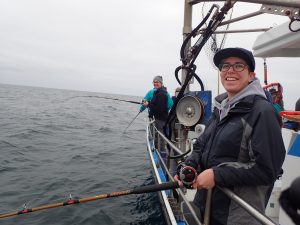
Photo credit: California Collaborative Fisheries Research Program
I will simultaneously collect stereo-video data on as many surveys as I can tag-along on in 2021. Which means I can then compare the length measurements I collect via stereo-video to the length measurements collected by hand during these surveys. Additionally, this is a unique opportunity to collect previously unobtainable data of the bycatch typically discarded on recreational charter boats. With this sampling design, I can make various comparisons that would shed light on whether electronic monitoring could be appropriate in recreational fisheries. Additionally, I will compare current reported data (collected via port samplers) to my own, with the ability to assess the accuracy of current reporting techniques and propose a cost effective, low maintenance alternative.
Given the current pandemic and potential for other disease outbreaks, I can imagine that in this new world of social distancing, an alternative form of port sampling may be necessary in the future. The stereo-video technology utilized in my project could be integrated into kiosks located at filet stations in all major Oregon ports. Thereby allowing the continued collection of recreational catch data without placing ODFW port samplers in danger or managing large absences in data.
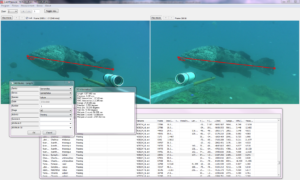
Photo credit: Pilbara Marine Conservation Partnership
The second half of my research project, entails investigating further into the uncertainty associated with bycatch data in the recreational fishery. Retained catch can be measured directly at the dock, but accurate monitoring of bycatch requires (1) anglers accurately identify released species and (2) remember what they released. Due to event recall biases and variability in species ID skills, this can introduce a high degree of uncertainty in recreational fisheries data. The main source of bycatch data for the recreational fishery in Oregon are in-person interviews conducted by port samplers. To supplement this, three at-sea observers sample a portion of the sport charter vessels for species composition, discard rates and sizes, location, depth, and catch per angler as part of ODFW’s Sport Groundfish Onboard Sampling Program (SGOSP). My objective is to determine whether current average bycatch values are accurately represented in port sampler collected interviews. To assess this uncertainty, we will compare data currently being collected by ODFW via ORBS port samplers to data collected by at-sea observers via SGOSP. By comparing these data, I will determine if bycatch recall values reported by recreational charter boat captains are in line with the same data documented by at-sea fisheries observers.
That’s the plan anyway. As the sun starts to peak out from the clouds more frequently, plans begin to form and pressure begins to build for my upcoming field season. I have a few updates I would like to share soon, so stay posted!