Thomas Robinson
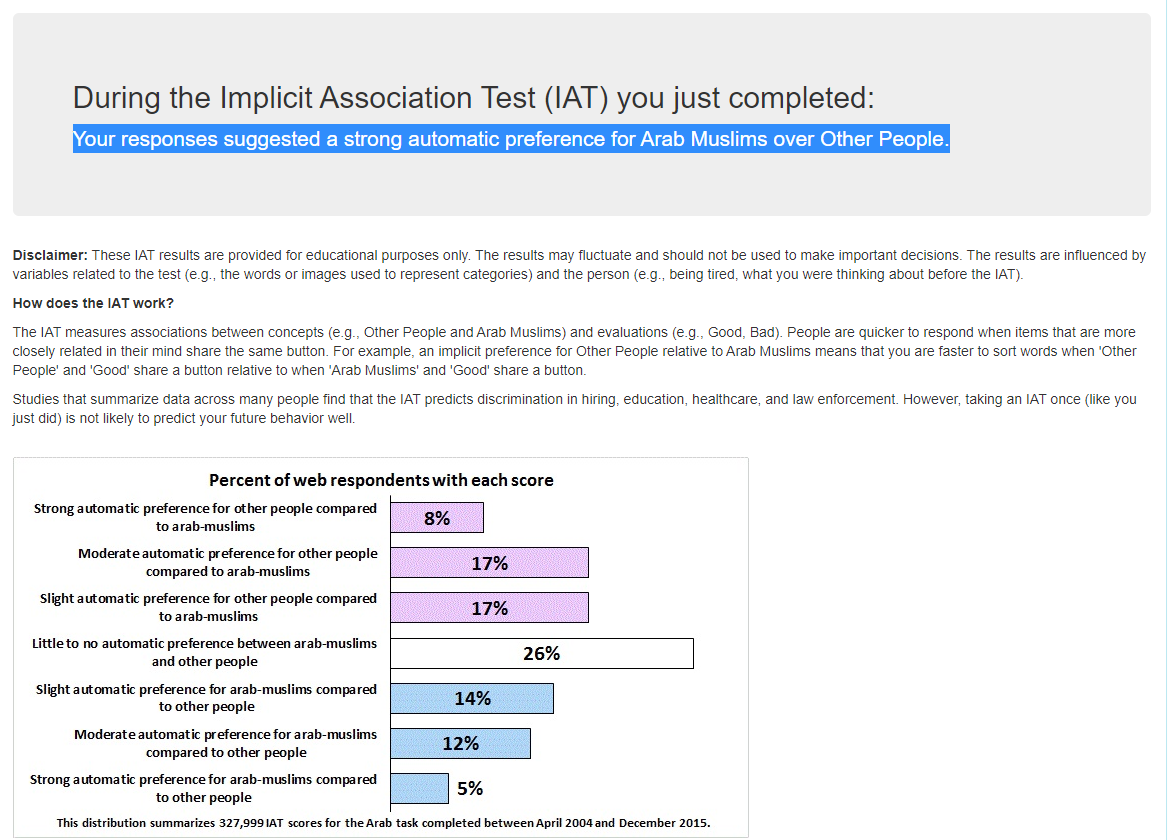
After visiting the Harvard Universities project implicit website, I opted to take the Arab-Muslim implicit association test for this week’s assignment. I was impressed by the design of these tests, and I was also surprised by the results that my test showed regarding implicit association with the Arab-Muslim community.
Implicit bias is something that is subconsciously programmed into our brains that has been growing and developing through out our lifetimes. Implicit bias can have negative consequences regarding the personnel hiring process to name one of the fields implicit biases has an impact on. As I learned from the required readings for this assignment, implicit and explicit bias are related but distinct mental constructs and that the implicit biases we all hold do not always conform to our declared beliefs and who we think we are regarding our stances on various subjects. As I read further, my eyes were opened to the harm these implicit biases can have in the classroom, in a hospital, or in a court of law according to previous studies.
Going into this implicit association test, I presumed I would have a score that was along the lines of being in the middle ground, showing no preference of one race or ethnicity to any other because I believe all people are created equal. My test results showed that my responses suggested a strong automatic preference for Arab Muslims over Other People. I was surprised by these findings, but it clearly supports the claim that “The implicit associations we hold do not necessarily align with our declared beliefs or even reflect stances we would explicitly endorse.” (Understanding Implicit Bias, The Kirwan Institute)
These findings tell me that implicit bias has a strong likely hood of negatively effecting the selection process for people from all walks of life in many different industries that are not just related to hiring for a job. While we may know ourselves and our predispositions well, my research has shown that implicit bias does not always conform to our declared beliefs which means that we may presume we are competent to select people fairly without bias while we subconscious deny people opportunities based on our implicit biases. This is obviously harmful for the selection process because it tricks our minds into thinking we give everyone a fair and equal chance and opportunity for something while we subconsciously make decisions differently.
To combat implicit bias hindering people’s opportunities subconsciously, it is first necessary to learn more about implicit bias through reading and tests. Once educated on the topic, remember what you learned and treat different applicants the exact same way with regards to questions and behavior and let go of all internal and implicit biases as much as possible.
Sources:
How To Think About Implicit Bias
https://www.scientificamerican.com/article/how-to-think-about-implicit-bias/
Understanding implicit Bias
https://kirwaninstitute.osu.edu/article/understanding-implicit-bias

Hi, this is a comment.
To get started with moderating, editing, and deleting comments, please visit the Comments screen in the dashboard.
Commenter avatars come from Gravatar.