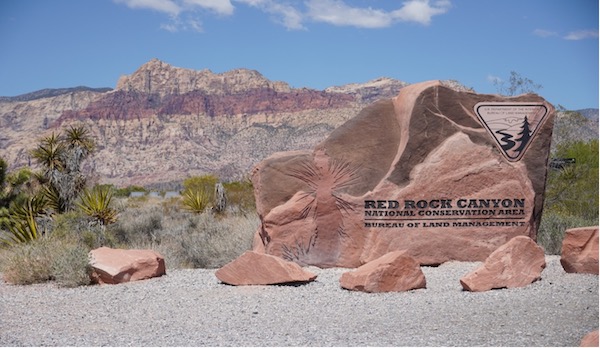
Entrance to the Red Rock Canyon Scenic Drive and Visitor Center
State Route-159 is a long, winding two lane road heading west out of Las Vegas, into the Mojave Desert. Where it leaves the city, it’s known as Charleston Blvd. Over the years, the edge of the city has reached further into the desert, like a flooding tide of lights that never recedes, but the Red Rock Canyon remains a secret to most Las Vegas tourists.
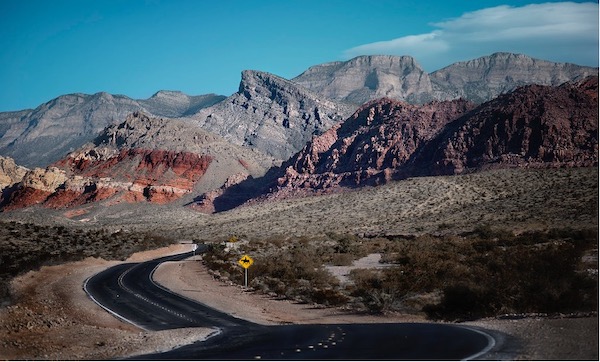
“Road & Rocks” by Jesus Solana Poegraphy is licensed under CC BY 2.0
As a child, I scrambled across the gritty red and white boulders with my brother and father. My father used these rocks to teach us lessons of risk and reward. As a teenager, I climbed to the summit of Red Rock frequently with my friends. The summit of Red Rock reveals a panoramic view of the entire Las Vegas Valley and beyond. Now, as an adult, I always spend some time at Red Rock when I’m in town visiting my family.
Every time I go, I learn something new and amazing at the Visitor Center. Just off SR-159 is a 13-mile, one-way, scenic loop that guides you to the starting point of countless adventures, and the Visitor Center is located just inside the entrance to the Scenic Drive.
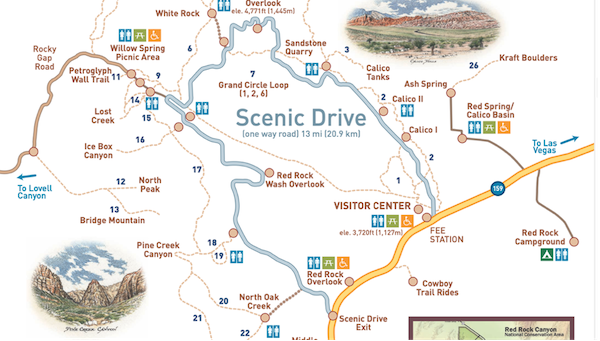
Screenshot from (Management, 2021)
Geography & History of Red Rock Canyon
Driving and hiking through the Red Rock area provides a glimpse back in time. If we could witness the changes through a time lapse video, it would begin with a tropical sea flourishing with marine life. This would last from about 500 million years ago (Mya) till around 250 Mya, encompassing the Paleozoic Era. So much life thrived in the warm sea that the fossilized skeletons and dissolved remains would pile upon the sea floor until they formed massive layers of rock 23,000ft thick (Moulin, 2013). Eventually the sea receded, and Nevada had the geography of a massive river delta until a subduction of tectonic plates would create the Sierra Nevada Mountains. The Nevada river delta was thrust from the water, exposing the riverbed. Vast sand dunes were formed from this delta dust around 200 Mya, trapped by the Sierra Nevada Mountains. These sands would later harden and form red and white sandstone mountains. Through further subduction events and erosion, the ancient limestone layers below the sandstone were forced up and over the newer sandstone. Erosion would expose the Red Rock Canyon area, and gray limestone mountains tower over the fiery hues of sandstone today.
This picture of the first pullout at Calico I captures the dynamic between the gray limestone mountains and the ancient Aztec sandstone that makes up the Red Rock Canyon area. If you take a close look above, the cars at the foot of the mountain shows you the scale of the giant boulders. Calico I pullout gives visitors the opportunity to take pictures or gain access to the red rocks for a climb.
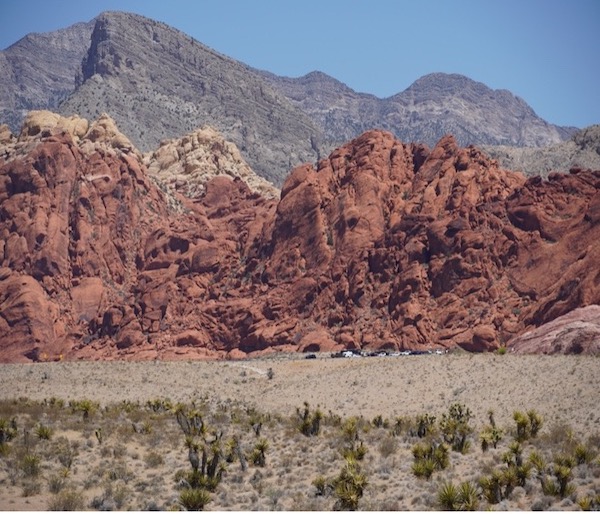
Calico I pullout at Red Rock Canyon
Before we get to the next adventure, we must stop and take in the views of the highest point of the 13-mile loop, High Point Overlook, elevation 4,771ft (Moulin, 2013). From here you have a jaw dropping view where the valley meets the rocky edge of the Spring Mountains.
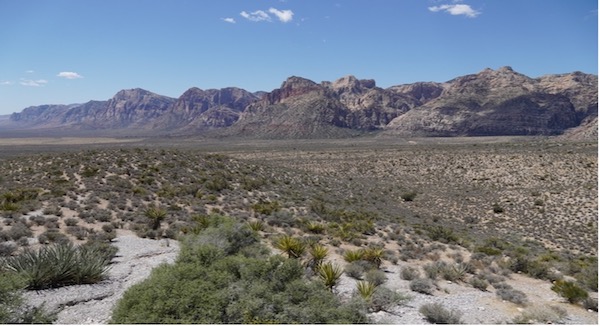
Red Rock Canyon Scenic Drive, High Point Overlook
The red and white sandstone rocks are behind the camera as we look at the second half of the 13-mile drive. Upon closer inspection, you may see the entrances to various canyons that offer amazing day hikes from the trailheads on the famous loop.
World Class Rock Climbing
Our next stop is White Rock, a favorite for technical climbers that use special climbing equipment to climb the walls of the sandstone cliffs. The white sandstones are much larger than their neighboring red stones. Bouldering, or climbing rocks that don’t require safety equipment to climb, is much more popular on the red rocks where one can easily climb from one boulder to the next.
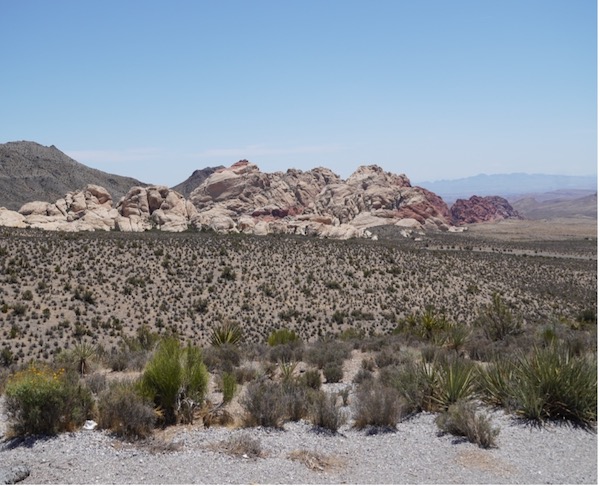
White Rock at Red Rock Canyon
The White Rock boulders are much larger and may require ropes and safety equipment. It’s a great training ground for technical climbers to hone their skills, or advanced bouldering enthusiasts looking for a challenge. For more experienced climbers, or those looking for more adventure, Pine Creek Canyon, the last turnoff on the loop, offers extensive single pitch and multipitch climbing from 5.6 to 5.12 (Moulin, 2013). There are also several professional guide services available that provide all the necessary safety equipment, experienced guides, and half-day or full-day options.
Traces of Native American History
As we follow the Scenic Drive past the outcropping of red and white sandstone, we come to a series of small canyons, carved by erosion into the rocky Spring Mountains. These canyons provided protection and a water source for ancient civilizations.
The first traces of humans date back to 9000 BC. The most recent native Americans, the Paiute and Anasazi tribes, have left their marks on the walls of the canyons for thousands of years. They also left the remnants of ancient agave roasting pits throughout the region. According to Tom, an older gentleman who joyfully spends his days at Red Rock Canyon Visitor Center as a Volunteer,
They would dig a hole in the ground and get a nice bed of coals going, and they would cover the holes with limestone, because it has the ability to hold the heat in. Then they’d put the agave plants on, along with anything else — if they had a Big Horn Sheep, a Mule Deer, lizards, or snakes, whatever they got. Then they would cover it all with another layer of limestone to cover it like a Dutch Oven. Then they’d set the timer– Tom waited for me to chuckle at his favorite joke, and I obliged– They would then take the limestone off and have a big party.
Our next stop will be at the Petroglyph Wall Trail to check out some of these ancient time stamps. Petroglyphs are markings that were etched into the rock, but you can also find Pictographs, which are designs painted on the walls. The paint was made from the pigment of organic substances.
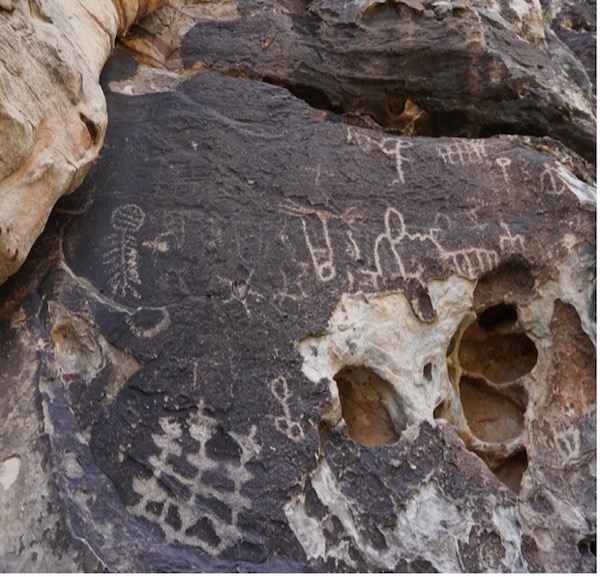
Petroglyphs at Willow Springs in Red Rock Canyon
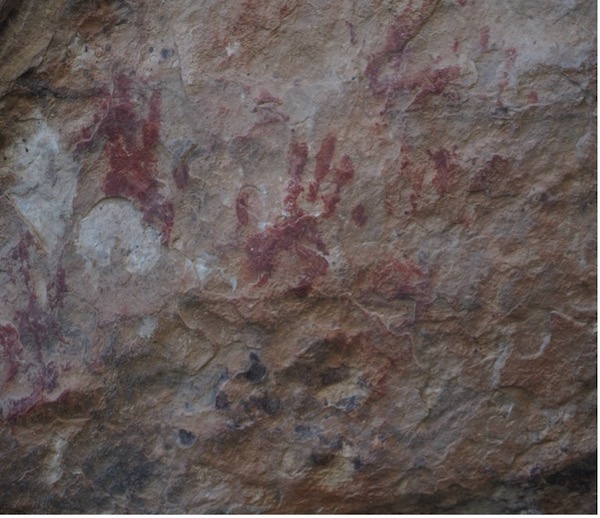
Pictographs at Willow Springs in Red Rock Canyon
It’s amazing to see the signs of civilization on the walls of desert sandstone, but it raises the question, how did people survive in such a dry and arid place? Our next stop presents an answer with a brief 0.6-mile hike, roundtrip.
Lost Creek Waterfall is a small oasis tucked up against the cliffs, hidden by tall brush. It’s often dry, but even a small amount of rain will produce a 50ft waterfall.
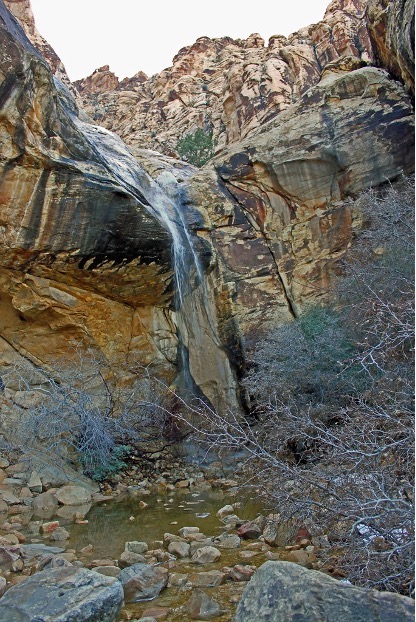
“Lost Creek Waterfall.jpg” by odonata98 (Kimberly Reinhart) is licensed under CC BY-NC-ND 2.0
Further down the Scenic Drive from Lost Creek trail, is a trailhead into Ice Box Canyon. This is a great hike on those warmer days, not so much for the journey, which is certainly picturesque, but for its cool destination. The terminus of Ice Box Canyon sees little sun, keeping the depths of the canyon quite cool compared to the exposed landscape of the desert. At certain times of year, there’s also a waterfall where the trail ends.
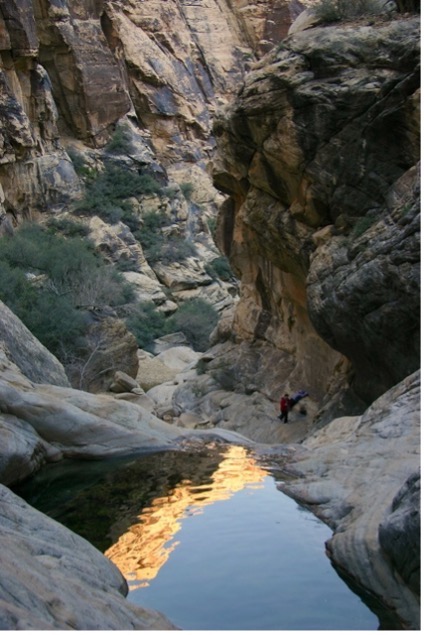
“Hiking in Ice Box Canyon” by kathrynaaker is licensed under CC BY-NC-SA 2.0
The warm desert air carries the fragrant essences of desert vegetation. These plants have adapted to thrive in the arid ecosystem of the Mojave Desert. They provide sustenance to other desert animals, and Native American tribes that once lived there. These are just a few common varieties found throughout the region.
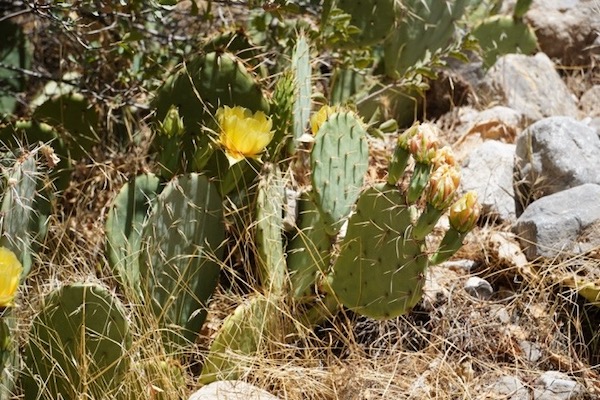
Pancake Pricklypear Cactus
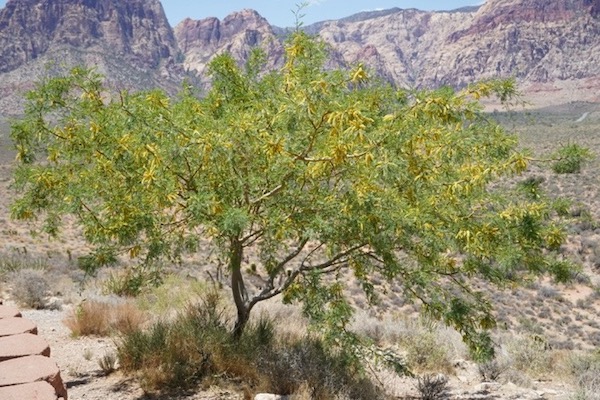
Honey Mesquite
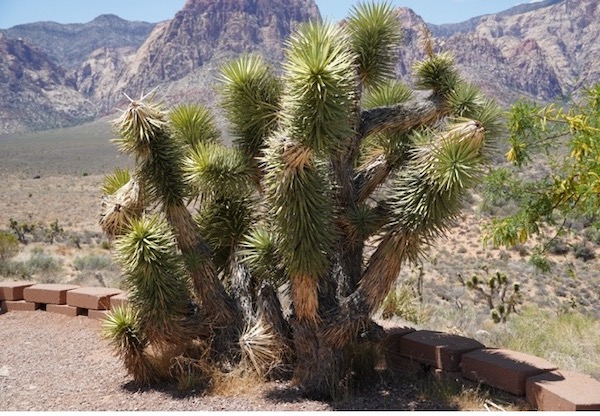
Joshua Tree
Most Las Vegas visitors are screaming “Vegas Baby!” as they drive in and finally see the City of Lights rise on the desert horizon. Blackjack, Craps and Roulette, call to them. Poolside cocktails and world class DJs lure them in. Strip clubs and buffets promise guilty pleasures. When it’s time to go home, promises are made to God and each other, What happens in Vegas, stays in Vegas.

“las vegas sign” by Shahar Hart is licensed under CC BY-NC-SA 2.0
The amazing adventures that lie just west of the city at Red Rock Canyon often become a missed opportunity, saved for another trip. Every Vegas native is obliged to become a part-time tour guide for any friends and family who come visit the famous city. The first 25 years of my life were spent in Las Vegas, and at the age of 48, I still come frequently to visit my family. I might hit a casino or two. I might hit a buffet, I might not. However, I always go to Red Rock Canyon.
Works Cited
Management, S. N. (2021, May 20). Red Rock Canyon Keystone Visitor Guide. Retrieved from Red Rock Canyon Keystone Visitor Guide: https://www.redrockcanyonlv.org/wp-content/uploads/rrckeystone2017_vfin-web.pdf
Moulin, T. (2013). Red Rock Canyon Visitor Guide. Las Vegas: Snell Press.
Tom. (2021, May 18). Volunteer. (R. Strasser, Interviewer)
