I would like to acknowledge the researchers, veterinarians, and field professionals who have provided mentorship and opportunities throughout my training. Their willingness to share knowledge and experience has shaped my interests in fisheries ecology, wildlife health, and aquatic conservation.
Five species of Pacific salmon thrive within the North Pacific waters of the U.S. and Canada- coho, pink, sockeye, and chum salmon. These fish are considered keystone species, having considerable economic importance and cultural significance for the Pacific Northwest indigenous peoples (Suffridge et al, 2024). Declines in wild populations within the Pacific Northwest have led to many of these fish being listed under the Endangered Species Act. Even with best efforts, few listed populations are showing much improvement. The lack of success may be tied to factors such as dietary needs, with trophic system dynamics having strong influence on salmonids (Bellmore et al. 2017; Benjamin et al. 2022; Bilby et al. 2024).
Thiamine deficiency complex (TDC) was first documented in 1968 in salmonine fishes within the Laurentian Great Lakes (Harder et al, 2018). Thiamine levels below suitable ranges can result in deleterious changes to cardiac morphology and function, impaired swimming and/or migratory success, weakness, edema, poor appetite, muscle atrophy, vascular degeneration, hemorrhage of midbrain and medulla, negative effects on upper thermal tolerances, and high mortality rates. (Adeli et al. 2025; Kraft et al. 2017; Horak. D.L., 1975; Honeyfield et al. 2009). TDC has led to a growing awareness and suspicions of whether it is present within the PNW and what monitoring and treatment solutions should be applied.
Thiamine, vitamin B1, is an essential vitamin comprised of three main vitamers: Free Thiamine (Th), Thiamine monophosphate (TMP), and Thiamine pyrophosphate (TPP) (Futia et al. 2019). Free Thiamine is the mobile form, a potential antioxidant, and is most commonly found within eggs. TMP is uncommonly found due to its reserved form, while TPP is commonly occurring in muscle and other tissues and is the active form used for the nervous system and metabolism of lipids and carbohydrates (Futia et al. 2019; Honeyfield, 1998). Thiamine originates in the lower food webs where species of bacteria, phytoplankton, fungi, and plants synthesize it through assembling and linking existing compounds into vitamin B1 (Bland, 2021; Fridolfsson et al., 2019). The bacteria and algae within the aquatic system that synthesize thiamine are ingested by planktivorous fishes whom are then consumed by predatory species (Harder et al, 2018). Through this consumption, the vitamin is extracted and metabolized by intestinal digestion (Harder et al, 2018).
Thiamine deficiency or early mortality syndrome (EMS) is characterized by high mortality rates during the early life stages of anadromous fish, and M74 syndrome (Mantua et al, 2025). M74 syndrome is a reproductive disorder of salmon that reveals itself with high offspring mortality during the yolk-sac fry phase. In adult salmonids, TDC can result in impaired neurological function, lower ovarian thiamine concentrations in females, and a “lack of coordination” (Harder et al. 2018). Higher mortality rates and reduced swimming endurance are often connected in adult salmon with TDC (Harder et al. 2018; Harder and Reed et al. 2024). Thiamine is a critical component for healthy regulation and activation of immune responses. TDC can lead to a dampened immune response system, allowing potential bacteria to compromise a host’s immune system (Kraft et al. 2017). As many salmonid species traverse long distances to return to spawning grounds, TDC ultimately could make fish unable to successfully navigate upstream migrations where they will face areas of fast water and obstructions, and have decreased chances of successful completion of spawning (Fitzsimons et al. 2005; Ketola et al. 2005; Harder et al. 2018).
Thiamine-deficient fry have a significantly lower chance of survival, while symptomatic signs include hydrocephalus, hemorrhaging within the yolk sacks, edema, and a ‘wobbling’ like swimming behavior where fish showed a loss of equilibrium. (Harder et al. 2018; Fitzsimons et al. 2005). Often, these fish prove unable to successfully navigate and hunt for their first meal, leading to 90% increased predation and mortality (Harder et al. 2024).
TDC is susceptible to species that are thiamine auxotrophs- those unable to synthesize the vitamin on their own. Primary diet shifts to prey that harbor naturally occurring thiaminase enzyme or lipid-rich prey items have shown signs of targeting species that harbor excess carbohydrates and the enzyme thiaminase. (Harder et al, 2024; Kraft et al, 2017; Honeyfield et al, 2005; Vuorinen et al. 2021). Thiaminase is an enzyme responsible for breaking down thiamine (Edwards et al. 2023). TDC in fish has been linked to cases of fish consumption of prey that were rich in thiaminase (Mantua et al, 2024). The most commonly associated species carrying this enzyme are clupeid fishes- Alosa pseudoharengus, Dorosoma cepedianum, Clupea harengus, and Engraulis mordax (Wistacka et al. 2002; Tillitt et al. 2005; Kraft et al. 2017). Shifts in diet within feeding grounds can correlate to natural shifts in ecosystems that bring a new prey population stock level and results in an unbalanced diet of prey with low thiamin per unit of energy (Lundeberg, 2024; Fridolfsson et al., 2020).
With climate change bringing warmer water temperatures, evidence has shown an increase in presence and earlier spawning of species such as anchovies and sardines within the Pacific Northwest over the last few years. This change could lead to dietary shifts of young salmon that have migrated out to the ocean (NOAA Fisheries, 2023). A study conducted in 2022 focused on prey species within California waters found anchovy and herring to hold high enough levels of thiaminase to be problematic for salmonids ingesting them (Mantua et al, 2024). While salmon typically rely on a diverse array of prey resources, their diets may consist primarily of anchovy and/or sardines due to scarcity of other prey or a super-abundance of a particular prey population (Thayer et al, 2014; Mantua et al, 2025).
Testing for TDC
According to Harder (2024), current means to test egg thiamine concentrations are time-consuming, with results taking up to weeks to finalize. The most common means to analyze thiamine components is through the use of ovulated, unfertilized eggs by high-performance liquid chromatography (HPLC). HPLC analysis is performed through the measurement of thiamine vitamers: free thiamine, thiamine monophosphate, and thiamine pyrophosphate (Brown et al, 1998; Adeli et al, 2025). TDC severity can be determined once a species and/or population baseline is established through prior analysis (Rowland, 2024). With adult specimens, collection of blood and tissue can be sent to laboratories for analysis using various forms of chromatography according to Brown (1998). It is also important to understand that critical values and baseline requirements can vary across populations of the same species (Harder et al. 2018; Rowland, 2024), making it necessary to strive for population-specific baselines.
Currently, most studies have been conducted and focused on determining how much thiamine is necessary for eggs and fry to prevent TDC, while fewer experiments have been conducted in examining how thiamine deficiency impacts adult health (Harder et al. 2018). Eggs are used to monitor and predict early life-stage mortality (Vuorinen et al. 2021; Mantua et al, 2025; Harder et al, 2024), while the stomach and gut content are used to determine and potentially link TDC to a dietary aspect of that animal (Thayer et al, 2014). Whole blood and tissue samples are used to determine total thiamin status in adult animals (Honeyfield, 2014).
Primary institutions that are involved in monitoring and testing thiamine levels include government agencies, university research programs, and specialized private companies.
These include:
U.S. Geological Survey (USGS) Columbia Environmental Research Center (CERC)– focused on routinely collecting biological samples from areas within the Great Lakes and Alaska to evaluate thiamine deficiency where wildlife s impacted
NOAA Fisheries Southwest Fisheries Science Center– involved in West Coast research on thiamine deficiency. This lab has worked with anglers in collecting samples for their monitoring project.
Oregon State University: department of microbiology have studies linking shifts in food webs that connects to widespread thiamine deficiency in salmon
University of California, Davis (UC Davis)– since 2020 has been active in researching and monitoring Chinook salmon in California through annual egg surveillance monitoring.
Washington Animal Disease Diagnostic Laboratory (WSU): offers diagnostics testing and consultation for aquatic animal health.
Treatment and Prevention of TDC in Hatchery Fish
Methods that have been used and found successful to treat TDC in fish, including either submersion application or injection administration. Providing female salmon with thiamine supplementation injections before spawning is reported as highly effective at increasing egg thiamine concentration and aiding in metabolic benefits, there are uncertainties about whether this may potentially lead to masking preexisting thiamine deficiency in a population. This could hinder managerial abilities to estimate its population level impacts (Mantua et al, 2025). For alevins or fry, a bath solution of thiamine mononitrate has been used, as well as placing eggs into an immersion treatment for 1 hour just after fertilization during water hardening as a preventative measure, has shown success (Fitzsimons, 1995; Rowland, 2024; Brown et al, 2005). For adult female fish, a single Thiamine HCL injectable solution given either intramuscular or intraperitoneal 2-3 weeks before spawning, has been shown to have success in preventing TDC in the progeny (Rowland, 2024; Koski et al., 1999; Fitsimons et al., 2005; Futia et al). In comparison, male adult fish were able to produce viable milt even if they themselves held TDC.
Fish hatchery managers found that adding thiamin to hatchery water systems can allow salmonine eggs to absorb and increase their thiamin levels. This can aid in reducing and even eliminating sac-fry mortality rates and increase production success in hatcheries (Kraft et al. 2017; Koski et al. 1999; Wooster et al. 2000; Brown et al. 2005). The decision to treat with thiamine supplementation in populations or within a hatchery is highly dependent on population characteristics and management goals (Harder et al. 2024). Some concerns are that hatchery-raised fish will naturally outcompete wild stock, risk changes to the natural flow of evolutionary adaptations, and concerns that hatchery fish risk genetic diversity and reduced fitness (Harder et al, 2018, 2024).
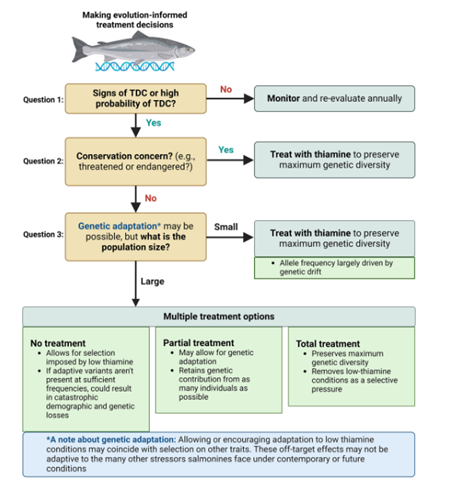
Genetic diversity in a population is highly correlated with adaptive potential. In other words, a population can genetically respond to environmental changes over time (Harder et al, 2024). The concerns towards the loss of fish due to TDC fall into the risk of losses of genetic variants, which, in turn, could lead to the chance of a population being extirpated while facing these future challenges. Juvenile mortality in fish with TDC has been documented to be as high as 90%, with some population females having no success in producing surviving offspring (Harder et al, 2024; Ketola et al, 2000). Though treating individuals with supplemental thiamine, this could remove selective pressure and prevent natural selection towards individuals’ susceptibility towards TDC. According to Harder (2024), no evidence suggests genetic variation corresponding to differential TDC susceptibility exists in the Pacific salmon populations. This was based on the results of a multigenerational genome-wide association study. Unsupplemented populations and relying on natural genetic adaptation risks the loss of these populations both regarding genetic diversity and population sizes (Harder et al, 2024; Mantua et al, 2025). To conserve overall population size and health and minimize demographic losses, it is suggested that thiamine supplementation for as many individuals as possible be the ideal option (Harder et al, 2024; Mantua et al, 2024).
Figure 2-2024, Overview of Treatment Considerations and Options. By Harder et al.
Discussion
Thiamine is an essential vitamin for growth, maturation, and survival success in anadromous fish, and a deficiency can result in early mortality syndrome and die-offs before spawning, leading to declines in the wild populations. Thiamine deficiency awareness began when it was documented in the Great Lakes fisheries and again in 2020, in the California Chinook salmon (Oncorhynchus tshawytscha) after fry at multiple hatcheries began displaying clinical signs. (Mantua et al, 2024).
While many studies have documented cases of symptoms to confirm a potential thiamin disorder, there is an inconsistency in testing methods for confirmation and prevention. Currently, the findings for TDC are based symptomatically, with reports based upon how fish responded to thiamin treatment. A large limitation to these findings is the lack of evidence that lists predicted thiamin normal ranges for species or populations.
There are still questions unanswered, including whether salmon are simply not getting enough thiamine from their food sources, whether the fat content may be causing TDC to use up more thiamine to break down lipid content, or whether it is simply due solely to the enzyme thiaminase from prey fish that they ingest, causing the TDC?
Conclusion
Much is still unknown nor fully understood about the roles of B vitamins in aquatic ecosystems, making thiamin an important subject for further study and research. Methods such as using nonlethal sampling of gut contents, tagging, and releasing salmon that can then be tracked via acoustic receiver during their return migration (Mantua et al, 2024). This data could provide insight into links between the ocean diet, thiamine status, adult migration, and survival rates. This systematic monitoring could be used to alert managers to conditions favorable or leaning towards a potential thiamine deficiency in salmon. Through further research and sampling, it is possible to determine a reliable thiamine level baseline for referral. The goal would be to use this baseline to find early warning of imminent thiamine deficiency, which could aid in determining necessary interventions and best management practices.