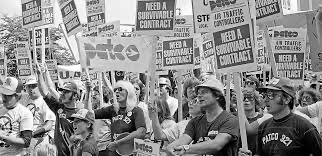
While unions provide key benefits for the employees they represent, they also introduce trade-offs for both employers and organizations. One of the main arguments in favor of unions is that they often improve pay and benefits. According to the U.S. Bureau of Labor Statistics, full-time union members earned a median weekly income of $1,404 in 2025, compared to $1,174 for nonunion workers. However, the Bureau of Labor Statistics notes that wage differences depend on many factors, including industry, occupation, and workers’ characteristics–rather than union membership alone. (Bureau of Labor Statistics, 2026).
What I learned this week is that unions matter because they give workers a real voice in scheduling, safety, and workplace conditions. Research cited in a report by the Economic Policy Institute shows that, on average, unionized workers earn more, while OECD research suggests that collective bargaining can reduce inequality and promote broader, more inclusive labor markets. Economic Policy Institute. (2025). Unions aren’t just beneficial for workers—they also support communities and democracy. But there are also concerns. For employers, unionization can reduce flexibility, increase labor costs, and sometimes slow decision-making. NBER research also indicates that unionization can decrease the value and future growth prospects of successful companies, which may explain why management often opposes it. National Bureau of Economic Research. (2009). Long-run effects of unions on firms.
The main takeaway is that unions are not inherently good or bad. They are valuable only when management treats employees fairly and when employees have a real voice. I might consider joining a union if I believed pay was unfair, safety issues were ignored, or employees had little input into work decisions. If an organization already provided fair wages, transparency, and respect, I might feel less need for one. Overall, this week’s materials have helped me see unions as a way to balance power in the workplace, rather than as a source of conflict. OECD. (2019/2025). Negotiating our way up: Collective bargaining and social dialogue.
References
- Bureau of Labor Statistics. (2026). Union members—2025.
- Economic Policy Institute. (2025). Unions aren’t just good for workers—they also benefit communities and democracy.
- OECD. (2019/2025). Negotiating our way up; Collective bargaining and social dialogue.
- National Bureau of Economic Research. (2009). Long-run effects of unions on firms.