
By Norma Kline, Oregon State University Extension Forester for Coos and Curry Counties
This is the fifth article in the Writing a Forest Management Plan series. The objective of this series is to simplify the process of writing a forest management plan, making it accessible and straightforward regardless of your prior skills and knowledge. If you already have a management plan, use these steps to review and update it.
The earlier articles cover generating basic property information and maps for your forest management plan using web-based mapping resources. They also discuss mapping forest cover (stands) by stand age and species and taking simple plot measurements. This information can be used to provide key summary information for the “Current Stand & Forest Health Conditions” section of your plan. The links to the first four topics can be found at the end of this article.
In this article, we will describe additional information needed to complete the “Stand Characteristics Table”, including details on a stand’s growth stage, spacing, vertical structure (layers), and forest health observations. We will use the forest stand referenced in the previous articles as an example. Previously, we discussed
Stand Characteristics Table
The Stand Characteristics Table includes fields to describe Growth Stage, Spacing, and Canopy:
- Growth Stage: This indicates the developmental stage of trees, ranging from seedlings (less than 4.5 feet in height) to saplings (1–5 inches DBH), small trees (6–11 inches DBH), large trees (12–29 inches DBH), and very large trees (30 inches or more DBH). Based on our plot data (referenced in articles 3 and 4), the growth stage of our example stand ranges from small to large trees.
- Spacing: Spacing describes the horizontal structure of a stand. Are the trees evenly spaced (planted in systematic rows), or are they clustered in dense patches with wide spacing or openings? If you measured the distance between trees during your fixed plot inventory, summarize that data here. In our example, the trees are evenly spaced (16–17 feet apart).
- Canopy: Canopy refers to the horizontal structure based on whether the tree crowns are “Open” (not touching), “Closed” (touching), or “Variable” (a combination). An open canopy might characterize a young stand in early growth stages or a mature stand with few trees per acre. In our example, the stand has evenly spaced trees with a closed canopy.
The table includes fields for Primary, Second, and Third Layers. Not all stands have multiple layers. In our example, the stand—planted after a clearcut—has one main layer. If multiple layers are present, record data in your inventory notes. For example, a stand may have a primary layer of large conifers (24–40 inches in diameter) and a secondary layer of shade-tolerant species such as western hemlock (around 10 inches in diameter). You can calculate the trees per acre for additional layers based on fixed plot data or provide a general estimate with a description of their distribution (e.g., uniform, variable, or filling openings).
Age may be challenging to determine for additional layers, as small, suppressed trees can be the same age as dominant trees. However, you may know the age if you planted the stand or have records of disturbance events that facilitated seedling germination.
Additional Observations
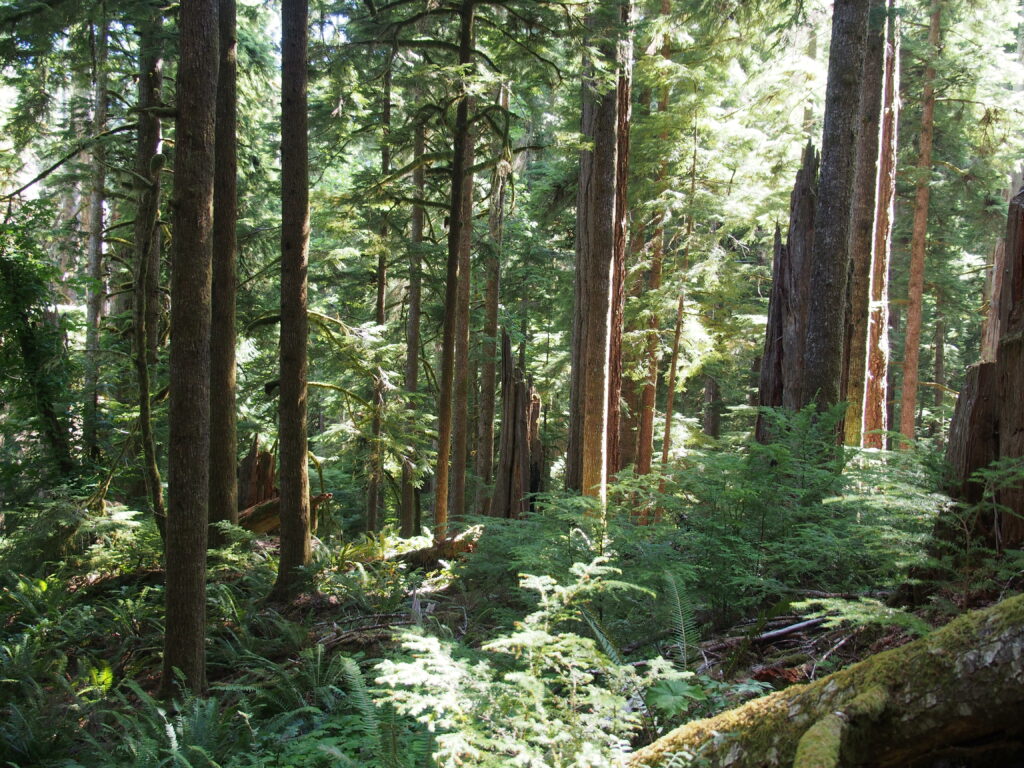
- Snags, Down Wood, and Understory Vegetation: Note observations of standing dead trees (snags), downed wood (logs), and understory vegetation. These elements are crucial for wildlife habitat, providing cover for amphibians and food for various species. If a stand lacks these structures, landowners can implement management actions to enhance habitat diversity (if desired). Figure 1 is an example of a stand with snags, down wood and understory vegetation.
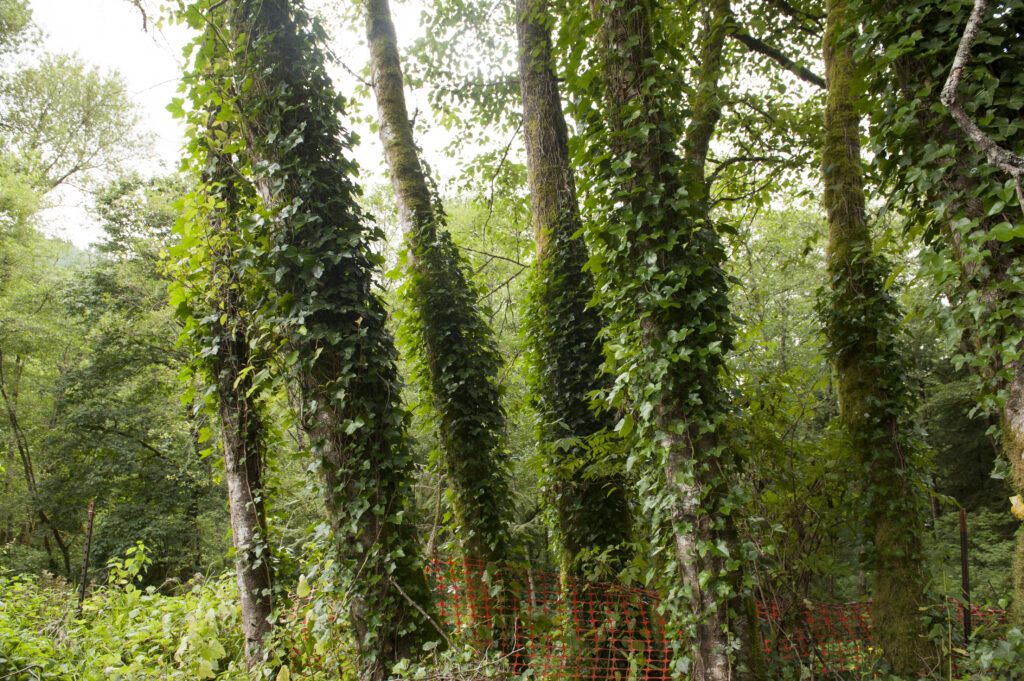
- Forest Health Conditions: Record observations of insect and disease issues, invasive plants (Figure 2), wildlife damage, storm damage, or excessive fuels. Examples include bear or rodent damage, storm damage, or invasive species. Landowners may use this information to develop management actions, such as eradicating invasive plants, salvaging dead trees, replanting areas with reforestation failures, and reducing fuels.
- Tree volume? You may have noticed that the general information documented in the Stand Characteristics Table does not include tree volume. If you would like to collect general volume information for a stand, consider using the Tarif System to take your stand data. The Tarif system is described in more detail in Measuring Your Trees and the Basic Forest Inventory Techniques for Family Forest Owners, below.
Management Objectives and Desired Future Conditions
The next step is to establish Management Objectives and Desired Future Conditions. Objectives for a specific stand will align with the overall goals for the property. This information will guide future management actions. Here it might be a commercial harvest or habitat for a desired wildlife species. Examples of desired future conditions you want to see in 5-10 years might include a certain desired harvest volume or a diversity of species and layers.
If your management objective is to keep the stand on the landscape for a long period of time, then keeping track of density (crowding) to make sure that the forest continues to grow vigorously is recommended.
In the next article, we will discuss a few additional calculations that you can take using basic fixed plot data including basal area and the stand quadratic mean diameter which can be used to determine the relative density of a stand, a useful measure for planning future planned actions.
References
Basic Forest Inventory Techniques for Family Forest Owners. https://pubs.extension.wsu.edu/basic-forest-inventory-techniques-for-family-forest-owners
Measuring Your Trees. https://extension.oregonstate.edu/catalog/pub/em-9058-measuring-your-trees
Oregon Forest Management Plan Template and Guidance. https://blogs.oregonstate.edu/forestplanning/templates/
Writing a Forest Management Plan: Start with the Easy Sections. https://blogs.oregonstate.edu/southcoastfieldforest/2024/02/15/writing-a-forest-management-plan-start-with-the-easy-sections/
Writing a Forest Management Plan: Mapping Stands.
Writing a Forest Management Plan: Measuring Plots to Describe Your Woodland.
Writing a Forest Management Plan: Summarizing Plot Measurements to Describe Your Woodland. https://blogs.oregonstate.edu/southcoastfieldforest/2025/02/20/writing-a-forest-management-plan-summarizing-stand-inventory-data-to-describe-stands/
