

Words from the Dean
December 2025
Words from the Dean
December 2025
Dear College of Science community,
With fall term behind us, I want to wish everyone a good holiday season. Thank you for all of your hard work this term –– we have collectively accomplished so much. I hope everyone is able to rest and recharge over winter break.
This fall was an especially intense term for me personally. I taught a section of the Transitions course (shout-out to Devon Quick and the Transitions Ecampus group for getting me up to speed on all things Ecampus and Canvas!). I also began analyzing an exciting new dataset on the genetics of human female reproductive traits –– while trying to ensure my Ph.D. student reaches the finish line before her funding runs out. At the same time, I jumped into a host of new OSU initiatives to increase student success.
I especially appreciate all of the help many of you have provided on the student success work –– educating me and brainstorming about where you think the opportunities are and what the resource needs are so that I can carry those messages back and help set priorities. I’m excited to be doing this work, and hopeful that we can continue it with some well-thought-out and well-executed interventions that will really help students.
Our commitment to students and to science is highlighted across the items in this newsletter: science students taking on childhood disease and climate challenges (including OSU’s first Marshall Scholar!), faculty innovation and entrepreneurship, interdisciplinary research that connects fundamental science with real-world systems, and a community that shows up for students in tangible ways.
The best of our College is also highlighted in a star-studded lineup of winter and spring events. On Jan. 15, David Ji will present the annual Gilfillan Lecture. On Feb. 17, we’ll come together for the Faculty and Staff Awards to recognize colleagues whose research, teaching, advising and commitment to inclusive excellence strengthen our mission. I am also excited about our spring Inclusive Excellence Lecture on March 17 that will bridge science and art. Hannah Stuwe, a Ph.D. candidate in biochemistry and biophysics, will present a multimedia presentation featuring live music, exploring what the sciences can learn from DIY counterculture.
On April 2nd (time TBD) we will hold a town hall with Provost Roy Haggerty and President Jayathi Murthy, followed by a showcase of faculty research. And finally, in May we will reprise last year’s incredibly successful graduate student research showcase (date TBD). I hope that all of these events will be opportunities to celebrate our colleagues, but also to come together, socialize, maybe even meet new people.
Go Beavs!
Eleanor Feingold
Dean, College of Science
All the news that’s fit to print.
Please submit news, honors and awards, discoveries, events, research funding, student news, alumni updates and more. Just send us a quick email by the end of the month.
Research
updates
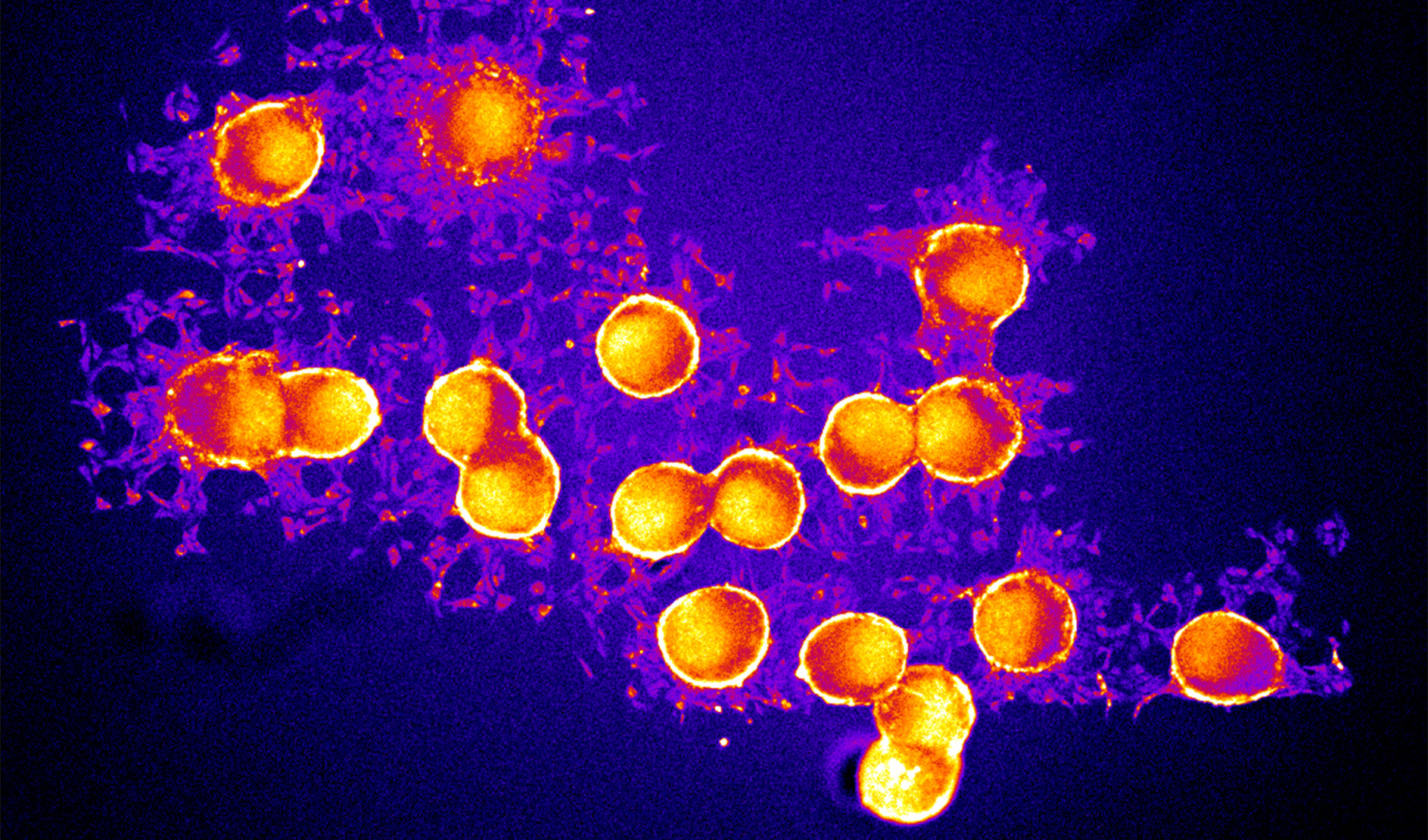
Neuron spheroids on a chip designed to control the communication channels between the neuron cells. Color shows the firing activity of the cells.
Research Funding
Four College of Science interdisciplinary research teams have been awarded funding through SciRIS stage 2 and stage 3 categories. Their projects span quantum materials, nanotechnology, spectroscopy and cell-based computing — exploring spin waves for future computing, tracking nanoplastics in living systems, developing single-pixel spectrometers, and advancing cell-based artificial intelligence.
- Transforming computing through spintronics (Stage 3): A cross-disciplinary team of Oksana Ostroverkhova (physics), Axel Saenz Rodriguez (mathematics) and Chong Fang and Tim Zuehlsdorff (chemistry) is designing and controlling spin waves (magnons) for faster, more energy-efficient computing technologies.
- Cell-based artificial intelligence (Stage 2): Bo Sun’s (physics) team, in collaboration with Patrick Chappell in the College of Veterinary Medicine, is developing computing systems based on engineered biological cells that can process information, sense environments and respond to inputs, offering energy-efficient and self-repairing alternatives to traditional computing.
- Using machine learning to develop single-pixel spectrometers (Stage 2): Ethan Minot (physics) and electrical engineering professor Xiao Fu are combining atomically thin semiconductor photodetectors with machine learning to create ultra-compact spectrometers for applications ranging from environmental monitoring to wearable health sensors.
- Labeling nanoplastics (Stage 2): Marilyn Mackiewicz (chemistry) and Stacey Harper (Colleges of Agricultural Science and Engineering) are working on metal nanoparticle tracers to visually track nanoplastics in cells and zebrafish models, improving understanding of nanoplastic uptake, toxicity and environmental health impacts.
Read more about these interdisciplinary SciRIS-funded projects.
Daniel Liefwalker received $50K from the Medical Research Foundation for his project titled “KDM5B is a barrier to MYC-dependent cancer progression.”

Congratulations
National Honors
Giulia Wood (’23 biochemistry and molecular biology & environmental sciences) has been named a 2026 Marshall Scholar, the first in OSU history.
The Marshall Scholarship is one of the world’s most prestigious fellowships for postgraduate study. Supported by funding from the U.K. government, Wood will pursue a Ph.D. in marine sciences at the University of Liverpool, investigating Antarctic krill physiology and their role in biogeochemical cycling in the Southern Ocean. Learn more fun facts about Wood, including her love of art.
University Honors
Congratulations to Rich G. Carter, professor of chemistry and faculty lead for innovation excellence, who has received the 2025 OSU Faculty Innovator Award. Carter co-founded Valliscor, an Oregon-based chemical manufacturing company expanding into the semiconductor sector with a 12-acre manufacturing campus in Albany. He also leads Promotion and Tenure – Innovation and Entrepreneurship (PTIE), an OSU coalition supported by the National Science Foundation that is reshaping how faculty innovation and entrepreneurship are recognized and valued. Read more about his impact here.

Visibility
Explore the fascinating story of how color pigments are made. This video traces the history of pigments used in clothing, when they were rare, difficult and often dangerous to create. The video also shows how color shaped trade, culture and identity across civilizations. It concludes with materials scientist Mas Subramanian (chemistry), whose work continues that quest today to develop a durable, non-toxic red pigment. See Mas featured in “The Most Dangerous Colors of the Ancient World – Ranked.”
A recent report on the WAMC public-radio program Earth Wise highlights hopeful news for ochre sea star populations along the Oregon Coast. Alongside researchers from Cal Poly San Luis Obispo, Oregon State marine biologists Sarah Gravem and Bruce Menge reported that a post-crash “baby boom” has produced enough young sea stars for many populations to rebound to pre-disease levels or higher. Listen to the full findings here.
An OregonLive article highlights BioHealth Sciences junior Riitvek Baddireddi, whose journey from immigrating from India to surviving a rare childhood disease inspired his path toward a career in healthcare. At Oregon State, he conducts research on venom proteins as potential cancer therapeutics in Nathan Mortimer’s lab and on renewable energy electrochemical cells in Xiulei “David” Ji’s lab, while also leading campus efforts to expand hands-on learning experiences for pre-med students and stem cell and marrow donor registration. Read the full feature on this dedicated pre-med student.
Follow along
Visit the College of Science instagram page for student happenings and science-related fun. This month’s fun highlights: “Little bits of wisdom from lab equipment” and “Wishing you a season of joy.”
Do you have an idea for a social media post or video, or a research reel to share? Contact erica.martin@oregonstate.edu.

College News
Oregon State’s Honors College gives science students early research experience and the opportunity to complete an honors thesis; students also earn a separate degree, unlike many honors programs. The research-driven program enables students to work closely with faculty mentors, gaining skills that set them apart for graduate school or careers in science. Read a new IMPACT article exploring the Honors College distinctions.
From OSU to Barcelona, Sahana Shah (’24, Honors biochemistry and biophysics) is making strides in autism research through her 2025-26 Fulbright U.S. Student Program grant. At the Institute for Research in Biomedicine Barcelona, she is studying a protein linked to autism spectrum disorder. The National & Global Scholarships Advising office recently spoke with her — see what insights she has gained along the way.
The Department of Integrative Biology donated a total of 164 pounds of food and 28 pounds of household items to the Basic Needs Center (BNC) during the month of November. The BNC provides resources for students facing financial challenges, focusing on food, housing and budgeting. Way to go, IB! We applaud your work to help all Oregon State students.
Events
Upcoming Events
Gilfillan Lecture
Thursday, Jan. 15, 2026
5:30 to 7 p.m., LaSells Stewart Center Construction & Engineering Hall
Mark your calendars! Chemist David Ji will present the annual Gilfillan Lecture. Ji is known as a leading scientist who pushes the boundaries of fundamental understanding in emerging battery chemistry. His recent contributions to aqueous batteries and use of anions as charge carriers have advanced the study of batteries toward addressing the grid energy storage crisis and sustainable electric vehicles. RSVP here.
COS Faculty and Staff Awards
Tuesday, Feb. 17, 2026
4 to 6:30 p.m., MU Horizon Room
Please join us for the 2026 Faculty and Staff Awards, where the College will honor outstanding achievements in research, teaching, advising and inclusive excellence. This is our chance to celebrate our colleagues and acknowledge the work that strengthens our College community. RSVP here.
Inclusive Excellence Lecture
Tuesday, March 17, 2026
Time TBD, PRAx
What can science learn from DIY counterculture? Hannah Stuwe, a PhD candidate in biochemistry and biophysics and co-founder of the Corvallis Music Collective, explores the intersection of scientific research, community organizing and the DIY punk scene, drawing on her work in SARS-CoV-2 research and grassroots music culture, with live musical performances woven throughout.