Tourism on Oahu
Evan Jantz, Lucy Wienberg, Tatianna Basney, Devin Squires
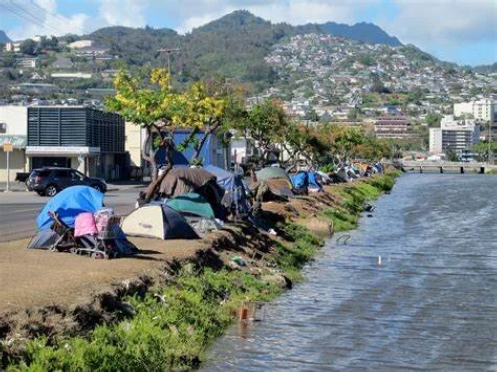
Homeless camp on Oahu, Homeless Hawaii 2024
Intro- Devin
Oahu is the third largest island in Hawaii that offers pleasant temperatures year round while being home to flora and fauna found nowhere else, making it a popular tourist destination. Oahu is home to a robust tourism industry that generates billions of dollars in economic activity while creating well over 200,000 jobs for the state every year (DBEBT, 2024). The industry pays hundreds of millions in tax revenue that funds essential services across the state. Tourism is the main driver of economic activity for the state, with few other industries that produce a fraction of the income made by the tourism industry. Due to the vast scale of the tourism industry and the state’s reliance on it to fund vital services, decreases in tourism could result in devastating cuts to government programs.
The growth of the tourism industry in Oahu hasn’t been without its problems from ecological damage, overcrowding, increases to costs of living and the largest of them being the vast disparity in who benefits from the economic gains from tourism and the suppression of local residents when it comes to policy around tourism and tourism development. But there is hope for the industry, as there is a growing number of policy reforms and community based solutions designed to combat the ills caused by tourism.
Sustainable Tourism Framework- Devin
Tourism on Oahu has fundamentally altered life for residents, creating vast economic fortunes for a small number of wealthy investors while creating underlying tensions on the island including frustrations from locals about the state of the tourism industry, damage to environmentally sensitive areas on and around the island, increased rents and overall costs of living for locals, unwelcome impacts, and commercialization of local culture. Collectively, all of these factors demand that policy makers, local governments, business interests, and local residents work together to create a more sustainable tourism industry on Oahu.
Reinventing the tourism industry has the potential to offer a number of benefits for Oahu, from an economically extractive industry to one that can provide meaningful livelihoods while reinvesting earnings back into the local economy, utilizing the economic and logistical capacity of the tourism industry to build up other industries on the island. This creates a pathway to much needed economic diversity, while empowering local residents by providing opportunities outside of tourism (Merritt, 2025). It may seem counterintuitive to direct resources away from growing the tourism industry, but by making local residents less reliant on the industry, residents gain leverage when negotiating with the tourism industry, increasing the likelihood of tourism projects that are actually supported by local residents.
Environmental Impacts- Tati
On the island of Oahu, which hosts over 5 million tourists per year, many adverse environmental impacts occur. Like many other tropical travel destinations, Oahu is home to some of the most beautiful coral reefs and ecosystems in the world. Along with the sandy beaches, the reefs are a major driver for tourism on the island. Unfortunately, with millions of tourists per year, the coral reefs have been badly damaged and are dying off entirely. Many tourists who snorkel here tend to use sunscreens that release toxins into the water and kill coral polyps. Additionally, tourists touching or stepping on coral may not realize it’s a living organism and that they are causing damage by doing so. Without corals, ecosystems can easily deteriorate and create unhealthy ocean conditions.
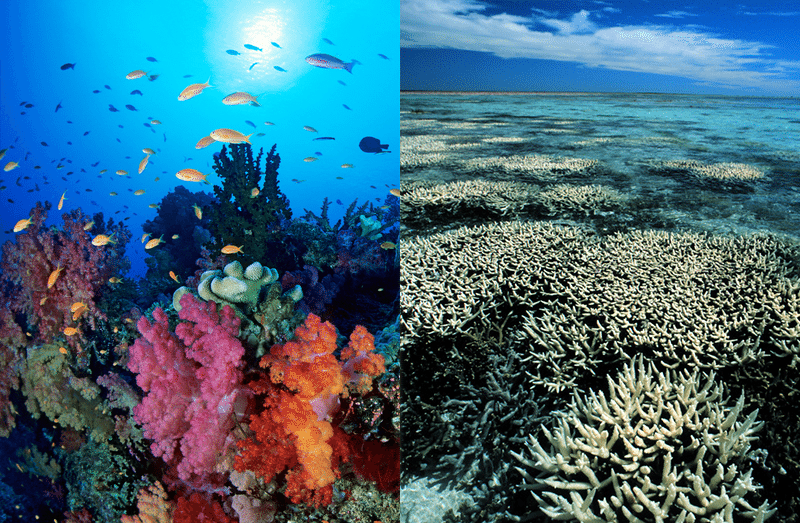
Healthy vs. dead coral reefs – Left photo by Gary Bell / Oceanwideimages.com. Right photo by Roger Grace / Greenpeace
Trail erosion is another major environmental impact that tourists may unknowingly cause. Heavy foot traffic on trails to see scenic areas has caused soil compaction, loss of vegetation, and trail erosion. This creates unsafe trail conditions for future tourists, impacts biodiversity, and takes away vegetation vital to ecosystems. Pollution is another environmental impact that tourists often carelessly create. Garbage and plastic waste can pile up or mix with beach sand, leading to hazardous conditions for both humans and wildlife. Small plastic bits in the sand can be sharp and potentially cut people unknowingly stepping on them. Some animals, like sea turtles, may confuse plastic pollution in the ocean for a food source. Ingesting plastic and other types of garbage can kill wildlife, which then disrupts ocean ecology and ecosystem function.
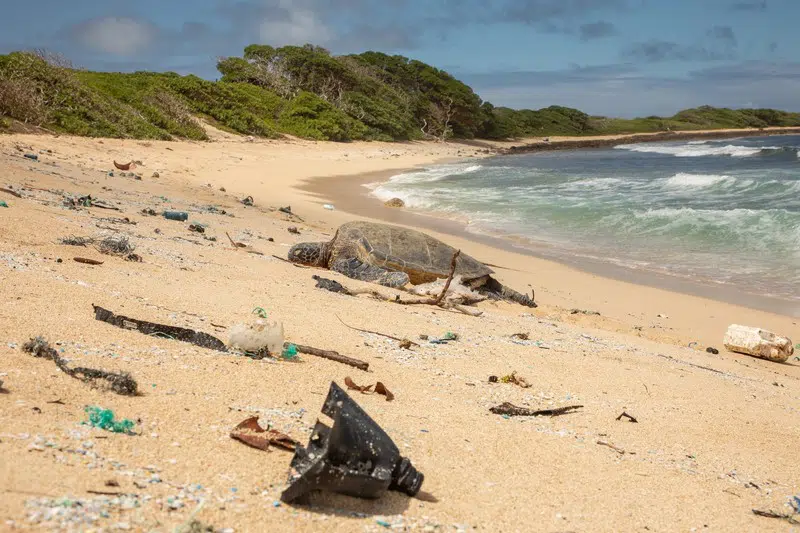
Plastic pollution on the beach – Photo by Raftography Sustainable Coastlines Hawaii
Socio-cultural impacts- Evan
In Oahu, similar to other Hawaiian islands, there are many negative socio-cultural impacts that come with tourism. Studies from as early as the 1980s show that the local people of Hawaii have had lifestyle and culture changes forced upon them, leading to distress among families and poor economic conditions. Without a stable income, it’s said that many native Hawaiians have fallen into “illicit activities such as burglary and robbery, drug selling, and welfare fraud,” in an attempt to afford their daily needs. (Matsuoka et al., 1988)
To maximize the efficiency of tourism in Oahu, stakeholders such as the state government focus on promotion and marketing of tourism. Economic planning typically hasn’t involved native Hawaiians leaving them unsatisfied and unheard. Oahu’s rural and Hawaiian homestead communities are named by John M. Knox in a written piece on sustainable tourism. It’s said that neighborhood boards on Oahu have been put in place to monitor the fairness of decision making of key stakeholders, allowing these underrepresented groups to be heard and considered when planning occurs (Knox, 2003).
As time has gone on, the local people of Oahu have also become increasingly unsatisfied with the status of new infrastructure in their community. A KHON2 article from 2022 shows that 66% of people in Oahu feel like the tourism industry favors building things like hotels and resorts, creating overcrowding throughout all areas of the island. Poor communication, forced culture changes, and distasteful use of land have all accumulated to create a bad image of the tourism industry, causing overall community resentment and ruining stakeholder relationships.
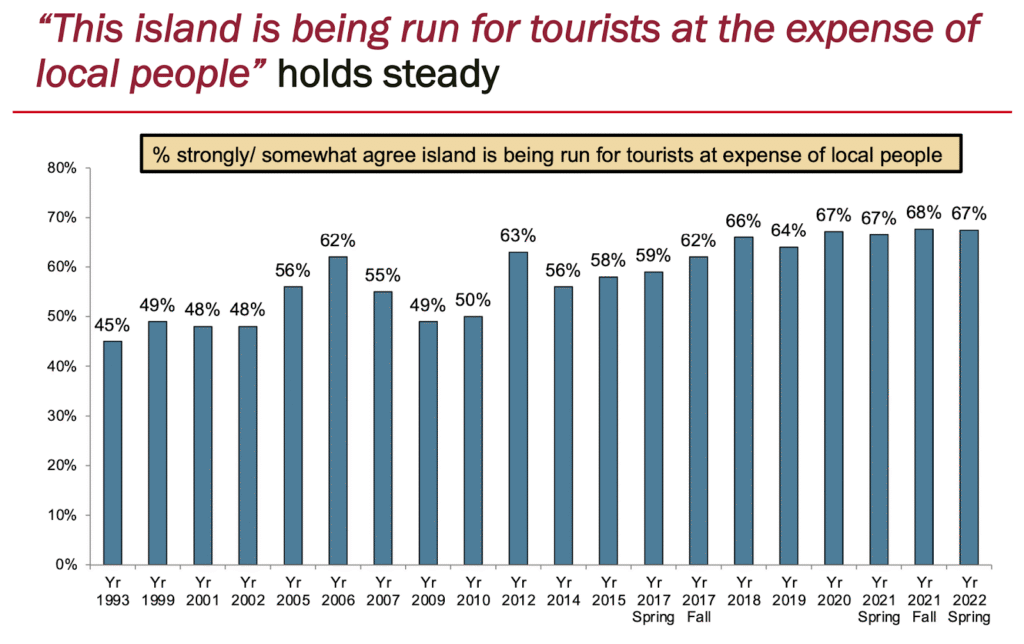
Resident Sentiment Survey (2022) – Provided by DBEDT
Economic Impacts: Lucy
The economic impacts of tourism in Oahu can be very complex. Tourism can be a big support to the economy and allow there to be more jobs but that comes at a great cost to the locals. Not only is there a huge disparity in benefit distribution as well as low wage labor and high housing costs. When it comes to how much benefit locals are truly receiving from the tourism industry it’s a little hard to pin down the exact amount but the big corporations are tending to take in a lot more of the benefits. Since tourism is oftentimes being maintained by minimum wage workers, many locals are simply not making enough to comfortably support themselves. On top of most of the jobs being low paid work, the cost of housing in Oahu, Hawaii is insanely higher than the national average. “Hawaii is the most expensive place to buy a house with the average home sale price being $100,000 more than most other states.” (Caporal, 2025) Pairing all of these negative economic factors together, tourism can have quite a negative impact on the local population in Oahu, Hawaii.
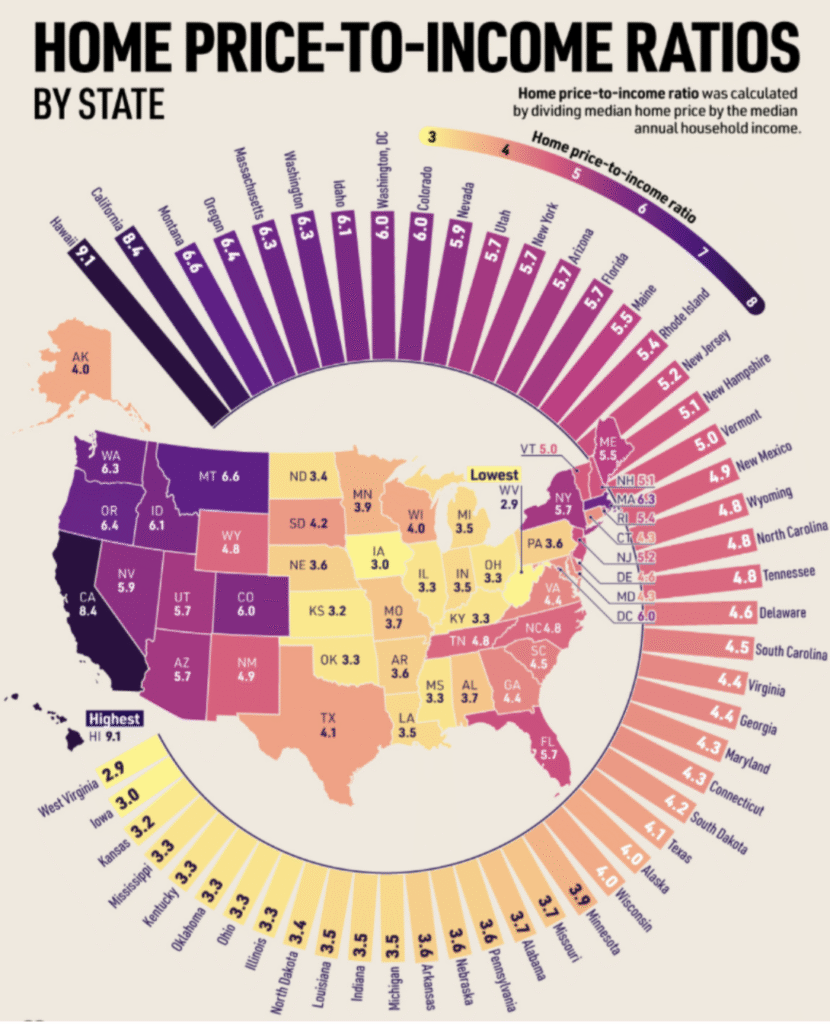
Home price to income ratio
Photo by Kayla Zhu / Visualcapitalist.com
One of the biggest drivers for these negative impacts is many locals are moving from traditional jobs to the tourism industry. “As tourism starts to become more and more popular in a community, conventional employment such as farming and fishing decreases.” (Sutton, 2024) The boom of tourism allows for locals to pursue jobs in that industry but at the same time removes other employment opportunities. This can put a huge strain on locals. The allure of Hawaii as a “paradise” also has many people moving to Hawaii. This added with the increase of tourism makes the cost of housing skyrocket. “Hawaii ranks #1 in the nation for move ins, with specifically a 252 to 100 move in to move out ratio.” (Robison, 2024) The removal of conventional jobs and the in flow rate in Hawaii are just two of the many drivers for negative economic impacts in Hawaii.
Solutions and Public Engagement- Devin
Improving the tourism industry can seem unimportant for places like Oahu as impacts are often measured in economic impact while overlooking other impacts. Fortunately, there is an ever growing number of tools that the public can use to reduce their negative impacts on Oahu. Individuals can make thoughtful decisions when traveling that work towards building a better industry. For long term success, government and policy managers must work to uplift residents in the planning and decision making process while creating policies that protect and strengthen local economic interests.
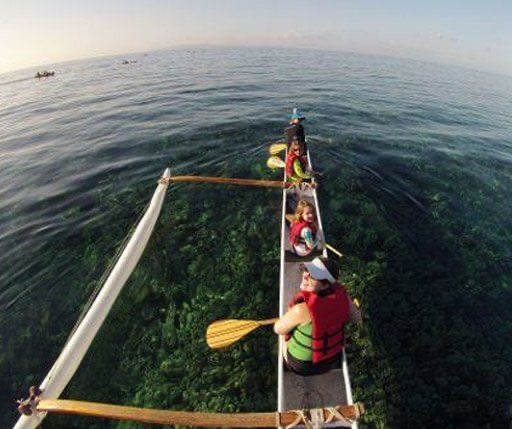
Family on Paddle excursion provided by local operator
Photo by Hawaiian Paddle Sports
Solutions for the Public- Devin
- When visiting Oahu stay at locally owned hotels, eat at local restaurants, purchase tourism from local guides, purchase local goods and services whenever possible. This can allow your money to stay in the community longer than it would if spent at businesses owned by foreign entities.
- Plans tours and activities with local businesses that are certified by the Sustainable Tourism Association of Hawaii. These operators are trained to avoid areas that are ecologically sensitive or culturally significant.
- Become knowledgeable about potential impacts before visiting the island, make sure to check that any products you used don’t contain chemicals that can impact local wildlife, especially chemicals that can impact coral reefs.
- Be mindful and respectful of local Hawaiian culture, while avoiding activities that can be seen as disrespectful towards locals.
Public Engagement- Devin
Is tourism an overall harm for the island of Oahu?
Do people’s individual choices impact local residents in ways that are more beneficial? Is it the responsibility of tourists to consider their potential negative impacts on an area?
References
- DBEDT. (2024, August). Department of Business, Economic Development and Tourism 2024 Annual Visitor Research Report. Hawaii Tourism Authority. https://www.hawaiitourismauthority.org/who-we-are/annual-report/
- Merritt, Jeff.(2025, July 2). “How Tourism Destinations Can Foster Sustainable Growth.” www.weforum.org/stories/2025/07/tourism-could-be-a-16-trillion-industry-by-2034-this-is-how-destinations-can-create-sustainable-growth/. World Economic Forum
- Bigley, M. (2024, September 6). Tourism Can Wreck Local Communities and Ecosystems. Sierra Club. https://www.sierraclub.org/sierra/tourism-can-wreck-local-communities-and-ecosystems
- Lai, O. (2022, March 1). Plastic Pollution in Hawaii: Environmental Impacts and Solutions. Earth.Org. https://earth.org/plastic-pollution-in-hawaii/
- Stoll, D. (2023, January 31). Coral Reef Degradation in Hawaii: Is Overtourism to Blame? Earth.Org. https://earth.org/coral-reef-degredation/
- Matsuoka, J., & Kelly, T. (1988). The Environmental, Economic, and Social Impacts of Resort Development and Tourism on Native Hawaiians. The Journal of Sociology & Social Welfare, 15(4). https://scholarworks.wmich.edu/cgi/viewcontent.cgi?article=1868&context=jssw
- Knox, J. (2003). Sustainable Tourism in Hawai`i Socio-Cultural and Public Input Component Volume III: Socio-Cultural Impacts of Tourism in Hawai`i – Impacts on Native Hawiians Prepared for the Project: Planning for Sustainable Tourism in Hawai`i Hawai`i State Department of Business, Economic Development & Tourism. https://files.hawaii.gov/dbedt/visitor/sustainable-tourism-project/drafts/Native-Hawaiian-Impact-Report.pdf
- Caporal, Jack. Average House Price by State in 2025 | The Motley Fool. 5 Aug. 2020, https://www.fool.com/money/research/average-house-price-state/
- Robison, Joe. “Island Surge: The moveBuddha 2021-2022 Hawaii Migration Report.” moveBuddha, 15 Dec. 2022, https://www.movebuddha.com/blog/moving-to-hawaii-migration-report/
- Sutton, Marie. “How Tourism Is Impacting Hawaiian Residents: Unraveling the Costs Behind the Paradise.” Brush and Palette, https://lbhsnews.com/6468/opinions/how-tourism-is-impacting-hawaiian-residents-unraveling-the-costs-behind-the-paradise/
- Yee, C. (2022, August 27). Do you agree Hawaii is being run for tourists at the expense of locals? KHON2. https://www.khon2.com/hawaii-travel/do-you-agree-hawaii-is-being-run-for-tourists-at-the-expense-of-locals/
- Resident Sentiment Survey Spring 2022 Highlights. (2022). https://www.hawaiitourismauthority.org/media/9744/dbedt-resident-sentiment-spring-2022-hta-board-presentation-accessible.pdf

One reply on “Tourism on Oahu”
Hi, this is a comment.
To get started with moderating, editing, and deleting comments, please visit the Comments screen in the dashboard.
Commenter avatars come from Gravatar.